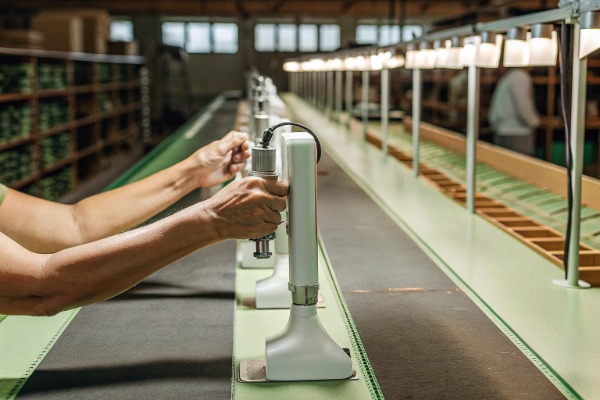
Sourcing reliable equipment from overseas is a minefield, and I have seen too many distributors lose money on low-quality units. At our facility in Guangzhou, we often hear horror stories from clients who previously bought from "manufacturers" that turned out to be middlemen with zero technical control. If your supplier cannot explain the specific frequency modulation of their shockwave handpiece, you are likely dealing with a trader, not the source.
shockwave handpiece 1
To determine if a company is a source factory, you must verify their business license scope for "Production," check if their ISO 13485 certificate lists them as the "Manufacturer," and request a live, unscripted video call to inspect their assembly line, aging test room, and raw material inventory in real-time.
Distinguishing between a legitimate OEM factory and a savvy trading company requires a detective's mindset. The following guide breaks down the specific verification steps you need to take to protect your supply chain.
supply chain 2
How do I verify a factory's manufacturing capabilities via a live video audit?
When we invite potential partners to view our operations, we encourage them to look beyond the showroom. A polished meeting room proves nothing; the truth lies in the messy, noisy reality of the production floor where components are actually assembled.
You verify manufacturing capabilities by demanding a live video walk-through of the production floor, specifically asking to see the Incoming Quality Control (IQC) station for pneumatic components and the active aging test area where machines run for 24-48 hours before packaging.

The "Unscripted" Walk-Through
A trading company can easily rent a showroom or visit a factory they partner with to stage a call. However, they cannot fake deep operational control. When you arrange a video audit, do not settle for a PowerPoint presentation or a pre-recorded video. Ask to see the facility live.
During the call, ask the host to walk to specific areas immediately. For shockwave therapy machines, the most critical area is the assembly line for the handpiece (applicator). This is the core of the technology. If they are a true factory, you will see technicians assembling the projectile mechanism, installing the electromagnetic coil or pneumatic compressor, and testing the impact energy. If they hesitate or say "the factory is in another building," that is a major red flag.
Inspecting the Aging Test Room
Every reliable manufacturer tests their electronics rigorously. In our production process, every machine undergoes an "aging test" where it runs continuously for a set period to ensure stability. Ask your supplier to show you this room.
You should see rows of machines turned on, screens active, and handpieces firing into test blocks. A trading company rarely holds stock in this state; they usually only have boxed finished goods ready to ship. If the supplier cannot show you a room full of active, humming machines, they likely do not manufacture them.
Verifying Component Inventory
Another powerful tactic is to ask to see the warehouse for raw materials (BOM – Bill of Materials). A factory will have shelves stacked with specific components: empty casings, circuit boards (PCBA), touch screens, and internal tubing.
Trading companies stock finished boxes. They do not stock bags of screws, unmounted screens, or loose pneumatic pumps. By asking to see the raw components, you validate that they are building the product from scratch, not just reselling it.
Visual Cues: Factory vs. Trader Office
| Feature | Source Factory Environment | Trading Company Environment |
|---|---|---|
| Background Noise | Pneumatic sounds, assembly tools, testing beeps. | Quiet office, typing, phones ringing. |
| Staff Attire | Blue/White anti-static coats, uniforms. | Business casual or suits. |
| Inventory | Raw materials, PCBs, unpainted casings. | Only finished, sealed boxes. |
| Response Time | Can show a specific part immediately. | "Let me check with the engineer." |
What specific documents prove a supplier manufactures their own shockwave devices?
Our regulatory team spends months compiling technical files for certifications, so we know exactly what genuine documentation looks like. Many traders will send you a generic CE certificate, but that piece of paper often hides the true origin of the equipment.
The most definitive documents are the Chinese Business License explicitly listing "Manufacturing" or "Production" in the business scope, and an ISO 13485 certificate where the supplier is the license holder, not just an "Authorized Representative" or "Applicant."

The Business License "Scope" Trap
In China, every company has a business license with a "Business Scope" section. This is legal data, not marketing fluff. You can ask the supplier for their license and use a translation tool (or ask a third-party agent) to read it.
- Factory: The scope will include words like "Production" (生产), "Manufacturing" (制造), or "Processing" (加工).
- Trader: The scope will be limited to "Wholesale" (批发), "Retail" (零售), or "Sales" (销售).
If the license does not explicitly state production or manufacturing, they are legally not allowed to manufacture. No matter what their website says, they are a trading company.
ISO 13485 and Medical CE Ownership
For medical and aesthetic devices like shockwave machines, ISO 13485 (Medical Devices Quality Management Systems) is the gold standard. When you receive this certificate, look closely at the "Manufacturer" field.
Traders often provide a certificate that belongs to the actual factory, or they might have a certificate that lists them as a "Distributor." If the company name on the ISO certificate matches the company name on the bank account and the business license, you are likely dealing with the source. Furthermore, check the "Scope of Certification." It should cover the design and manufacture of shockwave therapy equipment specifically, not just "sales of beauty equipment."
Patent Documentation
True manufacturers invest heavily in R&D. We often patent our specific handle designs or software interfaces. Ask the supplier if they hold any patents for the machine's design or utility.
You can verify these patents on Google Patents or the Chinese patent database (CNIPA). If they claim to be the manufacturer but hold zero patents, or if the patents are held by a different company entirely, they are likely white-labeling someone else's technology.
Google Patents 3
Document Checklist: Manufacturer vs. Trader
| Document Type | Source Factory Indicator | Trading Company Indicator |
|---|---|---|
| Business License | Scope includes "Production/Manufacturing". | Scope limited to "Sales/Wholesale". |
| ISO 13485 | Name listed as "Manufacturer". | Name listed as "Exporter" or certificate is from a 3rd party. |
| Test Reports | Internal IQC and OQC reports available. | Only final 3rd party safety reports available. |
| Patents | Holds design or utility patents. | No patents or patents belong to another entity. |
Can I ask for a virtual production tour to distinguish a factory from a trader?
We actually prefer when clients ask for a tour because it instantly separates us from the hundreds of trading companies on Alibaba. It is frustrating to compete on price with companies that have no overheads for R&D or quality control facilities.
Yes, you should absolutely request a virtual production tour and specifically ask to speak with the R&D engineers regarding the machine's internal structure or software logic, as traders rarely have technical staff on-site.

Real-Time Interaction vs. Pre-recorded Video
A common trick used by trading companies is to send a "factory video" that is professionally edited. These videos are often bought or filmed during a one-time visit to an OEM partner.
To bypass this, insist on a live video call (Zoom, WhatsApp, FaceTime). During the call, direct the camera yourself. Say, "Can we look at the back of that machine?" or "Can you zoom in on the label of that compressor?" A trader in an office cannot comply with these requests. They might say, "The network is bad in the factory" or "We are not allowed inside right now." These are excuses. A real factory owner wants to show off their equipment.
The "Exploded View" Request
Shockwave therapy machines rely on precise internal mechanics—specifically the projectile and the barrel in the handpiece. Ask the supplier to disassemble a handpiece for you live on camera.
- Factory: A technician can easily take a rejected or sample unit, unscrew it, and show you the internal projectile, the O-rings, and the dampening system. They can explain the material of the projectile (e.g., stainless steel vs. chrome).
- Trader: They will likely refuse, fearing they cannot put it back together, or they simply do not have the tools on hand. They might not even know what is inside the handle.
Talking to the Engineers
Salespeople sell; engineers create. In a trading company, the "technical support" is often just a salesperson with a manual. In a factory, there is an engineering department.
During your virtual tour, ask to say hello to the R&D team. Ask a technical question like, "How do you calibrate the frequency stability at 20Hz?" or "Can we modify the boot-up logo in the firmware?" A trader will have to "ask the factory" and get back to you. A source manufacturer can often bring a software engineer over to the camera to explain the possibility immediately.
Key Questions to Ask During the Tour
- "Can I see the PCBA mounting area?" (Shows electronic assembly).
- "Where do you store the spare parts for repairs?" (Shows after-sales capability).
- "Can you show me the machine's serial number label printing station?" (Proves they label the goods themselves).
Why is buying directly from the manufacturer better for my long-term profit margins?
Our partners who switch from trading companies to working directly with us often realize they were previously paying a premium for a service that added no value. When we control the supply chain, we can offer pricing that allows you to dominate your local market.
Original Design Manufacturing 4
Buying directly from the manufacturer improves profit margins by eliminating the 20-50% middleman markup, providing faster access to spare parts for repairs, and enabling deep OEM customization that builds your brand equity rather than selling generic products.

medical and aesthetic devices 5
Eliminating the Middleman Markup
The most obvious benefit is cost. Trading companies add a margin of 20% to 50% on top of the ex-factory price to cover their marketing and office costs. By going to the source, you capture that margin.
For a shockwave therapy machine that costs a factory $2,000 to produce:
- Factory Price to You: ~$2,500 (Factory profit included).
- Trader Price to You: ~$3,500 – $4,000.
Over an order of 10 units, that is a difference of $10,000 to $15,000 in pure profit. This extra capital can be reinvested into your local marketing or customer acquisition in the US.
Quality Management Systems 6
After-Sales Speed and Spare Parts
In the beauty and medical equipment industry, downtime is the enemy. If a machine breaks down in a client's salon, they lose revenue every hour.
If you buy from a trader, the repair process is: You -> Trader -> Factory -> Trader -> You. This "telephone game" delays communication and parts shipment. Traders often do not stock spare parts; they have to buy them from the factory when you complain.
If you work with us directly, we diagnose the issue via video, identify the part, and ship it from our warehouse immediately. We know exactly which batch of PCBs went into your machine. This speed builds trust with your downstream customers, protecting your reputation and future sales.
Bill of Materials 7
Customization (OEM/ODM) Capabilities
Long-term profit comes from brand building, not just box-moving. A trading company can usually only offer "logo slapping"—printing your name on a standard case.
A source factory can offer true ODM (Original Design Manufacturing). We can:
- Change the shape of the machine casing to make it unique to your brand.
- Modify the software interface (GUI) to match your color scheme and language.
- Adjust the technical parameters (e.g., increasing max energy) based on your market feedback.
Incoming Quality Control 8
Owning a unique product prevents your customers from price-shopping your machine against identical units on Alibaba. This exclusivity allows you to charge a premium price.
ISO 13485 certificate 9
Cost Analysis: Factory Direct vs. Trader
| Cost Factor | Source Factory Direct | Trading Company |
|---|---|---|
| Unit Cost | Low (Base Manufacturing Cost) | High (Base + Markup) |
| Customization Cost | Low (In-house engineering) | High (Outsourced fees) |
| Communication Cost | Efficient (Direct to technical team) | High (Misunderstandings/Delays) |
| Warranty Risk | Low (Direct support) | High (Trader may disappear) |
Conclusion
To secure your business, verify the "Production" scope in business licenses, demand unscripted live video inspections of assembly lines, and ensure ISO certificates list the supplier as the manufacturer.
business license 10
Footnotes
1. Technical overview from a leading manufacturer of shockwave technology. ↩︎
2. Academic resource defining supply chain management principles. ↩︎
3. Direct reference to the patent search tool mentioned. ↩︎
4. Standard definition of the ODM manufacturing business model. ↩︎
5. Global health authority definition and categorization of medical devices. ↩︎
6. US Government regulation parallel to ISO 13485 for medical devices. ↩︎
7. Definition of BOM from a major supply chain software provider. ↩︎
8. Authoritative explanation of quality control processes by an industry body. ↩︎
9. Official standard definition for medical device quality management. ↩︎
10. Official US government guidance on verifying foreign supplier credentials. ↩︎

 English
  Español de México
  Deutsch
  Français
  العربية
  Русский