
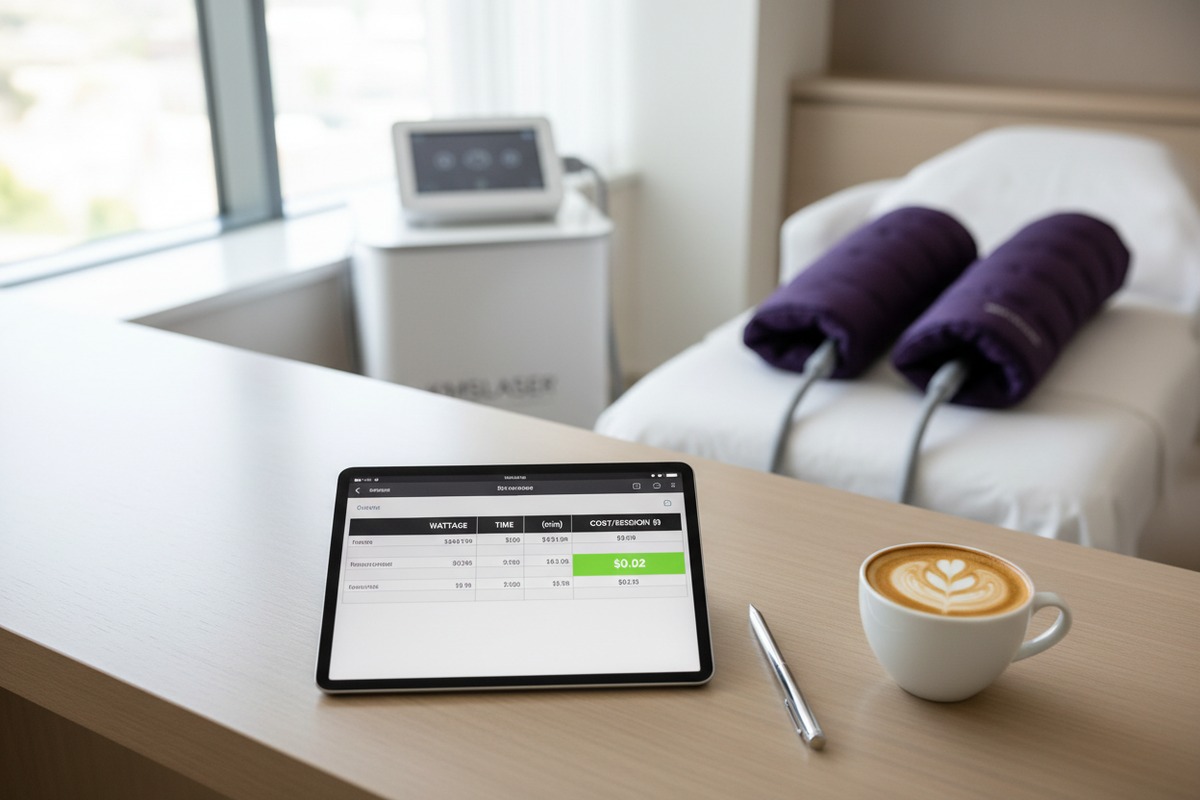
When we test new air compression circuits 1 in our Guangzhou laboratory, we often see how surprised clients are by the low power requirements. You might worry that expanding your service menu with advanced lymphatic drainage technology 2 will spike your overhead, but the reality on our production line tells a different story.
To calculate the electricity cost per session, simply multiply the machine’s power rating in kilowatts by the duration of the session in hours, then multiply that figure by your local electricity rate per kilowatt-hour. For most professional units, this results in a cost of less than two cents per standard treatment.
Let’s break down the math so you can see exactly how these numbers work for your business.
How do I calculate the exact electricity cost for each of my pressotherapy sessions?
Our engineering team measures power fluctuations daily to ensure the voltage stability 3 of the units we export to the US. We know that the numbers on the technical sticker can sometimes be confusing when you are trying to budget for daily operations.
You need to identify the machine’s wattage, convert it to kilowatts by dividing by 1000, and multiply this by the hours the machine runs. Finally, multiply the total energy used by your local utility rate to get the precise cost for a single treatment session.
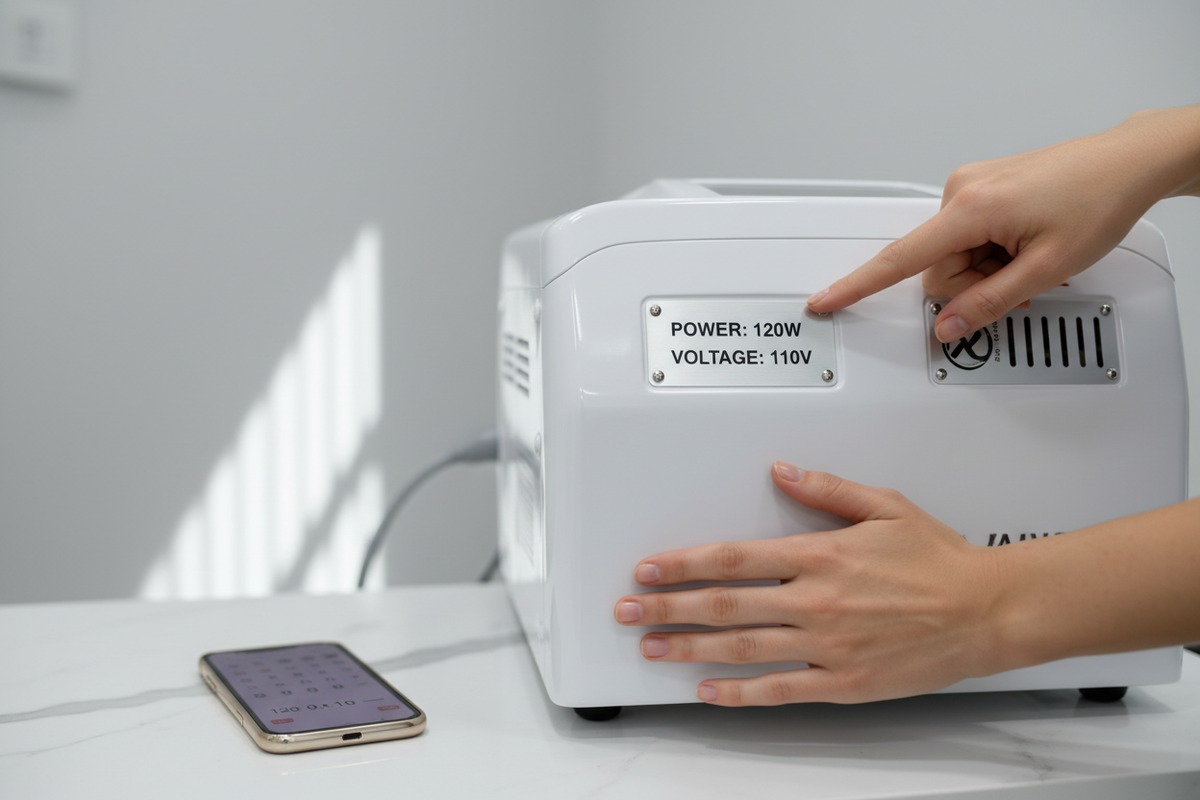
To get a precise figure, you must look beyond the marketing brochure and look at the technical specifications plate on the back of your device Far-Infrared 4. Most professional pressotherapy machines operate within a specific power range, but the math remains the same regardless of the model.
Understanding the Core Formula
The electricity cost calculation is straightforward Far-Infrared (FIR) 5. It consists of three variables: Power (Watts), Time (Hours), and Rate (Price per kWh).
- Find the Wattage (W): Check your machine's manual. A standard air-pressure-only machine typically draws between 50W and 120W. If your machine includes infrared heating or EMS (Electrical Muscle Stimulation 6), this might rise to 300W or more.
- Convert to Kilowatts (kW): Electricity is billed in kilowatt-hour 7s. Divide the wattage by 1000. For example, a 120W machine is 0.12 kW.
- Determine Session Length: A typical lymphatic drainage session lasts between 30 and 45 minutes. Convert minutes to hours (e.g., 45 minutes = 0.75 hours).
- Apply Your Local Rate: The average commercial electricity rate 8 in the US hovers around $0.15 per kWh, though this varies by state.
Real-World Calculation Examples
Let's run a scenario based on the machines we ship most frequently to North America. Suppose you have a high-end unit rated at 150W (0.15 kW) and you run a 45-minute session.
- Energy Used: 0.15 kW × 0.75 hours = 0.1125 kWh.
- Cost: 0.1125 kWh × $0.15 (rate) = $0.0168.
The cost is roughly 1.7 cents. Even if you use a more power-hungry machine with infrared heat active, the cost remains negligible compared to the service price.
Variables That Affect Consumption
Not every session consumes the maximum rated power. When we calibrate pressure sensors 9, we observe that the air pump does not run continuously. It cycles on and off to maintain the target pressure (mmHg).
- Inflation Phase: The pump draws peak power to fill the airbags.
- Holding Phase: Power draw drops significantly as the valves seal the air.
- Deflation Phase: Minimal power is used to release valves.
This means the "Rated Power" is often a maximum ceiling, not a constant draw. Your actual cost may be 20-30% lower than the calculated theoretical maximum.
Cost Matrix by Machine Type
The following table provides a quick reference for different machine configurations.
| Machine Type | Rated Power (Watts) | Session Duration | Energy Used (kWh) | Cost @ $0.15/kWh |
|---|---|---|---|---|
| Portable / Home Unit | 35 W | 30 mins | 0.0175 | $0.002 |
| Standard Professional | 120 W | 45 mins | 0.0900 | $0.013 |
| 3-in-1 (Infrared + EMS) | 350 W | 45 mins | 0.2625 | $0.039 |
| High-Intensity Clinic | 500 W | 60 mins | 0.5000 | $0.075 |
How will adding these machines impact my monthly utility bills and overall profit margins?
We work closely with distributors who order container loads, and they often ask for ROI projections to share with their salon clients. We always emphasize that while equipment cost is a factor, the operational electricity cost is surprisingly low.
Adding these machines will have a virtually undetectable impact on your monthly utility bill while drastically improving your profit margins. The electricity cost per session is typically less than 1% of the treatment price, meaning almost all revenue generated goes directly to covering fixed costs and profit.

When you look at the big picture of running a salon or spa, HVAC and lighting are your primary energy consumers. Pressotherapy equipment is incredibly efficient by comparison. Let's analyze how this scales when you start booking clients back-to-back.
Monthly Utility Impact
Imagine a busy month where you perform 100 sessions. Using our previous calculation of approximately $0.015 per session for a standard machine:
- 100 sessions × $0.015 = $1.50 per month.
Even if you run a "power hour" promotion and do 300 sessions a month, your extra electricity cost is under $5.00. Compare this to the revenue. If you charge a conservative $60 per session:
- 100 sessions × $60 = $6,000 Revenue.
- Electricity Cost = $1.50.
The ratio of revenue to energy cost is 4000:1. The impact on your utility bill is statistically insignificant, often lost in the noise of daily lighting usage.
Profit Margin Analysis
The real "cost" of adding pressotherapy is not electricity; it is the capital investment (buying the machine), floor space (rent), and marketing.
- High ROI Potential: Because the variable cost (electricity + disposable pants/liners) is so low, your gross margin per service is exceptionally high.
- Break-Even Point: With electricity costing pennies, you don't need to factor it into your break-even analysis. You only need to cover the machine's purchase price. If a machine costs $2,000, you pay it off in roughly 35 sessions ($2,000 / $60).
Scaling Up: Multiple Machines
Many of our clients in the US start with one unit and quickly expand to a "recovery lounge" concept with 4 or 5 machines. Does this change the math?
Running 5 machines simultaneously draws about 600W–800W total. This is equivalent to running a single small microwave or a high-powered blender. It does not require a facility power upgrade.
Revenue vs. Cost Projection (Monthly)
The table below illustrates the financial power of low-energy treatments.
| Sessions / Month | Total Revenue ($60/session) | Electricity Cost (Est.) | Net Revenue (Pre-Rent/Labor) |
|---|---|---|---|
| 50 (Low Volume) | $3,000 | $0.75 | $2,999.25 |
| 150 (Medium Volume) | $9,000 | $2.25 | $8,997.75 |
| 300 (High Volume) | $18,000 | $4.50 | $17,995.50 |
| 500 (Multi-Machine) | $30,000 | $7.50 | $29,992.50 |
Hidden Efficiency of Standby Modes
One factor that can slightly affect monthly bills is leaving machines on overnight. Modern units from our production line have low-power standby modes, but older units might draw 5-10W just by being plugged in. We always recommend using power strips with switches or instructing staff to power down completely at closing to save that extra $1-$2 per month.
What technical specs should I check to ensure my pressotherapy equipment is energy-efficient?
When we source components for our internal circuitry, we look for air pumps that deliver high pressure without generating excessive heat or waste. We know that efficiency isn’t just about saving money; it’s about machine longevity and performance.
You should look for machines with independent chamber control, variable pressure settings, and high-efficiency air pumps rated around 100 liters per minute. Avoid units with unnecessarily high wattage ratings unless they include thermal features you specifically plan to monetize.
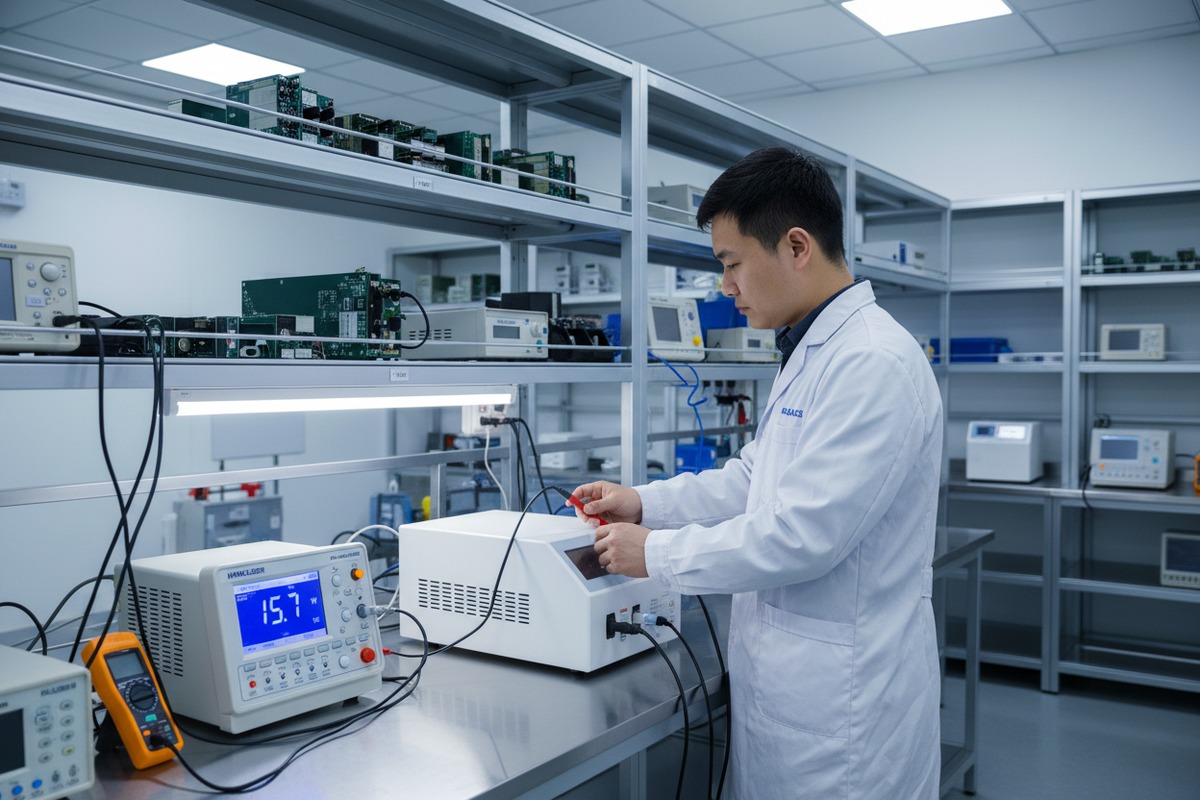
Not all watts are created equal. A machine that consumes 200W but leaks air or struggles to reach pressure is less efficient than a 100W machine with a high-quality sealed pump system. Here is what you need to inspect on the spec sheet before purchasing.
The Air Pump Efficiency
The heart of the machine is the compressor.
- Flow Rate vs. Power: You want a pump that delivers roughly 50-100 Liters/minute. If a machine claims high flow but has a low wattage (e.g., <20W), it may be too weak to provide therapeutic pressure (usually 20-360 mmHg).
- Cycle Efficiency: Look for "Intelligent Pressure" or similar terminology. These systems stop the motor once the target pressure is reached, rather than venting excess air continuously. This reduces power consumption by up to 40% during a session.
Integrated Features: Infrared and EMS
The biggest jump in power consumption comes from thermal features.
- Far-Infrared (FIR): Adding heat to the suit requires resistive heating elements. This can triple the power draw (from ~100W to ~350W). Ensure these can be toggled off. If you are doing a simple drainage massage without fat-dissolving heat, you shouldn't be paying for the electricity of the heating element.
- EMS (Electrical Muscle Stimulation): This uses very little power, typically negligible, but check if the machine requires a separate power supply or if it runs off the main unit efficiently.
Voltage and Frequency
Since we export to both Europe (220V) and the US (110V), we ensure our power supplies are compatible.
- Universal vs. Fixed Voltage: A "Universal Voltage" (100V-240V) machine is often more efficient as it uses a modern switching power supply. Fixed voltage machines using heavy transformers are older tech and less energy-efficient.
- Frequency (50Hz vs 60Hz): Ensure the machine matches your local frequency (60Hz for the US). A mismatch can cause the motor to run hotter and less efficiently, drawing more power and risking burnout.
AC Power vs. Battery Models
There is a rising trend in portable, battery-powered pressotherapy boots.
- Pros: No cords, lower perceived "plug-in" time.
- Cons: Charging a battery is not 100% efficient. You lose energy as heat during the charging process. For a high-volume salon, a wired AC model is generally more consistent and energy-efficient than constantly recharging lithium batteries.
Specification Comparison
Here is a breakdown of what to look for in the "Technical Parameters" section of a catalog.
| Feature | Energy-Efficient Spec | Less Efficient / High Draw |
|---|---|---|
| Power Supply | Switching (100-240V) | Transformer (Fixed 110V) |
| Pump Control | Auto-stop at pressure | Continuous run |
| Heating | Independently toggleable | Always on / Linked to power |
| Max Power | 100W – 150W (Standard) | >400W (Without justification) |
How can I accurately include electricity overhead in the pricing I set for my salon customers?
We advise many new brand owners on how to structure their pricing to ensure long-term viability. While electricity is cheap, ignoring overheads creates bad habits that can hurt your business as you scale up to larger equipment.
You should calculate a “Facility Overhead Fee” that aggregates electricity, rent, and HVAC per hour, then divide this by your average session count. Add this specific overhead figure to your base treatment price, ensuring you round up to create a safety buffer for rate fluctuations.

Pricing a service isn't just about checking what the competitor down the street charges. It is about understanding your true "Cost of Goods Sold" (COGS). Even though electricity for pressotherapy is low, bundling it correctly helps you justify your prices and protects your margin.
The "All-In" Hourly Cost
Instead of trying to calculate the electricity for one specific machine session in isolation, calculate your room cost per hour.
- Total Monthly Electricity: $200 (Lighting, HVAC, Machines).
- Total Operating Hours: 160 hours/month.
- Electricity Cost Per Hour: $1.25/hour.
- Pressotherapy Share: If the machine is running, it contributes ~1-2% of that load. However, the room is occupied.
- Pricing Rule: Allocate $0.50 – $1.00 per session for "Utilities" in your internal cost sheet. This covers the machine power ($0.02) plus the AC keeping the client cool and the lights overhead.
Peak vs. Off-Peak Considerations
In some US states, commercial electricity rates spike during peak afternoon hours (e.g., 2 PM – 6 PM).
- Strategy: If your utility plan has aggressive peak pricing (e.g., $0.30/kWh vs $0.10/kWh), consider scheduling low-margin treatments during off-peak morning hours.
- Pricing: Since pressotherapy is often an add-on or a passive treatment, you can offer "Happy Hour" pricing during off-peak times to fill the schedule without worrying about peak energy rates.
Marketing the "Green" Angle
Since these machines are so energy efficient, you can use this in your marketing.
- Eco-Friendly Beauty: Promote your treatments as "Low Impact." Clients are increasingly eco-conscious. Knowing that their slimming treatment uses less energy than a lightbulb is a strong selling point.
- Transparency: If you charge a premium, explain that it covers high-end, efficient equipment that ensures better results with a smaller carbon footprint.
Calculating the Buffer
When setting the final price, always add a buffer.
- Base Cost: Labor ($20) + Consumables ($2) + Utilities ($0.50) = $22.50.
- Desired Margin: 50%.
- Price: $45.00.
- Safety Buffer: Round up to $49 or $55.
This extra few dollars covers any unforeseen spikes in energy rates, machine maintenance, or idle time where the machine is plugged in but not generating revenue.
Conclusion
Calculating the electricity cost for pressotherapy is simple: Multiply watts by hours and rate. The result is consistently negligible—often under two cents per session—meaning your profit margins remain secure. By choosing efficient equipment and factoring in a small overhead buffer, you can confidently scale your business without fear of utility bill shocks.
Footnotes
1. Explains medical air compressors and their role in providing clean air for various systems. ↩︎
2. Discusses various lymphatic drainage techniques, including pneumatic compression, and their benefits. ↩︎
3. Defines voltage stability in power systems and its importance for maintaining steady voltages. ↩︎
4. Scientific study on the biological effects of this specific technology. ↩︎
5. Discusses the benefits and uses of Far-Infrared therapy, including improved circulation and pain relief. ↩︎
6. Details the uses, benefits, and risks of electrical muscle stimulation in a medical context. ↩︎
7. Provides a clear definition of kilowatt-hour from a U.S. government energy information source. ↩︎
8. Provides historical and current average commercial electricity rates in the U.S. from a government source. ↩︎
9. Scientific overview of the component used for calibration. ↩︎

 English
  Español de México
  Deutsch
  Français
  العربية
  Русский