Clinics often ask us whether the machine can store user profiles, treatment history, or preset programs, especially when multiple therapists rely on one system for daily treatments.
Most modern shockwave therapy machines support some form of user-profile or treatment-record storage, but the capacity, interface, backup reliability, and search convenience vary widely—so clinics should always verify how many profiles can be stored, how easily they can be retrieved, and whether the device retains data after power loss.
These capabilities directly affect workflow efficiency and treatment consistency 1.
What digital features help manage patient or client treatment data?
When we develop or test systems for clinics, one of the most common requests is the ability to recall previous sessions quickly and store protocols for repeat patients.
Digital features that help manage treatment data typically include patient-profile lists, saved treatment presets, session logs, non-volatile memory for power-loss protection, and export options that let clinics keep a complete digital record of treatment progress 2.
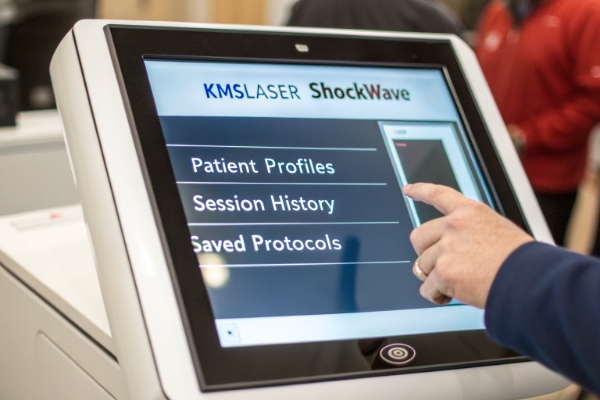
Below is a deeper explanation of these features and how they enhance day-to-day operations.
Core Features for Data Management
Clinics generally need fast, reliable access to previous treatment information. Features that support this include:
-
Patient profile storage
Many systems allow storing dozens or hundreds of patient identifiers.
Higher-end units can store thousands. -
Treatment session logging
Machines can record:
– energy level
– pressure (bars) or energy flux density
– frequency (Hz)
– total shock count
– treatment area
– operator notes -
Custom protocol saving
Clinics can save personalized presets for common medical or aesthetic indications. -
Power-loss data retention
Non-volatile memory 3 ensures treatment data remains available even after unplugging the device. -
Search and recall functions
Systems may offer alphabetical lists, ID-number lookup, or touchscreen selection.
Comparison of Features Across Device Categories
| Feature | Radial Shockwave Machines | Focused Shockwave Machines | Notes |
|---|---|---|---|
| Patient profile capacity | 20–200 | 50–1000 | Higher-end focused units store more |
| Treatment session logs | Yes | Yes | Depth varies by model |
| Power-loss memory | Sometimes | Usually | Must verify retention duration |
| Protocol saving | Yes | Yes | Count varies |
| Data export (USB/SD) | Rare | Sometimes | Helpful for EMR integration |
Why These Features Matter to Clinics
Short, direct reasons:
- They reduce the risk of inconsistent treatment settings.
- Operators can easily repeat successful protocols.
- Multi-therapist clinics maintain continuity of care.
- They support long-term clinical decision-making.
- Documentation becomes more accurate and efficient.
How can clinics ensure data privacy and secure storage?
Many clinics we work with—especially in Europe and North America—want clarity on privacy because treatment logs may contain patient identifiers.
Clinics must secure device-stored data by restricting operator access, minimizing personally identifiable details, encrypting exported files, and complying with local regulations such as GDPR 4, HIPAA, or equivalent national privacy laws.

Below are practical steps to help clinics protect sensitive information.
Key Privacy Practices
-
Access control
Use device passwords if available; otherwise restrict who can physically access the machine. -
Minimal patient identifiers
Many clinics use IDs instead of full names. -
Encrypted backups
When exporting logs, use encrypted USB drives. -
Device reset protocols
Ensure the device can be wiped before resale or disposal. -
Compliance with local laws
– EU = GDPR
– US = HIPAA 5
– Canada = PIPEDA
Data Privacy Risks and Controls
| Privacy Risk | Example Situation | Mitigation |
|---|---|---|
| Unauthorized access | Staff access logs without permission | Passwords + user restrictions |
| Lost physical device | Portable unit stolen | Device locking + minimal stored identifiers |
| USB data leak | Unencrypted export drive lost | Encrypted drives + anonymized IDs |
| Retained data on resale | Patient logs left on a used machine | Factory reset / secure data wipe |
Balancing Convenience and Compliance
Data tracking is helpful, but clinics must avoid storing more sensitive information than necessary.
Using numeric IDs is usually the safest approach.
Allow only trained staff to access logs and export options.
Are record-keeping functions important for treatment tracking?
When customers compare different models, they often want to know whether record-keeping is merely “nice to have” or truly meaningful for clinical outcomes.
Record-keeping functions are essential for consistent treatment delivery, long-term tracking, multi-operator coordination, and documenting patient responses—especially in medical clinics or physiotherapy centers where progress must be monitored 6 over multiple weeks.
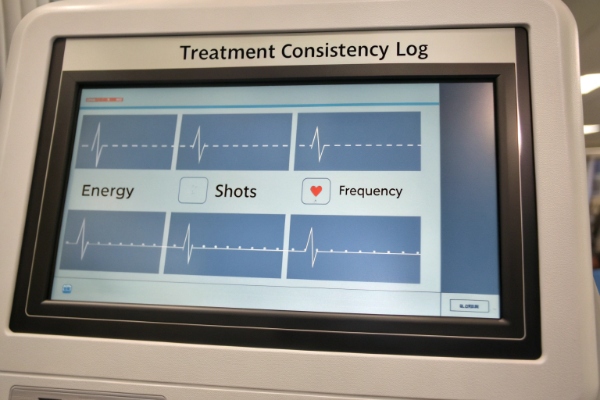
Here’s why clinics value these functions.
Why Treatment Tracking Improves Clinical Outcomes
-
Consistency across multiple visits
Shockwave treatment plans often require 3–8 sessions. -
Improved protocol accuracy
Therapists avoid guesswork by referencing logged settings. -
Multi-staff operational efficiency
When several therapists share one machine, logs maintain continuity. -
Outcome evaluation
Clinics can compare changes in pain, function, or tissue response. -
Legal and documentation support
Some regions require treatment logging for clinical compliance.
Clinical Benefits of Digital Record-Keeping
| Benefit | Medical Clinics | Beauty Clinics |
|---|---|---|
| Consistent treatment | Essential for chronic cases | Increases customer satisfaction |
| Progress tracking | Important for outcome metrics | Useful but not mandatory |
| Multi-therapist coordination | Necessary | Helpful |
| Legal documentation | Often required | Recommended |
What Happens Without Treatment Logs
Short, clear points:
- Protocols drift over time.
- Results become inconsistent.
- New therapists cannot continue treatment smoothly.
- Treatment errors increase.
- Patient experience degrades.
What integration options exist with clinic management software?
Many clinics already rely on EMR, EHR, or CRM platforms and want to know whether the shockwave machine can interface with their existing system.
Some advanced shockwave therapy machines offer data export via USB, SD card, or network connectivity, allowing clinics to upload records into EMR or practice-management software 7, while simpler models rely on manual documentation.

Below are the most common integration levels.
Levels of Software Integration
-
Manual entry
Staff read session logs from the device and enter them into EMR by hand. -
Exportable logs
Some devices allow CSV or XML exports via USB or SD. -
Network-enabled transfers
High-end units may sync through LAN or Wi-Fi. -
Mobile app integration
A few manufacturers offer app-based protocol libraries and cloud backups.
What Clinics Should Ask Suppliers
To confirm whether the device truly supports integration, clinics should ask:
- Does the machine export data?
- What formats are supported (CSV, XML, proprietary)?
- How many profiles can it store?
- Does it support offline and power-loss storage? 8
- Can multiple therapists save presets separately?
Integration Readiness Checklist
| Feature | Why It Matters | Good Indicators |
|---|---|---|
| USB/SD export | Allows digital storage and EMR import | CSV or open-format logs |
| Multi-user preset storage | Supports team clinics | Separate operator profiles |
| Treatment log depth | Improves documentation quality | Full history saved per user |
| Cloud or LAN connectivity | Enables automated syncing | Wi-Fi/LAN support 9 |
| Reliable offline retention | Prevents data loss | Non-volatile memory |
When Integration Is Optional
Not all clinics need advanced integration.
Smaller studios can rely on manual notes.
If staff prefer physical charts, digital export may be unnecessary.
Choose the level that fits daily workflow, not just the technology trend.
Conclusion
Record-keeping capabilities in shockwave therapy machines 10 help clinics deliver consistent treatments, protect patient data, coordinate multi-staff workflows, and integrate with clinic management tools. These functions bring measurable value to both medical and aesthetic settings.
Footnotes
1. Study highlighting the importance of standardized treatment parameters for achieving consistent, predictable outcomes in therapy. ↩︎
2. Guide detailing the professional necessity and methods of proper clinical record-keeping to track patient progress and care. ↩︎
3. Technical explanation of non-volatile memory and its role in retaining data even when a device is powered off or unplugged. ↩︎
4. Official resource detailing Article 4 of the General Data Protection Regulation (GDPR), which defines key concepts in data privacy law. ↩︎
5. Overview from the CDC on the US Health Insurance Portability and Accountability Act (HIPAA) and its regulations regarding patient data. ↩︎
6. Research paper discussing the clinical monitoring of progress in aesthetic treatments, emphasizing the need for reliable logging. ↩︎
7. Health IT resource explaining the definition and benefits of Electronic Health Records (EHR) and practice-management software integration. ↩︎
8. Technical article defining non-volatile storage and why it is critical for reliable data retention in electronic equipment. ↩︎
9. Explanation of network connectivity features and how they facilitate data transfer and synchronization for modern devices. ↩︎
10. Guidelines from the International Society for Medical Shockwave Treatment, which recommends standardization and documentation of all treatments. ↩︎

 English
  Español de México
  Deutsch
  Français
  العربية
  Русский