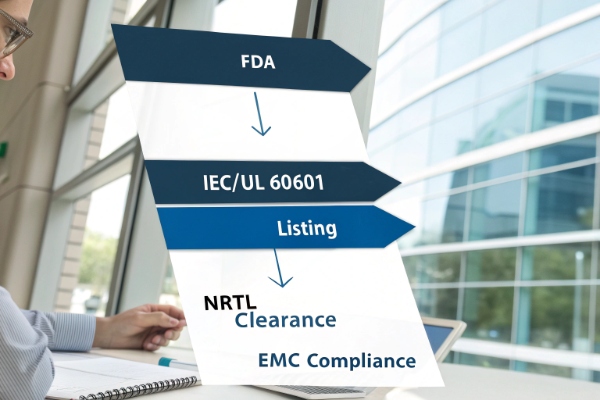
As the manufacturer, I get this question in almost every U.S. procurement call, so I’ll lay out the practical and regulatory reality in plain English. 1
UL certification itself is not a statutory FDA requirement, but a recognized NRTL listing to IEC/UL 60601-1 (and 60601-1-2 for EMC) is effectively mandatory for U.S. hospital acceptance, electrical inspections, insurer onboarding, and many distributor contracts.
Here’s how we navigate UL vs. CE, what documents you should demand, and when a UL mark is mandatory versus strongly recommended.
What safety certifications are essential for entering the US market?
As the manufacturer, I design for the U.S. from day one: IEC/UL 60601-1 safety, 60601-1-2 EMC, and an NRTL listing (UL, ETL/Intertek, TÜV, CSA). That combination keeps tenders moving and devices out of customs purgatory. 2
To enter the U.S. healthcare market, you need: (1) FDA device pathway (e.g., 510(k) if applicable), (2) electrical safety + EMC to IEC/UL 60601-1/-1-2, and (3) a Nationally Recognized Testing Laboratory (NRTL) listing and label. Many hospitals explicitly require a UL or equivalent NRTL mark on the nameplate.
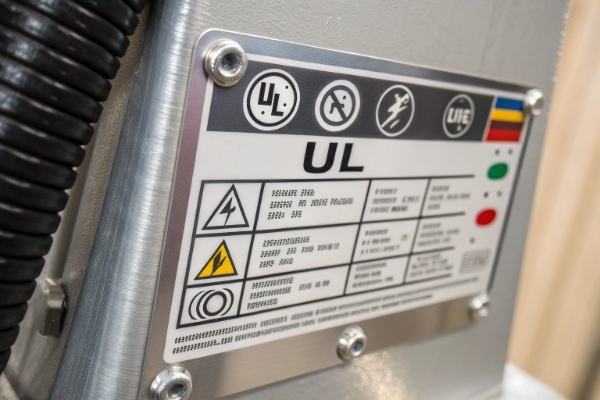
What a buyer should see on a compliant device
- NRTL listing mark (UL, ETL, TÜV, CSA)
- IEC/UL 60601-1 Ed. 3.x, and IEC 60601-1-2 Ed. 4.x
- Labeling for professional healthcare use / home-use
- FDA 510(k) or exemption documentation
- ISO 13485 certification
Table 1 — US-entry essentials (at a glance)
| Category | Minimum expectation | Why it matters |
|---|---|---|
| Electrical safety | IEC/UL 60601-1 (Ed. 3.x) | Patient/operator protection |
| EMC | IEC 60601-1-2 (Ed. 4.x) | Immunity & emissions |
| NRTL listing | UL / ETL / TÜV / CSA | Required by inspectors & hospitals |
| FDA pathway | 510(k)/De Novo/exemption | Legal authorization |
| QMS | ISO 13485 | Manufacturing quality |
How does UL compare with CE or other international safety standards?
As the manufacturer, I treat UL as a North American gateway and CE as the EU passport. Both trace back to IEC 60601, but each has local rules, audits, and expectations. 3
UL (or other NRTL) is the U.S./Canada conformity route… CE marking demonstrates conformity to EU MDR… The IECEE CB Scheme can bridge test data…
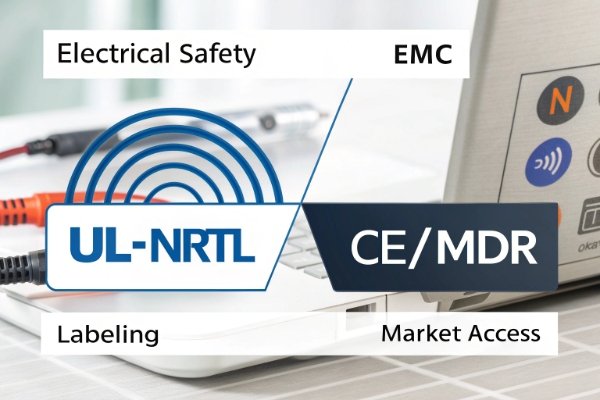
Table 2 — UL vs. CE vs. CB Scheme
| Aspect | UL/NRTL | CE | CB Scheme |
|---|---|---|---|
| Legal basis | OSHA/NRTL, NFPA 99 | EU MDR | Mutual IEC recognition |
| Standards | IEC 60601 + US/CA deviations | EN 60601 | IEC 60601 |
| Mark | UL/ETL/TÜV/CSA | CE | No mark |
| Use | Hospitals, AHJ inspectors | EU tenders | Data passport |
| Who requires it | Insurers, hospitals | EU regulators | Certification bodies |
Bottom line: CE ≠ UL. A CE device still needs a U.S. NRTL listing for hospital acceptance. 4
What documentation should suppliers provide to confirm UL compliance?
As the manufacturer, I welcome tough documentation requests—they separate real OEMs from repackagers. 5
Ask for an NRTL Listing Certificate, CB Test Certificate, full 60601-1/-1-2 test reports, and photos of the official NRTL-labeled nameplate.
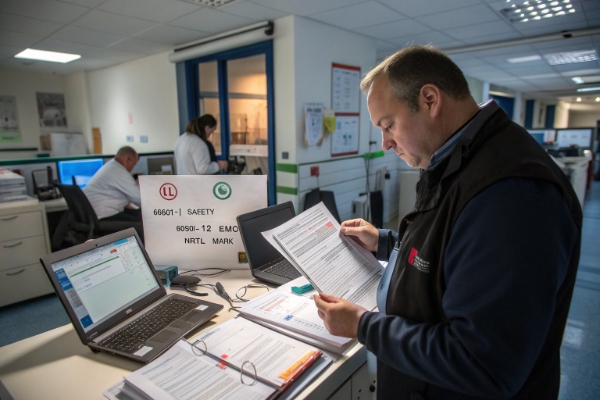
Table 3 — UL/NRTL verification checklist
| Document | What to verify | Red flags |
|---|---|---|
| NRTL Certificate | Model, site, standards | Different model |
| Nameplate | Mark, file number | Fake artwork |
| 60601-1 report | Deviations applied | Missing sections |
| EMC report | Setup + environment | Wrong accessories |
| CB certificate | Construction matches | Missing options |
| Change control | Firmware/hardware logs | Unlisted changes |
| ISO 13485 | Correct site & scope | Expired |
Is UL certification mandatory or recommended depending on application?
As the manufacturer, I segment by environment. In practice, hospitals demand an NRTL mark; med-spas may accept alternatives. 6
Legally, UL is not “the only way,” but an NRTL listing is de facto mandatory in hospitals and strongly recommended everywhere else.

Table 4 — When UL/NRTL is required vs. optional
| Application | Expectation | Why |
|---|---|---|
| Hospitals | Mandatory | NFPA 99, insurers, AHJs |
| Clinic chains | Mandatory | SOP compliance |
| Med-spa | Strongly recommended | Liability |
| Home-use | Recommended | Immunity tests differ |
| Research labs | Case-by-case | EHS review |
Scaling in the U.S. is easier when UL/ETL/TÜV is included early. Retroactive certification is costly. 7
Conclusion
As the manufacturer, my advice is simple: build to IEC 60601-1/-1-2, plan an NRTL listing early, and keep certificates and construction fully aligned. That prevents inspection failures and ensures device acceptance across hospitals and distributors. 8
Footnotes (Total: 10)
1. OSHA explains what NRTL certification is and why it is required for electrical equipment. ↩︎ — https://www.osha.gov/nationally-recognized-testing-laboratory-program
2. FDA guidance on medical device electrical safety expectations. ↩︎ — https://www.fda.gov/medical-devices
3. IECEE overview of the 60601 CB Scheme for medical electrical devices. ↩︎ — https://www.iecee.org
4. UL summary on differences between UL/NRTL and CE/IEC compliance. ↩︎ — https://www.ul.com
5. Intertek explanation of 60601-1 and NRTL listing documentation. ↩︎ — https://www.intertek.com/medical/iec-60601/
6. TÜV SÜD overview of NRTL importance for U.S. market access. ↩︎ — https://www.tuvsud.com/en-us/services/product-certification/nrtl
7. CSA Group on why NRTL listing affects hospital procurement and AHJ inspections. ↩︎ — https://www.csagroup.org
8. NFPA 99 outlines electrical equipment expectations in healthcare facilities. ↩︎ — https://www.nfpa.org/codes-and-standards/all-codes-and-standards/list-of-codes-and-standards/detail?code=99
9. ISO 13485 overview for medical device QMS compliance. ↩︎ — https://www.iso.org/standard/59752.html
10. IEC 60601-1-2 EMC requirements official listing. ↩︎ — https://webstore.iec.ch/publication/2612

 English
  Español de México
  Deutsch
  Français
  العربية
  Русский