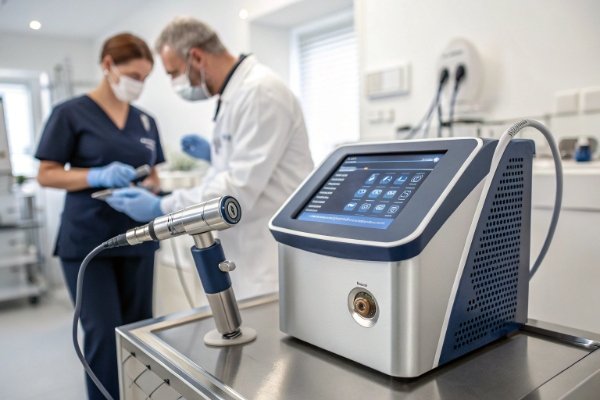
As the manufacturer, I am often asked how our machines maintain precise output levels over years of use. The answer lies in calibration — our built-in systems and factory protocols ensure every pulse stays accurate.
Yes, modern shockwave therapy machines include calibration systems for both touchscreen alignment and output energy verification; these systems, often password-protected, allow periodic recalibration to maintain consistent treatment performance and regulatory compliance.
This article explains how calibration works, why it matters, and what buyers should expect from professional OEM/ODM suppliers.
Why is routine calibration crucial for maintaining consistent treatment performance?
As the manufacturer, I’ve learned that calibration is not optional — it is the difference between a reliable treatment outcome and unpredictable therapy intensity. Even the best components drift over time.
Routine calibration ensures the machine delivers the specified energy level, frequency, and pulse consistency across treatments, preventing underperformance or patient discomfort, and upholding compliance with ISO 13485 calibration requirements 1.
What calibration actually controls
- Touchscreen Calibration – aligns the interface with the display to ensure accurate parameter input.
- Energy Output Calibration – verifies that the delivered acoustic pressure matches the selected intensity.
- Frequency & Pulse Calibration – confirms correct repetition rate and waveform stability.
- Sensor Accuracy – checks temperature and vibration feedback sensors to prevent drift.
Table 1 — Calibration parameters and their functions
| Parameter | Purpose | Drift Risk | Calibration Tool |
|---|---|---|---|
| Touch panel | Accurate menu response | Low | Software-only |
| Energy level | Consistent therapy dose | Medium–High | Power meter or reference probe |
| Frequency | Stable pulse rate | Medium | Oscilloscope or digital counter |
| Pressure | Correct mechanical impulse | Medium–High | Calibrated load sensor |
| Temperature sensor | Prevents overheat misreads | Medium | IR reference standard |
Why calibration matters for clinics
Without regular calibration, a setting of “2.0 bar” might actually deliver 1.7 or 2.4 bar — creating inconsistent clinical results. Regular calibration ensures every treatment matches the intended protocol, strengthening client trust and reducing warranty returns.
How often should calibration be performed and what documentation is generated?
As the manufacturer, I design every machine with a defined calibration cycle embedded in the service manual. The interval depends on operating hours and output type.
Calibration should be performed at least every 6–12 months or after major repairs, with service engineers documenting results in calibration certificates traceable to the factory’s ISO 13485 records and the device’s unique serial number 2.
Typical frequency and process
- Touchscreen alignment – when first installed or if screen misalignment occurs.
- Energy output check – every 6 months or after handpiece replacement.
- Full functional calibration – annually, as part of preventive maintenance.
- Extra validation – following firmware updates or transport shock.
Table 2 — Recommended calibration schedule
| Calibration Type | Interval | Performed By | Record |
|---|---|---|---|
| Touchscreen | As needed | User/Technician | Auto log in system |
| Output energy | Every 6 months | Service engineer | Calibration certificate |
| Frequency & pressure | Every 12 months | Factory/Authorized agent | Maintenance report |
| Sensor/temperature | During annual PM | Technician | Test checklist |
| Post-repair | Immediately after fix | Technician | Repair log + validation |
Documentation generated
- Calibration Certificate: includes test date, measured values, correction factors, technician signature.
- Service Log: shows preventive maintenance and any parts replaced.
- Traceability Record: links calibration tools to ISO/IEC 17025 accredited laboratories 3.
All these records form part of the Technical File required under MDR or FDA registration, ensuring traceable accuracy.
For OEM/ODM private-label clients, how should calibration capability be integrated into service/support?
As the manufacturer, we understand that private-label partners need not only the hardware but a full calibration ecosystem that supports their brand’s after-sales credibility.
OEM/ODM clients should integrate calibration functions into both the device firmware and service documentation, enabling authorized distributors to access service menus, perform controlled recalibration, and issue branded calibration certificates under the ISO 13485 framework 4.
Integration roadmap for private-label clients
- Firmware Branding
- Incorporate your brand logo in calibration menus while preserving factory logic.
- Service Password Control
- Assign role-based access (user vs. engineer vs. admin).
- Documentation Template
- Co-branded calibration certificates referencing your brand’s service centers.
- Spare-Part Strategy
- Provide reference handpieces and meters for your QA staff.
- Training Programs
- Train regional engineers via video or onsite sessions.
Table 3 — OEM/ODM calibration integration plan
| Integration Element | Implementation | Benefit |
|---|---|---|
| Firmware calibration page | Custom logo + password layer | Consistent branding |
| Engineer training module | PDF + remote session | Uniform calibration skills |
| Certificate template | Editable PDF with logo | Easy issue to end clients |
| Data upload portal | Cloud-based record | Centralized traceability |
| Spare calibration tools | Included with first shipment | Faster regional service |
When your brand offers built-in calibration access and certificates, distributors can service locally, avoid factory returns, and build stronger client retention. It’s one of the clearest differentiators between basic resellers and professional OEM providers.
What impact does calibration capability have on regulatory compliance and equipment lifecycle?
As the manufacturer, I see calibration as the backbone of compliance. Regulators expect calibration evidence as part of both manufacturing and post-market control.
Calibration capability directly affects compliance with ISO 13485 and ISO 14971, supporting traceability, performance stability, and risk mitigation; it also extends the equipment lifecycle by ensuring consistent energy delivery and reducing component stress from mis-calibration 5.
Regulatory and quality system impact
- ISO 13485: requires calibration and verification of measuring equipment used in production and servicing. ISO 13485 clause 7.6 6
- ISO 14971: links calibration to risk controls—preventing harm due to incorrect energy dose.
- MDR/FDA requirements: demand traceable service records for each device.
- IEC 60601 validation: calibrated reference instruments confirm performance safety (IEC 60601 overview) 7.
Table 4 — Compliance and lifecycle benefits
| Area | Calibration Role | Benefit |
|---|---|---|
| Regulatory | Demonstrates ongoing conformity | Simplifies audits |
| Clinical performance | Ensures reproducible energy | Consistent treatment outcomes |
| Reliability | Detects drift early | Prevents premature failures |
| Warranty support | Validates usage conditions | Easier claim resolution |
| Lifecycle cost | Reduces major repairs | Extends device lifespan |
When energy delivery remains within ±5% of design specification, component wear decreases, applicator tips last longer, and users trust the brand more. Calibration is thus not just compliance—it’s engineering longevity (predictive maintenance insights) 8.
Conclusion
A reliable calibration system is the silent guardian of treatment accuracy. It maintains patient safety, supports compliance, and strengthens every OEM brand built on performance and trust (shockwave OEM service reference) 9.
Footnotes
1. Explanation of ISO 13485 calibration requirements for medical devices. ↩︎
2. Calibration frequency recommendations under ISO 13485 for measuring instruments. ↩︎
3. Why ISO/IEC 17025 accreditation ensures valid calibration results. ↩︎
4. Guide to integrating calibration functions into OEM firmware and service manuals. ↩︎
5. Overview of calibration’s role in compliance and lifecycle management. ↩︎
6. ISO 13485:2016 clause 7.6 — control of monitoring and measuring equipment. ↩︎
7. IEC 60601 standard ensuring safety and performance validation. ↩︎
8. Predictive maintenance relationship between calibration and equipment longevity. ↩︎
9. KMS Laser OEM/ODM calibration and shockwave system services. ↩︎
10. Best practices for calibration records, traceability, and risk control. ↩︎

 English
  Español de México
  Deutsch
  Français
  العربية
  Русский