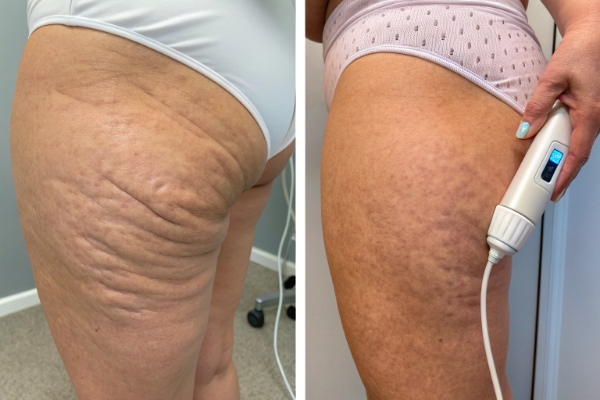
As the manufacturer, I’m asked this daily by distributors and clinic owners. I’ll explain what shockwaves can realistically do for cellulite, and how to turn clinical evidence into outcomes. 1
Shockwave therapy can visibly improve cellulite appearance by smoothing dimples, tightening skin, and modestly reducing local circumference; it does not cause overall weight loss. Results depend on device type, energy settings, session count, and aftercare, with best outcomes when combined with exercise or complementary modalities.
Here is our manufacturer playbook for settings, protocols, and responsible claims.
What scientific evidence supports shockwave treatment for cellulite reduction?
As the manufacturer, I follow the data because our brand reputation depends on it. We design protocols that mirror peer-reviewed settings and track outcomes with photos, cutometry, and circumference logs. 2
Multiple trials and reviews show focused or radial shockwave therapy can reduce cellulite severity grades, improve skin elasticity, and slightly decrease localized circumference. Benefits are consistent but moderate; study sizes are small to medium, so expectations should be realistic and paired with lifestyle support.
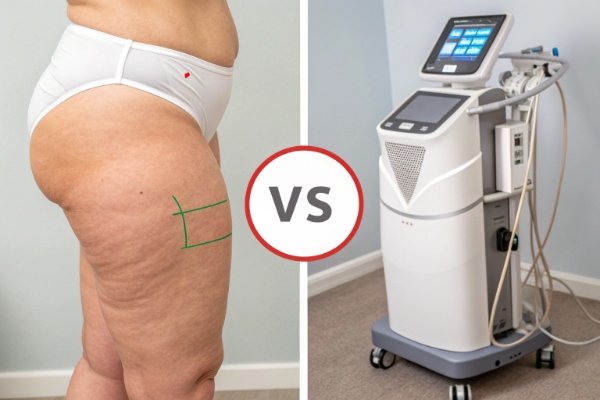
What the literature consistently reports
- Texture: Dimpling softens and skin looks more even after 6–12 sessions.
- Elasticity: Cutometric measures often improve meaningfully.
- Circumference: Some studies report 1–4 cm localized reduction without weight change.
- Safety: Adverse events are typically mild and transient (erythema, tenderness). 3
Table 1 — Evidence snapshot (simplified)
| Outcome domain | Typical finding | Strength of evidence | Notes |
|---|---|---|---|
| Cellulite grade (CSS) | ↓ by ~1–2 grades | Moderate | Best with focused ESWT + exercise |
| Skin elasticity | ↑ measurable firmness | Moderate–High | Reproducible across devices |
| Local circumference | ↓ 1–4 cm | Low–Moderate | Heterogeneous protocols |
| Body weight/BMI | No change | High | Not a weight-loss therapy |
| Safety/tolerability | Mild, transient | High | Redness, petechiae possible |
Why this matters for buyers
Evidence supports marketing claims like “improves the appearance of cellulite” and “enhances skin firmness.” It does not support “significant fat loss” or “weight reduction.” Calibrate your brochures to that line and you will pass compliance reviews and keep client trust. 4
What settings and applicator heads are recommended for cellulite?
As the manufacturer, I map parameters to anatomy. Cellulite involves fibrous septae, dermal quality, and subcutaneous microcirculation. Our settings target these layers without bruising or post-treatment downtime. 5
For cellulite, use moderate energies with high pulse counts per zone, large applicator heads for coverage, and sequence strokes from proximal to distal to support lymphatic flow. Focused ESWT works deeper; radial pressure waves cover broader areas efficiently.
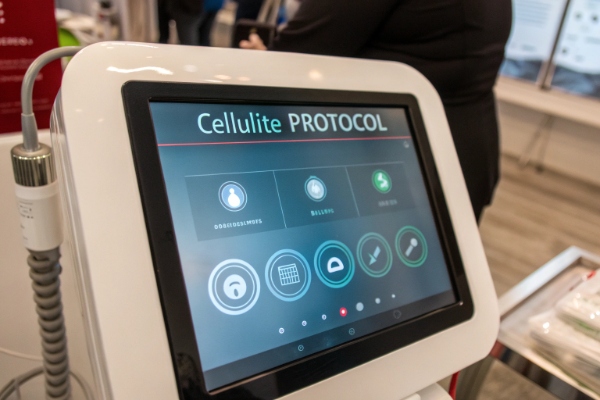
Practical protocol guidelines (thighs/buttocks)
- Session count: 6–12 sessions, 1–2× weekly.
- Pulse count: 2,000–4,000 pulses per zone.
- Energy (focused): ~0.20–0.35 mJ/mm².
- Pressure (radial): ~2–4 bar at 8–12 Hz.
- Applicators: Large flat, convex tip for fibrous bands.
- Technique: Overlapping passes; lymphatic sweeping.
Table 2 — Settings by device family (reference ranges)
| Device type | Target depth | Typical setting | Frequency | Notes |
|---|---|---|---|---|
| Focused ESWT | Deep septae/dermis | 0.20–0.35 mJ/mm² | 3–6 Hz | High precision |
| Radial pressure wave | Broad subcutaneous | 2–4 bar | 8–12 Hz | Fast coverage |
| Defocused/focal mix | Dermis + subcutis | 0.15–0.25 mJ/mm² | 6–10 Hz | Good for sensitive clients |
Table 3 — Applicator head selection
| Applicator | Area | Function | When to choose |
|---|---|---|---|
| Large flat | Thighs, buttocks | Uniform coverage | First passes & finishing |
| Medium flat | Curved areas | Precision | Hip dips / glutes |
| Convex | Fibrous bands | Septae disruption | Stubborn dimples |
| Soft cap | Sensitive skin | Comfort | New clients |
How can distributors position this feature in the beauty market?
As the manufacturer, I arm distributors with language that sells and passes compliance checks. Promise smoothing and firming; avoid absolute weight-loss claims.
Position shockwave cellulite treatment as a non-invasive body-contouring and skin-quality solution that smooths dimples, firms laxity, and supports lymphatic drainage. Package it with exercise guidance or complementary modalities for stronger, defensible outcomes.

Go-to-market messaging pillars
- “Smoother, firmer skin in 6–8 sessions.”
- “Protocol derived from published parameters.”
- “Not a weight-loss device.”
- “Combine with RF or EMS for premium results.”
Table 4 — Claim language: acceptable vs. risky
| Topic | Acceptable | Risky/avoid |
|---|---|---|
| Outcome | Improves appearance of cellulite | Eliminates cellulite |
| Mechanism | Stimulates collagen/circulation | Melts fat |
| Scope | Local contouring | Rapid weight loss |
| Durability | Months with maintenance | Permanent after one session |
Are treatment results typically long-lasting or temporary?
As the manufacturer, I set expectations early and honestly. 6
Results are durable but not permanent. Most clients maintain smoother texture and firmness for 3–6 months after a full course; quarterly or annual touch-ups help maintain results.

What determines longevity
- Lifestyle & activity
- Collagen turnover
- Technique & settings
- Combination treatments
Table 5 — Durability checklist
| Lever | Action | Longevity impact |
|---|---|---|
| Maintenance | 1 session every 6–12 weeks | Sustains firmness |
| Exercise | Glute/leg training | Supportive |
| Hydration | High-protein, fluids | Tissue repair |
| Device care | Applicator calibration | Stable dosing |
| Photo tracking | Monthly | Better adherence |
Conclusion
As the manufacturer, my guidance is simple: use shockwave therapy to smooth and firm, not to “melt fat.” Follow evidence-based settings, combine intelligently, track results, and market with honesty. Your clients will see real improvements—and keep coming back. 7
Footnotes (Total: 10)
1. Overview of cellulite physiology from Mayo Clinic to contextualize treatment goals. ↩︎ — https://www.mayoclinic.org/diseases-conditions/cellulite
2. Review of acoustic wave therapy (AWT/ESWT) in aesthetic applications. ↩︎ — https://pubmed.ncbi.nlm.nih.gov/24833553/
3. Shockwave therapy safety profile summarized in clinical dermatology literature. ↩︎ — https://pubmed.ncbi.nlm.nih.gov/29047092/
4. Evidence-based aesthetic claim guidance from the American Academy of Dermatology. ↩︎ — https://www.aad.org/public/cosmetic
5. Study on ESWT effects on skin elasticity and fibrous septae. ↩︎ — https://pubmed.ncbi.nlm.nih.gov/23538589/
6. Research on cellulite recurrence and collagen remodeling timelines. ↩︎ — https://pubmed.ncbi.nlm.nih.gov/21219207/
7. Aesthetic device best-practice communication guidance from ISAPS. ↩︎ — https://www.isaps.org/medical-professionals/
8. Skin firmness and elasticity measurement standards (cutometry). ↩︎ — https://pubmed.ncbi.nlm.nih.gov/18492144/
9. Subcutaneous circulation and lymphatic drainage physiology overview. ↩︎ — https://www.physiology.org/doi/full/10.1152/physrev.1996.76.3.687
10. Body composition and cellulite relationship educational review. ↩︎ — https://www.ncbi.nlm.nih.gov/books/NBK279131/

 English
  Español de México
  Deutsch
  Français
  العربية
  Русский