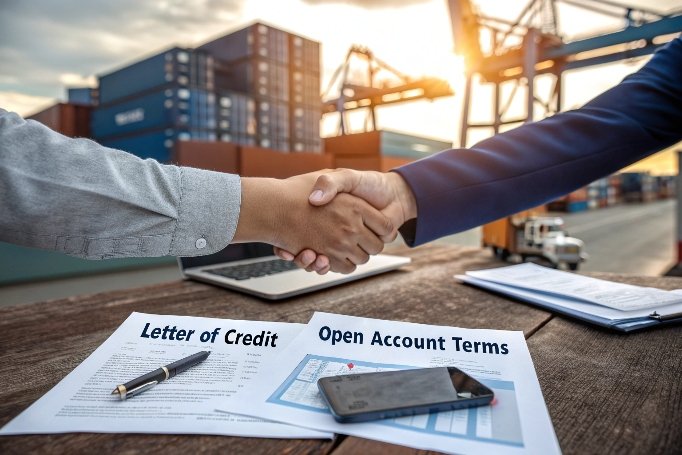
I hate tying up cash too early. I want credit terms that match my sales cycle without risking supply, quality, or timelines.
Yes, post-payment is possible if I show strong credibility, structure risk controls, and keep terms simple. For first deals, I expect deposits; for larger, repeat orders, I can negotiate documentary credit, escrow, or open-account net 30–90 days tied to shipment or bill-of-lading dates.
I start by mapping cash needs and risks on both sides. Then I anchor a staged plan: small orders stay prepaid, mid-sized use deposits plus document-triggered balances, and large, trusted volumes move to insured open account 1.
Do suppliers allow payment after delivery?
My ideal is to get the goods, clear customs, deliver to clients, and then pay. I know that is rare on the first PO.
Sometimes. Payment “after delivery” is usually reserved for repeat buyers with strong references, trade credit insurance, or bank-backed guarantees. If not possible, I ask for Net 30–90 from B/L date as a practical compromise.

When “pay after delivery” becomes realistic
Suppliers do not want their cash trapped across the ocean. So I plan a proof phase. I ship one or two successful POs with classic 30/70 terms and flawless QC. I share bank references and a 12-month forecast. Then I propose a trial open-account window on the next PO, such as Net 30 from B/L date on 30% of the order, with the rest on standard terms. If that runs clean, I expand the open-account share on the next order.
Practical variants I have used
- D/A (Documents against Acceptance) 60 or 90: Supplier ships, bank releases documents after I accept a time draft payable at maturity. The supplier still owns risk, but there is a formal promise to pay.
- Credit-insured open account: Supplier buys trade credit insurance for my account; premium cost might be added to price, but it unlocks net terms.
- Supplier financing via factor: A financer pays the supplier at shipment; I pay the financer at maturity. My price may include a financing fee.
I keep it transparent. If I need terms to grow, I explain my downstream receivables and share my aged AR report. Openness buys trust.
What risks are tied to post-payment?
I want credit, but I do not want to import risk I cannot manage. I list risks and assign controls before I ask for terms.
Post-payment shifts credit and performance risk to the seller, and timing and FX risk to both sides. On my side, the core risks are delivery delays, quality disputes, and cash timing mismatches if sell-through is slow. I mitigate with documents, inspections, and clear SOPs.

My risk map and how I handle each item
| Risk | Who carries it most | Why it matters | My control tool |
|---|---|---|---|
| Buyer default on net terms | Supplier | Cash loss for exporter | Credit insurance 2, L/C, smaller pilot |
| Quality dispute after ship | Both | Delayed payment or return | Pre-shipment inspection 3, golden sample, test reports |
| Shipping delay / demurrage | Buyer | Inventory gap and extra fees | Freight forwarder SLA 4 |
| Regulatory hold (medical devices) | Buyer | Release delay, fines | Medical device registration 5 |
| FX swings | Both | Price margin loss | Currency forward contracts 6 |
| Title / lien confusion | Both | Collection problems | Retention-of-title clause 7 |
The controls I bake into contracts
I add acceptance criteria aligned to a golden sample, and I require a final random inspection with an AQL table in the PI. I insist on document checklists: commercial invoice, detailed packing list, certificate of origin, HS code, serial-number log, and UDI/labeling where needed. For cash protection, I cap chargebacks to objective defects only, not to sell-through results. If we use Net terms, I commit to weekly shipment dashboards so the supplier sees that I manage receivables.
Can escrow services be used safely?
I love the idea of escrow, but I need it to fit real shipping flows and not choke on document timing.
Yes. Escrow works when I define clear release conditions. I link funds to inspection pass and document milestones. For medical devices, I add serial-number verification and packaging checks so there are no vague disputes.

How I set up a clean escrow workflow
I keep the rules simple: money in, goods out, documents verified, funds released. I choose an escrow service 8 that understands cross-border trade, not only marketplace goods. Then I fix three triggers:
- Pre-shipment: I deposit funds.
- QC pass: Independent inspection uploads a report; minor defects allowed per AQL.
- Document check: Supplier uploads B/L, CI, PL, COO, and any medical compliance documents.
- Release: Escrow pays the supplier against the agreed bundle; disputes resolve within a short window.
Do large buyers qualify for open account?
I want to graduate to true supplier credit. That saves cash and lets me scale inventory ahead of campaigns.
Yes. Large buyers often qualify for open account when annual spend exceeds USD 100–150k, or when they are recognized brands. If full “after-delivery” is rejected, I negotiate Net 30–90 from the B/L date to align both cash cycles.

I prepare a credit package 9 with references, bank letters, and forecasts. I am open to suppliers insuring receivables 10 to support extended terms.
Conclusion
Post-payment works when I earn trust, fix clean triggers, and tie credit days to the B/L date—so cash, quality, and timelines stay in balance.
Footnotes
1. Allianz Trade explanation of insured open-account credit structures. ↩︎
2. U.S. trade.gov guide to export credit insurance protection. ↩︎
3. Intertek overview of pre-shipment inspection procedures. ↩︎
4. Flexport article explaining freight forwarder SLAs. ↩︎
5. FDA resource outlining medical device registration requirements. ↩︎
6. Investopedia definition of forward currency contracts. ↩︎
7. Lexology article detailing retention-of-title clauses. ↩︎
8. Payoneer guide on escrow services for cross-border trade. ↩︎
9. Trade Finance Global guide to evaluating buyer creditworthiness. ↩︎
10. Coface overview of trade credit insurance and global coverage. ↩︎

 English
  Español de México
  Deutsch
  Français
  العربية
  Русский