
I know the pressure to hit margin targets while still growing market share. I have been there. Big orders help. But only if we ask for the right levers.
Yes. Buyers can get better pricing for bulk orders by asking for tiered quotes, linking discounts to volume, and trading extras for price. For 100+ units, a realistic target is 5%–8% off retail-like pricing, with more room if you standardize specs, bundle accessories, or confirm repeat orders.
When I negotiate, I do not start with “price only.” I map all cost drivers 1. Then I stack levers: volume tiers 2, shipping terms, payment terms, and production priority. This keeps the per-unit cost down and the lead time stable.
How much discount for 100+ units?
I always feel the tension here. I want a strong discount, but I still want stable quality and on-time execution.
For 100+ units, I anchor at 5%–8% off the small-batch price. If I standardize specs, pool accessories, commit to a reorder, or extend the lead time window, I can sometimes move toward 10%–12%.

What moves the needle at 100+ units
At this scale, I treat the deal as a package. Price is one line. Everything else supports that line: packaging, accessories, QA level, and shipping plan. If I accept a single universal carton size, the factory buys packaging in bulk. If I allow a shared test protocol (instead of bespoke reports per unit), the QC cost per unit drops a bit. If I confirm a reorder trigger, the supplier plans materials with less risk. Each concession buys me a little more discount.
Example tier structure you can ask for
Below is a simple table I use to frame counteroffers. The baseline “Unit List” is the supplier’s small-quantity number. The “Target Net” is my goal after discounts and value-add swaps.
| Quantity band | Typical discount vs. small-quantity price | Notes I use in negotiation |
|---|---|---|
| 1–50 | 0%–3% | Trials, mixed colors, extra accessories. Minimal scale. |
| 51–100 | 3%–5% | Fewer changeovers. Partial carton standardization. |
| 101–200 | 5%–8% | My core target. Push higher with spec lock and reorder option. |
| 201–500 | 8%–12% | Better packaging buys. FCL lanes. Possible accessory bundle. |
| 500+ | 12%–18%+ | Strategic pricing if you give a 6–12 month plan. |
I keep the message simple: I am not chasing an unrealistic cut that hurts quality. I want a fair deal that helps both sides. This tone protects me during ramp and after-sales support.
Do suppliers offer free shipping for bulk orders?
I hate surprise freight bills. I want a clean landed cost, or at least a stable model I can plan around.
Some suppliers can include shipping on bulk orders, but it depends on Incoterms, route, and margin. For heavy devices, “free shipping” usually means the freight cost is baked in. I ask for DDP or a freight subsidy at 100+ units.

Incoterms shape what “free shipping” really means
When I hear “free shipping,” I ask, “Which Incoterms 3?” If the quote is EXW or FOB, I own international freight. If it is CIF/CFR, the supplier covers ocean freight to my port, not duties or last-mile. If it is DAP/DDP, they bring it to my door, and DDP even covers duty. Most “free shipping” offers are CIF-like. That still leaves local charges on me. So I translate every claim into a landed cost table 4 and compare apples to apples.
How I push for a better freight outcome
At 100+ units, I ask for one of three options:
- A DDP landed price with a transparent duty line.
- A CIF price plus freight subsidy, e.g., the supplier covers $X per unit.
- A hybrid: I book freight, and the supplier absorbs origin charges and carton upgrades.
If I want genuine savings, I also push for FCL with optimized pallet counts, double-wall cartons, and fixed loading plans. These cut damage rates and claims, which protects my true landed cost. For planning, I share a stable carton map and book FCL 5 lanes early.
Can payment terms be improved for bulk orders?
I do not want to drain cash on a single PO. I also want the supplier to trust the deal and keep quality high.
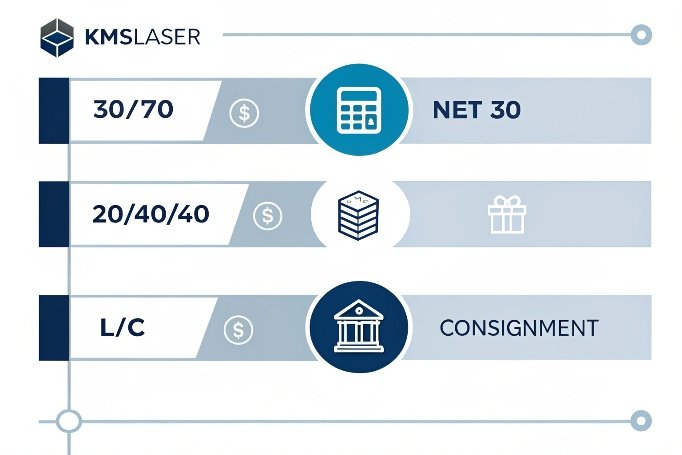
Yes. Bulk often unlocks better terms. For first orders, I see 30% deposit and 70% before shipment. With track record or credit support, I can move to Net 30/45/60, staged milestones, or an L/C that protects both sides.
What I ask for and why
Suppliers fear late payment. I show my plan. I share bank references or a trade credit report 6. I keep the structure simple and the paperwork clean. Then I propose two or three options so they can choose the one that fits their cash cycle. I am open about my cash needs too, because honesty speeds the deal.
Common payment structures, with pros and cautions
| Structure | What it looks like | Why I use it | Watch-outs |
|---|---|---|---|
| 30/70 (T/T) | 30% on PO, 70% before ship | Standard for new accounts | Balance due before release |
| 20/40/40 | 20% PO, 40% mid-production, 40% pre-shipment | Aligns cash with progress | Needs clear milestones |
| Net 30/45/60 7 | Invoice after delivery | Helps downstream cash flow | Needs credit approval |
| Letter of Credit 8 | Bank-backed payment | Risk control for both | Bank fees and documents |
| Consignment / Open Account 9 | Pay after sell-through | Great for distributors | Rare; needs high trust |
Are bulk orders prioritized in production?
I need my orders on time. Delays kill my launch plans and marketing spend.
Usually yes. Large, clean orders often get earlier slots because they are efficient to run and valuable to the factory. I secure priority by locking specifications, sharing forecasts, and agreeing on a clear production calendar with buffer days.

What priority really means on the line
Priority is not magic. It is a schedule. When I ask for priority, the factory manager thinks about line balance, component arrivals, and test station load. If my order is stable and uses standard parts, the manager can slot me early and run longer without changeovers. If I send many small variants, I lose time at each swap. So I reduce SKUs, freeze colors, and fix labeling rules. Then I ask for a Master Production Schedule (MPS) with gate dates: material in, first article, pilot run, mass run, final QA, and pack-out. I keep a shared MPS reference 10 handy so everyone aligns on terminology.
A simple capacity and priority map I use
I put this on one page and review it weekly in peak season:
| Week | Planned output (units) | My order slot | Notes |
|---|---|---|---|
| 1 | 300 | Pilot + line training | Lock test SOP |
| 2 | 500 | First 200 units | Early QA feedback |
| 3 | 600 | Next 300 units | Random drop tests |
| 4 | 700 | Final 500 units | Pack-out audit |
When we write this down, surprises drop. If a component shortens the plan, I help with alternates that pass the same specs. I also add a small rush premium if I want to jump the queue. That premium is cheaper than late launch costs.
Conclusion
Bulk orders can win price, freight support, friendlier terms, and priority—when I trade clarity, stable specs, and trust for real savings.
Footnotes
1. Cost drivers definition and uses in pricing analysis. ↩︎
2. Volume discount concept for B2B price breaks. ↩︎
3. ICC overview of Incoterms 2020 rules. ↩︎
4. Guide to calculating landed cost components. ↩︎
5. Full Container Load (FCL) explained for planners. ↩︎
6. D-U-N-S and trade credit reports for suppliers. ↩︎
7. Net 30 terms definition and implications. ↩︎
8. ICC guide to Letters of Credit mechanics. ↩︎
9. Open Account payment method explained by trade.gov. ↩︎
10. Master Production Schedule basics and terminology. ↩︎

 English
  Español de México
  Deutsch
  Français
  العربية
  Русский