
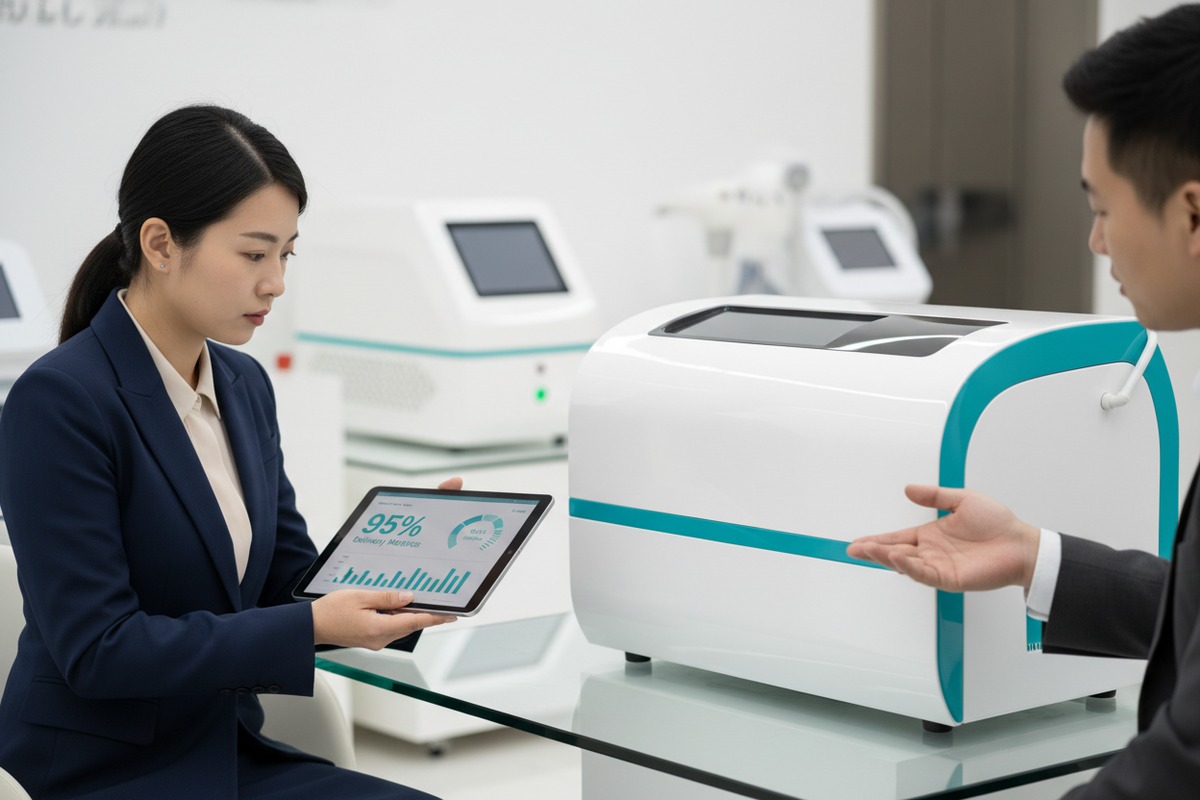
Our production floor handles dozens of custom color requests monthly CE marking compliance 1. Yet many buyers struggle to find suppliers who can deliver small batches without compromising quality or timeline. This frustration costs time, money, and market opportunities.
To evaluate supplier flexibility for small-batch color custom shockwave therapy machines, assess their MOQ policies, quality control systems, lead time adaptability, and prototyping capabilities. Request data on changeover efficiency, capacity utilization, and delivery performance above 95%. Conduct trial orders before committing to larger volumes.
The following sections break down each critical factor. You will learn exactly what to ask suppliers and how to measure their true flexibility for your custom needs.
What is the minimum order quantity I need for a custom color shockwave therapy machine?
When we first started offering color customization, many clients assumed they needed to order hundreds of units. shockwave therapy machines 2 This misconception kept smaller brands from entering the market. The reality is far more accessible than most people think.
For custom color shockwave therapy machines, flexible suppliers typically accept MOQs between 1-50 units for basic color changes. Complex customizations may require 10-30 units minimum. Premium suppliers with agile manufacturing systems can accommodate single-unit orders with appropriate pricing adjustments.

Understanding MOQ Variables
MOQ is not a fixed number. minimum order quantity 3 It depends on several factors that vary between suppliers. Our engineering team has identified the key variables that determine your actual minimum order.
Color complexity matters significantly. A standard Pantone color match 4 requires less setup than metallic finishes or gradient effects. Single-color requests typically have lower MOQs than multi-color designs.
The base machine model also affects MOQ. A supplier's best-selling model likely has more flexible MOQ options. They maintain component inventory and have optimized production cells for that specific design.
MOQ Comparison by Customization Type
| Customization Level | Typical MOQ Range | Lead Time Impact | Cost Premium |
|---|---|---|---|
| Standard color swap | 1-10 units | Minimal | 5-10% |
| Custom Pantone match | 10-30 units | +1-2 weeks | 10-20% |
| Metallic/special finish | 20-50 units | +2-3 weeks | 15-30% |
| Multi-color design | 30-50 units | +3-4 weeks | 20-35% |
| Full chassis redesign | 50-100 units | +6-8 weeks | 30-50% |
Questions to Ask About MOQ
First, ask suppliers about their pricing tiers. Many offer sliding scales where per-unit cost decreases at certain volume thresholds. Understanding these breakpoints helps you optimize order quantities.
Second, inquire about MOQ flexibility for repeat orders. Once a supplier has your color formula on file, subsequent orders often have lower minimums. Our facility stores customer color specifications digitally for exactly this reason.
Third, request information about pilot runs. Reputable suppliers offer small trial batches at slightly higher per-unit costs. This lets you validate quality before committing to larger orders.
Strategic Approaches to MOQ Management
Consider combining orders with other buyers. Some suppliers facilitate order pooling for customers requesting similar customizations. This spreads setup costs across multiple parties.
Another approach involves phased ordering. Place a small initial order to test the relationship. Once quality is confirmed, schedule larger follow-up orders with better pricing.
How do I ensure my supplier maintains strict quality control on small-batch custom finishes?
Quality concerns keep many buyers awake at night. In our experience supporting US distributors, we have seen how a single defective batch can damage brand reputation. Small batches actually present unique quality challenges that require specific safeguards.
Ensure supplier quality control by verifying ISO 13485 certification, requesting documented color matching protocols, demanding pre-shipment inspection reports, and establishing clear acceptance criteria. Require spectrophotometer data for color consistency and material traceability certificates for all colorants used in medical device applications.

Certification Requirements for Medical Devices
ISO 13485 certification 5 is non-negotiable for medical device manufacturing. This standard specifically addresses quality management systems for the medical industry. Ask suppliers for current certification documents and audit dates.
Beyond basic certification, look for FDA registration 6 if you sell in the United States. CE marking compliance matters for European markets. These certifications indicate the supplier understands regulatory requirements for medical devices.
Quality Control Checkpoints for Custom Colors
Our quality team implements multiple verification stages. Understanding these stages helps you evaluate what suppliers should offer.
| QC Stage | What to Verify | Documentation Required |
|---|---|---|
| Incoming materials | Colorant certificates, batch numbers | Material safety data sheets |
| Pre-production sample | Color accuracy vs. approved standard | Spectrophotometer readings |
| In-process inspection | Surface consistency, adhesion | Visual inspection reports |
| Final assembly | Overall finish quality, no defects | Photo documentation |
| Pre-shipment | Packaging integrity, labeling | Final inspection certificate |
Color Consistency Measurement
Subjective visual assessment is insufficient for professional applications. Request that suppliers use spectrophotometers or colorimeters 7 for objective measurement.
The Delta E value measures color difference between samples. A Delta E under 1.0 is imperceptible to human eyes. For medical devices, aim for Delta E below 2.0 for consistent branding.
Ask suppliers about their color tolerance specifications. They should provide written standards indicating acceptable variation ranges.
Material Traceability for Medical Applications
Every colorant and pigment must be traceable to its source. This is not optional for medical devices. It is a regulatory requirement.
Request certificates confirming biocompatibility of all colorants. The materials must meet ISO 10993 standards 8 for biological evaluation. Non-compliant colorants can cause regulatory problems and patient safety issues.
Batch-level traceability allows quick identification if problems occur. Good suppliers maintain detailed records linking finished products to specific material lots.
Building Quality Assurance Into Contracts
Include specific quality metrics in your purchase agreements. Define acceptable defect rates, typically under 2% for cosmetic issues. Establish procedures for handling non-conforming products.
Specify your right to third-party inspection. Independent quality verification protects both parties. Many buyers hire inspection services in China to verify shipments before they leave the factory.
Will opting for a custom color impact my delivery schedule and logistics lead times?
Time is money in the medical device market. When our clients at trade shows ask about customization, delivery concerns come up immediately. Understanding the real timeline impact helps you plan inventory and manage customer expectations.
Custom color shockwave therapy machines typically add 1-4 weeks to standard delivery schedules. Basic color changes add 1-2 weeks for setup and color matching. Complex finishes may extend lead times by 3-4 weeks. Flexible suppliers maintain capacity buffers allowing rush orders with 20-50% expedite fees.

Breaking Down the Timeline Components
Understanding each phase helps identify where delays might occur. Our production planning team tracks these milestones for every custom order.
Color formula development takes 3-7 days for new colors. If you provide an existing Pantone reference, this phase shortens significantly. Complex custom colors requiring multiple test batches take longer.
Material procurement adds variable time depending on colorant availability. Standard colors typically ship from local suppliers within days. Specialty finishes may require imports with longer lead times.
Production setup includes machine calibration and operator training for the specific color. Experienced suppliers with cross-trained staff complete this faster than facilities relying on specialized workers.
Lead Time Comparison Table
| Order Type | Color Matching | Material Sourcing | Production | Total Lead Time |
|---|---|---|---|---|
| Standard product | N/A | 1-3 days | 1-2 weeks | 2-3 weeks |
| Basic color change | 3-5 days | 3-5 days | 1-2 weeks | 3-4 weeks |
| Custom Pantone match | 5-7 days | 5-7 days | 2 weeks | 4-5 weeks |
| Special finish | 7-10 days | 7-14 days | 2-3 weeks | 5-7 weeks |
Logistics Considerations
Shipping mode significantly affects total delivery time. Air freight from China to the US takes 5-7 days. Sea freight requires 3-4 weeks but costs far less per unit.
For time-sensitive orders, consider splitting shipments. Send an initial batch by air to meet immediate needs. Follow up with sea freight for the larger quantity.
Customs clearance adds 2-5 days depending on documentation accuracy. Medical devices require specific FDA declarations. Work with suppliers experienced in US medical device exports to avoid delays.
Managing Rush Orders
Legitimate flexible suppliers maintain capacity buffers for urgent requests. Ask about their typical capacity utilization. Suppliers running at 95%+ capacity cannot accommodate rush orders without bumping other customers.
Expedite fees typically range from 20-50% of order value. This premium covers overtime labor, priority material sourcing, and schedule disruption costs. Budget for this possibility when planning product launches.
Establish rush order protocols in advance. Knowing the supplier's emergency procedures before you need them saves valuable time when urgent situations arise.
Building Time Buffers Into Your Planning
Experienced buyers add 1-2 weeks buffer to quoted lead times. This accounts for unexpected delays without creating customer disappointment.
Consider maintaining safety stock of your most popular variants. This inventory buffer lets you fulfill orders while awaiting new production.
Can my supplier provide a physical prototype or digital proof of my branded color before production?
Approving colors remotely creates anxiety. When we calibrate our coating systems for a new client, we understand the need for verification before full production. Modern suppliers offer multiple proofing options to build confidence.
Professional suppliers offer both physical prototypes and digital color proofs before production. Physical samples cost between $200-800 and take 1-3 weeks. Digital twin technology enables virtual color visualization within days. Request spectrophotometer data alongside any proof to ensure objective color verification.

Physical Prototype Options
A production-quality sample provides the most accurate representation. You receive an actual machine finished in your specified color. This lets you evaluate not just color but also texture, gloss, and durability.
For cost-sensitive projects, request a chassis sample only. This reduces material costs while still showing the finished appearance. Many suppliers offer unpainted chassis samples first, then a painted version for final approval.
Sample costs vary by complexity. Budget $200-500 for basic color samples on standard chassis. Complex finishes or full machine prototypes may cost $500-800 plus shipping.
Digital Proofing Technologies
Digital twin technology creates virtual representations of your customized product. You see photorealistic renders showing the exact color on the actual machine design.
These digital proofs generate quickly, often within 3-5 business days. They cost significantly less than physical samples. However, screen color accuracy varies, so digital proofs work best for preliminary approval.
Advanced suppliers provide color simulation under different lighting conditions. Medical devices appear under clinical lighting, retail displays, and natural daylight. This comprehensive view prevents surprises when products reach end users.
Proofing Method Comparison
| Proofing Method | Turnaround | Cost | Accuracy | Best For |
|---|---|---|---|---|
| Digital render | 3-5 days | $50-200 | Moderate | Initial concepts |
| Printed color chip | 5-7 days | $100-200 | Good | Color direction |
| Painted panel sample | 7-10 days | $150-300 | High | Surface evaluation |
| Chassis prototype | 10-14 days | $200-500 | Very high | Geometry fit check |
| Full machine sample | 2-3 weeks | $500-800 | Exact | Final approval |
Approval Documentation
Never approve colors verbally or by email description alone. Formal approval processes protect both parties from misunderstandings.
Request written approval forms specifying exact color references. Include Pantone numbers, spectrophotometer readings, and approved sample photographs. Both parties sign acknowledging the agreed standard.
Retain physical color standards for future reference. A kept-aside approved sample allows objective comparison of future production batches. This prevents gradual color drift over time.
Managing Expectations
Computer monitors display colors differently than physical objects. Explain this to stakeholders who will review digital proofs. A color appearing perfect on screen may look slightly different on plastic.
Environmental factors affect color perception. Viewing angle, lighting intensity, and surrounding colors all influence how we perceive the same objective color. Standardize viewing conditions when evaluating samples.
Allow revision cycles in your timeline. Most color matching processes require 2-3 iterations before perfect alignment. Build this expectation into project schedules.
Conclusion
Evaluating supplier flexibility requires examining MOQ policies, quality systems, delivery capabilities, and proofing options. Ask specific questions, request documented evidence, and conduct small trial orders before major commitments. The right supplier partner makes small-batch color customization achievable and profitable for your brand.
Footnotes
1. Official European Medicines Agency page explaining CE marking for medical devices. ↩︎
2. Explains what shockwave therapy machines are and their applications. ↩︎
3. Defines minimum order quantity and explains its importance in business. ↩︎
4. Official source defining Pantone color systems and their use in various industries. ↩︎
5. Explains ISO 13485 as the international QMS standard for medical devices. ↩︎
6. Official FDA page detailing requirements for medical device establishment registration. ↩︎
7. Explains what a spectrophotometer is and its role in color measurement and control. ↩︎
8. Provides an introduction to the ISO 10993 series for biological evaluation of medical devices. ↩︎

 English
 Español de México
 Deutsch
 Français
 العربية
 Русский
