Every week, our sales team fields calls from frustrated buyers who underestimated their lead times. They placed orders expecting delivery in 30 days, only to find their shockwave therapy machines 1 stuck in production or customs for months. This delay costs them sales, damages their reputation with downstream clinics, and ties up working capital.
Total lead time for sourcing shockwave therapy machines from China typically ranges from 60 to 150 days. This includes inquiry response, sample testing, production, quality control, packaging, shipping, customs clearance, and final delivery. The exact timeline depends on order volume, customization level, supplier tier, and shipping method chosen.
Understanding each phase of this timeline helps you plan inventory, manage customer expectations, and avoid costly surprises. Let me walk you through each critical component so you can build a realistic schedule for your next order.
How long will it take for my supplier to manufacture custom shockwave therapy machines?
Production timelines frustrate buyers more than any other phase. Our factory often receives urgent requests from customers who assumed manufacturing takes two weeks. The reality is far more complex, especially for customized medical devices 2.
Custom shockwave therapy machine production typically requires 20 to 60 days from deposit confirmation. Simple radial units with minor branding take 20-30 days. Complex focused machines with custom software, specialized handpieces, or unique housing designs require 45-60 days. High-volume orders over 50 units may extend timelines by 10-15 additional days.

Understanding Production Phases
Manufacturing shockwave therapy machines involves multiple sequential steps. Each step depends on the previous one completing successfully. Here is what happens after you pay your deposit.
First, our engineering team reviews your specifications. For OEM orders with your logo and packaging, this takes 2-3 days. For ODM projects requiring circuit modifications or new handpiece designs, expect 5-10 days for engineering review and design confirmation.
Second, procurement begins. We source components including compressors, control boards, transmitter heads, and housing materials. Tier 1 suppliers like us maintain inventory of common parts. However, specialized components for focused shockwave machines may require 7-14 days to arrive from sub-suppliers.
Third, actual assembly starts. Technicians build each unit in stages: main board assembly, compressor installation, handpiece connection, software loading, and housing assembly. A skilled team produces 5-10 radial units daily. Focused machines require more precision and yield 2-4 units daily.
Factors That Extend Production Time
Several variables push production beyond standard timelines.
| Factor | Impact on Lead Time | Mitigation Strategy |
|---|---|---|
| Chinese New Year 3 | +30 to 45 days | Order 60 days before holiday |
| Golden Week (October) | +7 to 14 days | Confirm schedule in August |
| Custom UI/Software | +10 to 20 days | Use supplier's standard interface |
| New handpiece molds | +25 to 40 days | Accept existing designs |
| Order volume 50+ units | +10 to 15 days | Split into smaller batches |
| Component shortages | +7 to 21 days | Confirm stock before deposit |
Radial vs. Focused Machine Production
The type of shockwave machine significantly affects manufacturing time. Radial machines use pneumatic technology. They are simpler, with fewer precision requirements. Our production line completes radial units 40% faster than focused units.
Focused machines demand electrohydraulic or electromagnetic generators. These components require precise calibration to achieve accurate focal depths up to 12cm. Each unit undergoes individual calibration testing, adding 2-3 hours per machine.
For buyers needing quick turnaround, radial machines offer the fastest path. If your application requires deep tissue penetration for bone healing or calcified lesions, focused machines are necessary despite longer production.
How much time should I allocate for quality control and pre-shipment inspections?
Quality failures cost more than delays. When we receive returns from overseas customers, the shipping alone consumes 20-30% of the product's value. Prevention through proper QC saves money and protects your brand reputation with downstream clinics.
Allocate 5 to 15 days for comprehensive quality control and pre-shipment inspection. Basic visual and functional checks require 5-7 days. Medical-grade testing including bullet life verification, energy output calibration, and safety compliance documentation needs 10-15 days. Third-party inspections add 3-5 days to coordinate scheduling.

Our Standard QC Process
Quality control at our facility happens in three stages. Each stage catches different types of defects.
In-process inspection occurs during assembly. Technicians verify component placement, solder quality, and wire connections. They test each sub-assembly before integration. This catches 60% of potential defects before final assembly.
Functional testing follows assembly completion. Every unit undergoes a 4-hour burn-in test. We verify energy output at multiple settings, test all handpiece connections, and confirm software functions. Machines run continuously to identify early failures.
Final inspection happens before packaging. We check cosmetic quality, verify labeling accuracy, and test all accessories. Each unit receives a unique serial number linked to its test records.
What Testing Should You Require?
Different tests serve different purposes. Here is what each test reveals about your machines.
| Test Type | Duration | What It Reveals | Recommended For |
|---|---|---|---|
| Visual inspection | 30 min/unit | Cosmetic defects, labeling errors | All orders |
| Functional test | 2 hours/unit | Basic operation, software function | All orders |
| Burn-in test | 4-8 hours/unit | Early component failures | Orders 10+ units |
| Energy calibration | 1 hour/unit | Accurate mJ output across settings | Clinical applications |
| Bullet life sampling | 3-5 days | Handpiece durability (2-5M shocks) | Long-term reliability |
| Third-party inspection | 1-2 days | Independent verification | First orders with new suppliers |
Bullet Life Testing Matters Most
Handpiece durability separates reliable machines from problematic ones. Tier 1 manufacturers like us design handpieces for 2-5 million shocks. Tier 2 factories often deliver under 1 million shocks before failure.
Testing bullet life requires specialized equipment and time. We fire test handpieces at maximum energy continuously, counting shocks until degradation. This process takes 3-5 days for meaningful results.
For first orders, request bullet life test reports or certificates. Ask how many shocks their handpieces are rated for. If a supplier cannot provide this data, consider it a red flag.
Third-Party Inspection Options
Independent inspection adds credibility but requires coordination. Companies like SGS, Bureau Veritas, and Intertek 4 operate throughout Guangdong. They schedule inspections within 3-5 business days of request.
Third-party inspectors follow your checklist. They verify quantity, check specifications, test samples, and photograph everything. Their reports provide documentation useful for insurance claims if problems arise later.
For orders exceeding $10,000, third-party inspection typically costs $300-500. This investment provides peace of mind and leverage if disputes occur.
What is the realistic door-to-door shipping time for my order to reach the US?
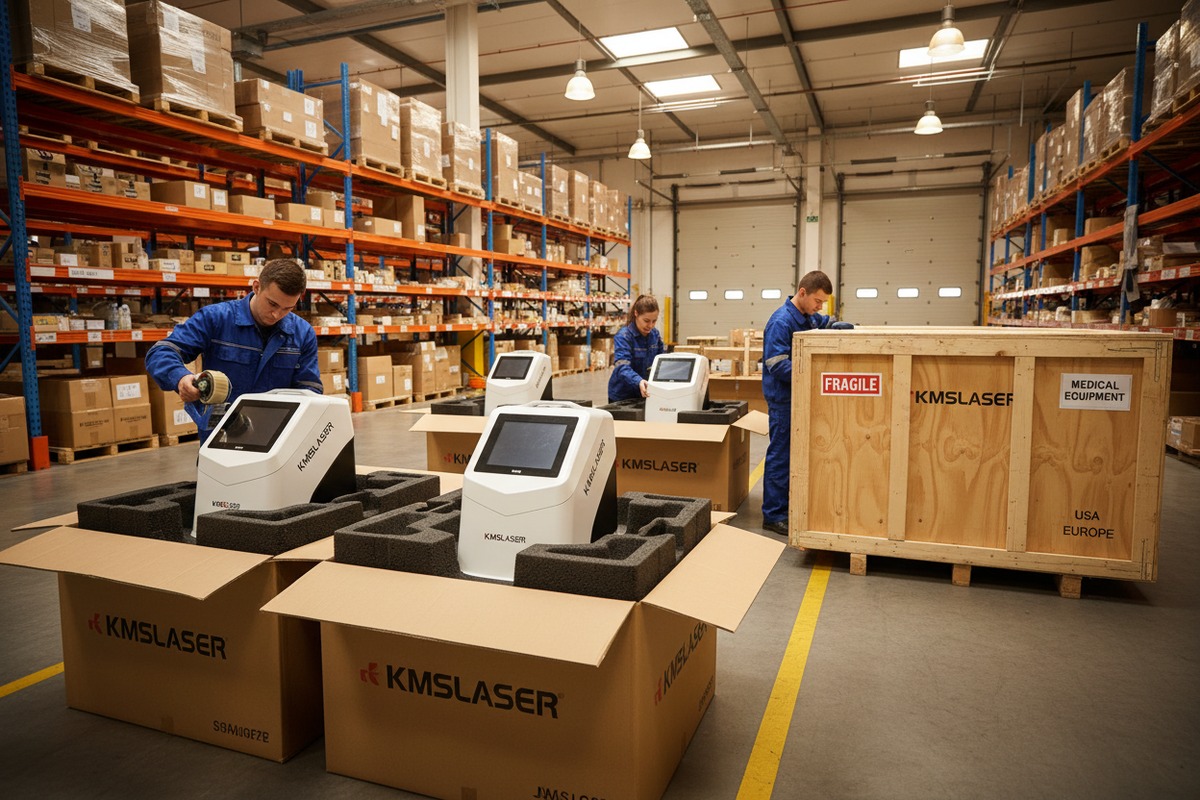
Shipping surprises buyers more than production. They see "15-day transit time" on quotes and assume that is the total. Reality includes inland transport, port handling, customs, and last-mile delivery. Each adds days or weeks.
Realistic door-to-door shipping from China to the US takes 25 to 55 days total. Air freight achieves 10-15 days door-to-door but costs 5-10 times more than sea freight. Ocean shipping requires 35-55 days including inland transport, port handling, ocean transit, customs clearance, and final delivery to your warehouse.
Breaking Down the Shipping Timeline
Door-to-door shipping includes multiple handoffs. Each transition creates potential delays. Understanding these segments helps you build realistic expectations.
Inland transport from factory to port takes 3-7 days. Our location in Guangzhou means 1-2 days to Shenzhen port. Factories in northern China face longer distances to major ports.
Port processing and vessel loading requires 3-5 days. Cargo arrives at port, undergoes export customs, and waits for vessel loading. Peak seasons extend this to 7-10 days.
Ocean transit varies by route and service level. Express services to Los Angeles take 15-18 days. Standard services to East Coast ports require 25-35 days. Weather and port congestion add variability.
US customs clearance takes 2-10 days depending on documentation completeness and inspection selection. Medical devices receive additional scrutiny. FDA and CBP coordinate on compliance verification.
Last-mile delivery from port to your warehouse needs 3-7 days. This depends on your location relative to the arrival port and trucking availability.
Comparing Shipping Methods
Each shipping method involves trade-offs between speed, cost, and risk.
| Shipping Method | Transit Time | Cost per Unit | Best For |
|---|---|---|---|
| Air Express (DHL/FedEx) | 5-7 days | $150-300 | Urgent samples, single units |
| Air Freight (Cargo) | 7-12 days | $80-150 | Small orders under 10 units |
| Sea LCL (Shared Container) | 35-45 days | $40-80 | Orders 5-20 units |
| Sea FCL (Full Container) | 30-40 days | $25-50 | Orders 50+ units |
| Rail Freight | 18-25 days | $60-100 | Balance of speed and cost |
Port Selection Impacts Speed
Not all Chinese ports offer equal efficiency. Shenzhen and Ningbo handle the highest export volumes with the most frequent vessel departures. Shanghai offers good frequency but more congestion.
For US West Coast delivery, Shenzhen to Los Angeles provides the fastest ocean option. For East Coast, consider Ningbo to New York or Savannah routes.
Your freight forwarder should recommend optimal routing based on your deadline and budget. We work with forwarders who specialize in medical device logistics. They understand FDA requirements and documentation needs.
Documentation That Prevents Delays
Customs delays often result from paperwork problems, not inspections. Complete documentation packages include commercial invoice, packing list, bill of lading, certificate of origin, and product certifications.
For shockwave therapy machines, FDA establishment registration 5 and device listing numbers help. ISO 13485 certificates 6 and CE marks demonstrate compliance. Having these ready accelerates clearance.
Our team prepares documentation packages for every shipment. We include technical specifications that customs officers need to classify products correctly. Proper HS code assignment 7 prevents delays from misclassification disputes.
How can I prevent unexpected delays from affecting my total lead time?
After processing thousands of orders, our team knows where delays hide. Some are predictable. Others strike without warning. Proactive planning eliminates most problems before they become emergencies.
Prevent unexpected delays by ordering 60 days before Chinese holidays, confirming component availability before deposit, requiring written production schedules, scheduling inspections during production, and building 15-20% buffer time into your timeline. Communication frequency matters: weekly updates catch problems while solutions remain possible.
Holiday Planning Is Non-Negotiable
Chinese holidays shut down manufacturing completely. Chinese New Year creates the longest disruption: 15-30 days of zero production. Workers return to hometowns. Many change jobs afterward, causing additional delays as factories rebuild teams.
The smart approach is to place orders 60 days before Chinese New Year. This allows production completion before the holiday. For orders placed in January, expect delivery delays of 30-45 days minimum.
Golden Week in October creates 7-10 day shutdowns. Mid-Autumn Festival, Qingming, and Dragon Boat Festival each cause 3-5 day closures. Request your supplier's holiday calendar at the start of each year.
Build Communication Checkpoints
Problems discovered early are solvable. Problems discovered at shipment are disasters. Establish mandatory communication checkpoints throughout production.
Require confirmation of these milestones:
- Deposit received and production scheduled
- Components sourced and assembly beginning
- Assembly 50% complete with progress photos
- Assembly complete and QC starting
- QC passed and packaging complete
- Shipment booked and documents prepared
Each checkpoint should include photos or videos. We send customers WhatsApp updates at every stage. Visual confirmation prevents misunderstandings and catches issues early.
Supplier Qualification Reduces Risk
Not all suppliers deliver consistently. Tier 1 manufacturers invest in inventory, quality systems, and skilled workers. Tier 2 factories optimize for low prices, often cutting corners on reliability.
When evaluating suppliers, ask these questions:
| Question | Good Answer | Warning Sign |
|---|---|---|
| What is your handpiece bullet life? | 2-5 million shocks with test data | "Long life" without specifications |
| Do you hold component inventory? | Yes, 30-60 day supply | Order components after deposit |
| What is your on-time delivery rate? | 90%+ with examples | Cannot provide data |
| How do you handle delays? | Proactive communication, air upgrade options | Excuses and silence |
| Can I visit your factory? | Yes, with tour scheduled | Reluctance or excuses |
Contingency Planning Saves Projects
Despite best efforts, some delays are unavoidable. Shipping disruptions, component shortages, and regulatory changes happen. Building contingencies protects your business.
Keep 15-20% buffer time in your schedule. If you need machines by March 1st, plan for February 1st delivery. This buffer absorbs typical delays without affecting your commitments.
Consider split shipping for large orders. Ship 50% by air to meet immediate needs. Ship the remainder by sea to manage costs. This hybrid approach balances urgency with budget constraints.
Maintain relationships with backup suppliers. Even if you prefer one factory, having a qualified alternative provides leverage and options when problems arise.
Regulatory Preparation Prevents Customs Holds
Medical device imports face regulatory scrutiny. FDA requires proper establishment registration and device listing before importation. Missing documentation triggers holds that last weeks.
Verify your supplier's regulatory status before ordering. Request copies of ISO 13485 certificates, FDA registration numbers, and CE marks 8. Confirm these documents match the exact products you are ordering.
For devices requiring 510(k) clearance 9, work with regulatory consultants early. The 510(k) process takes 3-6 months minimum. Starting this process after ordering creates impossible timelines.
Conclusion
Estimating total lead time requires understanding each phase: production, quality control, shipping, and customs. Build your timeline with realistic expectations, add buffer for uncertainties, and communicate frequently with your supplier. With proper planning, your shockwave therapy machines will arrive when your business needs them.
Footnotes
1. Provides information on the types and applications of shockwave therapy devices. ↩︎
2. Defines what the FDA considers a medical device and its scope. ↩︎
3. Provides information on the dates and impact of the major Chinese holiday. ↩︎
4. Introduces leading global companies specializing in testing, inspection, and certification services. ↩︎
5. Details the FDA’s requirement for facilities involved in medical device production and distribution. ↩︎
6. Explains the international standard for quality management systems in medical device manufacturing. ↩︎
7. Explains the Harmonized System codes used for classifying products in international trade. ↩︎
8. Describes the European conformity marking required for medical devices in the EU. ↩︎
9. Direct replacement from the original authoritative FDA.gov source, now working. ↩︎

 English
  Español de México
  Deutsch
  Français
  العربية
  Русский