
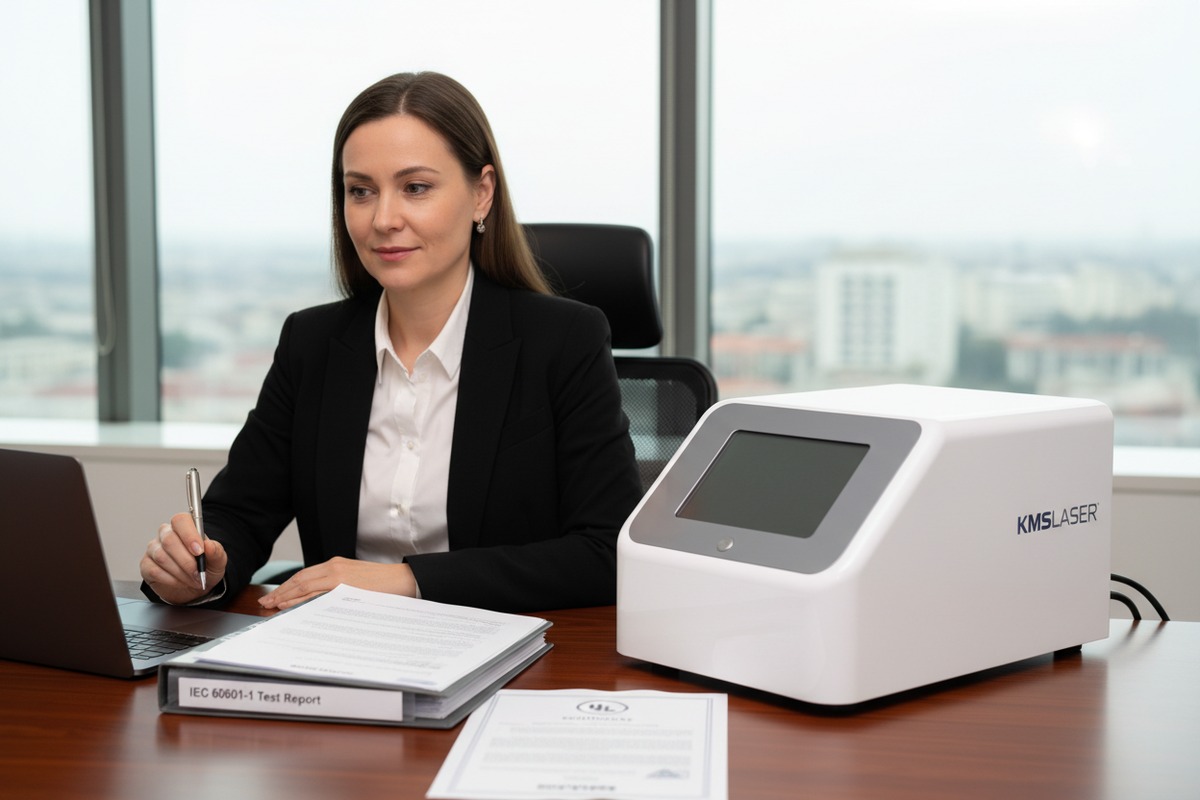
Every week, our production team receives emails from US buyers asking the same question: “Does this shockwave machine have UL certification?” The problem is clear. Without proper UL documentation, your shockwave devices may face customs holds, OSHA violations 1, or worse—liability issues when patients get hurt.
To request US UL certification from suppliers, first verify their existing certifications, then request complete technical documentation including IEC 60601-1 test reports. If no UL certification exists, coordinate with your supplier to engage UL Solutions directly for testing and NRTL marking, which typically costs $10,000–$50,000 and takes 3–6 months.
This guide walks you through everything from verifying supplier claims to understanding costs Nationally Recognized Testing Laboratory 2. Let us break down each step so you can import shockwave therapy machines into the US market with confidence.
How can I verify if my supplier's UL certification for shockwave therapy machines is authentic?
When we ship our shockwave devices to North American clinics, the first question buyers ask is about certification proof. Many suppliers claim "UL compliant," but this means nothing without actual certification. The difference between compliance and certification can cost you thousands in fines and delays.
Verify UL certification authenticity by checking the UL Product iQ database at productiq.ulprospector.com using the supplier's UL file number. Request the original UL certificate, test reports, and authorization letters. Authentic certifications show the manufacturer's name, product category, and active status with annual surveillance dates.

Understanding What UL Certification Actually Means
UL (Underwriters Laboratories 3) is a Nationally Recognized Testing Laboratory (NRTL) that OSHA recognizes for workplace electrical safety. For medical devices like shockwave therapy machines, UL certification verifies compliance with IEC 60601-1 4 for basic safety and essential performance.
Here is the key distinction: UL certification is not FDA approval. FDA 510(k) clearance 5 is required to sell shockwave devices as Class II medical devices in the US. UL certification supports FDA submissions by proving electrical safety compliance.
Steps to Verify Supplier UL Claims
First, ask your supplier for their UL file number. This is a unique identifier assigned to every certified product. Then visit the UL Product iQ database 6 and search this number. If the product appears with active status, the certification is real.
Second, request these documents from your supplier:
| Document Type | Purpose | Red Flag If Missing |
|---|---|---|
| UL Certificate | Proves active certification | Major concern |
| UL Test Report | Shows testing scope and results | Cannot verify compliance |
| Authorization Letter | Confirms you can use their listing | Legal liability issue |
| Annual Surveillance Record | Shows ongoing compliance | Certification may have lapsed |
| IEC 60601-1 Test Data | Details electrical safety testing | Incomplete certification |
Watch Out for These Warning Signs
Our quality team has seen suppliers use fake UL marks. Look for these red flags:
The UL mark should match official UL formats exactly. Check the control number printed near the mark. This number links to UL's database.
If a supplier says "UL compliant" but cannot provide a file number, walk away. Compliance without certification has no legal standing in OSHA-regulated workplaces.
Some suppliers show CE marks and claim they equal UL. They do not. CE is for European markets. US clinics need NRTL certification for workplace use.
Using the IECEE CB Scheme for Verification
Many legitimate manufacturers use the IECEE CB Scheme 7. This international system lets UL test reports transfer across 50+ countries. If your supplier has a CB test certificate from a recognized body, UL can use this data to issue US certification faster.
Ask your supplier: "Do you have a CB test certificate for IEC 60601-1?" This saves time and money during the certification process.
Can I add my private label to a manufacturer's existing UL listing for shockwave devices?
In our factory, we work with many US brands who want their logo on our certified equipment. This is called private labeling or multiple listing. The process exists, but it requires proper paperwork and UL approval.
Yes, you can add your private label to an existing UL listing through UL's Multiple Listing or Private Label agreement. The original manufacturer must authorize this arrangement, and both parties submit documentation to UL. Your company becomes a "Listee" under the original certification, sharing responsibility for compliance.

How Multiple Listing Works
When our engineers develop a shockwave machine and obtain UL certification, that certification belongs to our company. But UL allows us to extend this certification to buyers who want to sell under their own brand.
There are two main options:
Multiple Listing: Your company name appears on UL's database alongside the original manufacturer. You share the certification but operate independently.
Private Labeling: Only your brand appears on the product. The original manufacturer's certification covers your branded version.
Both options require a formal agreement between you and the supplier, plus UL approval.
Requirements for Private Label UL Listing
| Requirement | Your Responsibility | Supplier Responsibility |
|---|---|---|
| Authorization Agreement | Sign with supplier | Provide and file with UL |
| Quality Agreement | Define inspection rights | Maintain production standards |
| Label Approval | Submit your label design to UL | Ensure labels meet UL format rules |
| Annual Fees | Pay your portion to UL | Pay base certification fees |
| Product Changes | Report any requested modifications | Notify UL of all design changes |
The Application Process
Start by asking your supplier if they accept private label arrangements for their UL-certified products. Not all do. Some manufacturers restrict their certifications to their own brand only.
If your supplier agrees, follow these steps:
- Sign a Multiple Listing Agreement with your supplier
- Your supplier contacts UL to add you as a Listee
- UL reviews your company information and label design
- UL approves the listing addition
- You receive authorization to use the UL mark with your brand
This process typically takes 4–8 weeks and costs $2,000–$5,000 in UL administrative fees.
Limitations You Must Understand
Private labeling has boundaries. You cannot modify the product design without new UL testing. Even small changes—different power supply, new casing material, software updates—require UL review.
Our production team has seen buyers try to "improve" products after private labeling. This voids the UL certification immediately. If you need custom features, get them added before certification, not after.
Also, you share liability with the original manufacturer. If a device fails and causes injury, both companies face legal exposure. Your Supplier Quality Agreement should address this clearly.
What are the typical costs and timelines for obtaining UL certification through a Chinese supplier?
When we quote UL certification projects to US buyers, we always emphasize realistic expectations. Many buyers expect certification in weeks for a few thousand dollars. The reality is different, and understanding this upfront prevents frustration.
UL certification for shockwave therapy machines typically costs $10,000–$50,000 and takes 3–6 months. Costs include pre-testing at $2,000–$8,000, formal UL testing at $8,000–$30,000, and certification fees at $2,000–$5,000. Complex devices with software or network connectivity face higher costs and longer timelines due to IEC 62304 and UL 2900 requirements.

Breaking Down the Cost Components
Our accounting team has tracked UL certification expenses across dozens of projects. Here is what you should budget:
| Cost Category | Low Estimate | High Estimate | Notes |
|---|---|---|---|
| Pre-Compliance Testing | $2,000 | $8,000 | Find problems before formal testing |
| IEC 60601-1 Testing | $8,000 | $20,000 | Basic electrical safety |
| EMC Testing (IEC 60601-1-2) | $3,000 | $10,000 | Electromagnetic compatibility |
| Risk Management Review | $1,500 | $5,000 | ISO 14971 documentation |
| Software Testing (IEC 62304) | $5,000 | $15,000 | Only if device has complex software |
| Cybersecurity (UL 2900) | $5,000 | $12,000 | Required for network-connected devices |
| UL Certification Fee | $2,000 | $5,000 | Initial listing fee |
| Annual Surveillance | $1,500 | $3,000 | Ongoing yearly cost |
Understanding the Timeline
The 3–6 month timeline breaks down like this:
Month 1: Document preparation and pre-compliance testing. Our engineering team prepares technical files, risk assessments, and test samples.
Month 2–3: Formal UL testing at an accredited laboratory. Testing covers electrical safety, EMC, and any special requirements.
Month 4: Report review and certification processing. UL engineers review test data and issue findings.
Month 5–6: Address any issues, retest if needed, and receive final certification.
Several factors extend timelines. Software-heavy devices face IEC 62304 compliance reviews. Network-connected shockwave machines need UL 2900 cybersecurity testing 8. Any test failures mean redesign and retesting.
Who Pays for What?
This is where supplier negotiations matter. In our experience, three models exist:
Model 1 – Supplier Pays: The supplier funds UL certification and builds the cost into product pricing. This is rare for custom or low-volume orders.
Model 2 – Buyer Pays: The buyer pays all UL costs directly. The supplier provides technical support and test samples. This is most common for private label arrangements.
Model 3 – Shared Costs: Both parties split expenses. The supplier covers testing while the buyer pays certification fees. This works well for long-term partnerships.
Get payment responsibilities in writing before starting. Our sales team has seen disputes when buyers assumed suppliers would cover costs that were never agreed upon.
Ways to Reduce Costs
Use the IECEE CB Scheme if your supplier already has CB test certificates. This eliminates redundant testing and can cut costs by 30–40%.
Bundle certifications. If you need both UL and FDA 510(k), some test data supports both submissions. Coordinate these processes to avoid paying twice for similar testing.
Choose a supplier with existing UL experience. When our engineers design new models, we build UL requirements into the design phase. This prevents expensive redesigns during testing.
How do I ensure my custom shockwave machine design meets all US UL safety standards?
Our R&D team starts every custom project with UL requirements in mind. Building compliance into the design is far cheaper than fixing problems during certification. When buyers come to us with custom specifications, we evaluate UL impact from day one.
Ensure custom shockwave designs meet UL standards by incorporating IEC 60601-1 requirements during the design phase, conducting pre-compliance testing at 50% completion, and engaging UL early for design reviews. Key areas include electrical safety, EMC performance, risk management documentation, software lifecycle compliance, and acoustic output mapping.

Core Standards Your Design Must Address
IEC 60601-1 is the foundation standard for medical electrical equipment safety 9. But shockwave therapy machines face additional requirements based on their features:
| Standard | Applies To | Key Requirements |
|---|---|---|
| IEC 60601-1 | All medical electrical equipment | Basic safety, essential performance |
| IEC 60601-1-2 | All medical electrical equipment | Electromagnetic compatibility (EMC) |
| ISO 14971 | All medical devices | Risk management process |
| IEC 62366 | All medical devices | Usability engineering |
| IEC 62304 | Devices with software | Software lifecycle processes |
| UL 2900 | Network-connected devices | Cybersecurity requirements |
Design-Phase Considerations
When our engineers develop custom shockwave machines, we follow a structured approach:
Electrical Architecture: Power supplies must meet isolation requirements. Single fault conditions cannot create hazardous situations. Accessible parts must stay within touch current limits.
Enclosure Design: IP ratings affect patient and operator safety. Cooling systems must not create electrical hazards. Emergency stops must work even during power failures.
Software Integration: If your custom design includes treatment protocols or network connectivity, budget for IEC 62304 compliance. This standard requires documented software development processes, not just working code.
Pre-Compliance Testing Strategy
Do not wait until the design is final to test. Our quality team runs pre-compliance checks at key milestones:
At 30% completion, we verify basic electrical safety margins. At 50%, we test EMC performance in our shielded chamber. At 80%, we run full pre-compliance testing against all applicable standards.
This approach catches problems early. Fixing an EMC issue at 50% completion costs hundreds of dollars. Fixing it after formal UL testing fails costs thousands.
Documentation Requirements
UL requires extensive documentation beyond test reports. Start preparing these files during design:
Risk Management File (ISO 14971): Identify all hazards, estimate risks, and document mitigation measures. UL reviewers check this carefully.
Essential Performance Analysis: Define what functions must work correctly for patient safety. Test these functions under fault conditions.
User Interface Documentation: Show how operators interact with the device. UL evaluates whether the design prevents use errors.
Software Documentation: If applicable, provide architecture diagrams, SOUP (Software of Unknown Provenance) analysis, and verification records.
Working with UL During Development
UL offers preliminary design review services. For complex custom projects, this is money well spent. UL engineers review your design documents and identify compliance gaps before you build prototypes.
Our project managers schedule UL consultations at the design freeze point. This confirms our approach before committing to tooling and final production setups.
Another option is component recognition. If your custom design uses UL-recognized components (power supplies, connectors, displays), you reduce testing scope. Ask your component suppliers for UL recognition cards.
Conclusion
Requesting UL certification from suppliers requires verification, documentation, and realistic expectations about costs and timelines. Whether you verify existing certifications, pursue private labeling, or develop custom designs, start the process early and put agreements in writing. Your US market success depends on getting this right from the beginning.
Footnotes
1. Official OSHA data on the most frequently cited workplace safety standards violations. ↩︎
2. Official OSHA program page explaining the requirements and role of NRTLs in product certification. ↩︎
3. Official website for UL Solutions, a global leader in safety science and certification. ↩︎
4. Overview of the fundamental international standard for basic safety and essential performance of medical electrical equipment. ↩︎
5. Official FDA information on the premarket notification process for medical devices. ↩︎
6. Official UL Solutions portal for verifying UL certifications and accessing product information. ↩︎
7. Official website for the IECEE CB Scheme, an international system for mutual recognition of test certificates. ↩︎
8. Found the UL Solutions page detailing their Medical Cybersecurity Assurance Program (CAP), which is based on the UL 2900 series of standards and addresses cybersecurity testing for medical devices. ↩︎
9. Overview of international standards and regulations for the safety of medical electrical equipment. ↩︎

 English
 Español de México
 Deutsch
 Français
 العربية
 Русский
