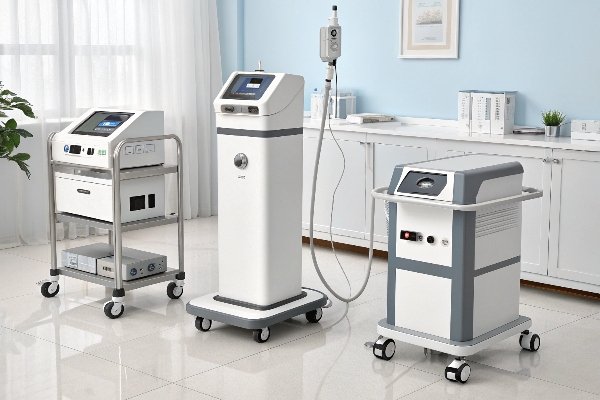
I often get asked by importers and clinic managers how large these machines really are, and whether size affects performance or shipping costs. It’s a good question.
Most professional shockwave therapy machines measure between 30 cm and 50 cm per side and weigh between 10 kg and 30 kg. Portable models can be as light as 3 kg, while trolley-mounted systems can exceed 50 kg.
Knowing these physical ranges helps buyers plan space, logistics, and portability when choosing between portable and stationary models. For background on how shockwave therapy machines work and are used clinically, see this overview. 1
How does machine size impact portability?
I remember testing several imported units in my showroom — some were easy to lift, others needed two people.
Size directly affects portability. Compact shockwave therapy machines are easier to carry between treatment rooms or mobile clinics, while full-size systems prioritize stability, continuous power, and integrated compressors.

Larger systems often include built-in air compressors for medical devices to deliver steady pneumatic power, which improves consistency but increases bulk. Smaller units frequently rely on radial vs. focused technology differences to keep footprints small. 2 3
Typical portability tiers
| Type | Weight Range | Best For | Portability |
|---|---|---|---|
| Handheld / Compact | 3–8 kg | Mobile physiotherapists, spas | Very portable |
| Mid-size desktop | 10–25 kg | Clinics with multiple rooms | Moderate |
| Full-size trolley | 40–60 kg+ | Hospitals, rehabilitation centers | Low |
Clinics that perform high daily volumes often prefer heavier, stable models that can run continuously without overheating. Mobile physiotherapy services prefer compact versions with quick setup.
What is the average shipping weight?
When I arrange exports, I always check freight class and packaging materials before quoting delivery.
The average shipping weight for a clinic-grade shockwave therapy machine is about 20 kg to 40 kg. Portable units can ship at 8 kg to 12 kg gross weight, while large trolley systems exceed 60 kg with crate and accessories.

For air shipments, freight is often billed by volumetric (dimensional) weight; packaging validated to ISTA 3A transit tests helps reduce damage. 4 5
Sample packing and logistics table
| Machine Type | Net Weight | Gross Weight (with packaging) | Package Size |
|---|---|---|---|
| Compact / portable | 5 kg | 8–10 kg | 45 × 40 × 25 cm |
| Mid-size clinic unit | 18–22 kg | 25–30 kg | 55 × 45 × 35 cm |
| Full-size trolley system | 50–60 kg | 65–80 kg | 100 × 60 × 70 cm |
Smaller parcels can ship by air express, while heavier trolleys are often moved by sea or pallet freight to reduce cost. Manufacturers usually add foam-in-box protection and double-wall cartons to absorb vibration.
Are smaller models available for clinics?
I used to think only large systems could deliver strong power, but compact models have improved a lot.
Yes. Portable and mini shockwave therapy machines are available for clinics, mobile therapists, and home treatment providers. These devices often use radial technology, which requires less internal space than focused systems.

Compact devices like the MASTERPULS ONE include carrying cases and quick-connect handpieces to maximize mobility. 6
Advantages of smaller models
- Easier to transport between rooms or clinics
- Lower freight cost and faster setup
- Reduced space requirements
- Optional car charger or battery use for mobile sessions
Limitations
- Lower continuous use time due to smaller compressors
- Fewer preset programs
- Reduced cooling efficiency for long operations
Still, the latest portable units balance weight and power effectively, making them ideal for growing clinics or on-site therapy programs.
How do dimensions vary by model?
When I line up different imported machines in the warehouse, their sizes tell a story of design philosophy.
Dimensions vary depending on whether the unit is radial, focused, or multi-modality. Focused systems often need more depth for cooling and focusing assemblies, while radial systems are more compact and square.

Below is a summary of real market examples showing how physical size shifts by model type.
| Device / Model | Dimensions (W×H×D) | Weight | Type |
|---|---|---|---|
| Storz MASTERPULS Ultra MP200 | 466 × 187 × 454 mm | 23 kg | Radial |
| Storz MASTERPULS ONE | 289 × 238 × 310 mm | 9.8 kg | Portable radial |
| Chattanooga Intelect RPW 2 | 410 × 420 × 1100 mm (on trolley) | 30 kg | Clinic radial |
| Storz DUOLITH® SD1 | 590 × 1261 × 660 mm | 59 kg | Focused + radial |
| Focused ESWT overview | — | — | Focused concept |
Conclusion
Most shockwave therapy machines fall between 30–50 cm per side and 10–30 kg in weight. Portable models under 10 kg suit mobile or small clinics, while heavy systems over 40 kg fit hospitals and full physiotherapy centers. Understanding size and weight helps clinics balance portability, power, and cost before purchasing.
Footnotes
1. Clinical overview of ESWT indications and basics. ↩︎
2. Medical air systems and compressor considerations. ↩︎
3. Comparison of radial vs. focused shockwave principles. ↩︎
4. IATA guide to dimensional (volumetric) weight. ↩︎
5. ISTA 3A transit testing for packaged products. ↩︎
6. Product page with compact dimensions and portability details. ↩︎
7. MP200 product page with size/weight specs. ↩︎
8. Chattanooga RPW 2 official specs and trolley format. ↩︎
9. DUOLITH SD1 system page with footprint data. ↩︎
10. Focused ESWT concept and background reading. ↩︎

 English
  Español de México
  Deutsch
  Français
  العربية
  Русский