

We often receive urgent emails from clients who sourced equipment elsewhere, only to face a nightmare scenario: their machines smoked and failed immediately upon plugging them in Bill of Materials 1. In our factory testing lab, we see firsthand how unstable power grids or mismatched voltage inputs can destroy sensitive air pumps and motherboards in seconds. This is not just a technical glitch; it is a direct threat to your brand’s reputation and your customer’s safety.
Verifying wide voltage compatibility (110V-240V) is critical for ensuring your pressotherapy machines operate safely across different global markets. It prevents catastrophic electrical failures, reduces return rates due to power mismatches, and simplifies inventory management by allowing a single SKU to serve international clients without additional transformers.
Before you finalize your next bulk order, you need to understand exactly why voltage specs are more than just a label on the back of the device.
How will wide voltage support simplify my international distribution of pressotherapy machines?
Our logistics team constantly manages shipments going to New York, London, and Sydney on the same day, and nothing slows down operations like managing multiple SKUs for the same product. We have seen distributors struggle with "dead stock" simply because they ordered too many 220V units and not enough 110V versions for the US market. This fragmentation eats into profit margins and complicates warehouse management.
Wide voltage support drastically simplifies international distribution by enabling a universal product standard for all regions. By sourcing machines with auto-switching 110V-240V power supplies, you can consolidate your inventory into a single SKU, streamline your supply chain, and fulfill orders globally without worrying about regional electrical incompatibility.

When you source pressotherapy machines 2 intended for a global audience, inventory flexibility is your best asset. A machine equipped with a wide voltage power supply (typically labeled AC 100-240V, 50/60Hz) is essentially a "world traveler." It contains an internal Switching Mode Power Supply 3 (SMPS) that automatically detects the incoming voltage and adjusts accordingly. This means the same physical unit sitting in your warehouse can be shipped to a spa in California (110V) or a clinic in Germany (230V) without any internal modifications.
reducing SKU Complexity
For a purchasing manager, this reduces the number of Stock Keeping Units 4 (SKUs) you need to track. Instead of stocking "Model A-US," "Model A-EU," and "Model A-UK," you stock "Model A-Global." The only variable becomes the external power cord, which is cheap and easy to swap at the last minute.
The Problem with Manual Switches
Some older or cheaper models claim "dual voltage" but require the user to physically flip a red switch on the back of the machine. In our experience, this is a recipe for disaster. End-users often forget to check this switch. If a user in a 220V region forgets to switch the machine from 110V mode, the fuse will blow, and the power board may fry the instant it is plugged in. True wide voltage implies automatic switching, removing user error from the equation entirely.
Market Reach Expansion
With wide voltage, you can test new markets rapidly. If you suddenly see a spike in demand from the Middle East or South America, you do not need to wait for a new production run of compatible machines. Your existing stock is already ready to deploy.
Comparison of Voltage Systems for Distribution
| Feature | Single Voltage (Fixed) | Dual Voltage (Manual Switch) | Wide Voltage (Auto-Ranging) |
|---|---|---|---|
| Input Range | 110V OR 220V | 110V / 220V (Selectable) | 100V – 240V (Automatic) |
| User Risk | High (if shipped wrong) | High (if switch is forgotten) | Lowest (Plug and Play) |
| Inventory | Multiple SKUs required | Single SKU possible | Single SKU (Universal) |
| Cost | Low | Low to Medium | Medium to High |
| Ideal For | Local sales only | Budget export | Global brands & high-end spas |
Can I reduce equipment failure rates by insisting on 110V-240V compatibility for my brand?
We analyze every return that comes back to our facility to understand the root cause of the failure, and a surprising number of "defective" motors are actually victims of unstable power. Many salons operate in buildings with older wiring or share circuits with high-power laser devices, creating voltage dips and surges 5 that standard fixed-voltage transformers simply cannot handle.
Insisting on 110V-240V compatibility significantly lowers failure rates because wide-voltage power supplies are engineered to tolerate fluctuations. These robust modules maintain stable DC output to the pump and motherboard even when the local grid becomes unstable, preventing overheating and extending the machine's operational lifespan.

The heart of a reliable pressotherapy machine is its ability to deliver consistent air pressure. If the voltage supplied to the air pump fluctuates, the pressure output becomes erratic. A wide voltage power supply does more than just accept different inputs; it acts as a buffer against "dirty power."
Understanding Voltage Fluctuations
In many regions, the standard "110V" can dip to 90V or surge to 125V depending on the load on the grid. A fixed 110V linear transformer is directly affected by these changes. If the voltage drops, the motor struggles to generate pressure, overheats, and eventually burns out. A wide-range SMPS (Switching Mode Power Supply) regulates the output actively. It takes whatever "dirty" AC enters (between 100V and 240V) and converts it into a clean, steady DC voltage (usually 24V or 12V) for the internal components.
Protecting the Air Pump
The air pump is the most expensive component inside your sleek white control unit. When we run life-cycle tests, machines with wide-voltage SMPS consistently outlast those with simple transformers. This is because the SMPS ensures the pump always receives the exact voltage it was designed for, regardless of whether the wall outlet is providing 110V or 230V.
Reducing "Dead on Arrival" (DOA)
For a distributor, DOA units are a nightmare. Often, a unit isn't actually broken but has blown a fuse due to a voltage spike upon initial plugin. Wide voltage systems usually include better internal protection circuits (varistors and fuses) that handle initial inrush current better than cheaper alternatives. By insisting on this spec, you are essentially buying an insurance policy for the machine's electronics.
Common Electrical Failure Modes in Pressotherapy
| Failure Type | Cause | Prevention Method |
|---|---|---|
| Motor Burnout | Undervoltage causes motor to stall and heat up | Wide voltage active regulation |
| Blown Fuse | Inrush current or wrong voltage selection | Auto-switching SMPS |
| Erratic Pressure | Grid fluctuation affects pump speed | Stabilized DC output |
| Control Board Reset | Voltage dip causes logic failure | High-quality power capacitors |
How do I ensure my Chinese supplier uses stable power modules during the OEM process?
During our development meetings for new models, we often debate the cost difference between a generic power supply and a branded, certified module. While it is tempting for some factories to save $5 or $10 per unit on this component, we know that this shortcut inevitably leads to angry customers and tarnished brands. You need to know exactly what to ask for to ensure corners aren't being cut inside the machine.
To ensure stable power modules, you must request specific component documentation, such as the Bill of Materials (BOM) and Hi-Pot test reports, rather than relying on the external label. Validating that the supplier uses reputable power supply brands like Mean Well or Delta, and demanding photos of the internal PCB layout, is essential for quality assurance.
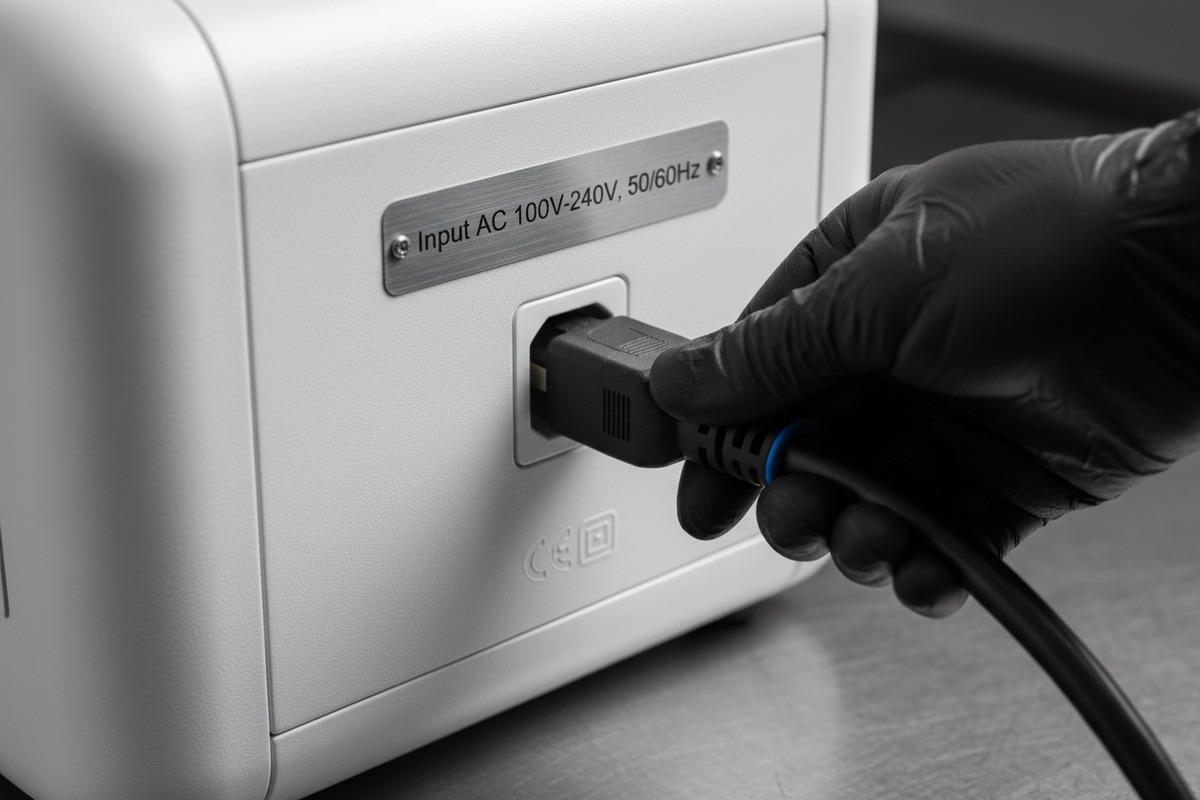
Trusting the sticker on the back of the machine is not enough. In the manufacturing hub of Guangzhou, we sometimes see generic machines labeled "110-240V" that, upon disassembly, reveal a cheap, fixed-voltage transformer. To protect your business, you must audit the internal components.
Ask for the Brand of the PSU
The Power Supply Unit (PSU) is a distinct component. High-quality manufacturers use recognized brands like Mean Well, Delta, or Mornsun. These brands carry their own UL/CE certifications. Ask your supplier: "What brand of switching power supply do you use inside? Can you send me the datasheet for that specific module?" If they are evasive or say "our own factory brand," be cautious.
Request "Hi-Pot" and "Burn-In" Test Data
A stable power module must pass safety tests.
- Hi-Pot Test (High Potential): This checks if the insulation can handle high voltage without arcing.
- Burn-In Test: This involves running the machine at full load for 24-48 hours. Ask for a video or report of your specific order undergoing the burn-in test 6. This filters out "infant mortality" failures where weak components fail early.
Visual Inspection of the PCB
Request a photo of the internal structure without the casing. You don't need to be an engineer to spot quality.
- Look for: Clean soldering, capacitors that stand straight and are glued down (to prevent vibration damage during shipping), and a PSU that is enclosed in a metal or plastic cage, not just exposed wires.
- Red Flags: Loose wires, "jumper" modifications (wires soldered manually across the board), or rusted components.
Verification Checklist for Buyers
| Verification Step | What to Ask For | What Success Looks Like |
|---|---|---|
| Component Source | "Send me the PSU datasheet." | Datasheet from Mean Well/Delta with UL number. |
| Safety Testing | "Show me the Hi-Pot test 7 log." | A report showing "Pass" at 3000V+ isolation. |
| Durability | "Do you do 100% burn-in testing?" | Video evidence of machines running for 24h+. |
| Certification | "Is the PSU separately certified?" | A UL or TUV certificate specific to the power module. |
Will sourcing wide voltage machines protect my business from costly returns and electrical issues?
We recently worked with a US distributor who switched from a cheaper supplier to our wide-voltage models after losing a major salon account due to a fire scare caused by an overheating transformer. The initial savings on the machine cost were wiped out instantly by legal fees and the loss of trust, proving that technical stability is directly linked to financial security.
Sourcing wide voltage machines protects your business by minimizing the risk of fire hazards, reducing liability claims, and ensuring consistent treatment performance, which lowers return rates. It safeguards your profit margins by preventing expensive reverse logistics and protecting your brand reputation from negative reviews associated with equipment failure.

The cost of a return is never just the shipping fee. Reverse Logistics 8 It involves the administrative time, the inspection cost, the inability to resell the unit as new, and most importantly, the damage to your relationship with the B2B client.
Liability and Safety
Pressotherapy machines involve direct contact with the human body via the compression suit. If a voltage mismatch causes an internal short circuit, there is a risk of electric shock or, in extreme cases, fire. In the US market, if a salon burns down or a client is injured because your machine wasn't compatible with the local grid, the liability falls on the importer (you). Wide voltage PSUs have built-in over-voltage protection 9 (OVP) that shuts the unit down safely rather than catching fire.
Performance Consistency = Customer Retention
A subtle but damaging issue is under-performance. If a 220V machine is somehow adapted to run on 110V without a proper wide-voltage supply, the pump might run at half power. The salon owner won't report it as "broken"; they will report it as "weak" and "ineffective." They will return it and leave a review saying your brand's compression is poor. Wide voltage guarantees that the pressure (mmHg) remains consistent whether plugged in Tokyo or London.
The Hidden Cost of Reverse Logistics
Shipping a bulky pressotherapy machine (often 10kg+) back to China for repair is not financially viable. You will likely have to absorb the cost of the unit. Investing an extra $15-$20 per unit for a high-quality, wide-voltage power supply eliminates the vast majority of power-related returns.
Return on Investment (ROI) for Wide Voltage
| Cost Factor | Cheap Fixed Voltage Unit | Wide Voltage Premium Unit |
|---|---|---|
| Unit Cost | Lower ($) | Slightly Higher ($$) |
| Return Rate | High (5-10%) | Low (<1%) |
| Liability Risk | High (Fire/Shock) | Low (Protected) |
| Customer Satisfaction | Variable (Grid dependent) | Consistent (High) |
| Total Cost of Ownership | High (due to returns) | Low (reliable) |
Conclusion
Verifying wide voltage support is not just a technical checkbox; it is a strategic decision that safeguards your supply chain and brand reputation. By insisting on 110V-240V auto-switching compatibility, you eliminate the risks of catastrophic failure, simplify your global inventory, and ensure your customers receive a safe, high-performance product. Do not let a $10 component compromise your business—always verify the power supply before you ship.
Footnotes
1. Provides a comprehensive definition of Bill of Materials and its importance in manufacturing. ↩︎
2. Provides a comprehensive overview of pressotherapy, its benefits, and how it works. ↩︎
3. Replaced HTTP unknown link with a Wikipedia article providing a comprehensive explanation of Switching Mode Power Supplies. ↩︎
4. Explains what Stock Keeping Units are, their purpose, and how they are used in inventory management. ↩︎
5. Explains the causes and effects of voltage fluctuations, including dips and surges, on electrical systems. ↩︎
6. Explains burn-in testing as a practice to detect early failures in electronic devices under stress. ↩︎
7. Defines Hi-Pot testing as a dielectric withstand test to verify electrical insulation. ↩︎
8. Defines reverse logistics as the supply chain process of returning products from end users. ↩︎
9. Explains Overvoltage Protection (OVP) as a safety feature that protects power supplies and connected loads. ↩︎

 English
 Español de México
 Deutsch
 Français
 العربية
 Русский
