
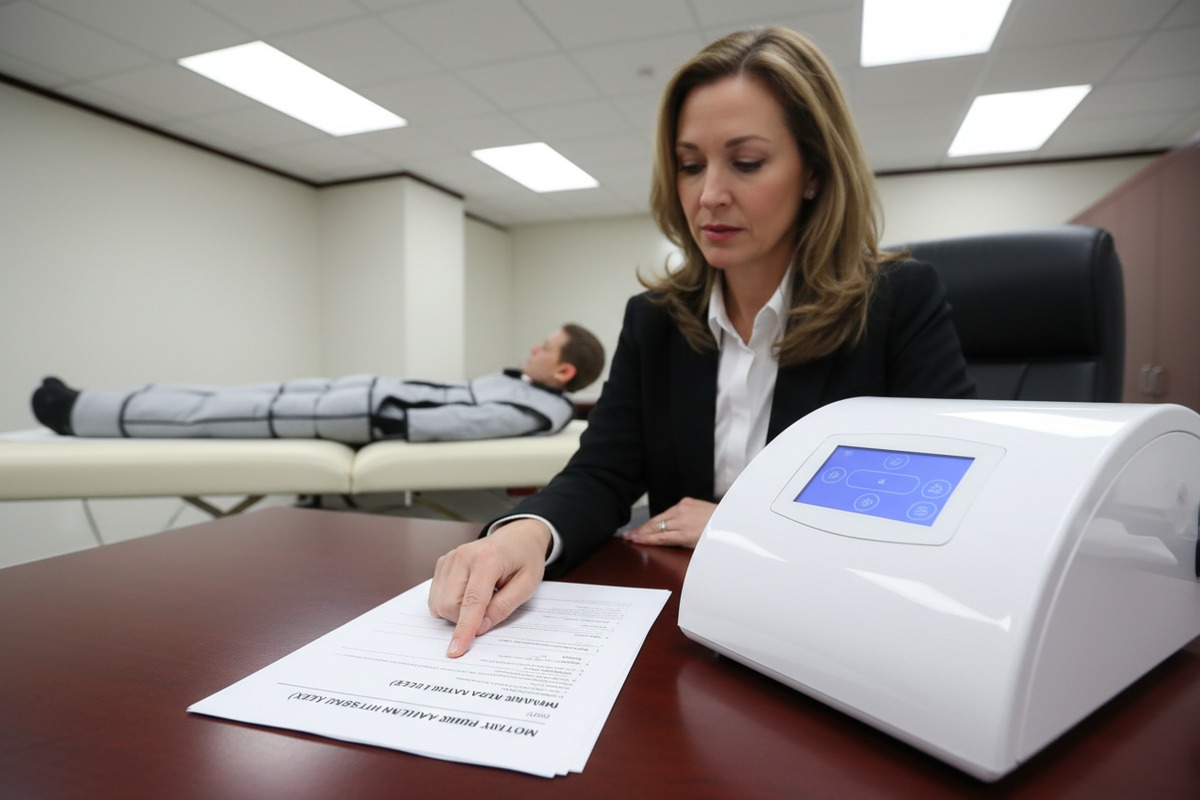
When our production team first started developing pressotherapy suits, we quickly learned that material selection could make or break a brand’s reputation FDA guidance on latex labeling 2. One allergic reaction from a latex-containing sleeve can destroy customer trust overnight. This risk keeps many beauty equipment buyers awake at night.
To confirm pressotherapy machines are latex-free, request Material Safety Data Sheets (MSDS) from your supplier, verify CE/FDA certifications, check for the statement “Not made with natural rubber latex,” and ask about dedicated manufacturing facilities that don’t process latex materials to prevent cross-contamination.
This guide walks you through every step of verifying latex-free compliance EU REACH compliance 3. We cover pre-purchase checks, supplier communication templates, OEM customization options, and quality control validation methods.
How can I verify that the pressotherapy sleeves are 100% latex-free before I place a bulk order?
Many buyers assume a quick product description check is enough. Our export team has seen this shortcut backfire repeatedly. Without proper verification, you're gambling with your clients' safety and your brand's future.
To verify latex-free sleeves before ordering, request Material Safety Data Sheets (MSDS), ask for specific material compositions like polyester/spandex blends or PU material, demand sample swatches for independent testing, and confirm the FDA-recommended statement "Not made with natural rubber latex" appears on all documentation.

Why Simple "Latex-Free" Claims Are Not Enough
The FDA recommends manufacturers avoid using terms like "latex-free" or "does not contain latex." These statements can create a false sense of security. According to FDA guidance, "free," "does not contain natural rubber latex 4," or "does not contain latex" are not accurate because it is not possible to reliably assure that there is an absence of the allergens associated with hypersensitivity reactions to natural rubber latex in the medical product. Use of these terms may give users allergic to natural rubber latex a false sense of security when using a medical product.
Instead, look for the precise language: "Not made with natural rubber latex" or "The
Materials to Look For in Pressotherapy Garments
When reviewing supplier specifications, look for these confirmed latex-free materials:
| Material Type | Common Use in Pressotherapy | Latex Risk Level |
|---|---|---|
| Polyester/Spandex (92%/8%) | Outer sleeve fabric | None |
| PU (Polyurethane) | Wearable accessories | None |
| Nylon fabric | Suit lining, airbag covers | None |
| Medical-grade silicone | Internal bladders | None |
| PVC | Tubing and connectors | None |
High-quality and multifunctional machines feature easy-clean wearable accessories made of PU material with a durable double-layer design and a user-friendly connector. This PU material eliminates latex concerns entirely.
Some professional pressotherapy systems use garments made from high-quality nylon fabric, which is comfortable, breathable, easy to clean, and durable for long-term use.
Red Flags in Product Listings
Watch for these warning signs:
- No material specifications listed
- Vague terms like "hypoallergenic" without material details
- Refusal to provide MSDS documentation
- Generic "latex-free" claims without supporting certificates
- Suppliers who cannot specify bladder and tubing materials
Pre-Order Verification Checklist
Before placing any bulk order, complete these steps:
- Request full material composition documents
- Ask for MSDS for all skin-contact components
- Verify the supplier uses the FDA-recommended labeling language
- Request physical samples for independent lab testing
- Confirm tubing and hose materials separately from garments
- Check if accessories and cleaning agents are also latex-free
What specific material certifications should I request from my supplier to ensure medical-grade safety for my brand?
In our years of shipping pressotherapy equipment to North America and Europe, we've seen buyers overwhelmed by certification acronyms. Not all certifications carry equal weight. Some address general safety. Others specifically cover material composition.
Request CE marking for European compliance, FDA approval for US markets, ISO 13485 for quality management systems, EU REACH compliance for chemical safety, and specific ASTM test results for latex protein testing. These certifications together provide comprehensive assurance of medical-grade safety and latex-free status.

Understanding Key Certifications
CE Marking 5: In Europe, pressotherapy machines must have a CE marking. This certification indicates that the product complies with the European Union's safety, health, and environmental protection requirements. The CE mark is a strong indication that the pressotherapy machine has been thoroughly tested for safety.
FDA Approval: In the United States, the Food and Drug Administration (FDA) is responsible for regulating medical devices, including pressotherapy machines. An FDA-approved device has been evaluated and deemed safe and effective for its intended use.
ISO Certification: Internationally, manufacturers may also seek ISO certification, specifically ISO 13485 6, which outlines the requirements for a quality management system specific to the medical device industry. This certification ensures that the manufacturing process adheres to the highest standards.
Certification Comparison Table
| Certification | Region | What It Covers | Latex-Specific? |
|---|---|---|---|
| CE Mark | Europe | Safety, health, environmental protection | Indirect |
| FDA 510(k) | United States | Safety and effectiveness | Requires latex disclosure per 21 CFR 801.437 |
| ISO 13485 | International | Quality management systems | Indirect |
| EU REACH | Europe | Chemical substances safety | Yes – covers natural rubber proteins |
| ASTM D6499 7 | International | Antigenic protein measurement in natural rubber | Yes |
| ASTM D7427 | International | Four principal allergenic proteins in natural rubber | Yes |
FDA Latex Labeling Requirements
Data in the Medical Device Reporting System and the scientific literature indicate that some individuals are at risk of severe anaphylactic reactions to natural latex proteins. This labeling regulation is intended to minimize the risk to individuals sensitive to natural latex proteins and protect the public health.
Devices containing natural rubber latex that contacts humans shall bear the following statement in bold print on the device labeling: "Caution: This Product Contains Natural Rubber Latex Which May Cause Allergic Reactions."
If this warning is absent from your supplier's documentation, it's a positive sign—but always verify through direct inquiry.
What Documents to Request
When contacting your supplier, ask for these specific documents:
- CE Certificate – Check validity date and notified body number
- FDA Registration Documentation – Confirm 510(k) clearance if applicable
- ISO 13485 Certificate – Verify current certification status
- Material Composition Report – Lists all materials in skin-contact components
- REACH Compliance Declaration – Confirms EU chemical safety standards
- Third-Party Lab Test Results – For latex protein testing
FDA has previously advised manufacturers to list certain materials in the device on the labeling based on case-by-case public health needs. For example, FDA developed a labeling regulation that requires disclosure on medical device labeling if the product contains natural rubber latex.
Can I customize the fabric and internal bladders of my machines to be completely latex-free through an OEM partnership?
Our OEM clients often ask this exact question. The good news is that complete customization is absolutely possible. We've helped numerous brands develop fully latex-free pressotherapy systems from scratch.
Yes, OEM partnerships allow full customization of fabrics, bladders, tubing, and all components to be latex-free. Reputable manufacturers can source medical-grade silicone, polyurethane, nylon, and polyester materials. Specify latex-free requirements in your OEM agreement and request dedicated production lines.

Components You Can Customize
Through OEM partnership 8s, every skin-contact component can be specified as latex-free:
| Component | Standard Material | Latex-Free Alternative | Customization Feasibility |
|---|---|---|---|
| Compression suit outer layer | Various | 92% Polyester/8% Spandex | Easy |
| Internal air bladders | TPU or various | Medical-grade silicone or TPU | Easy |
| Connection tubing | Various | PVC or silicone | Easy |
| Sleeve fasteners | Various | Velcro or nylon clips | Easy |
| Air chamber covers | Various | Nylon fabric | Easy |
| EMS pads | Various | Silicone with conductive gel | Moderate |
Many manufacturers have strong capabilities in research and development and are able to provide OEM and ODM services for clients. Most products pass CE and PSE certifications.
How to Structure Your OEM Agreement
When negotiating an OEM contract for latex-free pressotherapy equipment, include these clauses:
- Material Specification Clause – List all acceptable materials and explicitly prohibit natural rubber latex in any form
- Testing Requirement Clause – Require third-party lab testing for latex proteins before production
- Dedicated Production Line Clause – Request manufacturing on lines that don't handle latex products
- Documentation Clause – Mandate MSDS provision for all components
- Audit Rights Clause – Reserve the right to inspect manufacturing facilities
- Penalty Clause – Define consequences for non-compliance
Customization Options Beyond Materials
Many manufacturers understand the importance of brand identity, which is why they offer personalized customization services. Your logo can be elegantly integrated into the device's startup screen and etched onto the machine's body.
Beyond latex-free materials, you can customize:
- Brand logo on startup screen and machine body
- Color schemes for suits and accessories
- Language options in the control interface
- Packaging design and materials
- User manual content and branding
- Voltage specifications for different markets
Minimum Order Requirements
OEM customization typically requires minimum order quantities. Here's what to expect:
- Logo customization only: Often available with lower MOQ (10-50 units)
- Material specification changes: Usually requires 50-100 units minimum
- Complete custom design: May require 100+ units
Always request sample production before committing to bulk orders. This allows you to verify material compliance through independent testing.
How do I ensure my supplier's quality control process specifically validates latex-free compliance during production?
Quality control is where many supplier relationships fail. Our QC team inspects every pressotherapy unit before shipping. We've learned that verbal assurances mean nothing without documented processes.
Ensure latex-free compliance by requesting your supplier's incoming material inspection protocols, production-line segregation procedures, batch testing documentation, traceability systems, and final inspection checklists. Ask for evidence of dedicated latex-free production areas and employee training on allergen management.

Key Quality Control Checkpoints
A robust QC system for latex-free compliance includes multiple verification stages:
| QC Stage | What to Verify | Documentation Required |
|---|---|---|
| Incoming Materials | Raw material certificates, MSDS, supplier declarations | Incoming inspection reports |
| Storage | Segregation from any latex-containing materials | Warehouse layout maps, storage protocols |
| Production | Use of dedicated tools and equipment | Production batch records |
| Assembly | Worker training on allergen awareness | Training certificates, SOPs |
| Final Inspection | Random sampling for third-party testing | Test reports, inspection certificates |
| Packaging | Latex-free packaging materials | Packaging material MSDS |
Questions to Ask Your Supplier
In the U.S., the Occupational Safety and Health Administration requires that SDSs be readily available to all employees for potentially harmful substances handled in the workplace under the Hazard Communication Standard.
Request detailed answers to these questions:
-
Do you manufacture any latex-containing products?
- If yes, how do you prevent cross-contamination?
- Are latex and non-latex products made in separate facilities?
-
What are your incoming material inspection procedures?
- Do you verify MSDS for every raw material batch?
- How do you trace materials back to their source?
-
How do you train production staff on allergen management?
- Is there specific training on latex awareness?
- How often is training updated?
-
What testing do you perform during production?
- Do you conduct random batch testing for latex proteins?
- Which ASTM standards do you follow?
-
Can you provide production batch records?
- Do records show material traceability?
- Are quality checks documented at each stage?
Understanding MSDS Documentation
The MSDS provides comprehensive information about a chemical substance or mixture, including potential health, safety, and environmental hazards, and guidance on safe handling, use, and storage.
A Safety Data Sheet (SDS) 9, or Material Safety Data Sheet (MSDS), is a standardized document that contains crucial occupational safety and health information. It is mandated by the International Hazard Communication Standard (HCS). According to this standard, chemical manufacturers must communicate the hazard information of their chemicals to those who handle them.
When reviewing MSDS documents for pressotherapy components, check these sections:
- Section 2: Hazard identification (should show no latex-related hazards)
- Section 3: Composition/information on ingredients (should list no natural rubber)
- Section 8: Exposure controls (should not mention latex protein exposure)
- Section 11: Toxicological information (should not reference latex allergies)
Cross-Contamination Prevention
Allergic reactions can also result from contact with non-latex-containing products that have become "contaminated" through direct contact by persons wearing latex gloves or who have handled other latex-containing items.
Ask your supplier about these cross-contamination prevention measures:
- Dedicated production equipment for latex-free products
- Separate storage areas for latex and non-latex materials
- Worker protocols prohibiting latex gloves in production areas
- Cleaning procedures between production runs
- Environmental monitoring for airborne latex proteins
Factory Audit Checklist
If possible, conduct or commission a factory audit. Check for:
- Physical separation of latex and non-latex production
- Clear labeling on all raw material storage
- Documented cleaning procedures
- Worker training records
- Incoming material inspection logs
- Production batch traceability systems
- Third-party test certificates on file
To ensure exceptional quality, reputable manufacturers put all machines through a stringent quality control process and provide warranties of 36 months or longer.
Conclusion
Verifying latex-free compliance requires multiple layers of due diligence. Request MSDS documentation, demand proper certifications, specify materials in OEM agreements, and audit supplier QC processes. Your clients' safety depends on this thorough approach.
## Footnotes

<span id="footnote-1">
1. Defines MSDS, its purpose, and the information it contains for chemical safety. <a href="#ref-1" class="footnote-backref">↩︎</a>
</span>

<span id="footnote-2">
2. Provides official FDA guidance on labeling medical products to indicate they are not made with natural rubber latex. <a href="#ref-2" class="footnote-backref">↩︎</a>
</span>

<span id="footnote-3">
3. Provides official information on the EU REACH regulation for chemical substances and safety. <a href="#ref-3" class="footnote-backref">↩︎</a>
</span>

<span id="footnote-4">
4. Explains what natural rubber latex is, its origin, and properties. <a href="#ref-4" class="footnote-backref">↩︎</a>
</span>

<span id="footnote-5">
5. Explains the purpose of CE marking and its requirements for products sold in the EU. <a href="#ref-5" class="footnote-backref">↩︎</a>
</span>

<span id="footnote-6">
6. Describes the international standard for quality management systems specific to medical devices. <a href="#ref-6" class="footnote-backref">↩︎</a>
</span>

<span id="footnote-7">
7. Details the ASTM standard test method for immunological measurement of antigenic protein in natural rubber. <a href="#ref-7" class="footnote-backref">↩︎</a>
</span>

<span id="footnote-8">
8. Explains what an OEM partnership is and its role in integrating third-party technologies. <a href="#ref-8" class="footnote-backref">↩︎</a>
</span>

<span id="footnote-9">
9. Defines Safety Data Sheet (SDS) and its importance for occupational safety and health. <a href="#ref-9" class="footnote-backref">↩︎</a>
</span>

 English
 Español de México
 Deutsch
 Français
 العربية
 Русский
