
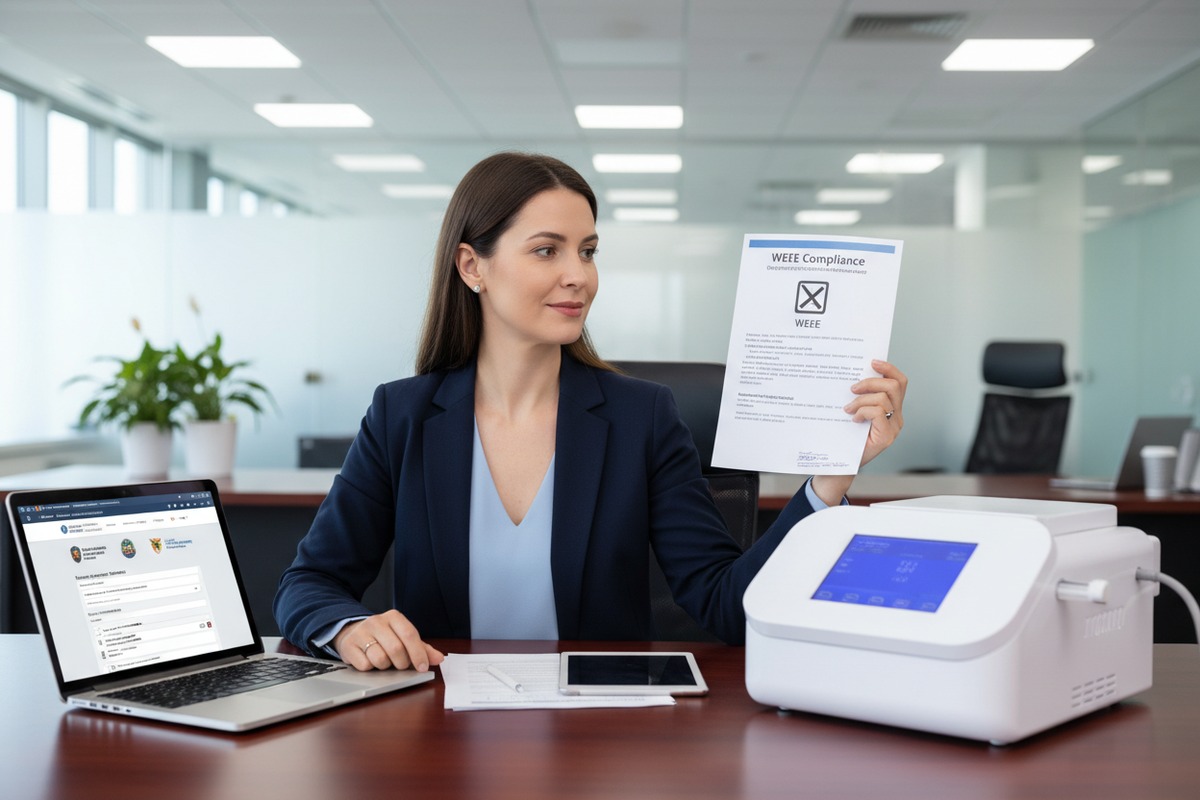
When our production team develops pressotherapy machines for export, one question keeps coming from European and UK buyers: How do we prove WEEE compliance 1? Without proper documentation, your shipment could be blocked, fined, or banned from sale entirely.
To verify a supplier’s WEEE compliance, request their WEEE registration number and check it against the national register in each target market. Confirm they display the crossed-out wheeled bin symbol, provide recycling documentation, and participate in a producer compliance scheme. This protects your business from fines up to €200,000 and sales bans.
This guide breaks down each verification step so you can source pressotherapy equipment with confidence EN 50419 standards 2. Let’s start with the most critical element: authenticating your supplier’s registration.
How do I verify that my supplier's WEEE registration number is authentic and active?
When we ship pressotherapy machines to distributors in Germany or France, they always ask for proof of registration producer compliance scheme 3. A WEEE number can be forged or expired. The risk falls on you as the importer if you don't verify it properly.
To authenticate a WEEE registration number, visit the national register website for your target market (e.g., Stiftung EAR for Germany, Environment Agency for the UK). Enter the supplier's registration number to confirm it is active, matches the correct company name, and covers the relevant product category. Repeat this for every EU country where you sell.
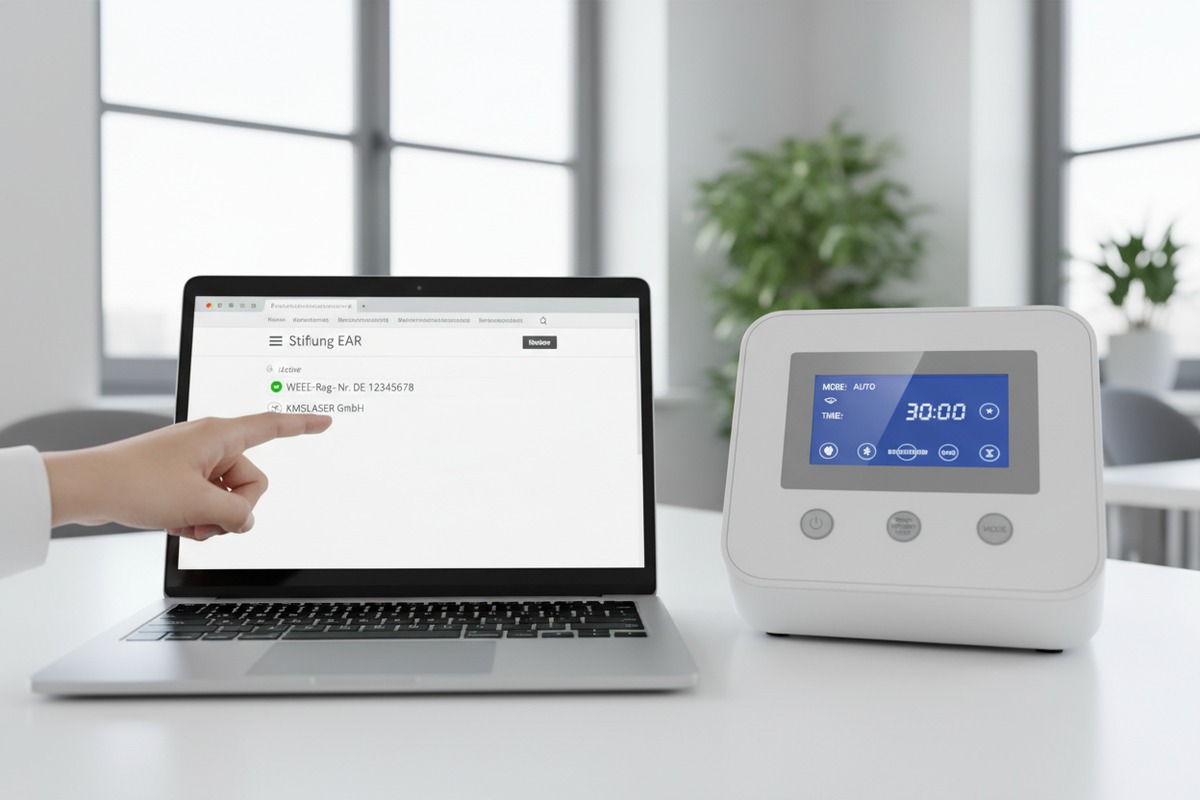
Why National Verification Matters
If you manufacture, distribute or sell electrical and electronic equipment such as computers, fridges, mobile phones, EU and national laws require that you contribute to ensuring it is disposed of and treated properly. This means registering with the responsible national authorities in each country where you distribute or sell equipment.
While the WEEE Directive 4 provides a unified framework for managing electronic waste across the European Union, each member state implements the directive in its own way, resulting in significant variations in WEEE compliance requirements from country to country.
This means a German registration does not cover France. Each market requires its own check.
Step-by-Step Verification Process
| Step | Action | Resource |
|---|---|---|
| 1 | Request WEEE registration number 5 from supplier | Email or contract clause |
| 2 | Identify the national register 6 for your target market | EWRN website |
| 3 | Access the public register portal | Varies by country |
| 4 | Enter the registration number | Search function |
| 5 | Confirm company name, status, and product category | Registry results |
Key National Registers to Know
A WEEE number is a unique identifier assigned to manufacturers and importers of electrical and electronic equipment (EEE) upon successful registration with the relevant national authority—in Germany, this is the Stiftung EAR 7 (Elektro-Altgeräte Register).
Even after Brexit, the UK has a WEEE-like regulation. Companies must register with the "Environment Agency," with some adapted standards.
| Country | National Register | Notes |
|---|---|---|
| Germany | Stiftung EAR | Largest EU market, strict enforcement |
| France | ADEME Syderep | Requires Triman logo |
| UK | Environment Agency | Separate post-Brexit system |
| Netherlands | Stichting-OPEN | Producer responsibility scheme |
| Italy | Erion WEEE | National Register Category 8 |
What If Your Supplier Is Outside the EU?
In some countries, like Germany, foreign companies are required to appoint a local authorized representative who handles compliance on their behalf.
At our facility in Guangzhou, we work with authorized representatives in each EU market. Non-EU suppliers must appoint an EU-based authorized representative to handle registration and compliance obligations.
Red Flags When Verifying Registration
Watch for these warning signs:
- Registration number does not appear in the official database
- Company name does not match exactly
- Registration shows as "inactive" or "expired"
- Product category does not include medical or small equipment
- No authorized representative listed for non-EU suppliers
"We make sure that all business partners possess a valid WEEE registration number and fulfil their duties in order to avoid potential fines or even a ban on sales."
What specific labels must I check for on my pressotherapy equipment to ensure WEEE compliance?
Our quality control team inspects every pressotherapy unit before shipment. We know that missing or incorrect labels can stop your products at customs. Labels are not just stickers—they are legal requirements.
Every pressotherapy machine must display the crossed-out wheeled bin symbol meeting EN 50419 standards, a producer identification mark (brand name or trademark), and a date mark for products placed on market after August 2005. The symbol must be at least 7mm in height, visible, legible, and indelible on the product or packaging.

The Three Required Label Elements
WEEE labeling is mandatory for almost all electrical and electronic equipment sold in the EU, and non-compliance can lead to fines over €100,000 and sales bans. The label must include three key elements: the crossed-out wheeled bin symbol 8, a producer identification mark (brand name), and a date mark for products post-August 2005.
| Element | Requirement | Purpose |
|---|---|---|
| Crossed-out wheeled bin | Minimum 7mm height, EN 50419 standard | Indicates separate collection required |
| Producer identification | Brand name or trademark | Traceability to responsible party |
| Date mark | Black bar or date of manufacture | Distinguishes post-2005 products |
Understanding the Black Bar
The symbol adopted by the European Council to represent waste electrical and electronic equipment comprises a crossed-out wheelie bin with or without a single black line underneath the symbol. The black line indicates that goods have been placed on the market after 2005, when the Directive came into force.
The black bar is not optional for modern equipment. For products placed on the market after August 13, 2005, an additional mark is required. You can either add a solid bar beneath the wheeled bin symbol or print the date of market placement.
Symbol Specifications
The symbol shall have a minimum height of 7 mm (a = 3,33 mm). The black bar shall be at least 1 mm (0,3 a).
The marking shall be visible, legible, and indelible on the product. If the marking cannot be on the product due to size or its function, then the marking shall be placed on the packaging, in the instructions for use and in the warranty of the EEE.
Where Labels Must Appear
For pressotherapy machines, the crossed-out wheeled bin should appear on:
- The main control unit body
- The product rating plate
- External packaging
- User manual
The symbol indicates that the product should not be discarded as unsorted waste but must be sent to separate collection facilities for recovery and recycling. The WEEE marking must appear on any electrical and electronic equipment placed on the EU market.
Additional Country-Specific Labels
France mandates products to bear the Triman logo, and WEEE distributors must maintain a national ID number.
| Country | Additional Label | Notes |
|---|---|---|
| France | Triman logo | Required for recyclable products |
| UK | UKCA or CE marking | Post-Brexit requirements |
| Germany | Producer ID | Must match EAR registration |
Common Labeling Mistakes
When we audit supplier samples, these errors appear frequently:
- Symbol too small (under 7mm)
- Missing black bar on post-2005 products
- Symbol printed on removable sticker instead of permanent label
- No brand name near the symbol
- Symbol only on packaging, not on product
The symbol indicates that end users should segregate the product from other waste at end-of-life. This symbol on Cisco product or its packaging means that the product should not be disposed of with your other household waste.
How can I confirm my manufacturer's internal processes align with WEEE recycling requirements?
Beyond paperwork, real compliance happens on the factory floor. Our engineering team designs pressotherapy machines with recycling in mind—but how do you verify that a supplier actually follows through?
Confirm internal process alignment by requesting Bills of Material (BoM) documenting recyclable components, auditing treatment instructions provided with products, reviewing annual compliance scheme reports, and checking for third-party certifications like ISO 14001. Ask for evidence of established take-back systems and recycler partnerships.
Documentation You Should Request
| Document | What It Shows | Why It Matters |
|---|---|---|
| Bill of Materials | Recyclable components breakdown | Proves design-for-recycling |
| Treatment Instructions | End-of-life handling guidance | Required by Article 15 |
| Compliance Scheme Certificate | Membership in take-back system | Proves financial responsibility |
| Annual Reports | Quantities reported to register | Shows ongoing compliance |
| Recycler Contracts | Partnership with approved facilities | Verifies real recycling happens |
Financial Responsibility Requirements
According to Article 12 of the WEEE Directive, importers and manufacturers are financially responsible for the collection, treatment, and recovery of their waste electrical and electronic equipment (WEEE).
You must contribute to the proper disposal of equipment that you manufacture, distribute or sell once the consumer discards it. You either choose to join an existing WEEE collective compliance scheme, or to set up your own scheme.
Understanding Compliance Schemes
Collective compliance schemes exist in most EU countries, set up by either the private sector or government. The schemes allow manufacturers, distributors and sellers to meet their waste‑management obligations jointly. They function on a paid membership basis.
At our company, we help buyers connect with compliance scheme providers in their target markets. The choice between individual and collective schemes depends on your volume and budget.
| Scheme Type | Advantages | Disadvantages |
|---|---|---|
| Collective Scheme | Lower admin burden, established infrastructure | Less control, membership fees |
| Individual Scheme | Custom solutions, full control | High setup costs, complex to manage |
Reporting and Record-Keeping
You should create and maintain records of all EEE products sold and submit them annually or face penalties such as fines. The records should contain: Units sold and weight in kg or tons of EEE products (per year), types of products per category, the volume of WEEE collected, and waste recovery and/or recycling data.
Once you start selling WEEE-labelled products on the EU market, you must submit to the national authorities a regular report detailing the types of equipment you manufactured, distributed or sold, and in what amounts.
Third-Party Verification
When conducting supplier audits, look for:
- ISO 14001 environmental management certification 9
- Membership certificates from recognized compliance schemes
- Audit reports from accredited third-party verifiers
- Documented relationships with approved treatment facilities
Take-back operators and recycling vendors shall be audited on a regular basis.
Questions to Ask Your Supplier
- Which compliance scheme(s) are you registered with?
- Can you provide your most recent annual compliance report?
- How do you track the quantities of EEE placed on market?
- Who handles end-of-life treatment for your products?
- Do you have ISO 14001 or equivalent environmental certification?
What are the potential liabilities for my business if my imported beauty machines lack proper WEEE documentation?
When buyers skip WEEE verification, they gamble with their entire business. We have seen clients face customs seizures, market bans, and legal action—all preventable with proper due diligence.
Importing pressotherapy machines without proper WEEE documentation exposes your business to fines up to €200,000 in Germany and similar penalties across EU states, immediate sales bans, product recalls, customs rejections, and potential criminal prosecution. Additionally, your products may be blocked from online marketplaces that verify WEEE compliance.

Financial Penalties by Market
Non-compliant products face severe penalties, including fines that can be as high as €200,000 in Germany, product recalls, and complete sales bans across the EU.
National authorities can impose fines that reach tens of thousands of euros for each violation. WEEE remains the fastest-growing waste stream in the EU, increasing by 2% each year, which drives stricter enforcement.
| Country/Region | Potential Penalty | Additional Consequences |
|---|---|---|
| Germany | Up to €200,000 | Sales ban, product recall |
| EU General | €100,000+ per violation | Market access suspension |
| UK | Unlimited fine | Criminal prosecution possible |
| California (US) | $50,000 per day | Market restrictions |
Types of Liability Exposure
Penalties may include administrative fines, bans on placing products on the market, or suspension of authorizations for non-compliant producers.
Failing to comply with WEEE regulations can result in severe penalties, which vary depending on the country within the EU. These can include substantial fines, legal sanctions and, in some cases, criminal charges.
Enforcement Is Increasing
Manufacturers, importers, distributors, and sellers of electronic and electrical products in the EU are all affected by the directive. Non-European companies, such as those based in the United States, are also still bound to comply with its requirements and will face stiff penalties such as fines and the products being banned from sale if they don't, regardless of the company's origin.
EEE brands or companies dealing with such equipment should familiarise themselves with these latest rules to ensure compliance, at the risk of prosecution and an unlimited fine from a magistrates' court or Crown Court.
UK-Specific Changes
From 1 January 2025, significant changes to the UK's Waste Electrical and Electronic Equipment (WEEE) regulations will shift compliance responsibilities for products placed on the British market. Non-UK producers of electrical and electronic equipment (EEE), such as toner and inkjet cartridges, sold via UK-based importers will no longer need to register as WEEE producers. Instead, these obligations will fall squarely on the UK importers themselves.
This means if you import pressotherapy machines into the UK, you bear full compliance responsibility—not your Chinese supplier.
Impact on Market Access
Producers are responsible for registering in each country of sale and financing the collection and recycling of their products. Failure to comply with WEEE labeling can result in immediate sales prohibitions.
Failure to register in even one country can lead to a sales ban there.
Future Requirements to Watch
The Digital Product Passport 10 (DPP) will become mandatory for many products by 2026, requiring unprecedented supply chain transparency.
The EU's emerging Digital Product Passport requirements will create unprecedented visibility into product composition, repairability, and end-of-life handling.
Preparing for these changes now protects your business from future compliance gaps.
Risk Mitigation Checklist
| Action | Timeline | Priority |
|---|---|---|
| Verify supplier WEEE registration | Before ordering | Critical |
| Confirm proper labeling on samples | Pre-production | Critical |
| Join compliance scheme in target markets | Before first sale | Critical |
| Establish annual reporting process | Ongoing | High |
| Plan for Digital Product Passport | By 2026 | Medium |
Conclusion
Verifying WEEE compliance protects your business from costly penalties and market exclusion. Always confirm registration through national portals, inspect labels for proper symbols, audit internal processes, and understand your liability as an importer. Your due diligence today prevents expensive problems tomorrow.
Footnotes
1. Explains WEEE compliance obligations for manufacturers and distributors in the EU. ↩︎
2. Explains EN 50419 standards for marking electrical equipment for WEEE separate collection. ↩︎
3. Defines producer compliance schemes and their role in fulfilling WEEE obligations. ↩︎
4. Provides the official consolidated text of the WEEE Directive 2012/19/EU. ↩︎
5. Replaced with an authoritative EU ‘Your Europe’ page detailing WEEE responsibilities, including registration. ↩︎
6. Provides a network and list of national WEEE registers across Europe. ↩︎
7. Replaced with the current English homepage of Stiftung EAR. ↩︎
8. Replaced with an authoritative EU ‘Your Europe’ page that explains the WEEE label and its meaning. ↩︎
9. Explains ISO 14001, the international standard for environmental management systems. ↩︎
10. Replaced with an authoritative data.europa.eu article explaining the EU’s Digital Product Passport. ↩︎

 English
 Español de México
 Deutsch
 Français
 العربية
 Русский
