
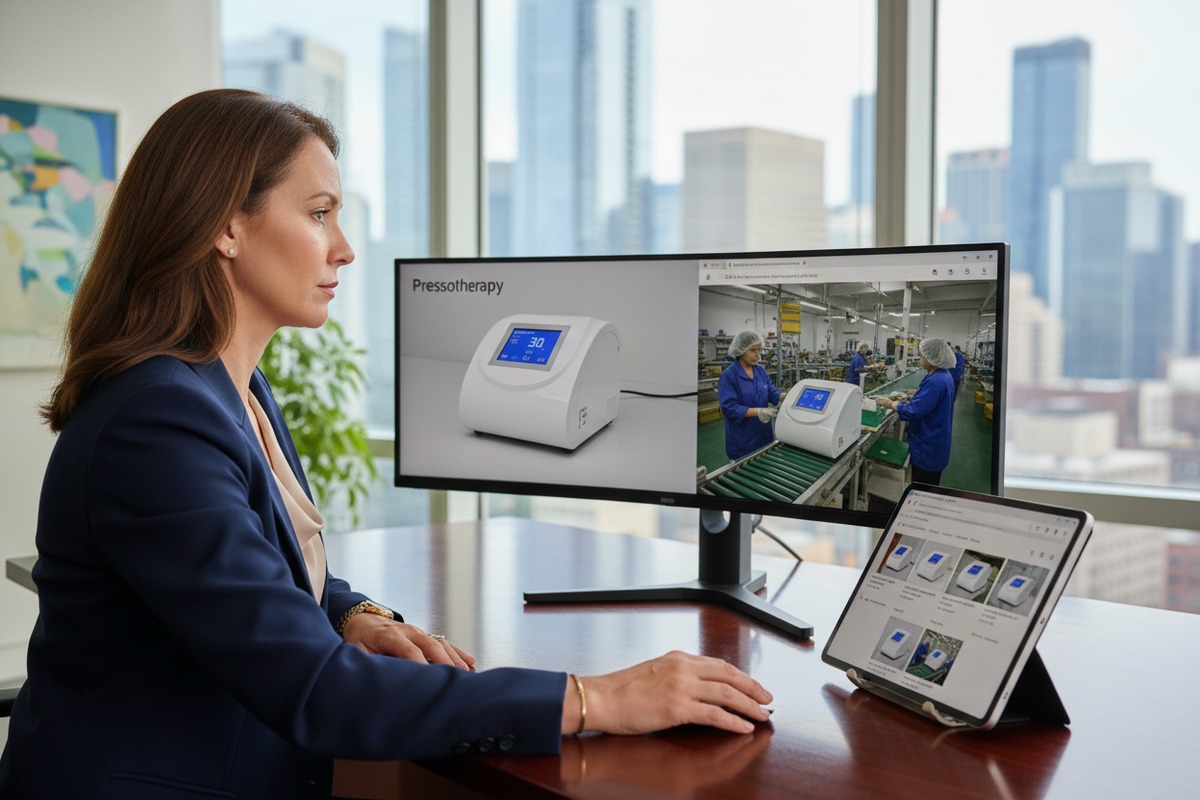
Sourcing pressotherapy machines 1 from overseas can feel risky. You browse supplier listings, see attractive photos and videos, but wonder if what you see is what you get. Our production team has seen buyers receive equipment that looks nothing like the original images.
To evaluate supplier images and videos for pressotherapy machines, verify photo authenticity through reverse image searches and factory-specific details. Analyze product videos for real-time pressure tests, chamber sequencing, and build quality. Request factory footage showing private labeling capabilities and shipping preparation to confirm OEM services and packaging durability.
In this guide, we will walk you through step-by-step methods to spot red flags, validate supplier claims, and make confident purchasing decisions ISO 13485 certificates 2. Let’s dive into the key evaluation techniques.
How can I tell if the pressotherapy machine photos are authentic or just stolen stock images?
When we first started exporting pressotherapy systems to US distributors, we learned that trust starts with visual proof compression test results 3. Buyers often asked us to prove our product photos were real. This makes sense—fake images cost importers thousands of dollars in bad orders.
Authentic product photos show factory-specific details like serial numbers, branded control panels, and unique backgrounds. Stock images lack these elements. Use reverse image search tools to check if photos appear on multiple unrelated websites. Genuine suppliers provide multiple angles, close-up shots of components, and images with their branding visible.

Why Fake Images Are Common in B2B Marketplaces
Many suppliers on B2B platforms grab images from competitors or stock photo sites. They do this to appear professional without investing in real product photography. This practice misleads buyers about actual product quality and features.
Step-by-Step Image Verification Process
Here is a simple process to verify supplier images:
-
Run a reverse image search. Use Google Images or TinEye. Upload the supplier's photos. reverse image search tools 4 Check if the same images appear on other websites with different company names.
-
Look for factory-specific markers. Real product photos often show:
- Serial numbers on machines
- Factory floor or production line backgrounds
- Branding on control panels and garments
- Unique lighting consistent across all images
-
Request custom photos. Ask the supplier to take a new photo with today's date on paper next to the machine. Genuine manufacturers do this quickly.
-
Check image metadata. Download the image and view its properties. image metadata 5 Original photos contain camera data, dates, and location info. Stock images usually have this stripped.
Red Flags in Supplier Product Photos
| Red Flag | What It Indicates | Action to Take |
|---|---|---|
| Perfectly white backgrounds with no shadows | Likely edited or stock images | Request real factory photos |
| Different branding visible on machine vs. supplier name | Stolen images from another company | Verify brand ownership |
| Low resolution or watermarked images | Not their own photos | Ask for high-resolution originals |
| Inconsistent styling across product images | Photos from multiple sources | Request a full photo set from one session |
| No close-up shots of components | Hiding quality issues | Demand detailed component images |
Examining Image Quality and Consistency
Professional manufacturers invest in good product photography. When we photograph our pressotherapy systems, we ensure every image shows the same lighting, background, and styling. Inconsistency across images suggests the supplier collected photos from different sources.
Check that the control unit, compression suit, and accessories appear identical across all photos. The LCD screen should display the same interface. The color of the garments should match perfectly.
What specific build quality details should I look for in a supplier's product video?
Our engineering team often reviews competitor videos to benchmark our own products. We have noticed that many supplier videos focus on marketing rather than substance. Buyers need to look deeper to assess actual build quality.
When evaluating supplier product videos, focus on hose connection quality, pump operation sounds, control panel responsiveness, and garment stitching. Watch for real-time pressure demonstrations showing sequential chamber inflation and accurate pressure readings. Listen for pump noise levels and check that all components function smoothly without hesitation.

Critical Build Quality Elements in Video
A good product video reveals what images cannot. Sound, movement, and real-time operation show the machine's true performance. Here are the key elements to examine:
Hose and Connection Quality
Watch how the air hoses connect to both the control unit and the compression garments. Secure connections show:
- Smooth insertion without forcing
- No visible air leaks when pressurized
- Reinforced connection points that resist pulling
Weak connections cause air leaks and reduce treatment effectiveness. In our production line, we test every hose connection for at least 10,000 cycles before shipping.
Pump and Motor Performance
The pump is the heart of any pressotherapy machine. Video footage should reveal:
- Consistent pump sounds without grinding or clicking
- Smooth pressure buildup without stuttering
- Quick response when changing programs
A noisy pump indicates low-quality components that will fail quickly. Professional units operate quietly, typically below 50 decibels.
Technical Specifications to Verify in Videos
| Specification | What to Look For | Industry Standard |
|---|---|---|
| Pressure Range | Visible gauge reading during operation | 20-120 mmHg for medical use |
| Pressure Accuracy | Consistent readings across cycles | ±3 mmHg tolerance |
| Chamber Count | Watch sequential inflation pattern | 20+ chambers for effective drainage |
| Program Modes | UI showing multiple preset options | 5+ presets minimum |
| Cycle Speed | Timing of inflation and deflation | Adjustable between 3-30 seconds |
Control Panel and Interface Assessment
The control panel should respond instantly to touch or button presses. Look for:
- Clear LCD display with readable text
- Smooth menu navigation
- Accurate pressure readings that match visible garment inflation
- Timer displays that count correctly
Garment Construction Details
Zoom in on the compression suit in videos. Quality indicators include:
- Even stitching along seams
- No loose threads or puckering
- Reinforced stress points at zippers and connections
- Material that appears durable and cleanable
Medical-grade pants typically have overlapping compression cells for effective lymphatic drainage 6. Videos should show these chambers inflating in sequence from feet to abdomen.
What Videos Should Demonstrate
Request videos showing these specific functions:
- Complete treatment cycle from start to finish
- All available program modes being selected
- Pressure gauge readings during operation
- Garment inflation sequence across all chambers
- Power-on and boot-up process
How do I verify their private labeling and OEM capabilities through factory footage?
When buyers from the US and Europe ask about OEM services, we always recommend they request factory footage. Our facility tours have helped many distributors feel confident about our customization capabilities. Factory videos reveal whether a supplier can truly deliver private label services.
Verify OEM capabilities by requesting factory footage showing logo printing equipment, label application stations, and packaging customization areas. Look for dedicated production lines for custom orders, sample rooms displaying previous private label projects, and quality control checkpoints where custom branding is verified. Genuine OEM factories show the entire branding process.

What Genuine OEM Factories Show in Videos
Real OEM manufacturers have dedicated infrastructure for customization. When reviewing factory footage, look for these elements:
Branding and Printing Facilities
Authentic private label suppliers have:
- Screen printing or laser engraving equipment for control units
- Label printing machines for garments and accessories
- UV printing stations for packaging customization
- Sample displays of completed private label projects
A factory with real OEM capabilities shows this equipment in operation. They should demonstrate how your logo gets applied to different components.
Production Line Organization
Professional OEM factories organize production by customer orders. Video footage should reveal:
- Separate work stations for different client brands
- Clear labeling systems identifying custom orders
- Dedicated quality control for branded products
- Storage areas for brand-specific components
OEM Capability Verification Checklist
| Capability | Evidence in Video | Questions to Ask |
|---|---|---|
| Logo application | Printing equipment in operation | What printing methods do you use? |
| Custom packaging | Packaging design and assembly area | Can you show samples of custom boxes? |
| Label customization | Label printing and application stations | What label materials are available? |
| Color matching | Pantone color samples visible | How do you ensure color accuracy? |
| Documentation | Custom manual printing capability | Can you include branded user manuals? |
Certification Visibility in Factory Footage
Legitimate manufacturers display their certifications prominently. Factory videos should show:
- CE marking documentation 7 on walls or in offices
- ISO 13485 certificates framed and visible
- FDA registration numbers 8 if selling to the US
- Testing equipment for quality verification
These certifications matter because pressotherapy machines used for medical purposes require regulatory compliance. Devices sold in the EU need CE marking, while US markets often require FDA 510(k) clearance depending on intended use.
Sample Room Assessment
A well-established OEM factory maintains a sample room showing previous private label projects. This room demonstrates:
- Range of customization options completed for other clients
- Different branding styles and quality levels
- Packaging variations from simple to premium
- Case studies of successful partnerships
Request a video tour of the sample room. This provides evidence of real OEM experience beyond marketing claims.
Questions to Ask During Video Calls
Schedule a live video call with the factory. During the call, ask them to show:
- The exact machine that will be used for your production
- Where your logo will be placed on the control unit
- How the garments will be tagged with your brand
- The packaging materials for your order
- Quality control stations checking custom branding
Suppliers who hesitate to show these areas likely lack true OEM capabilities. They may be trading companies reselling other manufacturers' products.
Can I assess the durability of the export packaging from the supplier's shipping videos?
Damaged goods during shipping cost us a significant order early in our export journey. Since then, we have invested heavily in protective packaging. Shipping videos now form a crucial part of how we demonstrate our quality commitment to overseas buyers.
Assess export packaging durability by reviewing shipping videos showing box construction, internal cushioning, and palletization methods. Look for double-wall cartons, foam inserts custom-fitted to machine components, moisture barriers, and proper sealing with H-pattern tape. Request drop test videos and ask about compression test results to verify carton strength.

Why Packaging Quality Matters for Pressotherapy Machines
Pressotherapy equipment includes sensitive electronic components and inflatable garments. Poor packaging leads to:
- Damaged control units with cracked screens
- Punctured air chambers in garments
- Bent or broken hose connectors
- Cosmetic damage reducing resale value
Professional packaging protects your investment and your reputation with customers.
Elements to Check in Shipping Videos
Request videos showing the complete packing process from start to finish:
Carton Construction
| Carton Feature | Standard for Export | Red Flag |
|---|---|---|
| Wall thickness | Double-wall (5-ply) minimum | Single-wall construction |
| Corner protection | Reinforced or foam corners | No corner protection |
| Tape pattern | H-pattern across all openings | Single strip on main opening only |
| Strapping | Nylon bands for heavy units | No strapping or weak tape only |
| Markings | Clear handling instructions | Missing fragile labels |
Single-wall cartons are not suitable for export packing. They collapse under stacking pressure during container shipping.
Internal Protection Assessment
Watch how the supplier secures items inside the carton:
- Foam inserts: Custom-cut foam that cradles each component
- Bubble wrap: At least two layers around sensitive parts
- Desiccants: Moisture-absorbing packets prevent humidity damage
- Dividers: Separate compartments for different components
The control unit should never touch the garments directly. Electronic components need their own protective cavity.
Palletization Standards
If ordering in bulk, evaluate how cartons are arranged on pallets:
- Cartons should align perfectly without overhang
- Stretch wrap should cover at least 200% around the pallet
- Corner boards protect against strap damage
- Maximum stacking height should be respected
Packaging Tests to Request
Ask suppliers to share results from these standard tests:
- Drop test: Box dropped from 76cm onto each face, edge, and corner
- Compression test: Weight applied to simulate container stacking
- Vibration test: Simulates truck and ship transport conditions
- Temperature and humidity test: Verifies packaging survives variable climates
Professional manufacturers conduct these tests and keep records. They should provide test certificates upon request.
Video Checklist for Packaging Evaluation
When reviewing shipping preparation videos, confirm:
- Carton dimensions match product size with minimal excess space
- Internal cushioning fills all gaps
- Machine components are individually wrapped
- Moisture barriers are visible in packaging
- Carton sealing uses proper tape patterns
- Shipping labels are clear and correctly positioned
- Handling instructions are printed on exterior
Packaging Quality Impact on Customs
Poor packaging also causes customs issues. Missing or illegible markings can result in shipment holds, fines, and delays. Ensure shipping videos show:
- Clear product descriptions
- Country of origin marking 9
- Proper barcodes that scan correctly
- Required regulatory symbols
Conclusion
Evaluating supplier images and videos requires a systematic approach. Verify photo authenticity, analyze build quality in videos, confirm OEM capabilities through factory footage, and assess packaging durability before shipping. This visual vetting process protects your investment and ensures you receive exactly what you expect.
Footnotes
1. Explains what pressotherapy machines are and their therapeutic benefits. ↩︎
2. Explains the ISO 13485 standard for quality management systems in medical device industry. ↩︎
3. Explains what a carton compression test is and its procedure for packaging. ↩︎
4. Provides a guide on how to use various reverse image search tools. ↩︎
5. Defines image metadata and explains its various types and uses. ↩︎
6. Explains what lymphatic drainage is, its benefits, and how it works. ↩︎
7. Details the CE marking process and requirements for medical devices in the EU. ↩︎
8. Provides an overview of FDA device regulation, including establishment registration. ↩︎
9. Outlines the requirements for country of origin marking on U.S. imports. ↩︎

 English
 Español de México
 Deutsch
 Français
 العربية
 Русский
