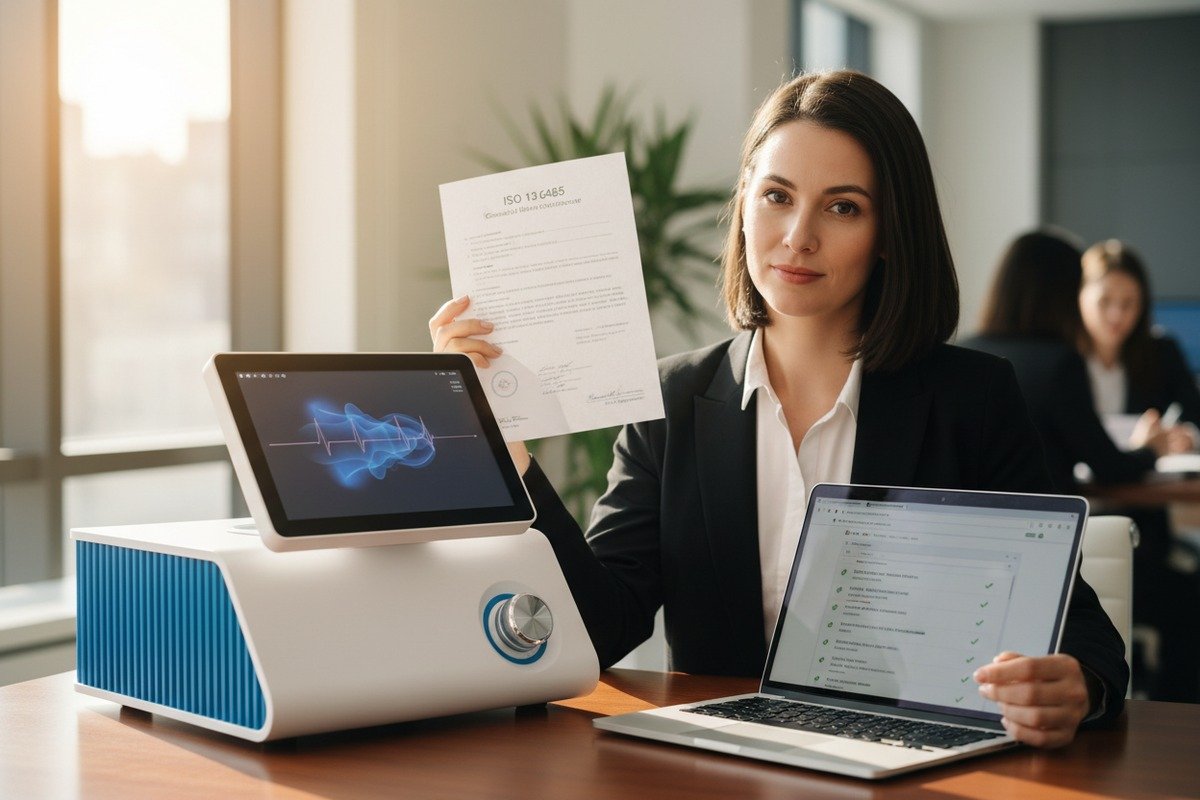
Every week, our quality team receives inquiries from international buyers worried about fake certificates China National Accreditation Service (CNAS) 1. The problem is real. Unverified ISO 13485 documents flood the market. They put patients at risk and expose your business to regulatory nightmares.
To verify a supplier’s ISO 13485 certificate for shockwave therapy machines, check the certification body’s accreditation through IAF member databases, confirm the certificate number on the CB’s official portal, and ensure the scope specifically covers medical device manufacturing including shockwave equipment.
This guide walks you through every step of the verification process. You will learn to spot red flags, understand why authenticity matters, and confirm your supplier’s scope covers the equipment you need.
How can I verify my Chinese supplier’s ISO 13485 certificate through official accreditation databases?
When our team audits new component suppliers, we start with database verification. Many buyers skip this step. They trust documents without checking. This creates serious compliance gaps that surface during regulatory inspections.
Verify Chinese supplier ISO 13485 certificates by first identifying the certification body on the document, then checking that CB’s accreditation status through the IAF CertSearch database or the relevant national accreditation body website like CNAS for China-based certifiers.
Understanding the Accreditation Chain
The verification process follows a clear hierarchy. At the top sits the International Accreditation Forum (IAF) 2. Below that are national accreditation bodies. These bodies oversee certification bodies that actually issue ISO 13485 certificates 3.
For Chinese suppliers, the China National Accreditation Service (CNAS) is the primary national body. CNAS accredits certification bodies operating in China. When a CB has CNAS accreditation, their certificates gain international recognition through the IAF Multilateral Recognition Arrangement.
| Level | Organization Type | Example | Role |
|---|---|---|---|
| 1 | International Forum | IAF | Sets global standards for accreditation |
| 2 | National Accreditation Body | CNAS, UKAS, ANAB | Accredits certification bodies |
| 3 | Certification Body | TÜV, SGS, BSI | Issues ISO 13485 certificates |
| 4 | Supplier | Your shockwave machine manufacturer | Holds the certificate |
Step-by-Step Database Verification
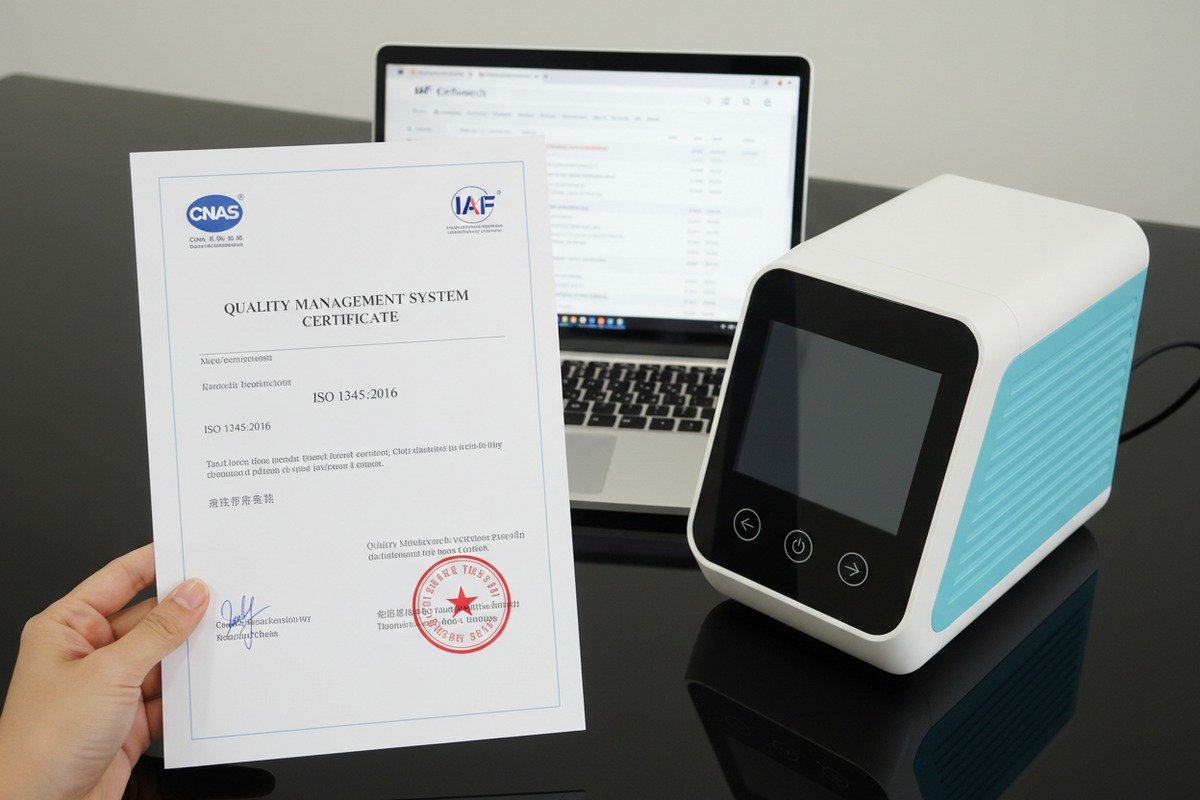
Start by examining the physical certificate. Look for the certification body’s name and logo. Note the accreditation body mark. Record the unique certificate number.
Next, visit the IAF CertSearch portal 4 at www.iafcertsearch.org. Enter the supplier’s company name or certificate number. The database shows active certificates from participating CBs.
If the certificate does not appear in IAF CertSearch, go directly to the accreditation body’s website. For CNAS, visit www.cnas.org.cn. Search for the certification body first. Confirm they hold accreditation for ISO 13485 audits.
Then visit the certification body’s own verification portal. Major CBs like TÜV, SGS, and Bureau Veritas maintain public databases. Enter the certificate number. Check the validity dates. Confirm the certified scope matches your supplier’s actual activities.
Common Database Verification Pitfalls
Our experience shipping to US and European markets taught us some hard lessons. Some CBs look legitimate but lack IAF MLA participation. Their certificates may not be accepted by notified bodies in Europe.
Watch for certificates issued by CBs from countries not participating in the IAF MLA. Reports suggest 70% of EU audits reject certificates from non-MLA certification bodies. Always cross-reference the CB’s country with the IAF MLA signatory list 5.
Another issue is outdated database entries. Some CBs update their portals slowly. If you find conflicting information, contact the CB directly. Request written confirmation of certificate status.
What red flags should I look for when reviewing my shockwave therapy machine manufacturer’s ISO documents?
In our production facility, we train quality staff to spot document inconsistencies immediately. Fake certificates share common patterns. Knowing these patterns saves you from costly mistakes and regulatory violations.
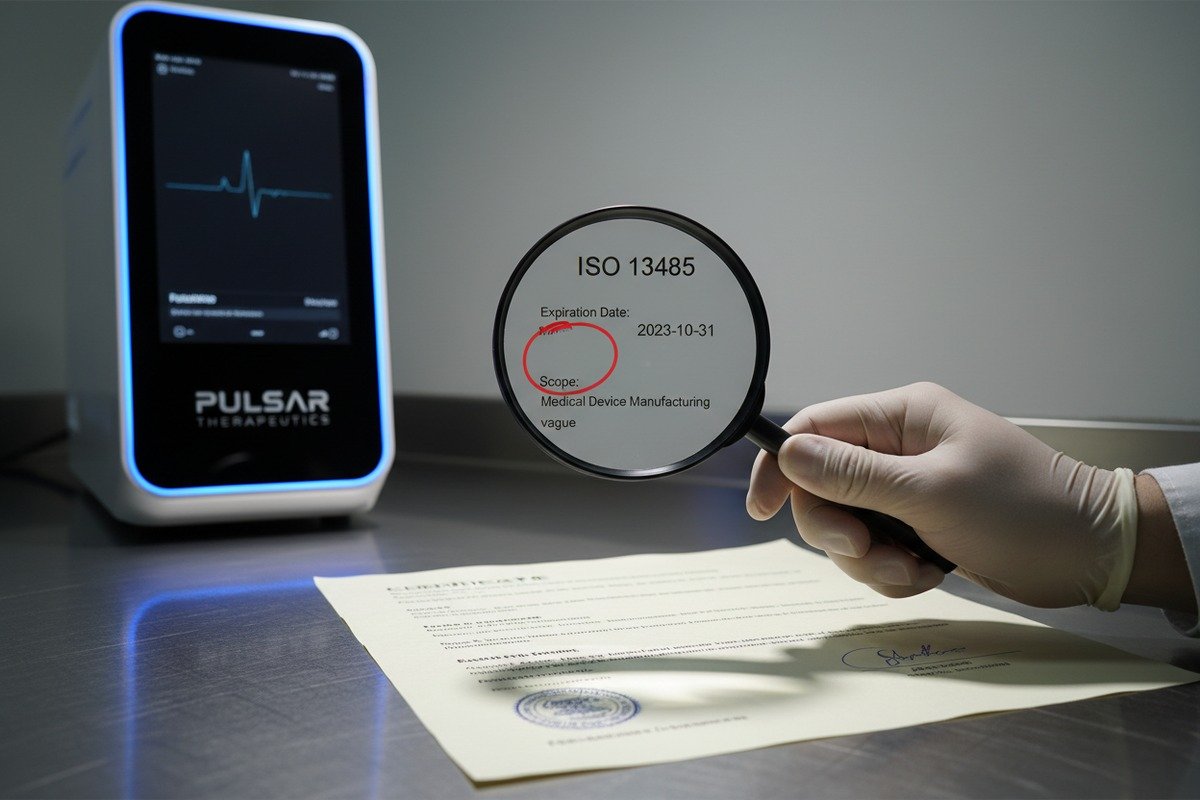
Red flags in ISO 13485 documents include missing IAF MLA marks, certification body logos you cannot verify online, expired validity dates, vague scope statements not mentioning medical devices, mismatched company names or addresses, and poor print quality with typos or formatting errors.
Visual Inspection Red Flags
Begin with the document’s physical appearance. Legitimate certificates have crisp logos and consistent formatting. Look for the certification body logo in a prominent position. The accreditation body mark should appear nearby, often with the IAF MLA mark.
Check font consistency throughout the document. Fake certificates often mix fonts or use slightly different sizes. Look at the certificate number format. Most CBs use standardized numbering systems. Random or unusually short numbers warrant investigation.
Examine dates carefully. The certificate should show issue date and expiry date. ISO 13485 certificates typically last three years. An expiry date more than three years from the issue date signals a problem.
| Red Flag | Why It Matters | What To Do |
|---|---|---|
| Missing IAF MLA mark | Certificate may lack international recognition | Verify CB’s MLA status on IAF website |
| Vague scope language | May not actually cover medical device manufacturing | Request scope clarification letter |
| Company name mismatch | Could indicate certificate belongs to different entity | Confirm legal entity matches |
| No certificate number | Prevents verification in databases | Reject document immediately |
| Expired validity date | QMS no longer certified | Request current certificate |
| Unknown certification body | May be unaccredited or fictional | Search accreditation body databases |
Content Red Flags
Read the scope statement carefully. It should clearly mention medical devices. Ideally, it specifies the type of devices. A certificate covering “general manufacturing” or “electronic products” without medical device language is insufficient for shockwave therapy equipment.
The certified organization name must exactly match your supplier’s legal entity. Some suppliers share certificates from parent companies or affiliated factories. This does not guarantee the specific facility making your products operates under the certified QMS.
Address verification matters too. The certificate address should match where your products are actually manufactured. Some suppliers hold certificates for one location but manufacture elsewhere. Our shipping team confirms production addresses during every pre-shipment inspection.
Process-Related Red Flags
Ask for surveillance audit evidence. ISO 13485 requires annual surveillance audits between certification cycles. If your supplier cannot provide recent audit reports or statements, their certificate status may have changed.
Request information about the certification process timeline. A legitimate ISO 13485 certification takes 6-12 months including document preparation, Stage 1 audit, and Stage 2 audit. Suppliers claiming certification within weeks likely hold fraudulent documents.
Watch for suppliers unwilling to provide certification body contact information. Legitimate certificate holders have nothing to hide. They can connect you with their CB for verification.
Why is ISO 13485 authenticity critical for the safety and compliance of my imported shockwave machines?
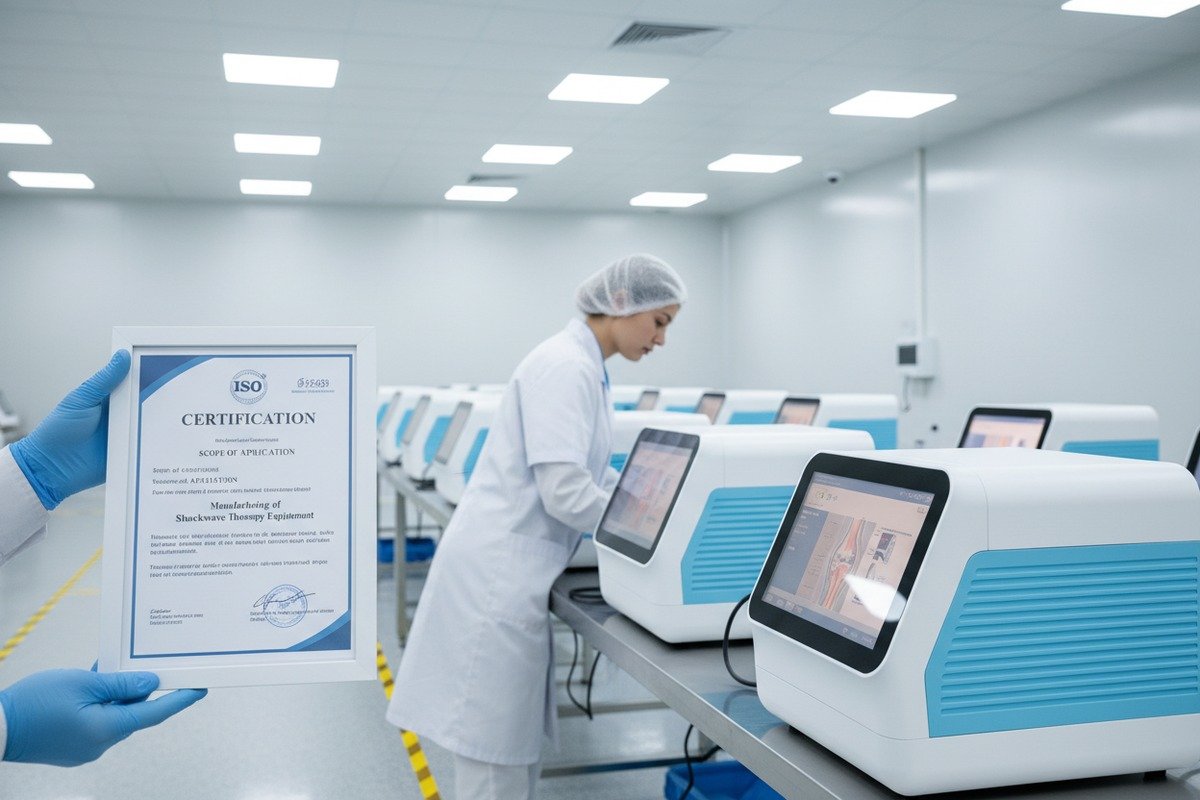
Our engineers understand that shockwave therapy devices generate high-energy acoustic waves. These waves penetrate tissue to treat musculoskeletal conditions. Without proper quality controls, these devices can cause burns, bruising, or internal injuries.
ISO 13485 authenticity ensures your shockwave therapy machines come from a facility with verified quality management systems covering design controls, process validation, sterilization procedures, and risk management—all critical for patient safety and regulatory compliance in the US and EU markets.
Patient Safety Implications
Shockwave therapy machines are Class II medical devices 6. They deliver focused acoustic energy to specific body areas. The energy levels and delivery patterns must be precisely controlled. Improper calibration or manufacturing defects create direct patient harm risks.
ISO 13485 clause 7.5.6 requires validation of processes whose output cannot be fully verified afterward. Shockwave device manufacturing involves several such processes. These include software validation 7, acoustic calibration, and component assembly affecting energy output.
A fake certificate means these validation processes likely never occurred. The factory may skip critical testing. Calibration procedures may be inconsistent. Software may contain undetected bugs affecting treatment delivery.
Our production line follows strict process validation protocols. We verify acoustic output at multiple stages. Every unit undergoes calibration checks before shipping. This discipline comes from genuine ISO 13485 implementation.
Regulatory Compliance Consequences
Importing medical devices into the US or EU requires demonstrating supply chain quality. FDA expects importers to verify supplier quality systems. European MDR 8 demands even stricter supply chain documentation.
| Compliance Requirement | US (FDA) | EU (MDR) | ISO 13485 Connection |
|---|---|---|---|
| Supplier QMS verification | Expected | Mandatory | Certificate authenticity proves QMS |
| Design controls documentation | 21 CFR 820 | Annex II | ISO 13485 Clause 7.3 |
| Process validation records | Required | Required | ISO 13485 Clause 7.5.6 |
| Traceability | Required | Required | ISO 13485 Clause 7.5.9 |
| Post-market surveillance | Required | Mandatory | ISO 13485 Clause 8.2.1 |
When auditors discover fake supplier certificates, consequences escalate quickly. FDA can place your products on import alert. EU notified bodies may suspend your CE marking. Your business faces recalls, fines, and reputational damage.
Financial and Business Risks
The shockwave therapy market exceeds $1.2 billion globally. Competition is intense. Market entry requires significant investment. Losing regulatory approval due to supplier certificate fraud destroys that investment.
Product liability exposure multiplies with unverified suppliers. If a patient suffers injury from a device manufactured without proper QMS, legal discovery will expose your supplier verification gaps. Plaintiffs’ attorneys specifically target supply chain documentation failures.
Insurance coverage may also be affected. Some medical device liability policies exclude claims arising from suppliers with unverified quality systems. Check your policy language carefully.
Beyond legal risks, customer relationships suffer. Our US and European buyers increasingly audit their own supply chains. They ask for our ISO 13485 certificate and verify it independently. They expect the same diligence from their suppliers.
How do I confirm that my supplier’s ISO 13485 scope actually covers the manufacturing of shockwave therapy equipment?
When we prepare documentation for buyer audits, scope clarity is essential. Generic certificate language creates problems. You need confirmation that your specific product type falls within the certified quality management system.
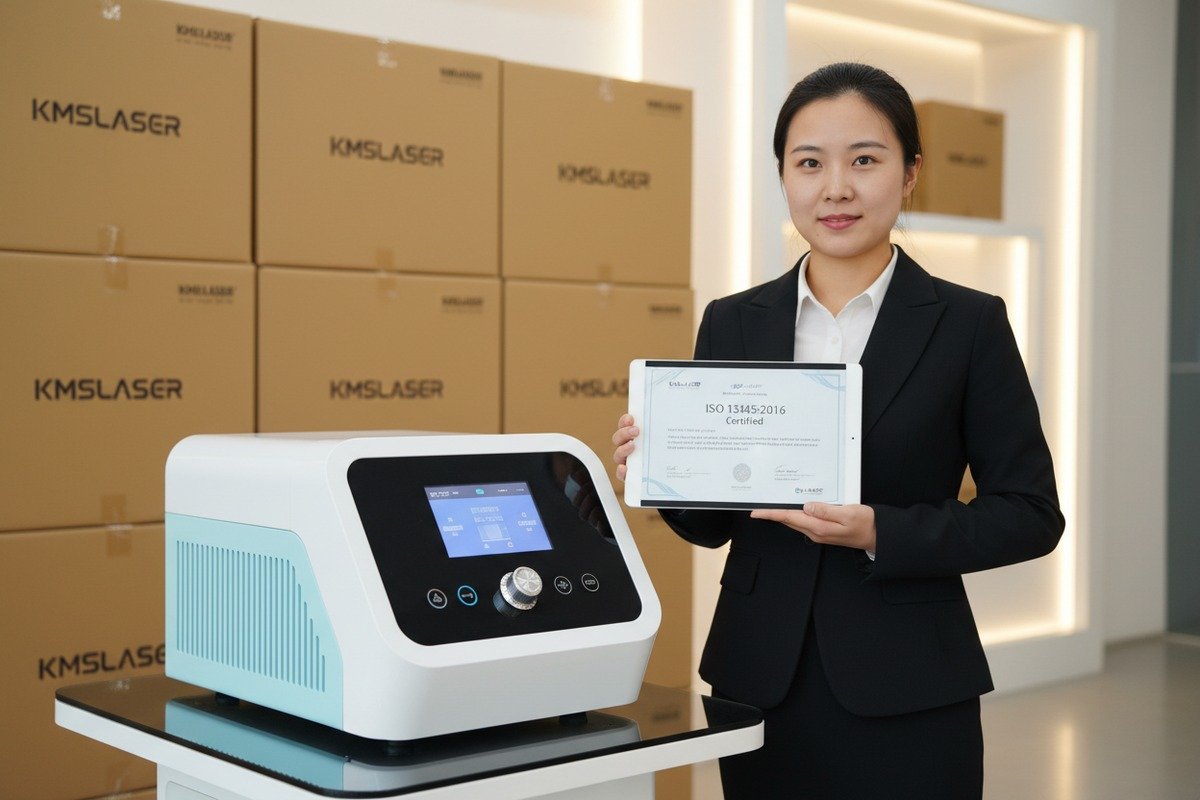
Confirm ISO 13485 scope coverage by examining the certificate scope statement for explicit mention of medical device manufacturing, requesting a scope clarification letter from the certification body, and verifying that shockwave therapy devices or equivalent product categories appear in the supplier’s certified product listings.
Decoding Scope Statements
Certificate scope statements vary in specificity. Some list exact product categories. Others use broader descriptions. Both can be valid, but you need to understand what falls within the scope.
Look for language like “design and manufacture of therapeutic medical devices” or “production of physiotherapy equipment.” These broader scopes typically include shockwave therapy machines. Very narrow scopes like “dental instruments only” clearly exclude your product type.
When scope language is ambiguous, request clarification. The certification body can provide a scope clarification letter. This letter confirms whether specific product types fall within the certified scope. Keep this letter with your supplier qualification records.
Product Category Analysis
Shockwave therapy machines fall into specific regulatory categories. In the US, FDA classifies them under several product codes depending on application. In Europe, they are typically Class IIa devices under MDR.
Your supplier’s ISO 13485 scope should align with these classifications. A certificate covering only Class I devices would not be appropriate for Class IIa shockwave equipment.
| Scope Element | What To Verify | Acceptable Examples |
|---|---|---|
| Product type | Medical devices explicitly mentioned | “Medical therapeutic devices,” “Physiotherapy equipment” |
| Device class | Appropriate risk classification | “Class II medical devices,” “Class IIa and IIb devices” |
| Activities | Manufacturing included | “Design, development, and manufacture” |
| Applications | Relevant therapeutic area | “Musculoskeletal treatment devices,” “Rehabilitation equipment” |
Beyond Basic Scope Verification
Scope coverage alone does not guarantee capability. The supplier must actually implement QMS requirements for shockwave device manufacturing. Ask for specific evidence.
Request validation records for shockwave-specific processes. These include acoustic calibration procedures, software validation documentation, and if applicable, sterilization validation for probe components.
Our engineering team maintains detailed validation protocols for every product variant. When buyers request this documentation, we provide it promptly. Suppliers hesitant to share validation evidence may not have genuine ISO 13485 implementation.
Ask about design control procedures 9. ISO 13485 clause 7.3 requires documented design and development processes. Shockwave devices involve complex design considerations. Your supplier should demonstrate systematic design control implementation.
Inquire about software validation specifically. Modern shockwave machines include sophisticated software controlling energy delivery, treatment protocols, and safety interlocks. ISO 13485 requires software validation proportionate to associated risks. Request evidence of software validation activities.
Practical Verification Steps
Create a scope verification questionnaire for suppliers. Include questions about specific product types, manufacturing processes, and QMS documentation availability.
Consider requesting a site visit or third-party audit. Seeing the actual manufacturing environment reveals whether the QMS operates in practice. Our facility welcomes buyer audits. We find they strengthen relationships and build trust.
Ask for recent surveillance audit reports. These reports from the certification body show whether the supplier maintains compliance. Specific audit findings related to manufacturing processes indicate active QMS implementation.
Conclusion
Verifying ISO 13485 certificate authenticity protects your business and patients. Use official databases, check scope carefully, and watch for red flags. Your due diligence today prevents costly problems tomorrow.
Footnotes
- Details the national accreditation body for China. ↩︎
- Provides information about the global association of accreditation bodies. ↩︎
- Explains the ISO 13485 standard for medical device quality management systems. ↩︎
- Direct link to the official global database for accredited certification validation. ↩︎
- Provides the official list of countries participating in the IAF Multilateral Recognition Arrangement. ↩︎
- Explains the FDA classification system for medical devices, including Class II. ↩︎
- Provides FDA guidance on general principles of software validation for medical devices. ↩︎
- Provides the official text of the European Union Medical Device Regulation. ↩︎
- Explains FDA requirements for design controls in medical device development. ↩︎

 English
  Español de México
  Deutsch
  Français
  العربية
  Русский