
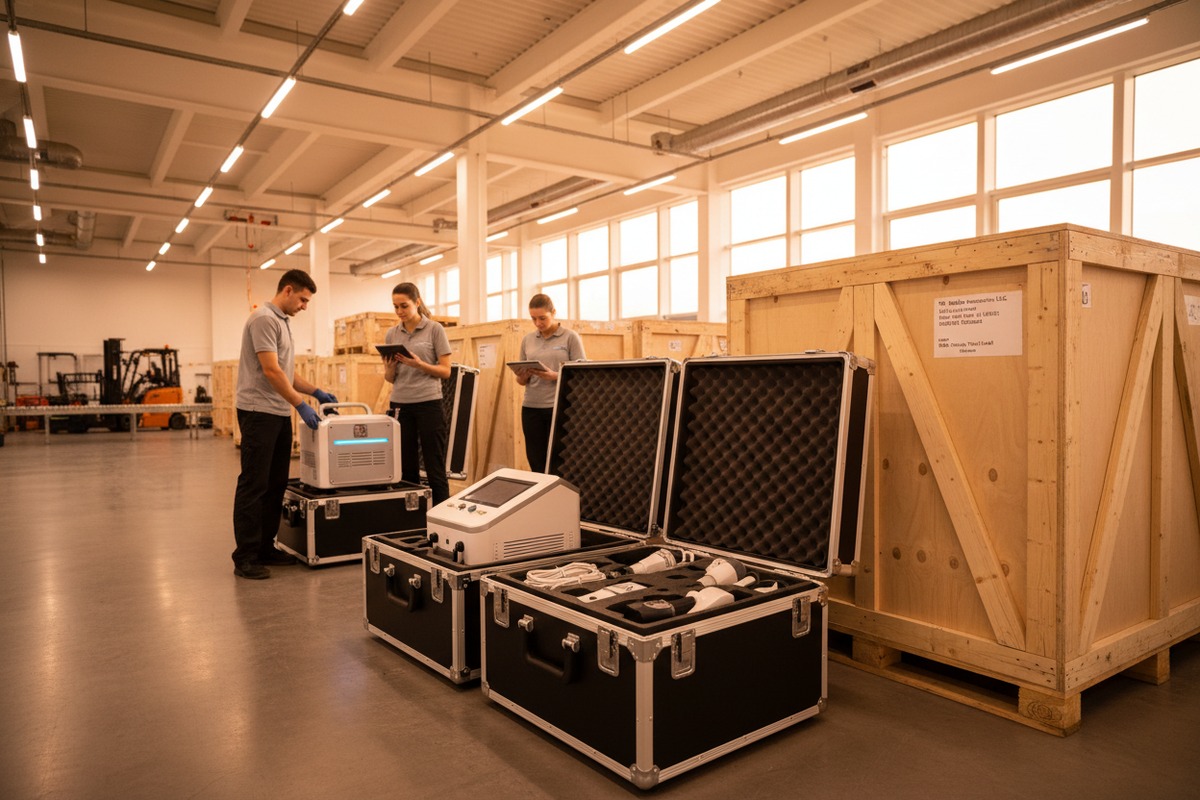
Every week, our production floor ships shockwave therapy machines 1 to distributors worldwide. Yet we constantly hear the same frustration from new partners: their previous suppliers sold them machines that looked impressive but failed within months. The handpieces wore out fast. The energy output dropped unexpectedly. Returns piled up, and their brand reputation suffered.
When importing shockwave therapy machines, verify energy output range (60-185 mJ for radial, 0.01-0.55 mJ/mm² for focused), frequency range (1-25 Hz), handpiece durability (minimum 2-3 million shots), voltage compatibility (AC 100-240V/50-60Hz), and regulatory certifications including CE marking and ISO 13485 compliance.
This guide breaks down exactly what specifications matter most ISO 13485 compliance 2. We will cover energy and frequency standards, handpiece longevity, software customization, and internal component quality. Let us dive into each critical area.
How do I determine if the energy and frequency ranges meet the professional standards my salon clients expect?
Our engineering team tests every shockwave unit before shipment electromagnetic ballistic generators 3. We have learned that energy and frequency specs make or break a machine's clinical performance. Salon owners expect consistent results for their clients, and inconsistent output leads to complaints IEC 62304 compliant software validation 4.
Professional shockwave therapy machines should deliver 60-185 mJ energy for radial systems or 0.01-0.55 mJ/mm² energy flux density for focused systems, with frequency ranges of 1-22 Hz (radial) or up to 25 Hz (focused). These ranges ensure effective treatment for diverse conditions from cellulite to chronic pain.

Understanding Radial vs. Focused Energy Output
Radial shockwave machines 5 use electromagnetic ballistic generators. They spread energy superficially, reaching depths of 50-60mm. This makes them ideal for soft tissue treatments that salons commonly offer FDA clearance documentation 6.
Focused shockwave machines 7 penetrate deeper—up to 125mm. They use electroacoustic or electrohydraulic principles. The energy concentrates at a specific point. This precision suits deep pathologies but costs more.
When we calibrate machines at our facility, we measure energy in different units depending on the technology type. Here is what to look for:
| Specification | Radial Shockwave | Focused Shockwave | Why It Matters |
|---|---|---|---|
| Energy Output | 60-185 mJ | 0.34-4.22 mJ total | Higher energy treats stubborn conditions |
| Energy Flux Density | Not typically measured | 0.01-0.55 mJ/mm² | Determines tissue penetration efficacy |
| Frequency Range | 1-22 Hz | Up to 25 Hz | Higher Hz enables faster treatments |
| Penetration Depth | 0-60mm | 0-125mm | Match to treatment types offered |
Frequency and Treatment Speed
Frequency directly impacts treatment time. A machine running at 22 Hz delivers pulses much faster than one limited to 8 Hz. For high-volume salons, this difference matters tremendously.
Our quality control process tests frequency stability over thousands of cycles. Cheap machines often advertise high frequency but cannot maintain it consistently. The output drops after extended use.
We recommend requesting test reports showing frequency consistency at different energy levels. A reliable machine maintains its stated specifications even after 100,000 shots.
Burst Mode Options
Modern shockwave machines offer burst modes. These deliver pulses in groups—typically 4, 8, or 12 pulses—followed by a pause. Burst modes can reduce patient discomfort while maintaining efficacy.
When evaluating machines, check if continuous and burst modes are available. Some budget machines offer only continuous operation. This limits treatment flexibility for your salon clients.
What technical details should I verify to ensure the handpiece and bullet lifespan will reduce my after-sales service burden?
At our factory, the most common warranty claims involve handpiece failures. When we analyze returned units, worn projectiles and damaged coils cause most problems. These issues are preventable with proper specification verification upfront.
Verify handpiece durability rated at minimum 2-3 million shots, projectile/coil replacement availability, integrated controls to reduce operator fatigue, and multiple applicator sizes (6mm, 15mm, 25mm diameter). Request cumulative usage tracking features and temperature monitoring to prevent premature component failure.

Shot Count and Realistic Lifespan
Manufacturers advertise shot counts, but these numbers need context. A handpiece rated for 2 million shots sounds impressive. But how long does that actually last?
Consider a busy salon performing 20 treatments daily, each using 3,000 shots. That equals 60,000 shots per day. The handpiece would need replacement in about 33 days of continuous operation.
Our engineering team designs for real-world durability. Here is how different specifications translate to practical lifespan:
| Daily Usage Level | Shots Per Day | 2 Million Shot Lifespan | 3 Million Shot Lifespan |
|---|---|---|---|
| Light (10 treatments) | 30,000 | 67 days | 100 days |
| Medium (20 treatments) | 60,000 | 33 days | 50 days |
| Heavy (40 treatments) | 120,000 | 17 days | 25 days |
Applicator Sizes and Replacement Costs
Professional machines include multiple applicator sizes. Standard sets include 6mm, 15mm, and 25mm diameter transmitters. Some clinical applications require 5 or more adapter options.
Before importing, calculate long-term applicator costs. Some manufacturers price applicators affordably but charge premium rates for replacements. Others bundle replacement sets at reasonable prices.
We always recommend requesting a full price list for consumables before committing to any supplier. The initial machine cost means little if replacement parts drain your profits.
Temperature Monitoring and Protection
Heat destroys handpiece components faster than mechanical wear. Continuous operation generates significant heat in the electromagnetic coils. Without proper monitoring, coils burn out prematurely.
Quality machines include temperature sensors that pause operation when heat exceeds safe levels. This feature protects your investment and prevents mid-treatment failures that frustrate clients.
Cumulative Usage Tracking
Modern machines log total shot counts and usage patterns. This data helps you plan maintenance schedules and budget for replacements. It also provides evidence for warranty claims if components fail prematurely.
When our team inspects returned handpieces, usage logs tell us exactly what happened. Machines without tracking make it difficult to diagnose problems or verify warranty eligibility.
How can I customize the machine's software and technical specifications to align with my private label brand identity?
When we develop custom units for our partners, software flexibility ranks among their top priorities. Your brand identity extends beyond logos. The entire user experience must reflect your positioning in the market.
Customize shockwave machine software through branded boot screens, logo placement on interface, custom color schemes matching brand guidelines, pre-programmed treatment protocols under your brand name, multi-language support for your target markets, and user interface adjustments including screen layouts and menu structures.
Interface Customization Options
The touchscreen interface is what your clients see and interact with. It shapes their perception of your brand. Generic interfaces with supplier logos undermine your private label positioning.
Our software team offers these standard customization options:
| Customization Element | Basic Package | Premium Package | Enterprise Package |
|---|---|---|---|
| Boot Screen Logo | ✓ | ✓ | ✓ |
| Interface Color Scheme | Standard | Custom colors | Full brand palette |
| Language Options | 2 languages | 5 languages | Unlimited |
| Treatment Protocols | 30 presets | 50+ presets | Custom protocols |
| Body Diagrams | Standard | Enhanced | Custom anatomical |
| User Manual Branding | PDF only | Printed + PDF | Full documentation |
Pre-Programmed Treatment Protocols
Salons value machines with preset treatment programs. These protocols guide operators through correct settings for specific conditions. They reduce training time and ensure consistent results.
When customizing machines for your brand, consider developing unique protocol names. Instead of generic labels like "Cellulite Program 1," create branded names that reinforce your market positioning.
Our development process allows you to define exact parameters for each protocol. You specify energy levels, frequency, shot counts, and applicator requirements. We program these into the machine under your protocol names.
Screen Size and Interface Design
Current machines offer screens ranging from 7 inches to 15.6 inches. Larger screens improve usability but increase unit size and weight. Consider your target market when choosing.
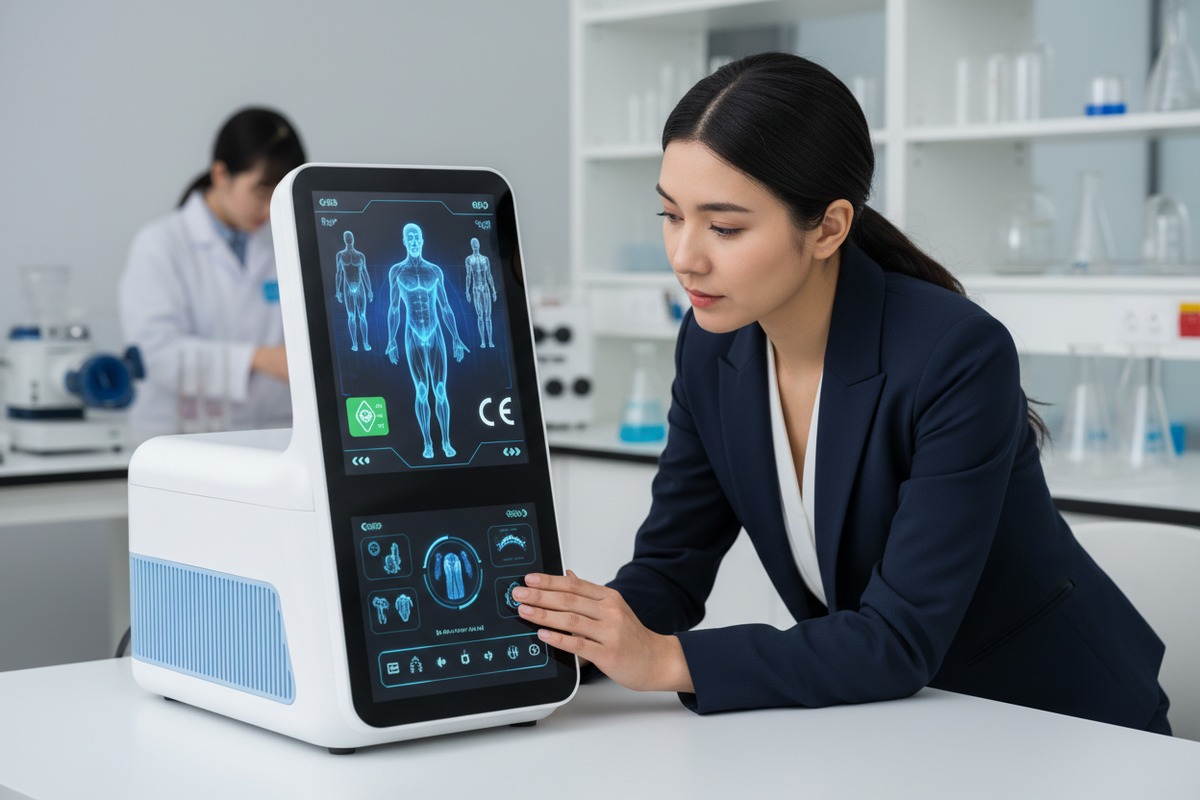
Mobile practitioners prefer compact units with 7-10 inch screens. Established salons often want larger displays that look impressive to clients. The machine we manufacture features a large vertical touchscreen that displays high-tech interfaces with anatomical diagrams and technical data.
Documentation and Training Materials
Private label branding extends to all documentation. User manuals, quick-start guides, and training videos should feature your brand consistently.
We provide editable documentation templates. Your team can customize content while maintaining professional formatting. This approach saves time compared to creating materials from scratch.
What internal component standards should I demand from my supplier to guarantee long-term stability and performance?
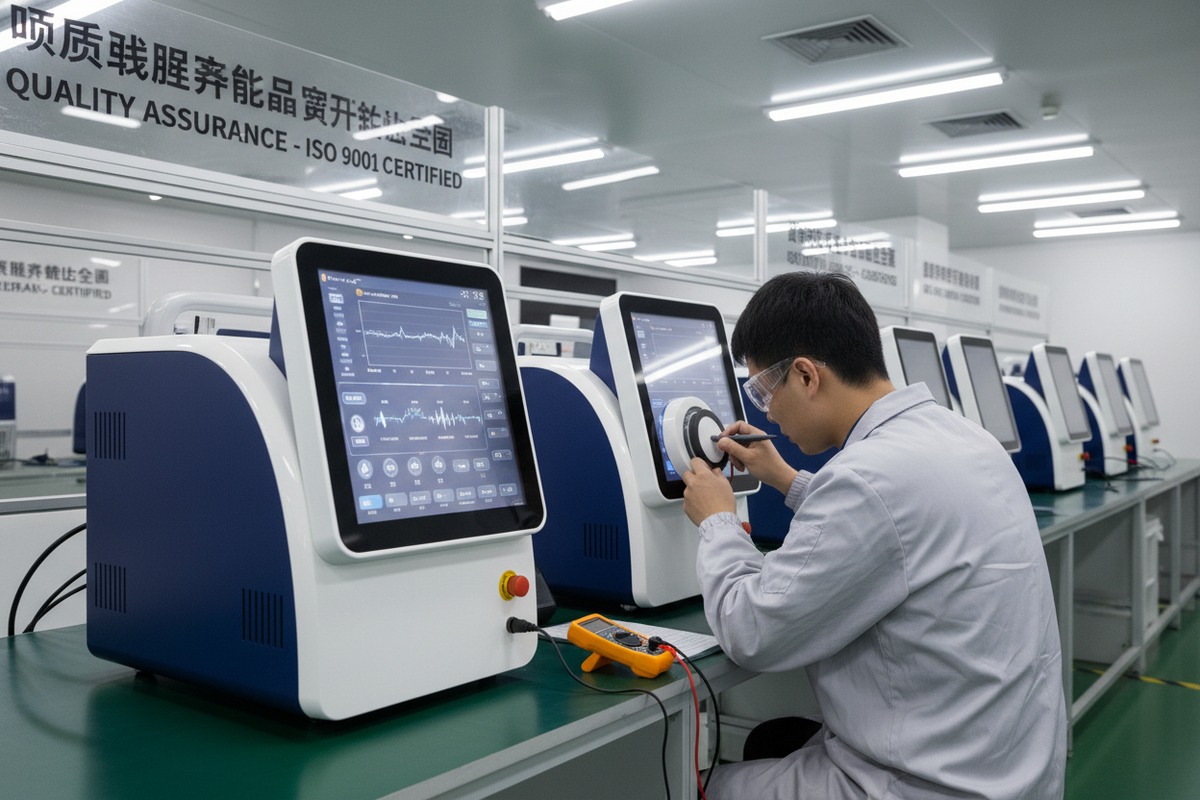
On our production line, we source components from qualified suppliers who meet strict specifications. Internal parts determine whether a machine performs reliably for years or fails within months. Your supplier's component choices directly impact your brand reputation.
Demand ISO 13485 certified manufacturing, IEC 62304 compliant software validation, electromagnetic generators with proven longevity, medical-grade power supplies (AC 100-240V/50-60Hz compatible), CE marking or FDA clearance documentation, and written specifications for all critical components including coils, projectiles, and circuit boards.
Regulatory Certifications and What They Mean
Certifications indicate quality management standards. They are not just paperwork requirements. Each certification addresses specific aspects of manufacturing quality.
| Certification | What It Covers | Why Importers Should Care |
|---|---|---|
| ISO 13485 | Quality management systems | Ensures consistent manufacturing processes |
| CE Marking 8 | EU safety requirements | Required for European market access |
| IEC 62304 | Software lifecycle | Validates software reliability and safety |
| IEC 61846 | Shockwave measurement | Ensures accurate energy output claims |
| FDA 510(k) | US market clearance | Required for US distribution |
When we manufacture devices for export, our quality team maintains documentation for each certification. We can provide this paperwork to support your import applications.
Electromagnetic Generator Quality
The electromagnetic generator is the heart of any shockwave machine. Low-quality generators produce inconsistent energy output. Over time, output degrades even faster.
Quality indicators include:
- Consistent energy delivery over millions of cycles
- Stable frequency output under varying loads
- Minimal heat generation during operation
- Documented testing at multiple intensity levels
Our facility tests generators extensively before installation. We reject units showing any output variation exceeding 5% from specifications.
Power Supply Specifications
Power supplies must handle voltage variations common in different countries. A machine designed only for 220V will fail or underperform on 110V circuits without proper conversion.
Universal power supplies accepting AC 100-240V and 50-60Hz ensure your machines work anywhere. This specification is non-negotiable for international distribution.
The machines we produce include medical-grade power supplies rated at 200-282 VA. These components meet safety standards and provide stable power regardless of local grid conditions.
Cybersecurity for Connected Devices
Modern shockwave machines often include network connectivity for software updates or data collection. This connectivity creates potential security vulnerabilities.
Verify that your supplier follows IEC 62443 or equivalent cybersecurity standards. Connected devices should use encrypted communications and secure authentication protocols.
Environmental Operating Specifications
Machines must function reliably in varied environments. Salon conditions differ from climate-controlled hospital settings. Humidity, temperature, and dust levels all affect component longevity.
Request documented environmental specifications including:
- Operating temperature range (typically 10-40°C)
- Humidity tolerance (typically 30-75% non-condensing)
- Storage temperature range
- Altitude limitations
Our standard machines operate reliably across typical salon environments worldwide. Custom specifications are available for extreme conditions.
Conclusion
Importing shockwave therapy machines requires careful specification verification. Energy output, frequency ranges, handpiece durability, software customization, and internal component quality all determine your long-term success. Use this guide as your checklist when evaluating suppliers.
Footnotes
1. Provides a comprehensive overview of extracorporeal shockwave therapy. ↩︎
2. Details the international standard for quality management systems in medical devices. ↩︎
3. Explains the physical principles of electromagnetic shockwave generation. ↩︎
4. Explains the international standard for medical device software lifecycle processes. ↩︎
5. Explains the principles and applications of radial shockwave therapy. ↩︎
6. Provides official information on FDA 510(k) premarket notification clearances. ↩︎
7. Describes the physics and generation of focused shockwave therapy. ↩︎
8. Explains the purpose and requirements of CE marking in the EU. ↩︎

 English
  Español de México
  Deutsch
  Français
  العربية
  Русский