

When our engineering team first developed shockwave therapy machines for the US market, we quickly learned that OSHA compliance 1 was not optional—it was essential. Many salon owners face unexpected fines, sometimes exceeding $14,000, simply because they purchased equipment without verifying safety standards. This problem costs businesses money, reputation, and customer trust.
To ensure OSHA compliance when purchasing a shockwave therapy machine, you must verify FDA 510(k) clearance, confirm electrical safety certifications, assess noise levels below 85 dB, request complete technical documentation, ensure staff training protocols, and maintain detailed records for audits and inspections.
This guide breaks down every step you need to take before buying a shockwave therapy machine Lockout/tagout compatibility 2. We will cover certifications, supplier verification, documentation, and safety features. Let us start with the most critical piece—safety certifications.
What safety certifications should I look for to ensure my shockwave therapy machine is OSHA compliant?
Our quality control team reviews certification requirements daily because we export to strict markets like the US. Many buyers confuse FDA registration with FDA clearance. This mistake can lead to OSHA violations and unsafe equipment in your salon.
Look for FDA Class II 510(k) clearance, ISO 13485 certification for medical device quality management, IEC 60601-1 electrical safety standards, and CE marking for electromagnetic compatibility. These certifications prove your shockwave machine meets workplace safety requirements and medical device efficacy standards.

Understanding FDA 510(k) Clearance vs. FDA Registration
Many vendors market their devices as "FDA registered." This term sounds official, but it means very little. FDA registration simply means a facility has notified the FDA of its existence. It does not mean the device was tested or approved.
FDA 510(k) clearance 3 is different. The FDA reviews the device, compares it to legally marketed devices, and confirms it is safe and effective. For shockwave therapy machines, Class II 510(k) clearance is the gold standard. Devices without this clearance may have unstable energy output. Energy levels above 0.22 mJ/mm² can cause cellular stress and harm patients or staff.
Key Certifications Comparison Table
| Certification | What It Covers | Why It Matters for OSHA |
|---|---|---|
| FDA 510(k) Class II | Device safety and efficacy | Proves equipment is safe for medical use; avoids General Duty Clause 4 violations |
| ISO 13485 | Quality management systems | Ensures consistent manufacturing standards |
| IEC 60601-1 | Electrical safety for medical devices | Protects against shock and arc flash hazards (OSHA 29 CFR 1910.333) |
| CE Marking | European safety and EMC compliance | Confirms electromagnetic compatibility with other equipment |
| IEC 63045:2020 | Non-focused ESWT parameters | Standardizes treatment parameters for safety |
Electrical Safety Standards
OSHA enforces strict electrical hazard standards under 29 CFR 1910.333. Shockwave machines contain high-voltage circuits. Without proper certification, these circuits pose shock and arc flash risks. Look for devices tested under IEC 60601-1. IEC 60601-1 electrical safety 5 This standard ensures the machine has proper insulation, grounding, and emergency shutoff features.
Our production line tests every unit for electrical safety before shipping. We also provide incident energy calculations so your team can select appropriate PPE. OSHA requires PPE rated for at least 75 cal/cm² in high-risk situations.
Noise Level Certifications
OSHA limits workplace noise exposure to 85 dB for an 8-hour time-weighted average 6. Shockwave machines produce acoustic pulses during treatment. Most compliant devices operate at 1-8 Hz repetition frequency with sound levels below 85 dB. However, poor acoustic coupling can increase noise unexpectedly. Request noise test reports from your supplier before purchase.
How can I verify that my Chinese manufacturer's quality control meets US workplace safety standards?
When we ship equipment to American salons, our clients often ask how they can trust our quality control. This concern is valid. Not all Chinese manufacturers follow the same standards. The key is knowing what questions to ask and what evidence to request.
Verify your Chinese manufacturer's quality control by requesting ISO 13485 certification, conducting pre-shipment inspections, reviewing factory audit reports, checking production line testing protocols, and confirming they understand FDA and OSHA requirements. A reliable supplier will provide traceable documentation for every unit.

Factory Audit Essentials
A factory audit reveals the truth about a manufacturer's capabilities. Third-party audits from organizations like SGS, TÜV, or Bureau Veritas provide unbiased assessments. These audits check raw material sourcing, production processes, testing equipment, and documentation systems.
Our facility in Guangzhou welcomes audits. We maintain detailed records of every component, from high-voltage circuits to acoustic applicators. This traceability ensures that if a problem occurs, we can identify the source and correct it immediately.
Quality Control Checkpoints Table
| QC Checkpoint | What to Request | Red Flags |
|---|---|---|
| Incoming Material Inspection | Test reports for electrical components | No documentation for critical parts |
| In-Process Testing | Production line test data for each unit | Batch testing only, no individual unit records |
| Final Assembly Testing | Energy output calibration reports | Missing calibration certificates |
| Pre-Shipment Inspection | Independent third-party inspection report | Refusal to allow inspections |
| Documentation Package | User manuals, compliance certificates, test data | Incomplete or missing documents |
Testing Protocols You Should Request
Ask your supplier to explain their testing protocols in detail. For shockwave machines, critical tests include:
- Energy output verification: Confirm the device produces energy within regenerative levels (≤0.18 mJ/mm²), not catabolic levels (>0.22 mJ/mm²).
- Electrical safety testing: High-pot testing, ground continuity, and leakage current measurements per IEC 60601-1.
- Acoustic coupling verification: Ensure the applicator delivers consistent energy through recommended gels or spacers.
- EMI testing: Confirm the device does not interfere with other clinic electronics.
Our engineers perform these tests on every unit. We provide calibration certificates showing exact measurements. This documentation protects you during OSHA audits.
Communication and Service Response
Quality control extends beyond manufacturing. Evaluate your supplier's communication responsiveness. Can they answer technical questions clearly? Do they provide service bulletins and software updates? Our team offers WhatsApp support for urgent inquiries and maintains a service log for every client.
What technical documentation must I request from my supplier to prove my equipment is compliant?
From our experience exporting to the US, documentation is where many purchases fail. Buyers receive a machine but lack the paperwork for OSHA audits. This gap creates legal liability and compliance headaches. Proper documentation protects your business.
Request the FDA 510(k) clearance letter, ISO certification copies, IEC test reports, user manuals with safety protocols, calibration certificates, energy output specifications, noise level test data, and maintenance schedules. Complete documentation proves compliance and supports OSHA audit readiness.

Essential Documentation Checklist
OSHA does not directly regulate medical device efficacy, but it holds employers responsible for workplace hazards. The General Duty Clause (Section 5(a)(1)) requires employers to provide a workplace free from recognized hazards. Without documentation proving your equipment is safe, you risk citations.
Documentation Requirements Table
| Document Type | Purpose | OSHA Relevance |
|---|---|---|
| FDA 510(k) Clearance Letter | Proves device meets safety standards | Demonstrates due diligence in equipment selection |
| IEC 60601-1 Test Report | Confirms electrical safety | Supports compliance with 29 CFR 1910.333 |
| Noise Level Test Data | Verifies sound below 85 dB | Supports compliance with 29 CFR 1910.95 |
| Energy Output Calibration | Shows treatment parameters | Prevents patient/staff harm from excessive energy |
| User Manual | Provides operational safety guidance | Required for staff training documentation |
| Maintenance Schedule | Outlines service requirements | Ensures ongoing equipment safety |
| Training Materials | Guides staff on safe operation | Required under OSHA training mandates |
Energy and Treatment Parameter Documentation
The ISMST (International Society for Medical Shockwave Treatment) guidelines 8 recommend detailed dosing records. Your documentation should include:
- Energy flux density: Typically ≤0.18 mJ/mm² for regenerative treatment
- Repetition frequency: Standard range is 1-4 Hz
- Pulse count per session: Varies by treatment area
- Acoustic coupling method: Gel type and application technique
- Treatment zone specifications: Broad-focused devices cover 7×12 cm areas
Our machines come with parameter guides showing safe operating ranges. This information helps your staff deliver consistent, safe treatments.
Recordkeeping for Audits
OSHA may request equipment documentation during inspections. Maintain organized records including:
- Purchase date and supplier information
- Installation records and initial calibration data
- Staff training completion dates
- Maintenance logs with technician signatures
- Incident reports (if any)
- Clinical outcome tracking linked to equipment use
We provide digital documentation packages with every order. These files are organized for easy retrieval during audits. Our service team also offers guidance on setting up compliant recordkeeping systems.
Verifying Document Authenticity
Unfortunately, some suppliers provide fake or outdated certificates. Verify FDA 510(k) clearance directly on the FDA database (accessdata.fda.gov). Cross-check ISO certification numbers with the issuing body. For IEC test reports, contact the testing laboratory if the report looks suspicious.
How do I ensure the machine's safety features are robust enough to protect my staff and salon customers?
When we design our shockwave machines, safety features come first. Our engineers have seen what happens when safety fails—staff injuries, customer complaints, and business closures. Robust safety features are not optional. They are essential for daily operations.
Ensure robust safety features by checking for automatic shutoff mechanisms, energy limiters preventing catabolic output, insulated housing, clear warning indicators, ergonomic applicator design, proper grounding, and emergency stop buttons. These features protect staff from electrical hazards, noise exposure, and repetitive strain injuries.
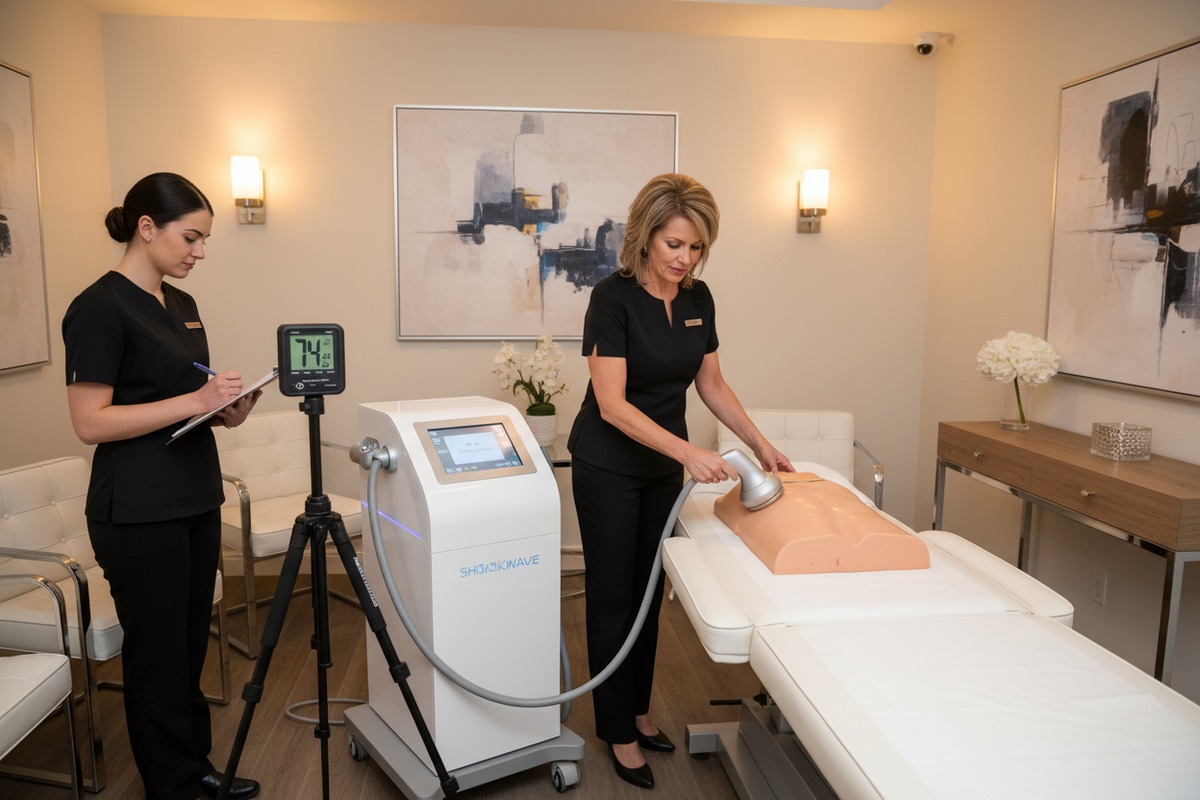
Critical Safety Features Overview
Modern shockwave machines should include multiple safety layers. Each feature addresses specific OSHA hazard categories.
Safety Features and OSHA Requirements Table
| Safety Feature | Hazard Addressed | OSHA Standard |
|---|---|---|
| Emergency Stop Button | Unexpected equipment behavior | General Duty Clause |
| Energy Limiter | Excessive tissue damage | General Duty Clause |
| Insulated Housing | Electrical shock | 29 CFR 1910.333 |
| Grounding System | Arc flash | 29 CFR 1910.147 |
| Noise Dampening | Hearing damage | 29 CFR 1910.95 |
| Ergonomic Applicator | Repetitive strain | Ergonomic guidelines |
| Warning Indicators | Operational hazards | 29 CFR 1910.145 |
| Auto-Degas System | Inconsistent energy delivery | Equipment safety |
Electrical Safety Features
High-voltage circuits require specific protections. Look for:
- Double insulation: Prevents shock even if primary insulation fails
- Grounding fault interrupter: Automatically cuts power if ground fault detected
- Lockout/tagout compatibility: Allows safe maintenance per OSHA 1910.147
- Voltage verification points: Enables safe testing before service
Our machines include all these features. We also provide insulated tools for maintenance and PPE recommendations for your staff.
Acoustic and Energy Safety
Shockwave devices produce acoustic pulses that can harm tissue if uncontrolled. Safety features should include:
- Energy flux limiters: Prevent output above 0.22 mJ/mm²
- Treatment timers: Auto-stop after preset pulse counts
- Coupling sensors: Warn if acoustic coupling is poor
- Closed water systems with auto-degas: Ensure consistent energy delivery
Broad-focused electrohydraulic systems like our models include SmartTrode electrodes that maintain consistent output. This design reduces the risk of unexpected energy spikes.
Staff Protection Features
Your staff uses these machines daily. Ergonomic features reduce injury risk:
- Lightweight applicators: Reduce arm and shoulder strain
- Adjustable handpiece angles: Accommodate different treatment positions
- Low-vibration design: Minimize hand-arm vibration syndrome risk
- Clear LCD displays: Reduce eye strain from reading settings
We also recommend workstation assessments. Position the machine at proper height. Ensure operators can maintain neutral wrist positions. Provide anti-fatigue mats for standing treatments.
PPE Requirements
Even with built-in safety features, some PPE may be required:
- Eye protection: Per OSHA 1910.133 for procedures near face
- Hearing protection: If ambient noise exceeds 85 dB
- Arc-rated clothing: For maintenance personnel working on electrical systems
- Insulated gloves: For any electrical testing or troubleshooting
Conduct a hazard assessment before operations begin. Document your findings and PPE decisions. This documentation supports OSHA compliance.
Conclusion
Purchasing an OSHA-compliant shockwave therapy machine requires attention to certifications, supplier verification, documentation, and safety features. Take time to verify FDA 510(k) clearance, audit your manufacturer, collect complete documentation, and confirm robust safety features protect your team and customers.
Footnotes
1. Official government resource for workplace safety and health standards. ↩︎
2. Official OSHA page on the Control of Hazardous Energy (Lockout/Tagout) standard. ↩︎
3. Replaced with official FDA Premarket Notification 510(k) page. ↩︎
4. Official OSHA page for laws and regulations, including the General Duty Clause. ↩︎
5. Intertek is a recognized testing and certification body for IEC 60601-1 standards. ↩︎
6. Official OSHA page detailing occupational noise exposure limits and programs. ↩︎
7. BSI is a leading global standards and certification body for ISO 13485. ↩︎
8. Official website for the International Society for Medical Shockwave Treatment. ↩︎

 English
  Español de México
  Deutsch
  Français
  العربية
  Русский