

When our engineering team first developed shockwave therapy devices 1, we quickly learned that flashy marketing often masks critical performance gaps. Many buyers struggle to separate genuine clinical value from exaggerated claims, leading to costly mistakes and disappointed end-users.
To compare technical specs effectively, focus on energy flux density (0.09-0.25 mJ/mm²), frequency range adjustability, shockwave type (focused versus radial), handpiece durability ratings, compressor technology, and verified clinical data. Request third-party test reports and evaluate manufacturer transparency before committing to any purchase.
This guide breaks down every critical specification you need to evaluate. We will walk through energy parameters, build quality indicators, technology comparisons, and data verification methods to help you make informed decisions.
How can I verify if the energy density and frequency range meet my brand's performance standards?
Our quality control team tests every unit before shipment, yet we still encounter buyers who struggle to interpret energy specifications. Without proper understanding, you risk purchasing machines that underperform or fail to deliver therapeutic results.
Verify energy density by requesting calibration certificates showing 0.09-0.25 mJ/mm² output for ED applications. Check frequency adjustability between 1-22 Hz. Demand third-party test reports from accredited labs, and compare stated specs against peer-reviewed clinical protocols to ensure alignment with proven therapeutic thresholds.

Understanding Energy Flux Density
Energy flux density 2 measures the energy delivered per unit area, expressed in millijoules per square millimeter (mJ/mm²). For ED treatment 3, clinical studies consistently use energy levels between 0.09 and 0.25 mJ/mm². Going below this range produces insufficient biological response. Going above risks tissue damage.
When reviewing manufacturer specifications, look for adjustable energy settings within this therapeutic window. Some machines offer only fixed energy outputs, limiting your ability to customize treatments for different patient profiles. Our production line includes variable energy controls specifically because we understand this clinical necessity.
Frequency Range Considerations
Frequency determines how many shockwave pulses the device delivers per second. Most clinically validated protocols 4 operate between 1 and 22 Hz. Higher frequencies allow faster treatment sessions but may reduce per-pulse efficacy. Lower frequencies deliver more energy per pulse but extend treatment time.
| Specification | Recommended Range | Clinical Justification |
|---|---|---|
| Energy Flux Density | 0.09-0.25 mJ/mm² | Proven neovascularization stimulation |
| Frequency | 1-22 Hz | Balance between efficacy and comfort |
| Shocks per Session | 1500-3000 | Standard protocol requirement |
| Treatment Sites | 5-6 penile areas | Complete coverage approach |
Verification Methods
Never accept manufacturer claims at face value. Request calibration certificates 5 dated within the last 12 months. Ask for third-party test reports from accredited laboratories. Compare stated specifications against published clinical trial protocols.
During our export process to US and European markets, we routinely provide calibration documentation because experienced distributors demand this transparency. If a manufacturer hesitates to share testing data, consider it a red flag.
Cross-reference the machine's specifications against meta-analyses showing effective ED treatment parameters. Studies indicate focused shockwave therapy at 0.12 mJ/mm² with 3000 shocks per session produces measurable IIEF-5 score improvements. Your chosen device must match these benchmarks.
What should I look for in the handpiece lifespan and build quality to minimize my maintenance costs?
From our factory floor, we have seen how handpiece failures account for the majority of warranty claims. Buyers often overlook this component, focusing instead on the main unit, only to face unexpected replacement costs within months.
Evaluate handpiece lifespan by checking manufacturer-stated shot counts (aim for 2-5 million shots minimum), material composition (medical-grade polymers or stainless steel), and warranty terms. Request historical failure rate data, inspect seal quality, and verify replacement part availability and pricing before purchase.

Shot Count Ratings
Every handpiece has a finite lifespan measured in total shots delivered. Entry-level devices may offer only 500,000 to 1 million shots before requiring replacement. Premium handpieces last 2 to 5 million shots. Given that each ED session involves 1500 to 3000 shocks, this difference dramatically impacts your long-term costs.
Calculate your expected usage. If you perform 20 treatments weekly with 3000 shocks each, you deliver 60,000 shocks weekly. A 1-million shot handpiece lasts roughly 16 weeks. A 3-million shot handpiece lasts nearly a year. The initial price difference often pales compared to replacement costs.
Material and Construction Quality
Our engineers specify medical-grade polymer housings with stainless steel internal components because these materials withstand the repetitive mechanical stress of shockwave generation. Cheaper alternatives use consumer-grade plastics that crack, warp, or degrade under clinical use conditions.
| Build Quality Factor | Budget Device | Premium Device |
|---|---|---|
| Housing Material | ABS plastic | Medical-grade polymer |
| Internal Components | Aluminum alloy | Stainless steel |
| Shot Count Rating | 500K-1M | 2M-5M |
| Seal Type | Standard O-ring | Double-sealed gasket |
| Warranty Period | 6-12 months | 24-36 months |
Warranty and Replacement Economics
Examine warranty terms carefully. Some manufacturers cover the main unit for two years but limit handpiece coverage to six months. Others exclude handpieces from warranty entirely, calling them "consumables."
Request replacement handpiece pricing upfront. A machine priced at $15,000 with $3,000 handpiece replacements every quarter costs significantly more than a $25,000 machine with $1,500 replacements annually. Our sales team provides total cost of ownership projections specifically because savvy buyers demand this analysis.
Maintenance Accessibility
Check whether the handpiece requires factory service or allows field replacement. Machines requiring factory repairs mean extended downtime and shipping costs. Field-replaceable handpieces minimize interruption to your business operations.
Verify that replacement parts remain available throughout your expected equipment lifecycle. Manufacturers who discontinue handpiece models leave buyers stranded with expensive, non-functional equipment.
How do I evaluate the internal compressor versus electromagnetic technology for my custom machine?
When we design custom configurations for OEM partners, technology selection becomes the most debated decision. Each generation mechanism offers distinct advantages, and the wrong choice undermines your entire product positioning.
Evaluate compressor-based (pneumatic/ballistic) systems for radial waves and electromagnetic generators for focused waves. Focused electromagnetic technology delivers deeper penetration (up to 12cm) with superior clinical evidence for ED. Compressor systems offer lower cost but shallower effect. Match technology to your target market's clinical expectations.
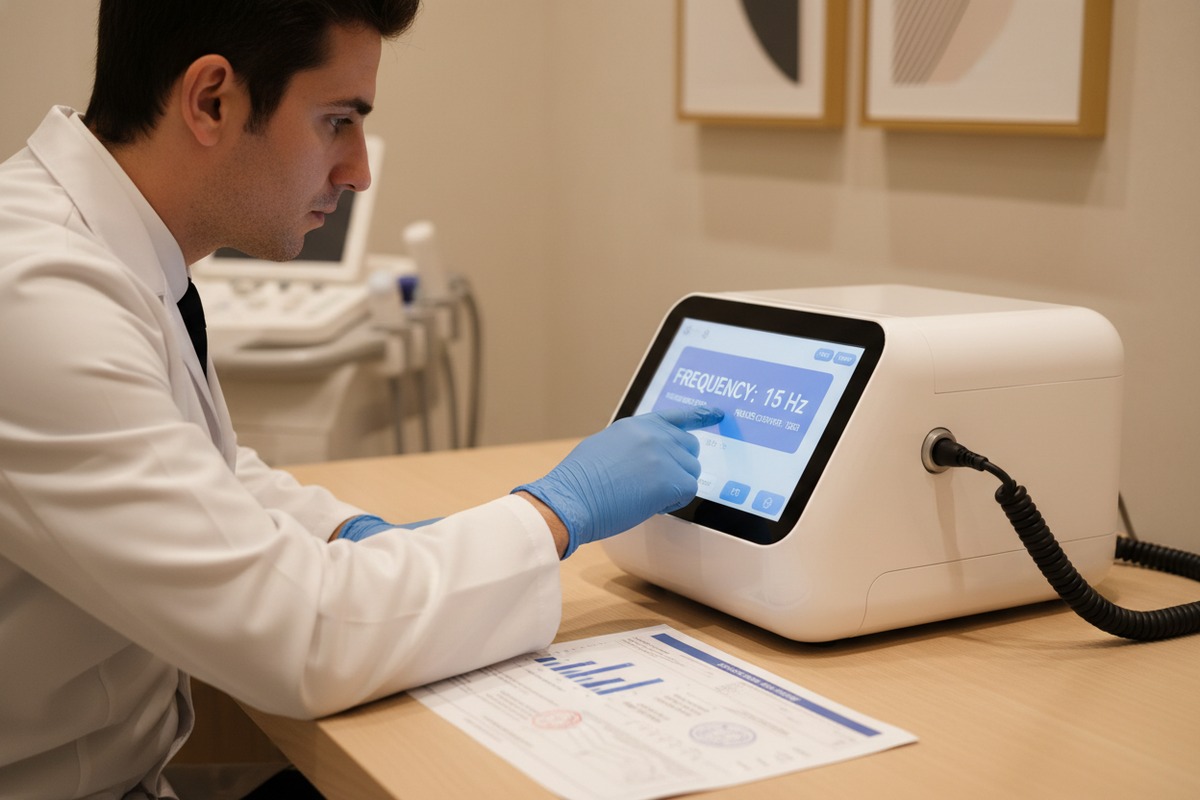
Focused Electromagnetic Technology
Electromagnetic generators create focused shockwaves through rapid coil movement inducing pressure waves. What is Focused Shockwave Therapy 6 These waves converge at a precise focal point within tissue, delivering concentrated energy to targeted depths. For ED applications, this means reaching the deep vascular structures responsible for erectile function.
Clinical literature strongly supports focused shockwave therapy for ED. Meta-analyses report IIEF-5 score improvements of 3-4 points at six months, with 70% of patients achieving clinically meaningful gains versus only 10% in sham groups. This evidence base makes focused technology the preferred choice for medical-grade positioning.
Pneumatic Compressor Systems
Pneumatic systems use compressed air to accelerate a projectile against an applicator surface, creating radial pressure waves 7. These waves disperse quickly as they enter tissue, producing a superficial effect pattern.
Radial systems cost less to manufacture and maintain. However, clinical evidence for ED treatment shows inconsistent results. Some studies report comparable outcomes to focused therapy, while meta-analyses find no significant difference from sham treatment. This controversy makes radial technology riskier for brands emphasizing clinical credibility.
| Technology Type | Focused Electromagnetic | Radial Pneumatic |
|---|---|---|
| Wave Penetration | Deep (up to 12cm) | Shallow (2-3cm) |
| Energy Pattern | Convergent focal point | Dispersing radial |
| Clinical Evidence for ED | Strong (multiple RCTs) | Weak/inconsistent |
| Manufacturing Cost | Higher | Lower |
| Maintenance Complexity | Moderate | Lower |
| FDA Status for ED | Off-label | Off-label |
Hybrid Considerations
Market trends show growing interest in hybrid machines offering both focused and radial modes. When we developed our dual-mode platform, we recognized that clinicians want flexibility for different treatment protocols and patient populations.
Hybrid systems command premium pricing but reduce the need for multiple devices. If your distribution network serves diverse clinical settings, this versatility may justify the added investment.
Matching Technology to Market Position
Your technology choice should align with your brand positioning. Premium medical distribution channels expect focused electromagnetic technology backed by clinical evidence. Budget-conscious markets may accept radial systems if priced accordingly.
Our recommendation for ED-specific applications: prioritize focused electromagnetic technology. The clinical evidence gap between focused and radial therapy creates liability concerns for medical distributors. Investing in proven technology protects your brand reputation and supports marketing claims.
Can I trust the manufacturer's technical data sheets to ensure the product is safe for my medical distribution?
During pre-shipment inspections at our facility, we regularly document specification discrepancies between marketing materials and actual device performance. This experience taught us that data sheet verification requires systematic due diligence.
Never rely solely on manufacturer data sheets. Cross-reference specifications against third-party lab reports, regulatory filings, clinical trial citations, and independent reviews. Request sample units for in-house testing. Verify safety certifications (CE, ISO 13485) and confirm clinical claims match peer-reviewed evidence before distribution commitments.

Data Sheet Red Flags
Watch for vague specifications lacking precise measurements. Statements like "high energy output" or "powerful shockwaves" without numeric values indicate potential exaggeration. Legitimate manufacturers provide exact energy flux density ranges, frequency specifications, and tolerance margins.
Clinical efficacy claims deserve particular scrutiny. If a data sheet references "clinically proven" without citing specific studies, request the underlying research. Our technical documentation includes study citations because credible buyers demand verifiable evidence.
Third-Party Verification Steps
Request calibration certificates from accredited testing laboratories. Look for ISO/IEC 17025 accreditation, which indicates the lab meets international standards for testing competence. Manufacturer-generated test reports carry less credibility than independent verification.
| Verification Method | What It Confirms | Red Flags |
|---|---|---|
| Calibration Certificate | Energy output accuracy | Expired dates, missing lab accreditation |
| CE Marking 8 | European safety compliance | No notified body number |
| ISO 13485 Certificate | Quality management system | Expired or unverifiable |
| Clinical Study Citations | Efficacy claims | Vague references, non-peer-reviewed sources |
| Sample Unit Testing | Real-world performance | Refusal to provide samples |
Regulatory Documentation Review
For medical distribution, regulatory compliance documentation matters significantly. CE marking indicates European conformity but requires verification. Check that the notified body number is valid and that the certification scope covers the specific device model and intended use.
ISO 13485 certification demonstrates quality management system compliance for medical device manufacturing. Request current certificates and verify them through the issuing certification body. Expired or fraudulent certifications expose your distribution business to serious liability.
Safety Considerations for ED Applications
Shockwave therapy for ED remains off-label in FDA jurisdiction. This status does not prohibit distribution but requires careful marketing claim management. Avoid representations suggesting FDA approval for ED specifically.
Focus safety verification on general device safety standards rather than ED-specific approvals. Electrical safety (IEC 60601-1), electromagnetic compatibility, and mechanical safety standards apply regardless of intended use.
Due Diligence Process
Establish a systematic verification protocol before committing to any supplier. Request comprehensive documentation packages including calibration reports, regulatory certificates, clinical evidence summaries, and warranty terms. Compare documentation against marketing materials for consistency.
Our export team routinely prepares documentation packages for US and European buyers because we understand the due diligence requirements in these markets. Manufacturers who resist transparency likely have something to hide.
Consider requesting sample units for independent testing before volume orders. This investment protects against specification misrepresentation and allows real-world performance evaluation. Reputable manufacturers welcome this scrutiny as it builds buyer confidence.
Conclusion
Comparing shockwave therapy machine specifications requires systematic evaluation of energy parameters, build quality, technology type, and data verification. Prioritize focused electromagnetic technology with verified energy density ranges, durable handpiece construction, and transparent manufacturer documentation to protect your brand and satisfy clinical expectations.
Footnotes
1. Provides historical context and broad applications of shockwave therapy devices. ↩︎
2. Defines the physical concept of energy flux density and its units. ↩︎
3. Authoritative source on erectile dysfunction and shockwave therapy as a treatment option. ↩︎
4. Provides clinical recommendations and protocols for shockwave therapy in ED. ↩︎
5. Explains the importance and essential elements of calibration certificates for equipment accuracy. ↩︎
6. Explains focused shockwave therapy, its benefits, and how it works. ↩︎
7. Describes the mechanism and characteristics of radial pressure wave therapy. ↩︎
8. Authoritative information on CE marking for medical devices in the European Union. ↩︎

 English
 Español de México
 Deutsch
 Français
 العربية
 Русский
