When our engineers first encountered a batch of piezoelectric crystals damaged during assembly, we realized how devastating electrostatic discharge 1 can be. These invisible sparks cause latent failures that only surface months later. Your customers complain. Your reputation suffers. The cost of ignoring ESD protection far exceeds the investment in proper controls.
To evaluate anti-static measures for shockwave therapy machine production, you must audit factory ESD protocols, verify rigorous testing compliance with medical EMC standards like 60601-1-2, assess ESD-safe materials for internal components, and inspect anti-static packaging for shipping. This comprehensive approach ensures device reliability and regulatory compliance.
This guide walks you through every critical checkpoint medical EMC standards 2. You will learn what to look for during factory audits, how to verify testing procedures, which materials matter most, and how packaging protects your investment during international shipping.
What anti-static protocols should I look for during my factory audit?
Walking through our production floor, visitors often ask why we invest so heavily in static control IEC 61000-4-2 3. The answer lies in the sensitive components inside every shockwave therapy unit. Piezoelectric crystals, electromagnetic coils, and electronic controls all suffer from ESD events that may not show immediate damage but cause field failures later conductive foams 4.
During your factory audit, look for grounded workstations, ESD-safe flooring, personnel grounding equipment like wrist straps and conductive footwear, air ionization systems, humidity controls above 40% RH, and documented training programs. These protocols form the foundation of effective static control in medical device manufacturing.

Understanding ESD Risks in Shockwave Technology
Shockwave therapy machines use different generation principles ANSI/ESD S541 standards 5. Each has unique vulnerabilities to static discharge.
Electrohydraulic systems use spark gaps in water to create shockwaves. Static can contaminate the water medium and interfere with spark consistency. Piezoelectric systems 6 rely on crystal arrays that are extremely sensitive to ESD damage. Electromagnetic systems use coils with acoustic lenses that static can misalign. Even ballistic and radial pneumatic systems contain electronic controls vulnerable to discharge.
The energy flux density 7 in medical shockwave devices ranges from 0.02 to 0.36 mJ/mm². ESD-induced electromagnetic interference disrupts this precise output. Peak pressures reach approximately 1000 times that of diagnostic ultrasound. This precision demands manufacturing environments free from static interference.
Essential Audit Checkpoints
| Audit Area | What to Check | Acceptable Standard |
|---|---|---|
| Flooring | Surface resistivity 8 | 10⁶ to 10⁹ ohms |
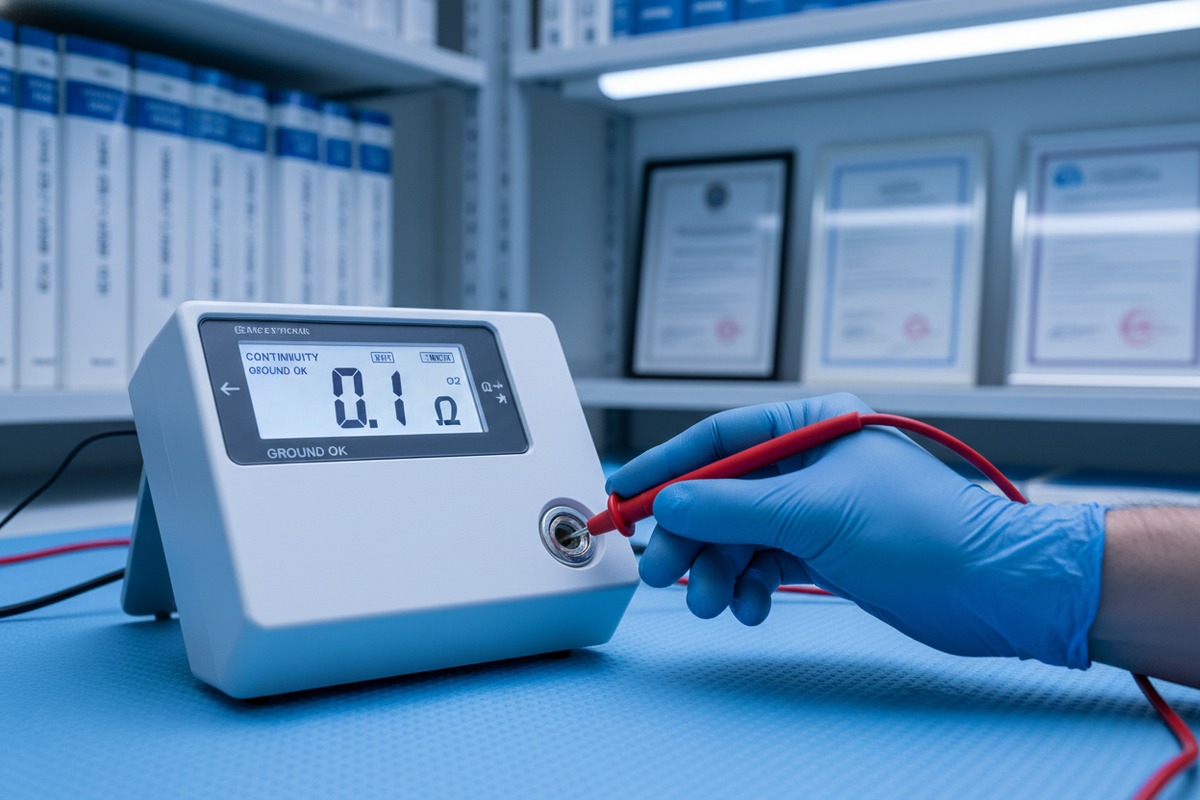
| Workstations | Grounding continuity | Less than 1 ohm to ground |
| Personnel | Wrist strap testing logs | Daily testing documented |
| Humidity | Control system records | Maintained above 40% RH |
| Ionizers | Balance and decay times | Less than 2 seconds decay |
| Training | Certification records | Annual refresher required |
Grounded Workstation Requirements
Every assembly station must connect to a verified ground point. This includes the work surface, tool holders, and component storage areas. Our technicians test ground continuity at the start of each shift. Records must be available for your review.
Wrist straps provide the primary path for discharging static from personnel. Look for continuous monitors that alert workers when the strap disconnects. Footwear and flooring work together as a secondary grounding system. Conductive shoes must contact ESD-safe flooring to be effective.
Air Ionization Systems
Ionizers neutralize static charges on non-conductive materials. In shockwave machine production, this matters for plastic housings, packaging materials, and certain component coatings. Overhead ionizers should cover all critical assembly areas.
Check ionizer maintenance logs. Balance readings should show ions are neither too positive nor too negative. Decay time testing confirms the ionizer can neutralize a charge within acceptable limits. Industry 4.0 facilities now use real-time ESD event logging that correlates with output consistency.
Documentation and Training
Paper trails prove protocols exist and are followed. Ask for training records, equipment calibration certificates, and corrective action reports from past ESD events. A mature ESD program includes root cause analysis when problems occur.
Training should cover the physics of static generation, handling procedures for sensitive components, and emergency response when controls fail. Annual refresher courses keep knowledge current. New employees need comprehensive onboarding before touching production materials.
How can I verify that my shockwave therapy machines undergo rigorous ESD testing?
In our testing laboratory, every shockwave unit faces deliberate static attacks. We simulate real-world discharge events because we know what happens when untested products reach clinics. Machines fail during treatment. Patients lose confidence. Clinics demand replacements. Proper ESD testing prevents these scenarios.
Verify ESD testing by requesting compliance certificates for IEC 61000-4-2 and medical EMC standard 60601-1-2, which requires withstanding up to 15kV air discharge. Ask for test reports showing discharge levels, contact points, and pass/fail criteria. Inspect testing equipment calibration records and observe actual test procedures during your audit.
Medical Device EMC Standards
Medical devices face stricter ESD requirements than consumer electronics. The 60601-1-2 9 standard mandates immunity testing at levels reflecting clinical environments. Shockwave machines must withstand discharges up to 15kV for air discharge and 8kV for contact discharge.
Testing verifies the device continues operating correctly during and after ESD events. This means shockwave output remains consistent. Display readings stay accurate. Safety interlocks function properly. Any performance degradation fails the test.
Testing Protocol Verification
| Test Parameter | Required Level | Verification Method |
|---|---|---|
| Air discharge | 2, 4, 8, 15 kV | Sequential application |
| Contact discharge | 2, 4, 6, 8 kV | Direct electrode contact |
| Test points | All accessible surfaces | Documented map required |
| Discharge count | Minimum 10 per point | Test report review |
| Performance criteria | No output deviation | Before/after comparison |
| Recovery time | Immediate | Functional testing |
In-Line vs. End-of-Line Testing
The debate continues in manufacturing circles. Some factories test only finished products. Others implement inline testing at critical assembly stages. Both approaches have merit, but comprehensive programs use both.
Inline testing catches problems early. If a component fails ESD immunity before installation, you save assembly labor. End-of-line testing confirms the complete system works correctly. The best manufacturers document both testing stages.
Equipment Calibration
ESD simulators require regular calibration to produce accurate discharge levels. Ask for calibration certificates traceable to national standards. Check calibration dates. Equipment should be recertified annually at minimum.
The test environment matters too. Temperature and humidity affect discharge characteristics. Testing rooms should maintain controlled conditions matching standards requirements. Metallic ground planes provide consistent reference points for contact discharge tests.
Interpreting Test Reports
Test reports should clearly identify the device model, serial number, test date, and technician. Each discharge point requires documentation. Pass/fail criteria must reference the applicable standard.
Look for anomalies in reports. If certain discharge points consistently show borderline results, this indicates design weaknesses. Strong manufacturers use test data to drive continuous improvement, not just compliance certification.
Third-Party Verification
Independent testing laboratories provide objective verification. Accredited labs follow documented procedures and maintain equipment calibrations. Their reports carry more weight with regulatory authorities.
FDA-approved shockwave devices like electrohydraulic and electromagnetic systems all underwent rigorous EMC testing. This approval history demonstrates that manufacturers can achieve compliance when they commit resources to proper testing programs.
What specific ESD-safe materials should my manufacturer use for internal components?
Our procurement team learned a difficult lesson years ago. We sourced housing materials that looked identical to our approved suppliers. But these alternatives lacked proper static dissipation. Three months later, field failure rates doubled. The savings disappeared in warranty claims and lost customers.
Manufacturers should use anti-static ABS plastic for housings, conductive foams for component storage, ESD-safe PCB materials, shielded cables with proper terminations, and static-dissipative coatings for transducer assemblies. Surface resistivity should measure between 10⁶ and 10⁹ ohms for static-dissipative materials and below 10⁵ ohms for conductive applications.

Material Categories and Applications
ESD-safe materials fall into three categories based on surface resistivity. Conductive materials have resistivity below 10⁵ ohms. Static-dissipative materials range from 10⁶ to 10⁹ ohms. Insulative materials exceed 10⁹ ohms. Each category serves specific purposes in shockwave machine construction.
Conductive materials quickly drain charges to ground. They work best for direct grounding applications. Static-dissipative materials release charges more slowly, preventing the spark damage that rapid discharge can cause. Insulative materials require ionization or other methods for charge control.
Critical Component Material Requirements
| Component | Material Type | Resistivity Range | Key Property |
|---|---|---|---|
| External housing | Anti-static ABS | 10⁶ – 10⁹ ohms | Stable dissipation |
| PCB substrate | FR-4 with treatment | 10⁸ – 10¹¹ ohms | Flame resistant |
| Internal brackets | Conductive plastic | < 10⁵ ohms | Direct grounding |
| Cable shielding | Braided copper | < 1 ohm | EMI protection |
| Component trays | Static-dissipative | 10⁶ – 10⁹ ohms | Storage safety |
| Transducer housing | Treated polymer | 10⁶ – 10⁹ ohms | Patient contact safe |
Transducer-Specific Considerations
Shockwave transducers generate and focus acoustic energy. The materials surrounding these components must not interfere with wave propagation while still providing static protection.
Piezoelectric crystals are particularly vulnerable. These crystals convert electrical energy to mechanical waves. Static discharge can alter their polarization or cause micro-fractures. Housing materials must provide shielding without dampening acoustic output.
Electromagnetic coils require different protection. The coils generate high-frequency fields that interact with nearby materials. Shielding must block external interference while allowing the therapeutic field to reach the acoustic lens.
Acoustic Coupling Gel Considerations
The gel connecting the transducer to patient skin also requires evaluation. Charge buildup in the gel can discharge during treatment, causing patient discomfort and inconsistent energy delivery.
Medical-grade coupling gels should have controlled conductivity. This allows charges to dissipate gradually rather than building to discharge levels. Ask manufacturers for resistivity specifications on their recommended gels.
Long-Term Material Stability
Anti-static properties must remain stable throughout the device lifespan. Some treatments degrade over time. Exposure to cleaning chemicals, UV light, or mechanical stress can alter surface resistivity.
Request accelerated aging test data. Materials should maintain their ESD specifications after simulated years of use. Repetitive mechanical stress from shockwave vibrations creates unique challenges that standard electronic device testing may not address.
Supplier Qualification
Material suppliers need qualification before their products enter your supply chain. This means verifying their testing capabilities, quality management systems, and lot-to-lot consistency.
Request certificates of analysis with each material shipment. Incoming inspection should include resistivity testing on a sampling basis. Statistical process control identifies suppliers whose materials drift out of specification before they cause production problems.
How do I ensure the final packaging provides adequate anti-static protection for international shipping?
Our shipping department tracks every damage claim. Years ago, before we upgraded our packaging protocols, static-related damage during transit cost us thousands in replacements. Products arrived functioning but failed within weeks. The static events during handling had caused latent damage we could not see.
Ensure packaging protection by requiring multi-layer anti-static packaging including conductive inner bags, static-dissipative foam cushioning, and moisture barrier outer packaging. Verify surface resistivity specifications meet ANSI/ESD S541 standards. Inspect packaging material certifications and conduct drop-test validation with ESD monitoring to confirm protection survives international shipping conditions.

Packaging Material Hierarchy
Effective ESD packaging uses multiple layers. Each layer serves a specific protective function. The combination provides comprehensive protection against static events throughout the shipping journey.
The innermost layer directly contacts the device. This should be a static-shielding bag that prevents external fields from reaching sensitive electronics. Middle layers provide cushioning while maintaining static-dissipative properties. Outer layers protect against moisture and physical damage.
Packaging Material Specifications
| Layer | Material Type | Function | Key Specification |
|---|---|---|---|
| Inner bag | Metallized shielding | Field protection | Shielding: > 30 dB |
| Cushioning | PE foam, static-dissipative | Impact protection | Resistivity: 10⁶-10⁹ Ω |
| Void fill | ESD-safe air pillows | Movement prevention | Non-tribocharging |
| Outer box | Corrugated with treatment | Structure/moisture | Resistivity: < 10¹² Ω |
| Humidity control | Desiccant packs | Moisture absorption | Indicating type |
| Labels | Static-warning symbols | Handling instruction | Visible, durable |
Shipping Environment Challenges
International shipping exposes packages to extreme conditions. Temperature swings cause condensation inside packaging. Humidity varies from jungle ports to desert warehouses. Handling involves multiple transfers between vehicles, conveyors, and storage racks.
Each handling event risks triboelectric charging. Materials rubbing against each other generate static. Without proper dissipation paths, charges accumulate until they discharge through the device. This happens invisibly inside sealed packages.
Aircraft cargo holds present unique challenges. Low pressure and low humidity at altitude increase static generation. Temperature cycling during ascent and descent can cause dramatic humidity changes inside packaging.
Validation Testing
Drop testing alone does not verify ESD protection. Packages must survive physical handling while maintaining electrostatic shielding. Testing protocols should include charge accumulation measurement before and after simulated shipping conditions.
Vibration testing simulates truck and aircraft transport. Extended vibration can wear through protective layers or shift components inside packaging. Post-vibration inspection should verify all layers remain intact and specifications unchanged.
Documentation Requirements
Shipping documentation should specify ESD precautions for handlers. Warning labels alert workers to avoid synthetic materials and maintain grounding. Unpacking instructions guide recipients through safe procedures.
Packing lists should identify all ESD-protective materials used. This allows recipients to verify correct materials before opening. Any substitutions should be flagged for engineering review before acceptance.
Cost-Benefit Analysis
Premium ESD packaging costs more than standard materials. But this cost is tiny compared to damage claims, replacement shipping, and customer relationship damage.
For shockwave therapy machines costing thousands of dollars, packaging might add 1-2% to total cost. If this investment prevents even one field failure per hundred units shipped, the return on investment is substantial. Most manufacturers find the math strongly favors premium protection.
Sustainability Considerations
Current trends favor recyclable ESD materials. Low-energy ionizers and sustainable foam alternatives align with green manufacturing initiatives. Ask suppliers about the recyclability of their ESD packaging materials.
Some customers now require sustainability documentation alongside quality certifications. Manufacturers who invest in environmentally responsible ESD packaging gain competitive advantages in markets prioritizing green supply chains.
Conclusion
Evaluating anti-static measures requires attention across the entire production process. From factory protocols to final packaging, each checkpoint protects your investment. Partner with manufacturers who demonstrate comprehensive ESD programs, documented testing, quality materials, and protective packaging.
Footnotes
1. Explains the fundamental principles and causes of ESD. ↩︎
2. FDA guidance on electromagnetic compatibility testing for medical devices. ↩︎
3. Official publication page for the international standard on ESD immunity testing. ↩︎
4. Explains the use and properties of conductive foams for ESD protective packaging. ↩︎
5. Official page for the standard defining packaging requirements for ESD sensitive items. ↩︎
6. Provides a general overview of piezoelectricity and its principles. ↩︎
7. Explains the definition and relevance of energy flux density in shockwave therapy. ↩︎
8. Defines surface resistivity in the context of ESD control and material classification. ↩︎
9. Official publication page for the international standard on medical electrical equipment EMC. ↩︎
10. Describes properties and applications of static dissipative ABS plastic for ESD control. ↩︎

 English
  Español de México
  Deutsch
  Français
  العربية
  Русский