
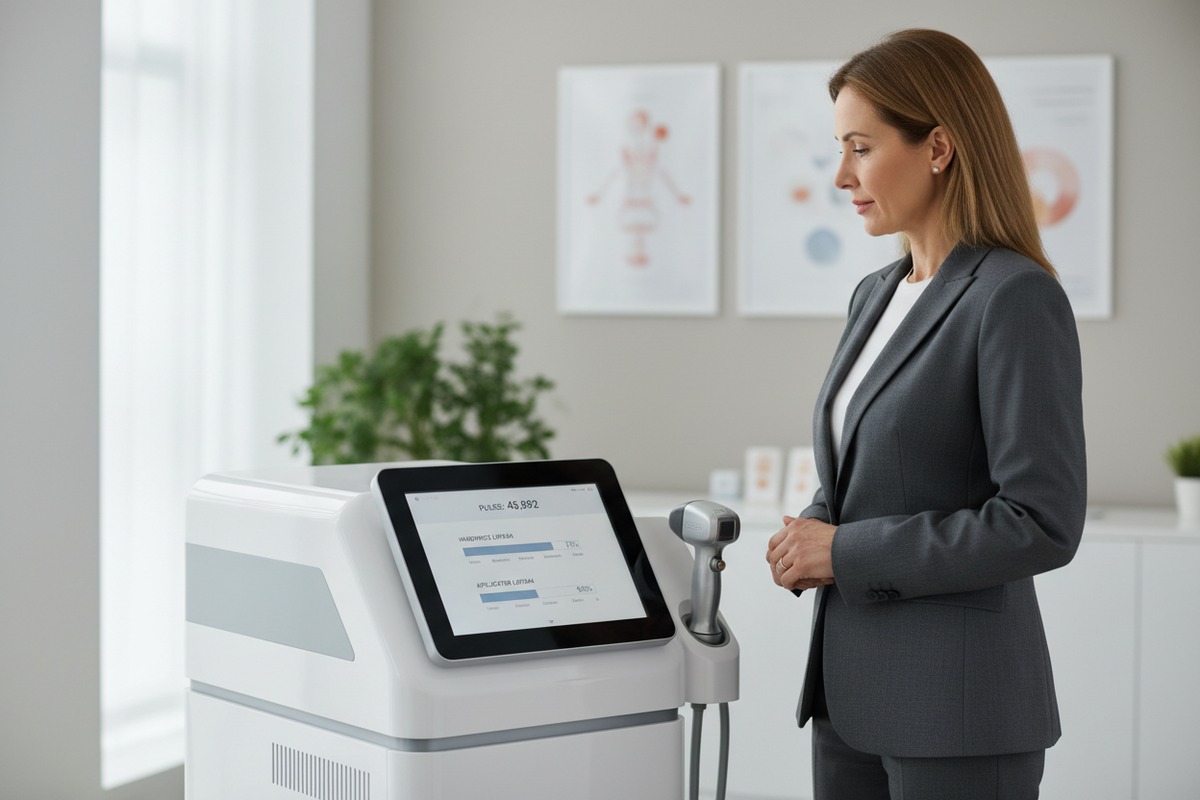
During our years designing shockwave therapy machines 1 on the production floor, we have seen many buyers overlook one critical detail: the smart counting system 2. Without accurate tracking, clinics face surprise consumable costs and unexpected downtime. This pain hits hard when your customers complain about failed treatments or inflated operating expenses.
To evaluate smart counting for consumable management, verify the counter accuracy through live demos, check if the system tracks individual component lifespans, assess data export capabilities for cost analysis, and confirm the software supports your branding needs. These factors directly impact your ROI and operational efficiency.
Let me walk you through each key evaluation area calibration certificates 3. By the end of this guide, you will know exactly what questions to ask and what features to demand from your shockwave machine supplier.
How can I verify that the smart counting system accurately tracks the lifespan of my shockwave consumables?
When our engineers test new smart counting modules, they run thousands of simulated sessions to catch any drift in accuracy predictive reordering 4. Many buyers assume all counters work the same way, but that assumption leads to costly surprises. A counter that skips pulses or double-counts shocks will give you false data.
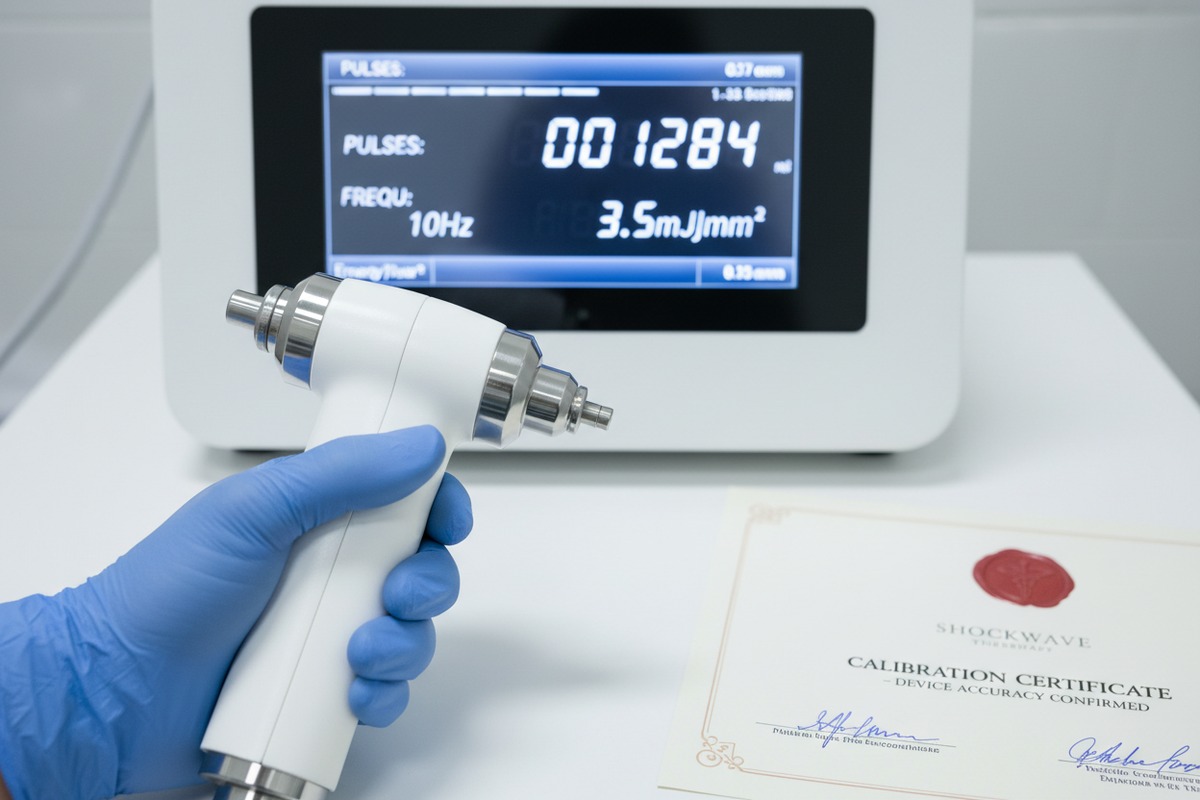
You can verify smart counting accuracy by requesting a live demonstration where you manually count shocks against the digital display, reviewing calibration certificates, checking for third-party validation reports, and testing the counter across different energy and frequency settings to ensure consistent tracking.
Why Accuracy Matters for Your Business
An inaccurate counter creates two major problems. First, you cannot predict when to replace consumables like bullets or handpieces. Second, your cost-per-treatment calculations become unreliable. If a bullet is rated for 3 million shocks but your counter reads high, you will replace parts too early and waste money. If it reads low, you risk equipment failure during patient treatment.
Our testing protocols involve running 10,000 consecutive shocks at various settings. We compare the digital readout against a calibrated external counter. The variance should stay below 0.5% for professional-grade equipment.
Testing Protocol for Buyers
Here is a simple verification process you can follow during equipment evaluation:
| Step | Action | What to Check |
|---|---|---|
| 1 | Request factory calibration certificate | Date, technician signature, variance percentage |
| 2 | Run 100 manual shocks at low energy | Compare your count vs. display count |
| 3 | Run 100 shocks at maximum energy | Check if energy level affects counting |
| 4 | Test at 1 Hz and 10 Hz frequencies | Verify count stays accurate at different speeds |
| 5 | Review data log export | Confirm each session is recorded separately |
Hidden Factors That Affect Counter Accuracy
Temperature can cause electronic drift 5 in cheap sensors. Humidity affects some optical counting mechanisms. Power fluctuations in clinics with unstable electricity may cause miscounts. Ask your supplier how their counting system handles these environmental variables.
Some machines use mechanical counters that physically click with each shock. These are reliable but cannot transmit data digitally. Electronic counters enable software integration but require better quality control during manufacturing. At our facility, we use industrial-grade sensors rated for medical environments.
The best systems include self-diagnostic features. They alert users when the counter needs recalibration. This proactive approach prevents gradual drift from corrupting your usage data over months or years.
How will a smart counting feature help my distributors manage their inventory of replacement bullets and heads?
From our experience supporting distributors across North America and Europe, inventory management 6 is often their biggest operational challenge. They order too many bullets and tie up capital. Or they run out and lose sales to competitors. Smart counting data solves this problem when implemented correctly.
Smart counting helps distributors by providing real-time usage data from deployed machines, enabling predictive reordering based on consumption patterns, reducing stockouts through automated low-inventory alerts, and minimizing excess inventory by matching orders to actual demand rather than guesswork.

From Reactive to Predictive Inventory Management
Traditional inventory management is reactive. Distributors wait until customers call to order replacement parts. This creates rush orders, higher shipping costs, and occasional stockouts that damage customer relationships.
Smart counting transforms this into a predictive model. When machines report usage data back to a central system, distributors see exactly how many shocks each customer has delivered. They know which bullets are approaching end-of-life weeks before the clinic notices.
Data Flow Architecture
The best smart counting systems work like this:
| Component | Function | Benefit |
|---|---|---|
| Machine counter | Tracks shocks per consumable | Accurate usage data |
| Cloud sync module | Uploads data to central server | Real-time visibility |
| Distributor dashboard | Displays all customer usage | Portfolio-wide insights |
| Alert system | Triggers at 80% consumable life | Proactive outreach |
| Order automation | Suggests reorder quantities | Reduced manual work |
Calculating Inventory Needs
Let me show you a practical example. Assume your distributor serves 50 clinics. Each clinic averages 20 treatments per week at 1,500 shocks per treatment. That equals 30,000 shocks per clinic weekly, or 1.5 million shocks monthly per clinic.
If bullets are rated for 3 million shocks, each clinic needs roughly one bullet every two months. Your distributor should stock about 25 bullets to cover the monthly replacement cycle plus a safety buffer.
Without smart counting data, distributors guess. With it, they calculate precisely. They can even segment customers by usage intensity and prioritize high-volume clinics for proactive service calls.
Supporting Your Distribution Network
When we ship machines to brand owners, we provide documentation on integrating smart counting data with common inventory systems. Some distributors use simple spreadsheets. Others connect to enterprise resource planning software. The key is making the data accessible and actionable.
Consider requiring your equipment supplier to provide API access for the counting data. This allows your technical team to build custom integrations with your existing business systems. Standardized data export formats like CSV or JSON simplify this process.
Can I customize the smart counting software interface to match my private label brand requirements?
Our development team works closely with brand owners who need complete control over their product presentation. The software interface is often the first thing clinic staff see every day. If it displays another company's logo or uses generic styling, your brand identity suffers.
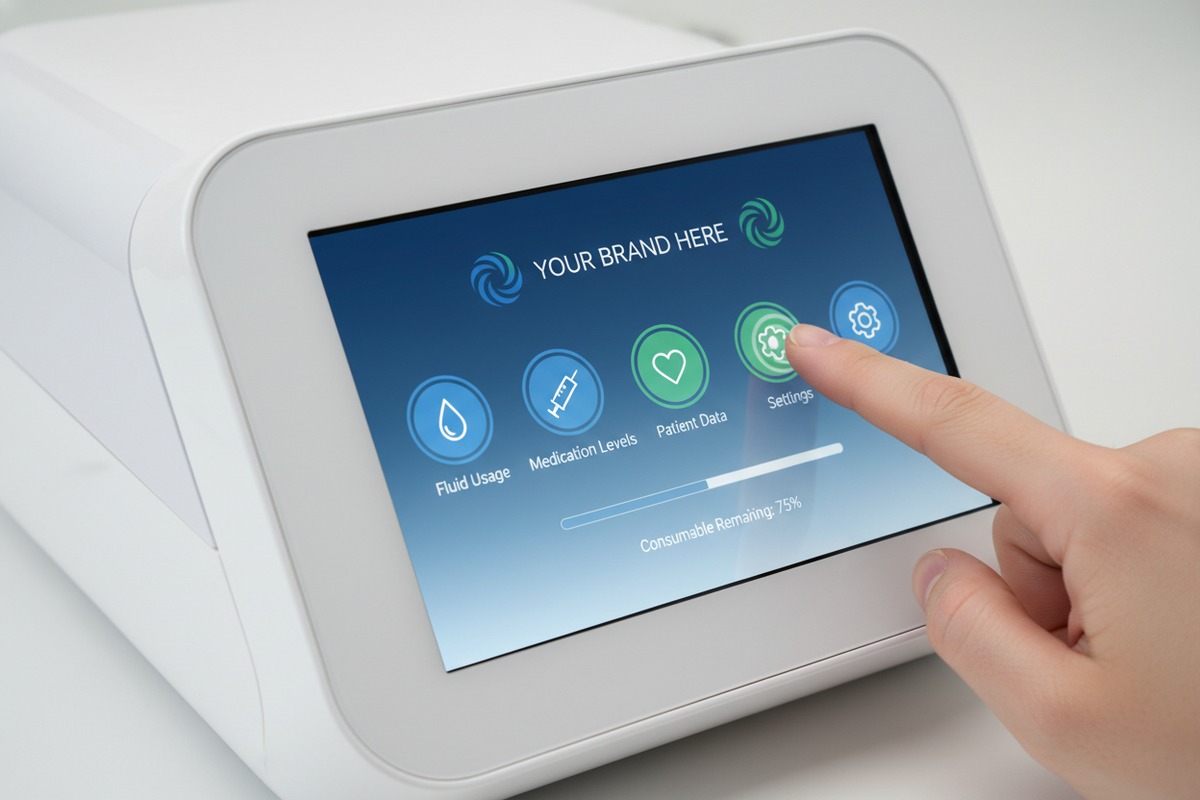
Yes, professional manufacturers offer full software customization including your logo, brand colors, custom terminology, personalized startup screens, and white-labeled reports. This ensures the smart counting interface reinforces your brand identity at every touchpoint rather than appearing as a generic or competitor-branded product.
Levels of Software Customization
Not all suppliers offer the same customization depth. Here is what to ask about:
| Customization Level | Features | Typical Lead Time |
|---|---|---|
| Basic branding | Logo replacement, primary color | 1-2 weeks |
| Interface redesign | Full color scheme, button styles, fonts | 3-4 weeks |
| Functional changes | Custom data fields, report formats | 6-8 weeks |
| Complete white-label | Unique interface, proprietary features | 12+ weeks |
What Should Be Customizable
The smart counting interface typically includes several screens. Each presents branding opportunities:
Startup screen: Your logo and tagline appear when the machine powers on. This sets the tone for the user experience.
Main dashboard: Shows current consumable status, remaining shocks, and session history. Colors and layout should match your brand guidelines.
Reports and exports: PDF reports sent to clinics should carry your branding, not the manufacturer's logo.
Alert messages: When consumables approach replacement thresholds, notifications should come from your brand.
User manual integration: On-screen help should reference your support channels, not the factory's.
Protecting Your Brand Investment
When you invest in building brand recognition, every detail matters. Imagine a clinic owner seeing a competitor's name in a corner of the software. Or a generic interface that looks identical to five other brands on the market. This undermines your positioning.
At our facility, we maintain strict separation between client brands. Each private label partner gets a unique software build. We sign non-disclosure agreements and never cross-promote between brands.
Ask potential suppliers these questions:
- Can I see examples of previous private label software projects?
- Who owns the customized software code?
- How are software updates handled without losing my branding?
- Can I make changes after initial deployment?
Technical Requirements for Customization
Your supplier needs access to your brand assets in specific formats. Prepare these materials before starting the customization process:
- Vector logo files in SVG or AI format
- Brand color codes in hex and RGB
- Typography specifications and font files
- User interface guidelines if available
- Approved terminology and product naming
The more complete your brand kit, the faster and more accurate the customization process becomes.
How does the smart counting data help my service team provide better maintenance support to my customers?
When our service engineers analyze warranty claims, they consistently find one pattern: problems that could have been prevented with better usage data. Smart counting does not just track consumables. It creates a complete picture of how each machine is being used, enabling truly proactive maintenance 8.
Smart counting data helps service teams by identifying abnormal usage patterns that indicate potential problems, tracking component wear for predictive maintenance scheduling, providing diagnostic information for faster troubleshooting, and documenting complete service histories that improve future support quality.
From Break-Fix to Preventive Service
Traditional service models wait for something to break. The customer calls angry. The service team scrambles to diagnose the problem. Everyone loses time and money.
Smart counting enables a different approach. Your service team monitors usage data across all deployed machines. They spot patterns before failures occur. High-energy usage at maximum frequency might indicate a clinic that needs training on proper protocols. Sudden drops in session counts might reveal a developing technical issue.
Key Metrics for Service Teams
| Metric | Normal Range | Warning Signs |
|---|---|---|
| Shocks per session | 1,000-2,500 | Consistently above 3,000 |
| Sessions per day | 5-15 | Sudden drop below 3 |
| Energy setting | Varied by treatment | Always at maximum |
| Frequency setting | 5-10 Hz typical | Consistently at extremes |
| Counter reset patterns | Match bullet changes | Frequent unexplained resets |
Building Customer Relationships Through Data
Imagine calling a customer before they experience a problem. Your service representative says: "We noticed your machine delivered 2.8 million shocks on the current bullet. You are approaching the 3 million limit. Would you like us to ship a replacement?"
This proactive approach transforms service from a cost center into a relationship builder. Customers feel cared for. They stay loyal to your brand. They refer colleagues.
Diagnostic Benefits
When problems do occur, smart counting data speeds resolution. Instead of asking customers vague questions about usage patterns, your service team pulls actual data:
- When did the issue start relative to usage history?
- What settings were being used when symptoms appeared?
- Has the usage pattern changed recently?
- Is the consumable within expected lifespan?
This information eliminates guesswork. Technicians arrive with the right parts and knowledge. First-visit fix rates improve dramatically.
Training Opportunities
Smart counting data also reveals training needs. If a clinic consistently uses excessive energy levels, they might benefit from protocol education. If another clinic barely uses their machine, they might need help integrating it into their practice.
Your service team becomes a strategic partner, not just a repair resource. They help customers get better outcomes from their investment. This value-added service justifies premium pricing and strengthens competitive positioning.
Data Security Considerations
Service data access requires careful management. Establish clear policies about:
- Who can view individual customer data
- How data is protected during transmission and storage
- Customer consent requirements for monitoring
- Data retention and deletion policies
Transparency builds trust. Inform customers about data collection and how it benefits them through better service.
Conclusion
Smart counting systems are no longer optional features when evaluating shockwave therapy machines. They directly impact your ROI calculations, distributor operations, brand presentation, and service quality. Take time to verify accuracy, assess customization options, and understand data capabilities before making your purchasing decision.
Footnotes
1. Provides an overview of shockwave therapy, its uses, and how it works. ↩︎
2. Explains how smart counting systems provide real-time digital counts for tracking. ↩︎
3. Details the importance of calibration certificates for accuracy and reliability of measuring devices. ↩︎
4. Discusses how predictive replenishment models optimize stock levels and prevent stockouts. ↩︎
5. Explains causes of sensor drift, including environmental changes and component aging. ↩︎
6. Outlines best practices for managing medical supply inventory, including automation. ↩︎
7. Highlights the importance of customizable software platforms for medical technology success. ↩︎
8. Replaced with an authoritative Wikipedia definition of proactive maintenance. ↩︎

 English
  Español de México
  Deutsch
  Français
  العربية
  Русский