

When our production team sources lithium batteries 1 for portable pressotherapy machines, we often face a frustrating question: Will this shipment clear air cargo compliance checks? Battery-powered wellness devices have become incredibly popular packaging instructions PI 965 2. But strict aviation rules can delay your entire import order if you miss even one compliance detail.
Aviation battery regulations for sourcing portable pressotherapy machines include IATA Dangerous Goods Regulations (DGR), UN38.3 testing certification, and ICAO Technical Instructions. Lithium-ion batteries under 100Wh ship freely, while 101-160Wh requires airline approval. From January 2026, a mandatory 30% state of charge limit applies to batteries packed with equipment during air transport.
Let’s break down each regulation step by step. Below, we cover compliance testing, shipping timelines, battery customization options, and quality control measures that protect your shipments from costly delays.
How do I ensure my portable pressotherapy machine batteries comply with IATA and UN38.3 standards?
Our engineering team has seen many importers struggle with battery documentation. They source pressotherapy machines without checking if the batteries meet international transport standards 3. This leads to rejected cargo at airports and unexpected costs.
To ensure compliance, your batteries must pass UN38.3 testing and meet IATA DGR packing instructions. This includes altitude simulation, thermal tests, vibration tests, shock tests, short circuit tests, and overcharge tests. All batteries must also carry proper labeling with UN numbers, hazard class markings, and Watt-hour ratings clearly visible on the packaging.

Understanding UN38.3 Testing Requirements
The United Nations regulates the global transport of dangerous goods through the UN Manual of Tests and Criteria 4. For lithium batteries, section UN 38.3 sets strict safety standards that must be confirmed through specific tests.
Batteries must undergo rigorous tests such as altitude simulation 5, thermal, vibration, and shock tests to ensure they can withstand various conditions during transit. When we select battery suppliers for our pressotherapy machines, we always request the full UN38.3 test report as a baseline requirement.
Key Battery Classifications for Air Transport
| Battery Type | UN Number (Alone) | UN Number (With Equipment) | Wh Limit | Special Conditions |
|---|---|---|---|---|
| Lithium-ion (Rechargeable) | UN3480 | UN3481 | ≤100Wh standard | No approval needed |
| Lithium-ion (Rechargeable) | UN3480 | UN3481 | 101-160Wh | Airline approval required |
| Lithium-ion (Rechargeable) | UN3480 | UN3481 | >160Wh | Cargo aircraft only |
| Lithium Metal (Non-rechargeable) | UN3090 | UN3091 | ≤2g lithium | Carry-on for spares |
Lithium metal (non-rechargeable) batteries are limited to 2 grams of lithium per battery. Lithium ion (rechargeable) batteries are limited to a rating of 100 watt hours (Wh) per battery.
Packing Instructions That Matter
Lithium-ion batteries 6 follow packaging instructions PI 965 (loose batteries) or PI 966/967 (with equipment). Lithium-metal batteries follow PI 968 (loose batteries) or PI 969/970 (with equipment).
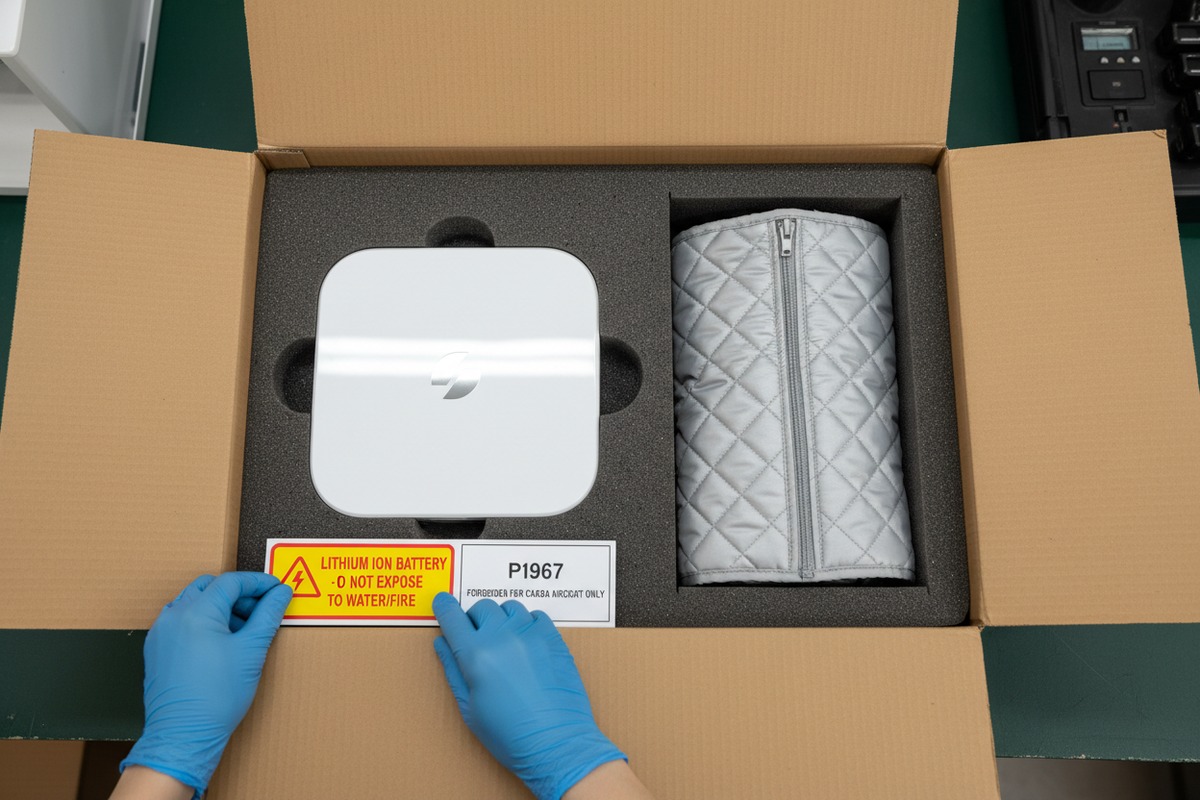
For our portable pressotherapy machines, the batteries typically ship installed in the equipment. This falls under PI967 for lithium-ion batteries contained in equipment. Our quality team ensures each unit ships with batteries properly secured and protected from short circuits.
Documentation Checklist for Compliance
Before shipping, verify you have:
- UN38.3 test summary document
- Material Safety Data Sheet (MSDS)
- Shipper's declaration for dangerous goods 7
- Proper outer packaging with required markings
- Watt-hour rating clearly labeled on battery
Enterprises should comprehensively assess product compliance. Compare new regulation requirements, check product compliance in classification, labeling, packaging, documentation, etc., identify gaps, and rectify in a timely manner.
What impact will aviation battery regulations have on my door-to-door shipping timeline and costs?
When our logistics team handles international shipments of pressotherapy machines from Guangzhou to the US, we track every regulation change. New battery rules can add days to transit times and hundreds of dollars to freight costs if you're not prepared.
Aviation battery regulations typically add 2-5 days to door-to-door shipping timelines and 20-40% to base air freight rates. The January 2026 mandatory 30% state of charge requirement creates additional handling steps. Non-compliant shipments face rejection, re-routing to sea freight, or return to origin—adding weeks to delivery schedules.

How the 2026 Regulations Change Everything
The current recommended limits on state of charge for lithium batteries during transport aboard aircraft will become mandatory requirements as of January 1, 2026, when the updated IATA Dangerous Goods Regulations (DGR) takes effect.
Starting January 1, 2026, lithium ion batteries packed with equipment where the cells/batteries have a Watt-hour rating greater than 2.7 Wh must be offered for transport at a state of charge not exceeding 30% of their rated design capacity.
This means our factory must now discharge batteries before packing them with pressotherapy machines. This extra step adds labor time and requires verification processes.
Cost Impact Breakdown
| Cost Factor | Before 2026 | After 2026 | Impact |
|---|---|---|---|
| Base Air Freight (per kg) | $3-9 | $3.60-12.60 | +20-40% |
| Battery Handling Fee | $50-100 | $100-200 | Additional charges |
| Compliance Documentation | $50-150 | $100-250 | More complex paperwork |
| Rejection Risk Cost | Low | Medium | Potential delays |
| SOC Verification | None | Required | New labor cost |
Dangerous goods, lithium batteries, pharmaceuticals, and perishables require special handling and certifications, adding 20-40% to base rates.
Timeline Considerations
Delays at the cargo terminal, rejected shipments, or compliance violations create cascading problems: disappointed customers, damaged business relationships, and potential regulatory penalties.
When we plan shipments, we build in buffer time for:
- Pre-shipment battery state of charge adjustment
- Documentation review and approval
- Potential airline operator verification requests
- Customs clearance with dangerous goods declaration
Alternative Shipping Options
For cost-sensitive orders, consider sea freight. Most lithium battery shipments also involve a road or rail leg, for example between factories, warehouses, ports, and airports. Road and rail movements are regulated regionally (ADR in Europe, 49CFR in the US, RID for rail, etc.).
Sea freight takes longer but avoids the strictest air transport restrictions. Our logistics team often recommends splitting urgent samples by air and bulk orders by sea to balance speed and cost.
Can I customize the battery specifications for my private-label brand while still meeting international safety requirements?
When our OEM partners ask about custom battery options for their branded pressotherapy machines, they worry about compliance complexity. Can they get the exact capacity they want without breaking transport rules? The answer is yes—with proper planning.
You can customize battery specifications including capacity, form factor, and connector types while meeting international safety requirements. Custom batteries must still pass UN38.3 testing, maintain Wh ratings within transport limits, and include proper labeling. Working with certified battery manufacturers who understand aviation regulations ensures your private-label products ship without compliance issues.
What You Can Customize
Custom lithium-ion battery packs address specific certification requirements during the initial design phase rather than adapting existing solutions to meet standards. This approach allows engineers to build safety features directly into the battery architecture.
For pressotherapy machines, common customization options include:
- Battery capacity (within Wh limits)
- Physical dimensions and form factor
- Connector type and polarity
- Charging speed and voltage
- Battery management system 9 (BMS) features
- External casing design with your branding
Safety Certifications for Custom Batteries
| Certification | Purpose | Region | Required For |
|---|---|---|---|
| UN38.3 | Transport safety | Global | All air/sea shipments |
| IEC 62133 | Consumer safety | International | Consumer electronics |
| UL 2054/1642 | Product safety | North America | US/Canada market |
| CE Marking | Compliance | Europe | EU market entry |
| KC Mark | Safety certification | South Korea | Korean market |
The certification process for lithium battery design encompasses multiple regulatory frameworks. UN38.3 establishes transport safety requirements, IEC 62133 governs consumer applications, UL standards control U.S. market access, and CE marking enables European distribution.
Labeling Requirements for Private-Label Batteries
To comply with battery labeling requirements, it's essential to include the battery type, voltage, energy capacity, and rechargeability on durable, easy-to-view labels. You should also provide clear safety warnings and instructions for proper usage and disposal.
Your custom battery labels must include:
- Your brand name (with underlying compliance data)
- Battery chemistry type (Li-ion, LiPo, etc.)
- Watt-hour (Wh) rating
- Voltage (V) and capacity (Ah/mAh)
- Recycling symbol and disposal instructions
- UN number for shipping purposes
Balancing Customization with Compliance
Pre-certified components can significantly reduce testing timeframes and sample requirements. Battery management systems, protection circuits, and individual cells that have already passed certification testing allow manufacturers to focus testing efforts on system-level integration rather than component-level validation.
Our engineering team recommends:
- Start with pre-certified cells from reputable suppliers
- Design custom BMS around proven protection circuits
- Keep Wh ratings under 100Wh when possible for easier shipping
- Plan for UN38.3 testing timeline (typically 2-4 weeks)
- Document everything for traceability
Custom batteries can be compliant with international safety standards. As a build to spec manufacturer, certifications are obtained based on whatever requirements are needed by the client.
How does your factory manage quality control to prevent battery malfunctions during air transport to my warehouse?
At our production facility in Guangzhou, battery quality control is not optional—it's built into every step of manufacturing. One defective battery cell can ground an entire shipment. We've developed systematic processes to prevent this from ever affecting our customers.
Our factory implements multi-stage quality control including incoming battery cell inspection, capacity and voltage verification, short circuit protection testing, thermal stress testing, and pre-shipment SOC verification. Each battery passes individual testing before installation, with traceability records maintained for regulatory compliance and warranty support.

Multi-Stage Quality Control Process
Lithium-ion batteries are required to undergo safety testing. All lithium-ion batteries are capable of overheating and experiencing a process called thermal runaway. Thermal runaway can occur without warning as a result of various factors, including if the battery is damaged, overheated, exposed to water, overcharged, or improperly protected.
Our QC process addresses each risk factor:
Incoming Material Inspection
Every battery cell lot receives:
- Visual inspection for physical damage
- Voltage measurement verification
- Capacity spot-check testing
- Documentation review (UN38.3 certificates)
- Supplier qualification verification
Production Line Testing
| Test Stage | What We Check | Pass Criteria | Action if Fail |
|---|---|---|---|
| Cell Matching | Voltage variance | Within ±0.02V | Reject cell |
| BMS Verification | Protection circuits | All triggers work | Replace BMS |
| Charge Test | Full charge cycle | Reaches rated capacity | Reject pack |
| Discharge Test | Capacity delivery | ≥95% rated capacity | Reject pack |
| Short Circuit Test | Protection response | BMS cuts power <1ms | Reject pack |
Pre-Shipment Protocols
Spare (uninstalled) lithium ion and lithium metal batteries must be carried in carry-on baggage only. When a carry-on bag is checked at the gate or at planeside, all spare lithium batteries and power banks must be removed from the bag and kept with the passenger in the aircraft cabin.
For air freight shipments, our warehouse team:
- Verifies state of charge is within required limits
- Inspects packaging for damage protection
- Confirms terminal protection against short circuits
- Applies correct hazard labels and markings
- Completes dangerous goods documentation
Preventing Common Transport Failures
Damaged or recalled batteries and battery-powered devices, which are likely to create sparks or generate a dangerous evolution of heat must not be carried aboard an aircraft unless the damaged or recalled battery has been removed, or otherwise made safe.
We maintain a rejection protocol for any battery showing:
- Swelling or deformation
- Electrolyte leakage
- Terminal corrosion
- Abnormal temperature during testing
- Inconsistent voltage readings
Traceability and Documentation
Train your team. Anyone handling battery shipments must complete dangerous goods training. Ensure your facilities and partners have an emergency response plan and clear standard operation procedures (SOPs).
Our quality records include:
- Battery cell lot numbers and supplier certificates
- Individual unit test results
- Production date and shift information
- QC inspector identification
- Packaging verification photos
- Shipping documentation copies
This traceability allows us to quickly investigate any issues and provide warranty support with confidence.
Conclusion
Aviation battery regulations for portable pressotherapy machines require attention to UN38.3 testing, IATA packing instructions, Wh limits, and new 2026 SOC requirements. Our factory maintains rigorous quality control to ensure compliant shipments. Contact us to discuss your sourcing needs and let our team handle the compliance complexity for you.
Footnotes
1. Provides a comprehensive overview of lithium-ion battery technology and characteristics. ↩︎
2. Explains IATA Packing Instruction 965 for lithium-ion batteries shipped alone. ↩︎
3. Original link was HTTP 404. Replaced with IATA’s official Dangerous Goods Regulations page, an authoritative source for international air transport standards. ↩︎
4. Official United Nations source for the Manual of Tests and Criteria for dangerous goods. ↩︎
5. Provides detailed explanation of the T1 altitude simulation test for lithium batteries. ↩︎
6. Defines lithium-ion batteries, their characteristics, and common applications. ↩︎
7. Official IATA page explaining the Shipper’s Declaration for Dangerous Goods. ↩︎
8. Official International Maritime Organization page describing the IMDG Code for sea transport. ↩︎
9. Explains the functions and importance of a battery management system in battery packs. ↩︎

 English
 Español de México
 Deutsch
 Français
 العربية
 Русский
