
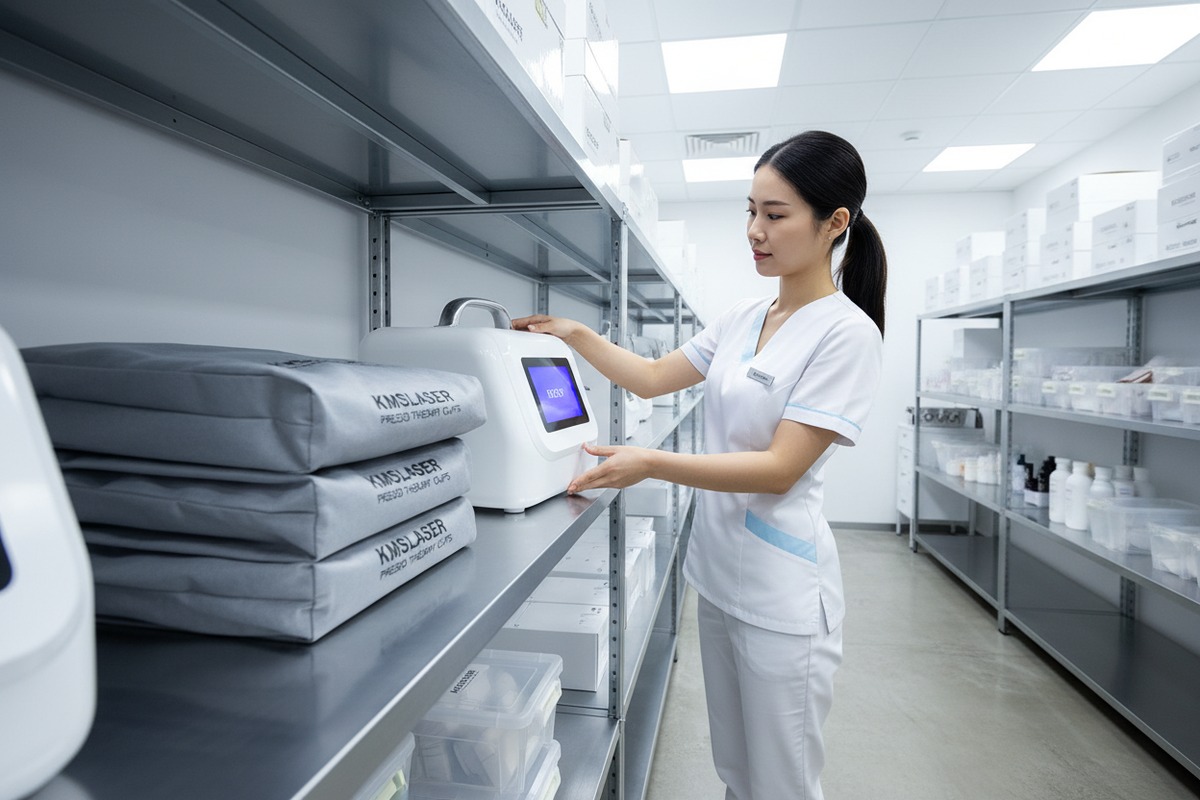
Running a busy beauty academy means managing space, equipment, and student rotations every single day physical footprint 1. Our production team has seen countless training facilities struggle with cluttered storage rooms and tangled accessories. The machines pile up. The garments get creased. Classes get disrupted. This is a real problem for educators who need quick setup and teardown between sessions.
To evaluate storage convenience, check the machine’s physical footprint, portability features like wheels and handles, accessory management systems, and packaging design. Prioritize compact, modular units with quick-connect hoses and breathable storage bags that fit your academy’s workflow and environmental conditions.
This guide walks you through every factor to consider quick-release hose connections 2. We will cover floor space needs, transport options, accessory organization, and packaging efficiency. Each section gives you practical steps to make smarter sourcing decisions.
How much floor space will these pressotherapy machines occupy in my academy's storage area?
Space is always tight in training facilities. When we design pressotherapy systems for academy buyers, we keep hearing the same concern: "Where will this actually fit?" A cramped storage closet or a shared classroom cannot handle bulky equipment without problems.
Most professional pressotherapy machines require a footprint of roughly 2 to 4 square feet for the control unit alone. When you add the full garment set—leg boots, arm sleeves, and abdominal binders—plan for at least 1.5 meters of clearance around the unit and dedicated shelf space for accessories.

Understanding Control Unit Dimensions
The central control unit 3 is the heart of any pressotherapy system. Compact tabletop models typically measure around 56cm x 37cm x 30cm (approximately 22" x 15" x 12"). These fit on a standard treatment cart or storage shelf. Larger vertical units with integrated displays may have packaging dimensions around 38.6" x 23.2" x 17.7". Always check the actual machine dimensions, not just the box size.
Calculating Total Storage Needs
Your total storage footprint includes more than the machine itself. Consider these components:
| Component | Typical Dimensions | Storage Notes |
|---|---|---|
| Control Unit | 50-60cm width | Needs stable, flat surface |
| Leg Boots (pair) | 80-100cm length | Roll, do not fold |
| Arm Sleeves (pair) | 60-70cm length | Store flat or rolled |
| Abdominal Binder | 40-50cm width | Avoid creasing |
| Air Hoses | 1.5-2m length | Coil loosely |
Space Planning Tips
Measure your storage area before ordering. Count how many machines you need for simultaneous student use. If you run four training stations, you need space for four complete sets. Vertical storage solutions like wall racks or tiered trolleys can save floor space. Keep a 1.5-meter clearance zone around any unit during operation—this protects ventilation fans and allows easy student access.
Modular vs. All-in-One Designs
Modular systems let you store components separately. All-in-one designs keep everything together but take more space. For academies with limited closet storage, modular units with detachable garments offer flexibility. You can stack control units and hang garments on hooks without blocking walkways.
Can my team easily move and transport these units between different training rooms?
Academies rarely use equipment in one fixed location. Students rotate between classrooms. Instructors set up demonstrations in multiple rooms. When we ship machines to training centers, portability is always a key question. A machine that cannot move easily wastes time and energy.
Yes, your team can move most professional pressotherapy units if you choose models with built-in wheels, lightweight designs under 15kg for the control unit, or battery-powered options. Look for quick-release hose connections and carrying handles to reduce setup time to under five minutes per station.

Key Portability Features
Not all machines move the same way. Here are the features that matter most:
| Feature | Benefit | Academy Impact |
|---|---|---|
| Wheeled Base | Roll between rooms | No heavy lifting |
| Battery Power | No cord dependency | Quick repositioning |
| Lightweight (<15kg) | Easy to carry | One-person operation |
| Carrying Handle | Secure grip | Safer transport |
| Quick-Connect Hoses | Fast setup | Under 5 min prep |
Weight Considerations
Professional pressotherapy units typically weigh between 12kg and 50kg depending on features. Some units have a net weight of 12kg with gross weight of 13kg including packaging. Portable models like the CarePump series weigh around 2kg for the device alone, or about 3kg with cuffs and cables. For academy use, aim for control units under 20kg. Heavier units need trolleys or wheeled carts.
Setup and Teardown Time
Every minute spent on setup is a minute lost from training. Compact and portable system designs are ideal for professional beauty centers. Look for machines with:
- Quick-release air hose connectors
- Zipper or velcro garment fastenings
- Pre-programmed treatment modes
- Clear labeling on all connections
Transport Between Rooms
If your academy has multiple floors, consider elevator access. Stairs make heavy equipment impractical. For single-floor facilities, wide doorways and smooth floors help. Non-slip flooring in storage areas prevents accidents when rolling equipment in and out.
Real-World Movement Scenarios
Imagine a typical day: morning class needs two machines, afternoon workshop needs four. Can your staff handle this without strain? Wheeled units with locking casters work best. Battery-powered models add flexibility but require charging schedules. Plan for at least two full treatment cycles on a single charge if you choose cordless options.
What design features should I prioritize to keep the machine accessories organized in my facility?
Accessories cause the most storage headaches. Air hoses tangle. Garments crease. Cuffs pile up in corners. Our quality control team has seen academies ruin expensive compression suits just from poor storage habits. Good organization extends equipment life and speeds up class preparation.
Prioritize machines with dedicated accessory bags, quick-connect hose systems, wipe-clean garment materials, and labeled compartments. Avoid folding compression garments to prevent wire damage. Use breathable storage bags and vertical hanging racks to keep accessories organized and ready for immediate use.

Garment Storage Best Practices
Store presses and clothes in areas protected from direct sunlight, and avoid folding clothes when storing them. Folding can damage internal wiring and air bladders. Instead:
- Roll garments loosely
- Hang on padded hooks
- Store flat in dedicated compartments
- Keep away from sharp objects
Hose Management
Air hoses connect the control unit to each garment chamber. Tangled hoses slow setup and cause wear. Use these methods:
| Method | How It Works | Best For |
|---|---|---|
| Velcro Straps | Wrap hoses in coils | Quick daily storage |
| Hanging Hooks | Suspend hoses vertically | Long-term organization |
| Labeled Bags | Separate by garment type | Multi-machine academies |
| Built-in Holders | Attach to unit body | Compact setups |
Material Durability
The easy-clean wearable accessory is made of PU material 5 with a durable double-layer design and a user-friendly connector. PU (polyurethane) materials resist moisture and wipe clean easily. Look for:
- Waterproof but not machine-washable fabrics
- Reinforced stitching at connection points
- Detachable chamber sections for partial replacement
Hygiene-Storage Overlap
Garments should not be cleaned in the same way as regular clothing and should not be washed in a washing machine. Wipe it gently enough. Avoid wringing, ironing, tumbling, or forcing heat to dry. Always wipe down garments with a damp cloth before storage. Power off the machine first. Never use harsh chemicals or oils on compression suits.
Storage Solutions for Multiple Machines
Large academies may run six or more machines. This means six sets of garments, hoses, and accessories. Consider:
- Multi-tiered trolleys with labeled shelves
- Wall-mounted racks with breathable bags
- Digital inventory tracking for larger facilities
- Color-coded labels for each training station
How does the machine's packaging design impact my long-term inventory storage efficiency?
Packaging matters more than most buyers realize. When we ship machines internationally, we design boxes to protect during transit and support long-term storage. A well-packaged unit stays in better condition between courses or seasonal training cycles. Poor packaging leads to condensation, damage, and early replacement costs.
Durable packaging with foam inserts, moisture-resistant materials, and clear labeling supports efficient inventory storage. Stackable box designs maximize vertical space. Climate-controlled storage between 5°C and 40°C with humidity below 60% protects equipment during off-season periods and ensures machines remain ready for immediate use.

Packaging Features to Look For
| Feature | Storage Benefit | Why It Matters |
|---|---|---|
| Foam Inserts | Shock protection | Prevents damage during stacking |
| Moisture Barrier | Humidity control | Stops condensation buildup |
| Reinforced Corners | Stackability | Saves vertical space |
| Clear Labels | Quick identification | Speeds inventory checks |
| Reusable Design | Long-term storage | Protects between training cycles |
Environmental Storage Requirements
Store the device in a cool, dry place, away from direct sunlight. Avoid placing heavy objects on the hoses and sleeves to prevent deformation. For beauty equipment specifically, maintaining proper humidity levels between 40% and 60% prevents moisture-related issues like mold growth or product spoilage.
Temperature Guidelines
Most pressotherapy machines specify storage temperatures between 5°C and 40°C (41°F to 104°F). After delivery, allow equipment to acclimate for at least two hours before powering on. This prevents condensation inside electronic components. Avoid storing machines:
- In basements prone to flooding
- Near heating vents or radiators
- In direct sunlight from windows
- In unventilated closets
Inventory Rotation Strategies
If your academy stores multiple machines for seasonal programs, rotate stock regularly. Use first-in-first-out principles. Check stored machines quarterly for:
- Moisture damage on packaging
- Hose integrity
- Garment condition
- Control panel functionality
Calculating Total Cost of Ownership
Poor storage leads to premature replacement. A 30-minute session is typically priced between $50 to $150. If damaged equipment forces you to cancel classes, you lose both revenue and student trust. Proper packaging and storage practices extend machine life by two to three times according to vendor guidelines. This directly impacts your academy's return on investment.
Future-Proofing Your Storage System
Plan for growth. If you add two more machines next year, will your current storage handle the load? Modular shelving, wall-mounted racks, and stackable packaging designs give flexibility. Some newer models include integrated carrying cases or wall-mount options that save floor space entirely.
Conclusion
Evaluating storage convenience requires checking dimensions, portability, accessory organization, and packaging quality. Measure your space. Test mobility features. Choose wipe-clean materials and proper storage bags. Control temperature and humidity. These steps protect your investment and keep your academy running smoothly.
Footnotes
1. Replaced HTTP 404 with a general and authoritative definition of ‘footprint’. ↩︎
2. Details quick-connect solutions, their features, and benefits for healthcare devices. ↩︎
3. Explains the role and features of a control unit specifically for medical devices. ↩︎
4. Replaced HTTP 404 with an authoritative source on pressotherapy. ↩︎
5. Provides an authoritative overview of polyurethane applications, including in medical contexts. ↩︎
6. Explains the science and benefits of compression garments for fluid reduction and circulation. ↩︎
7. Explains the benefits of climate-controlled storage for protecting sensitive items from environmental damage. ↩︎

 English
 Español de México
 Deutsch
 Français
 العربية
 Русский
