
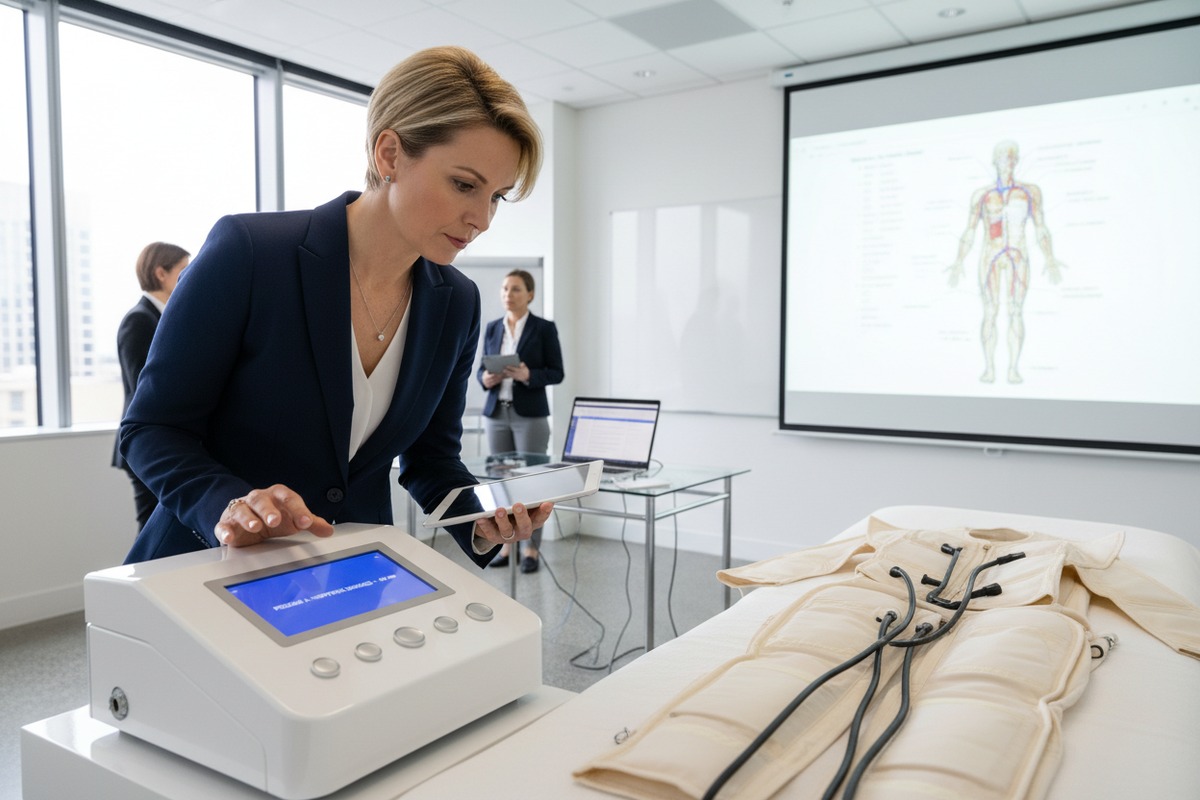
When our production team first integrated pressotherapy machines 1 into beauty training classrooms, we noticed unexpected issues. Screens flickered. Audio systems buzzed. Some devices shut down without warning. These problems frustrated instructors and students alike Shielding specifications 2. The culprit? Poor anti-interference engineering in the equipment we had sourced.
To evaluate pressotherapy machine anti-interference for classroom use, verify electromagnetic compatibility (EMC) certifications such as CE marking, IEC 60601-1-2 compliance, and FCC approval. Request EMC test reports showing emissions and immunity results. Assess compressor noise levels, power stability features, and shielding design before placing your order.
In this article, I will walk you through the practical steps for verifying anti-interference capabilities. You will learn what documents to request, which specifications matter most, and how to ensure your OEM customizations maintain high performance. Let’s dive in.
How can I verify the electromagnetic compatibility of a pressotherapy machine before placing my order?
When we ship pressotherapy units to beauty schools across Europe and North America, EMC compliance 3 is the first thing our quality team checks. A machine that interferes with classroom projectors or Wi-Fi networks creates headaches for everyone. You need proof that the device will operate cleanly in a shared electronic environment.
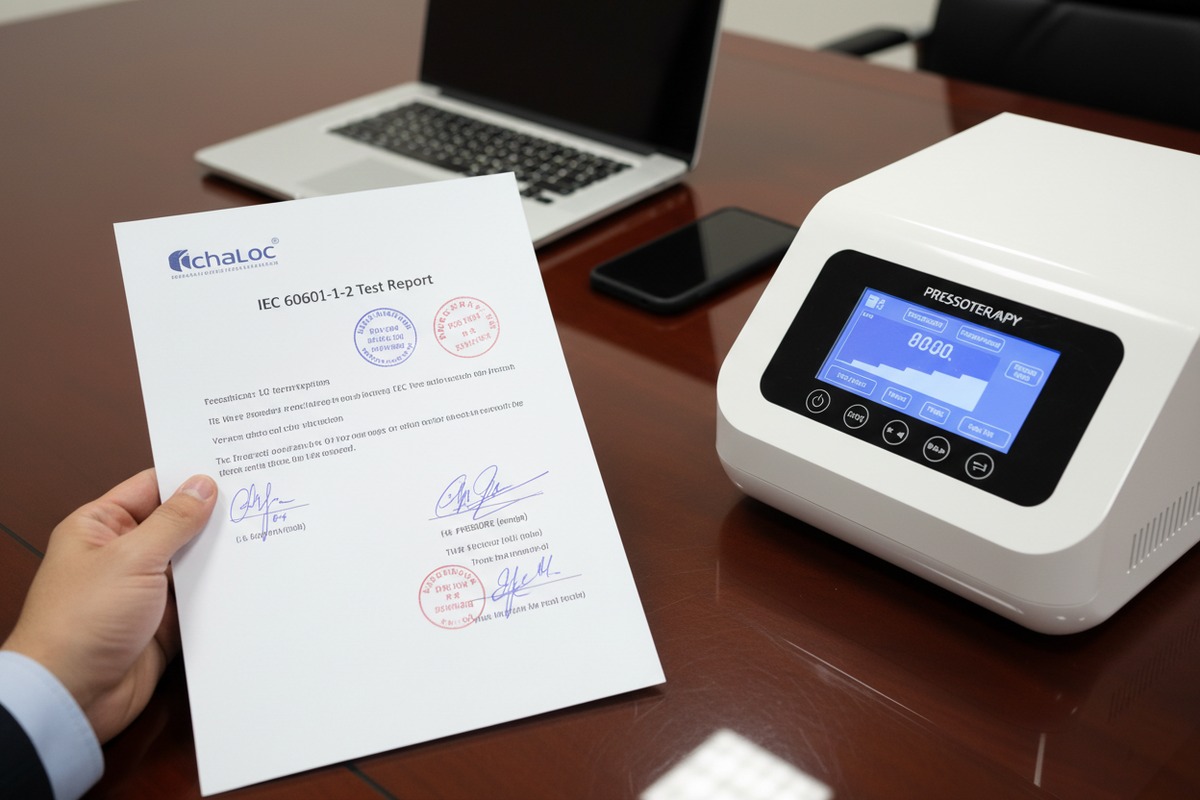
To verify EMC before ordering, request the manufacturer's Declaration of Conformity, IEC 60601-1-2 test reports, and CE or FCC certification documents. These prove the machine has passed emissions and immunity testing. Also ask for CISPR 11 radiated emissions data and IEC 61000-4-2 electrostatic discharge test results.
Understanding EMC Standards for Medical Beauty Equipment
EMC refers to a device's ability to function properly in its electromagnetic environment 4. It must not emit harmful interference. It must also resist external disturbances. For pressotherapy machines, this means the compressor, control circuits, and display should all operate without disrupting other classroom equipment.
The primary standard for medical electrical equipment 5 is IEC 60601-1-2. This standard "specifies the requirements and tests needed for EMC compliance" and "covers both emissions and immunity aspects." Medical device manufacturers must demonstrate their products meet these requirements to sell in regulated markets.
Key Certifications to Request
| Certification | Region | What It Verifies |
|---|---|---|
| CE Marking | Europe | Compliance with EU directives including EMC |
| FCC Part 15 | United States | Limits on radio frequency emissions |
| IEC 60601-1-2 | International | EMC for medical electrical equipment |
| CISPR 11 | International | Emissions limits for ISM equipment |
| ISO 13485 | International | Quality management for medical devices |
When you request these documents, look for actual test data—not just a certificate. The test report should show measured values against acceptable limits. If emissions exceeded limits during testing, the manufacturer should explain what modifications they made.
Emissions vs. Immunity Testing
EMC testing has two main components. Emissions testing measures "electromagnetic energy 6 traveling along the power lines" (conducted emissions) and "electromagnetic energy radiated into the air" (radiated emissions). Your pressotherapy machine must stay within limits so it doesn't disrupt nearby laptops, projectors, or audio equipment.
Immunity testing checks whether the device can withstand external interference. In classrooms, this matters because students carry smartphones, tablets, and laptops. The machine must continue working normally near these devices. IEC 61000-4-3 tests demonstrate that "the medical device will continue to function as intended in the presence of other device's EMI emissions and RF emissions."
Questions to Ask Your Supplier
Before ordering, send these questions to your supplier:
- Can you provide the full IEC 60601-1-2 test report, not just the certificate?
- What immunity test levels was the device tested to?
- Were any modifications made after initial testing to achieve compliance?
- Which accredited laboratory performed the EMC testing?
- Does the device meet both professional healthcare and home healthcare environment requirements?
A reliable supplier will answer these questions directly. If they hesitate or cannot provide documentation, consider it a warning sign.
Why is signal stability critical when I am operating multiple beauty devices in a classroom setting?
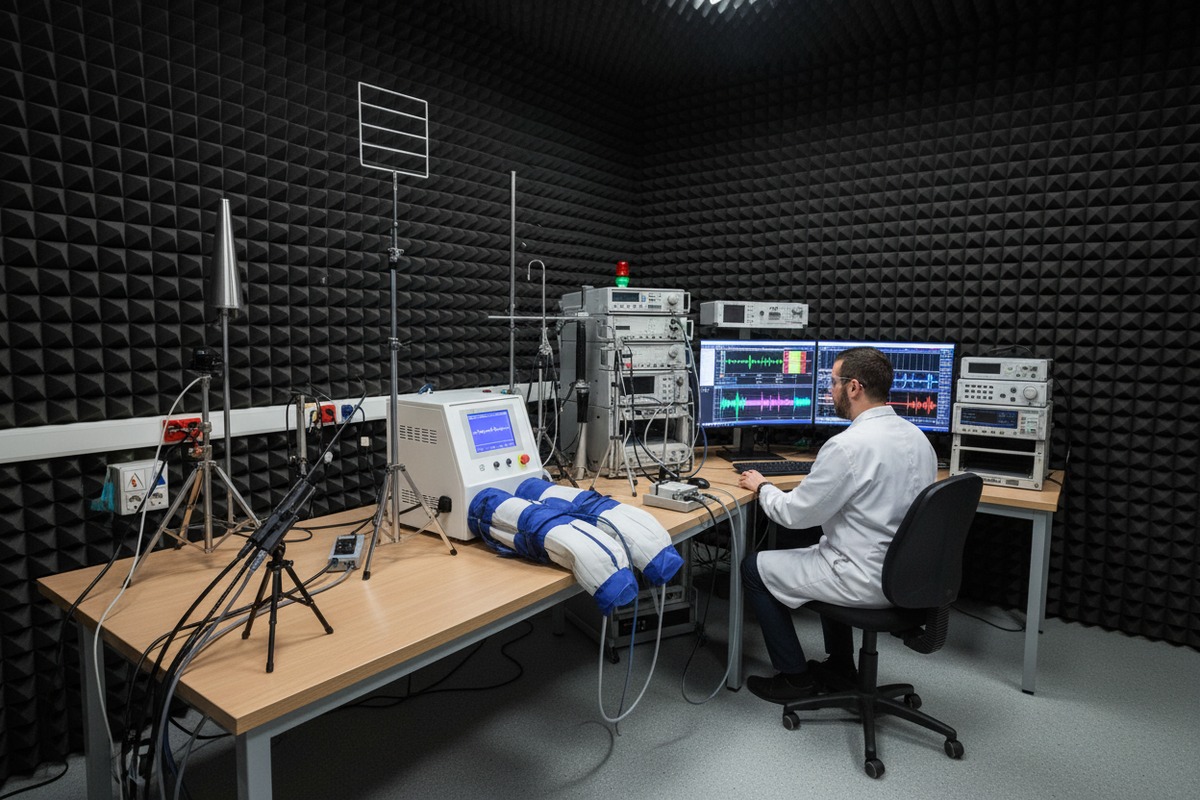
Our engineering team has tested classroom setups with six pressotherapy machines running simultaneously. Without proper anti-interference design, we saw pressure fluctuations, display glitches, and even compressor shutdowns. When you invest in training equipment, you need devices that work reliably—even when the whole class is practicing at once.
Signal stability is critical because multiple beauty devices create a dense electromagnetic environment. Each machine's compressor motor, control board, and display emit interference that can affect neighboring equipment. Poor signal stability causes inaccurate pressure readings, interrupted treatment cycles, inconsistent compressor performance, and disrupted classroom audio-visual systems.
The Multi-Device Interference Challenge
Classrooms present unique EMC challenges. In a spa, you might run one or two machines. In a training classroom, you might run ten. Each device becomes both a source and a potential victim of electromagnetic interference.
The piston compressors in pressotherapy machines generate electromagnetic noise during operation. Motors create conducted emissions that travel through power lines. Control circuits with microcontrollers produce radiated emissions. When multiple units share the same electrical circuit, these effects compound.
Sources of Interference in Classroom Settings
| Interference Source | Type | Impact on Pressotherapy Machines |
|---|---|---|
| Other pressotherapy units | EMI, conducted noise | Pressure reading errors, display corruption |
| Projectors | RF emissions | Control signal interference |
| Wi-Fi routers | 2.4/5 GHz RF | Touchscreen response issues |
| LED lighting | High-frequency noise | Power supply instability |
| HVAC systems | Motor noise | Compressor timing errors |
| Student devices | Bluetooth, Wi-Fi | Cumulative RF background |
As noted in research on signal interference, "electrical equipment emitting strong RFs can also interfere with Bluetooth" and similar wireless technologies. The same principle applies to the sensitive control circuits in pressotherapy machines.
Practical Mitigation Strategies
Beyond selecting equipment with strong EMC credentials, consider these classroom setup practices:
Proper grounding is essential. Each machine needs a dedicated ground connection. Ground loops—where multiple devices share grounding paths—can introduce noise. "Ensuring each piece of equipment has a dedicated connection to a single, low-impedance ground point is crucial."
Physical separation helps reduce cross-interference. Place machines at least one meter apart when possible. Keep power cables away from signal cables and data lines.
Power conditioning may be necessary in older buildings. "Fluctuations and anomalies in the power supply can introduce noise affecting measurements." A quality power conditioner filters electrical noise before it reaches your equipment.
Testing Multi-Device Performance Before Deployment
Before committing to a large classroom order, request a multi-unit test. Our factory provides this service for classroom buyers. We run multiple machines on the same circuit and measure:
- Pressure consistency across all units
- Display stability during simultaneous operation
- Compressor synchronization and timing accuracy
- EMI emissions with all units active
This real-world testing reveals problems that single-unit EMC testing might miss. Ask your supplier if they can demonstrate multi-device performance.
What technical documentation should I request from my supplier to prove their anti-interference engineering?
When we work with distributors buying for classroom use, we provide a complete documentation package. Not all suppliers do this willingly. But without proper documentation, you cannot verify claims about anti-interference performance. Here is exactly what you should request—and why each document matters.
Request IEC 60601-1-2 test reports showing specific emissions and immunity measurements. Ask for CISPR 11 radiated and conducted emissions data. Obtain electrostatic discharge (IEC 61000-4-2), RF immunity (IEC 61000-4-3), and electrical burst immunity (IEC 61000-4-4) test results. Also request design documentation showing shielding, filtering, and grounding strategies.

Essential EMC Test Reports
The foundation of anti-interference verification is the EMC test report. This document contains measured values from laboratory testing. It proves the manufacturer's claims are backed by data.
| Test Standard | What It Measures | Why It Matters for Classrooms |
|---|---|---|
| IEC 61000-4-2 | Electrostatic discharge immunity | Ensures machine survives static electricity from users |
| IEC 61000-4-3 | Radiated RF immunity | Proves resistance to Wi-Fi, phones, other RF sources |
| IEC 61000-4-4 | Electrical fast transient/burst immunity | Verifies stability during power fluctuations |
| IEC 61000-4-5 | Surge immunity | Confirms protection against voltage spikes |
| IEC 61000-4-6 | Conducted RF immunity | Shows resistance to noise on cables |
| CISPR 11 | Radiated and conducted emissions | Measures interference the machine generates |
"ESD Testing, under IEC 60601-1-2 is likely the most difficult measurement of the process" because medical devices must be "significantly more immune to electrostatic discharge" than consumer electronics. In classroom settings with many people moving around, ESD protection is critical.
Design Documentation to Examine
Beyond test reports, ask for engineering documentation that explains the anti-interference design approach:
Shielding specifications describe how the manufacturer blocks EMI. Metal enclosures, conductive gaskets, and shielded cables all reduce interference. "Encasing equipment in conductive enclosures, akin to Faraday cages, effectively blocks external electromagnetic fields."
Filtering documentation shows how the power supply and signal circuits suppress noise. Quality pressotherapy machines include EMI filters on power input lines and signal conditioning on sensor circuits.
Grounding diagrams reveal the internal grounding architecture. Proper grounding prevents ground loops and provides a low-impedance path for interference currents.
Noise and Acoustic Specifications
Anti-interference includes acoustic performance. Compressor noise affects classroom concentration and comfort. Request:
- Decibel (dB) measurements at specific distances
- Noise spectrum analysis showing frequency distribution
- Comparison against classroom ambient noise standards (typically 35-45 dB)
Current market offerings mention "quiet operation," but specific measurements are rare. Push your supplier for actual noise data measured in controlled conditions.
Red Flags in Documentation
Watch for these warning signs in supplier documentation:
- Missing test lab accreditation – Reports should come from accredited laboratories
- Outdated standards – IEC 60601-1-2 Edition 4.1 is current; older editions may not meet requirements
- Generic certificates – Certificates should reference the specific product model
- No deviation explanations – If testing required modifications, the manufacturer should document them
- Reluctance to share reports – Reputable suppliers provide documentation readily
The FDA guidance emphasizes that manufacturers should include "a summary of all voluntary consensus standards used to evaluate EMC" in their submissions. A transparent supplier will share equivalent information with you.
How do I ensure that customized OEM models maintain high-end performance without interference issues?
Our OEM service handles many classroom-specific customizations. We add custom branding, modify treatment protocols, and adjust interface languages. But every change carries risk. A poorly designed modification can compromise the EMC performance of an otherwise excellent machine. Here is how to protect your investment when ordering customized units.
To ensure OEM models maintain anti-interference performance, require re-testing after significant modifications. Insist on documented change control procedures. Verify that suppliers use the same EMI-shielded components in custom builds. Request pre-production samples for classroom environment testing before approving full production.

Modifications That Affect EMC Performance
Not all customizations carry the same risk. Some changes have minimal EMC impact. Others can significantly degrade anti-interference performance.
| Modification Type | EMC Risk Level | Why |
|---|---|---|
| Logo printing on casing | Low | No electrical changes |
| Custom color/finish | Low | Surface treatment only |
| Interface language change | Low | Software modification only |
| Custom power cable length | Medium | Longer cables can increase emissions |
| Different display module | Medium-High | Display electronics affect EMI |
| Modified compressor | High | Motor changes impact emissions directly |
| Custom PCB layout | High | Circuit changes require re-testing |
| Different power supply | High | PSU is critical for EMC |
When ordering OEM pressotherapy machines, understand which components will change. "Qualified manufacturers typically hold export certifications such as CE, RoHS, FCC, and FDA, ensuring products can be legally sold in European and American countries." But these certifications apply to specific configurations. Significant changes may invalidate them.
Documenting Change Control
Professional OEM suppliers maintain rigorous change control 8. They document every modification and assess its impact on compliance. Ask your supplier:
- What is your change control procedure for OEM orders?
- Which modifications trigger EMC re-testing?
- Do you maintain component traceability for custom builds?
- Can you provide a change impact assessment for my customization request?
"Advanced production equipment and strict quality control systems" should include processes that verify EMC performance is maintained through customization.
Pre-Production Testing Requirements
Before approving full production, request pre-production samples. Test these samples in conditions that mirror your classroom environment:
- Run the sample unit alongside other equipment
- Verify pressure accuracy and stability
- Check for display anomalies or control glitches
- Monitor for audio interference with classroom systems
- Test Wi-Fi and Bluetooth connectivity nearby
This hands-on evaluation catches problems that documentation review might miss. Our factory provides sample units for evaluation precisely because we understand how critical this step is.
Maintaining Compliance Through Production
EMC performance can vary unit-to-unit if manufacturing quality control is weak. Components from different suppliers, inconsistent soldering, or improperly seated connectors can all degrade EMC performance.
Quality-focused manufacturers implement multiple inspection stages. "Four stringent quality inspection processes 9: incoming material, random, production, and final inspections" ensure consistency across production runs. Ask your supplier about their quality control checkpoints and whether EMC-critical components are 100% inspected.
Ongoing Support and Updates
Technology evolves. Regulations change. A good OEM partner provides ongoing support:
- Firmware updates that maintain EMC compliance
- Component substitution notifications when parts become obsolete
- Re-certification assistance when regulations update
- Technical support for classroom deployment issues
"Established factories typically hold certifications such as CE, RoHS, FDA, and FCC, and can assist in providing test reports and related documentation" throughout your product's lifecycle, not just at initial purchase.
Conclusion
Selecting pressotherapy machines for classroom use requires careful attention to anti-interference engineering. Verify EMC certifications, request detailed test reports, and test multi-unit configurations before deployment. With proper due diligence, your classroom equipment will operate reliably for years.
Footnotes
1. Replaced HTTP 403 link with an authoritative health information source explaining pressotherapy. ↩︎
2. Details MIL-SPEC EMI shielding materials and their specifications for various applications. ↩︎
3. Provides a comprehensive definition and overview of electromagnetic compatibility. ↩︎
4. Replaced HTTP 404 link with a Wikipedia article providing a comprehensive definition of electromagnetic environment. ↩︎
5. Replaced HTTP unknown link with an authoritative source (BSI Group) on EN 60601 standards for medical electrical equipment. ↩︎
6. Explains what electromagnetic energy is and how it travels through space. ↩︎
7. Provides fundamental information about electrostatic discharge (ESD) and its causes. ↩︎
8. Explains the formal, documented process of change control in manufacturing environments. ↩︎
9. Replaced HTTP 405 link with a comprehensive article defining quality inspection in manufacturing. ↩︎

 English
 Español de México
 Deutsch
 Français
 العربية
 Русский
