
Every week, our quality control team reviews LVD documentation from various suppliers. We have seen everything—from pristine reports to obvious fakes. The stakes are high. A faulty pressotherapy machine can cause electric shock or fire. Your brand reputation depends on electrical safety compliance.
To verify LVD test report compliance, you must check the testing laboratory’s ISO 17025 accreditation, confirm the report covers your exact product model, verify that harmonized standards like IEC 60601 were applied, and cross-reference the Declaration of Conformity with the manufacturer’s technical documentation.
This guide will walk you through the complete verification process. You will learn how to spot red flags, understand technical standards, and protect your business when importing pressotherapy equipment from Chinese manufacturers.
How can I verify the authenticity of an LVD test report from a Chinese pressotherapy machine manufacturer?
Our experience exporting to the US and Europe has taught us one hard truth: fake certificates are everywhere. Many buyers only realize this after customs seizes their goods or a customer gets injured. The cost of poor verification can be devastating.
To verify authenticity, request the original PDF report (not scanned images), check the laboratory's accreditation status on CNAS or ILAC databases, contact the lab directly to confirm the report number, and match the tested product specifications exactly to your purchase order.

Understanding the LVD Framework
The Low Voltage Directive 2014/35/EU 1 applies to electrical equipment operating between 50-1000V AC or 75-1500V DC. Directive 2014/35/EU (LVD) concerns alternating current and direct current electrical equipment with nominal voltage between 50 and 1000 V and between 75 and 1500 V respectively. Most pressotherapy machines operate at 220-240V AC, placing them squarely within this scope.
Devices that pass the required tests and provide the necessary procedures are presented to the market by receiving an LVD Test Report. It is also proved within the scope of this regulation that the product is both structurally safe or complies with the relevant standards and regulations.
Step-by-Step Verification Process
| Step | Action | What to Check |
|---|---|---|
| 1 | Request original documentation | PDF format only, not JPEG or scanned copies |
| 2 | Verify lab accreditation | ISO 17025 status on CNAS, UKAS, or other ILAC members |
| 3 | Contact the laboratory | Confirm report number and tested product details |
| 4 | Match product specifications | Model number, voltage, serial number alignment |
| 5 | Review Declaration of Conformity 2 | Must accompany test report with manufacturer signature |
Checking Laboratory Credentials
In most countries, ISO/IEC 17025 is the standard for which most labs must hold accreditation in order to be deemed technically competent. In many cases, suppliers and regulatory authorities will not accept test or calibration results from a lab that is not accredited.
The key is to check the lab's accreditation status. In China, the main accreditation body for laboratories is CNAS (China National Accreditation Service for Conformity Assessment) 3. CNAS is a government-authorized body that accredits labs to the international ISO/IEC 17025 standard for competence in testing and calibration.
Red Flags in Document Format
Fake certificates often come in the form of .jpeg, .png, .doc or scanned documents. A real certificate will always be issued as a .PDF file. If you are ever unsure of the legitimacy of a certificate, you can always contact the testing company to verify.
When we receive documentation from new suppliers, our first check is always the file format. A legitimate test report will never arrive as a Word document or image file.
Some companies allow you to search through their online database for verification. You can use databases from Intertek, TÜV SÜD, and SGS for validation. If you're ever unsure about a testing laboratory, you can always Google their name and see if they are ISO 17025 certified.
What specific technical standards should I check for in my pressotherapy machine's LVD compliance documentation?
When our engineering team designs new pressotherapy systems, we follow specific harmonized standards. Understanding these standards helps you evaluate whether a supplier's documentation meets real compliance requirements—not just paperwork exercises.
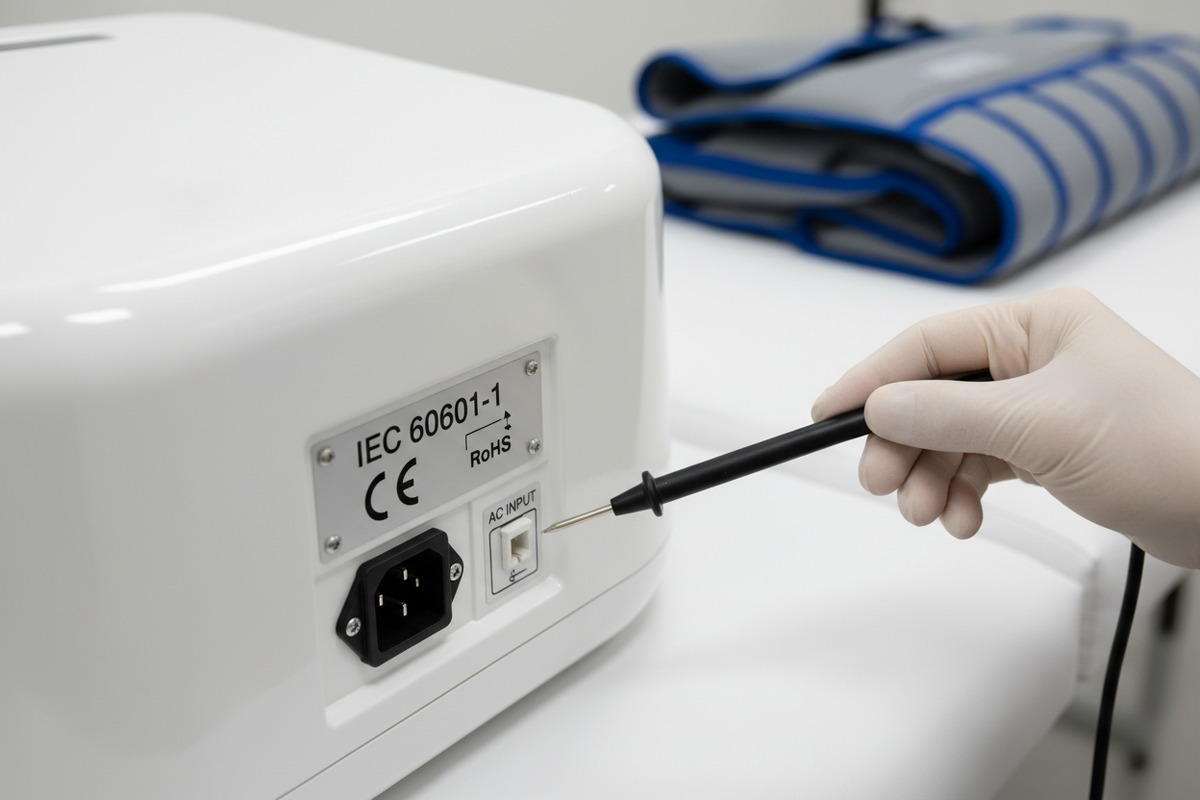
For pressotherapy machines, verify compliance with IEC 60601-1 (medical electrical equipment safety), EN 60601-1-2 (electromagnetic compatibility for medical devices), and the appropriate particular standard. The report must show pass results for insulation resistance, dielectric strength, leakage current, and protective earthing tests.
Medical vs. Non-Medical Classification
The applicable standard depends on how the pressotherapy machine is marketed. If sold as a medical or therapeutic device, IEC 60601 4 is a series of technical standards for the safety and essential performance of medical electrical equipment, published by the International Electrotechnical Commission 5. First published in 1977 and regularly updated and restructured, as of 2011 it consists of a general standard, about 10 collateral standards, and about 80 particular standards.
The general standard IEC 60601-1 – Medical electrical equipment – Part 1: General requirements for basic safety and essential performance – gives general requirements of the series of standards. 60601 is a widely accepted benchmark for medical electrical equipment and compliance with IEC60601-1 has become a requirement for the commercialisation of electrical medical equipment in many countries. Many companies view compliance with IEC 60601-1 as a requirement for most markets.
Essential Tests for Pressotherapy Equipment
| Test Category | Standard Reference | What It Measures |
|---|---|---|
| Insulation Resistance | IEC 60601-1, Clause 8 | Prevents current leakage through insulation |
| Dielectric Strength | IEC 60601-1, Clause 8 | Ability to withstand voltage surges |
| Earth Continuity | IEC 60601-1, Clause 8 | Protective grounding effectiveness |
| Leakage Current | IEC 60601-1, Clause 8 | Current flow to patient or operator |
| Temperature Rise | IEC 60601-1, Clause 11 | Maximum surface temperatures during operation |
Harmonized Standards vs. Alternative Solutions
The Low Voltage Directive (LVD) 2014/35/EU defines essential safety objectives but does not specify detailed technical requirements. In practice, conformity is demonstrated primarily through the application of harmonized safety standards 6. These standards translate the LVD's safety objectives into concrete technical requirements and provide a recognized pathway for demonstrating compliance.
The current list of harmonized standards published in the Official Journal is always authoritative, as only these standards provide a valid presumption of conformity. They provide a presumption of conformity with the essential safety requirements of the LVD. Their use is voluntary but strongly preferred from a regulatory perspective.
Standards Comparison Table
| Product Type | Primary Standard | Collateral Standards | Additional Requirements |
|---|---|---|---|
| Medical Pressotherapy | IEC 60601-1 | IEC 60601-1-2 (EMC), IEC 60601-1-6 (Usability) | Risk management per ISO 14971 |
| Wellness/Spa Equipment | EN 60335-1 | EN 60335-2-32 (Massage appliances) | General product safety |
| Professional Salon Use | EN 60335-1 | Appropriate part 2 standard | EMC Directive 2014/30/EU 7 |
IEC 60601-1 is the fundamental standard for the safety and essential performance of medical electrical equipment. It sets out the basic requirements for electrical medical devices to ensure that they do not pose any risk to patients, users, or the environment during normal use or under abnormal conditions. The standard covers general safety requirements for electrical equipment, including mechanical hazards, electrical hazards, and requirements for the overall functionality of the device.
How does a valid LVD report protect my brand when importing pressotherapy equipment into the US or Europe?
Our export team handles shipments to North America and the EU weekly. We have witnessed what happens when importers cut corners on compliance documentation. Customs delays, product seizures, and liability claims follow quickly. A valid LVD report is your first line of defense.
A valid LVD report demonstrates due diligence, enables smooth customs clearance, provides legal protection in liability cases, and builds customer trust. Without proper documentation, you risk unlimited fines, product recalls, import bans, and potential criminal charges in serious cases.

Legal Consequences of Non-Compliance
In the UK, directive violations are covered under Section 33 HSWA offenses and can result in an unlimited fine and up to two years imprisonment. Similar penalties exist across EU member states.
Affixing a CE Low Voltage Directive mark to your products ensures free access to nearly 30 countries in the EU and EEA. Without the CE Mark, you cannot legally sell to consumers within the bloc and could potentially face fines, product recalls and even be banned from one of the world's biggest markets.
The Role of the Declaration of Conformity
Fake "CE certificates" typically look official but are not backed by valid test results or any notified body approval, and EU authorities do not accept them as proof of conformity. In reality, the legally required document is the manufacturer's own Declaration of Conformity (along with authentic test reports). If an exporter presents a generic "CE certificate" instead of a DoC, it's a red flag that they might be bypassing the proper compliance procedure.
Documentation Requirements for Import
| Document | Purpose | Who Issues It |
|---|---|---|
| Declaration of Conformity | Legal declaration of compliance | Manufacturer |
| LVD Test Report | Technical evidence of safety testing | Accredited laboratory |
| Technical File | Complete product documentation | Manufacturer |
| Risk Assessment | Hazard identification and mitigation | Manufacturer |
| User Instructions | Safe use guidance | Manufacturer |
Self-Declaration vs. Third-Party Testing
The directive 2014/35/EU requires self-assessment of the products by the manufacturers to ensure safe and healthy electrical equipment for the European market. This directive, however, does not require specific independent notified bodies to assess any of the electrical equipment that fall under the scope of this directive.
While self-certification is technically permitted, our recommendation is always to use third-party testing. Independent verification provides stronger legal protection and demonstrates genuine commitment to safety.
Importers must ensure that products from non-EU countries comply with the LVD before being placed on the EU/EEA market. They must include their name and postal address on the product and cooperate with market surveillance authorities. Distributors must verify CE marking and the required documentation, ensure proper storage and transport, maintain traceability, and cooperate with authorities in cases of suspected non-compliance.
Benefits of Proper Documentation
When we ship pressotherapy equipment to European distributors, complete documentation delivers these benefits:
- Faster customs clearance: Authorities can verify compliance quickly
- Reduced liability exposure: Evidence of due diligence in product selection
- Stronger warranty claims: Recourse against manufacturers if products fail
- Market surveillance cooperation: Ready compliance with authority requests
- Customer confidence: Professional documentation builds brand trust
What are the red flags I should look for when reviewing a supplier's LVD test results?
After years of vetting suppliers and reviewing thousands of compliance documents, our team has developed sharp instincts for detecting problems. Some red flags are obvious. Others require deeper investigation. Knowing what to look for can save your business.
Key red flags include test reports in image formats instead of PDF, laboratories without ISO 17025 accreditation, missing or incomplete product specifications, reports covering components instead of the complete assembly, unusually low testing prices, and certificates that cannot be verified through official databases.

Common Fraudulent Practices
Through operating our verification service we unfortunately find that many of the Chinese certificates provided to our clients are not legitimate. In fact more than 20% of the certificates we have verified over the years have been found to be fake. The unfortunate fact is that some Chinese companies are giving their clients certificates that are not legitimate, and they are getting away with it. One reason for this is that foreign companies often make the mistake of taking Chinese certificates on face value.
During an interview with the technical lab director of a renown accredited Chinese laboratory, he confirmed the existence of a real business around fake laboratory CE certificates: "It is a 100% Chinese company, no bonus, and not a serious work: we do almost only fake CE certificates. When factories ask for CE certificates for some electrical appliances, the lab provides them without even seeing the sample! A report is made without any pictures but with all references related to the product to make it look real. Of course the price is much lower than with famous lab."
Red Flag Identification Table
| Red Flag | Why It Matters | What to Do |
|---|---|---|
| Image file format (JPEG, PNG) | Legitimate labs issue only PDF reports | Reject and request original PDF |
| No laboratory contact information | Cannot verify authenticity | Research lab independently |
| Generic "CE Certificate" title | Real documents are "Test Reports" or "DoC" | Request proper documentation |
| Missing product photos | Report may not relate to actual product | Verify sample photos match your order |
| Unusually fast turnaround | Proper testing takes time | Question how testing was completed |
| Price significantly below market | Quality testing costs money | Get quotes from reputable labs for comparison |
Verifying Laboratory Legitimacy
One thing we have found though is that the people creating fake certificates often make mistakes. ISO certificates should include a scope of certification but sometimes we find that the scope is missing or is seemingly unrelated to the service the company offers. Test reports claiming that testing has been done to a standard that isn't included in the laboratory's scope of accreditation are a red flag.
Database Verification Resources
When our quality team receives new documentation, we check these databases:
| Database | Organization | What to Verify |
|---|---|---|
| CNAS | China National Accreditation Service | Chinese lab accreditation |
| ILAC MRA 8 | International Laboratory Accreditation Cooperation | Global lab mutual recognition |
| NANDO 9 | European Commission | Notified Body registration |
| Certipedia | TÜV | Certificate authenticity |
| SGS Directory | SGS Group | Client certification status |
Accreditation of unknown verified body should be verified at: http://ec.europa.eu/growth/tools-databases/nando/index.cfm
Protecting Yourself from Fraud
As a foreign buyer or importer, due diligence is crucial to avoid being duped by fake CE compliance claims. Here are some practical steps: Ask for the Declaration of Conformity early. Don't wait until after purchase to see the compliance documents. Insist that the supplier provide the CE Declaration of Conformity and any supporting certificates before you place an order.
Be skeptical of deals that seem too easy or cheap—claims of "instant CE certification" are a red flag, since real compliance takes effort and investment. By being thorough and cautious, you can avoid the trap of CE certification fraud. Remember, CE compliance is about safety and conformity, not just a sticker or paper.
Questions to Ask Your Supplier
Before placing orders, we recommend asking these verification questions:
- Can you provide the laboratory's ISO 17025 accreditation 10 certificate?
- Is the tested product model exactly matching my order specification?
- Can I contact the laboratory directly to verify the report?
- Was the complete assembled unit tested, not just components?
- When was the last test conducted, and have production processes changed since?
Conclusion
Verifying LVD test report compliance requires systematic checks: confirm laboratory accreditation, validate report authenticity, match specifications exactly, and maintain complete documentation. Take time to verify—your brand and customer safety depend on it.
Footnotes
1. Provides the official legal text of the Low Voltage Directive. ↩︎
2. Replaced HTTP 403 with an authoritative source from the official European Union website. ↩︎
3. Provides information about China’s national accreditation body. ↩︎
4. Details the international safety standard for medical electrical equipment. ↩︎
5. Introduces the global organization for electrotechnical standards. ↩︎
6. Explains the role of harmonized standards in LVD compliance. ↩︎
7. Provides the official legal text of the Electromagnetic Compatibility Directive. ↩︎
8. Describes the international mutual recognition arrangement for accredited labs. ↩︎
9. Provides access to the EU database of notified bodies. ↩︎
10. Explains the international standard for laboratory competence. ↩︎


 English
 Español de México
 Deutsch
 Français
 العربية
 Русский
Join the Conversation
Have a question or insight to share? We read every comment — whether you're a distributor, salon owner, or just curious about the technology. Your real-world experience helps others make better decisions. Drop your thoughts below.