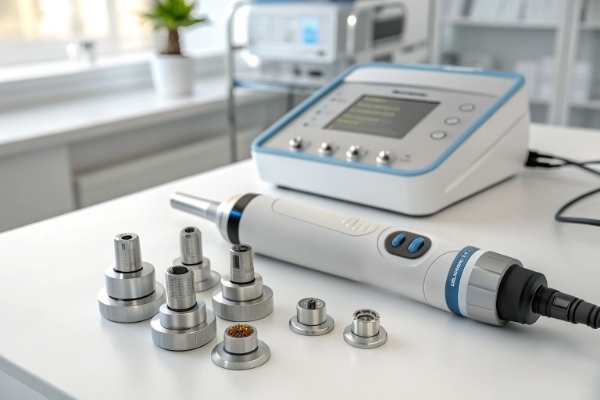
As the manufacturer, I design our shockwave therapy systems 1 to include a versatile range of applicator heads so clinicians can adjust treatment depth, focus, and comfort across different conditions.
Most professional shockwave therapy machines include four interchangeable applicator heads, typically ranging from 6 mm to 25 mm in diameter—a configuration similar to many clinical applicator sets with 6 mm, 15 mm, and 25 mm heads 2. These heads allow clinicians to adjust treatment depth, focus, and comfort across different conditions 3 without tools, ensuring both precision and efficiency during sessions.
The exact number may vary depending on the model, price tier, and intended clinical or aesthetic use.
What factors influence how many applicator heads are included in standard packages?
The number of included applicator heads depends on product design philosophy and market positioning. Entry-level units emphasize affordability, while professional models prioritize flexibility.
Manufacturers determine the number of included applicator heads based on treatment diversity, target market, and cost optimization. Devices for clinics and physiotherapy centers typically include 3–6 heads, as seen in some clinical ESWT systems that bundle five transmitters for multiple depths 4, whereas compact or home-use versions may provide 1–2.

Main influencing factors
- Target audience: Professional vs consumer.
- Treatment type: Medical rehabilitation, sports therapy, or aesthetics.
- Energy range: Machines with higher energy output require more head sizes to distribute impact safely.
- Customization: OEM/ODM buyers may specify different head sets.
- Cost strategy: More heads increase both production and retail price.
Table 1 — Factors affecting included head quantity
| Factor | Typical impact | Example |
|---|---|---|
| Market segment | Professional → more heads | 4–6 pcs for clinics |
| Power output | Higher → more variety | Adds deep-focus heads |
| Intended use | Rehab vs beauty | Narrow vs broad tips |
| Pricing tier | Budget → fewer heads | 1–3 pcs in entry models |
| Custom OEM | Buyer-defined | Private-label sets |
Designing the right balance helps maintain usability while controlling cost.
Should purchasers expect optional extras or bundled head sets, and how to evaluate value?
In most cases, standard packages include a basic set, while additional heads are sold as optional upgrades for specialized indications.
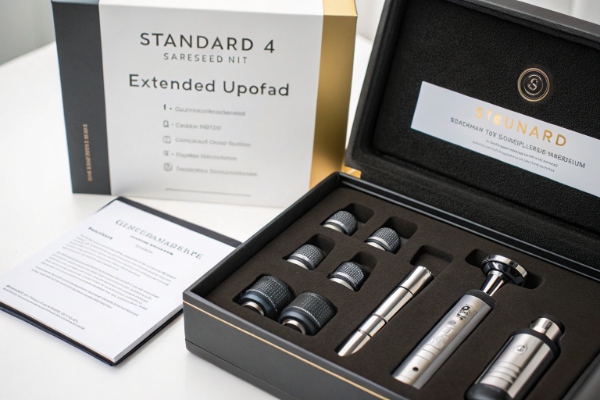
Buyers should expect a standard kit of 3–4 heads bundled with the device—similar to packages that ship with three applicators in different diameters 5—and optional upgrade sets offering extra diameters or special materials, much like advanced systems that provide up to 13 versatile applicator heads 6. Evaluating value means comparing total included heads, replacement cost, and compatibility with future accessories.
Evaluating bundle value
- Standard set: Usually 4 pcs (6 mm, 15 mm × 2, 25 mm).
- Optional upgrades: Titanium or sapphire heads for longevity.
- Bundled offers: Some suppliers include 6–8 pcs during promotions.
- After-sales pricing: Replacement cost per head ranges from USD 20 to 100.
Table 2 — Example head-set configurations
| Package type | Heads included | Typical diameters | Notes |
|---|---|---|---|
| Standard clinic set | 4 pcs | 6 mm / 15 mm × 2 / 25 mm | Common default |
| Extended sports set | 6 pcs | 6–35 mm range | For deep muscle |
| Beauty edition | 5 pcs | 10–30 mm range | Broad skin coverage |
| Budget unit | 2 pcs | 15 mm / 20 mm | Minimal configuration |
Purchasers should ask whether the base price includes all necessary heads or if accessories must be ordered separately.
How does the number of included heads affect cost, inventory, and usage flexibility?
The number of applicators directly influences both upfront cost and long-term operational flexibility, especially when combined with good maintenance habits for shockwave equipment 7.
Including more heads increases production and replacement costs but improves treatment versatility, allowing clinics to adapt to different patients without downtime or cross-contamination concerns.

Operational considerations
- Cost: Each additional head adds ~USD 20–60 to manufacturing cost.
- Inventory: Clinics with multiple handpieces benefit from shared head sets.
- Usage flexibility: Different diameters match specific anatomical regions.
- Maintenance: More heads require routine cleaning and inspection 8.
Table 3 — Cost and flexibility balance
| Head count | Clinic type | Pros | Cons |
|---|---|---|---|
| 2–3 | Basic/single-use | Low price, simple | Limited versatility |
| 4 | Standard | Covers 80 % of indications | Mid-cost |
| 5–6 | Advanced | Greater flexibility | Higher cost, more upkeep |
| 8+ | Specialty | Full versatility | Complex inventory |
Clinics treating both musculoskeletal and aesthetic clients should favor systems with at least 4 interchangeable applicators, as recommended in many head-variant planning guides for ESWT machines 9.
What questions should buyers ask about spares, head compatibility and interchangeability?
To prevent supply interruptions and ensure long-term usability, buyers should confirm spare-part policies before purchase and align them with internal maintenance routines and lifecycle extension strategies for shockwave machines 10.
Buyers should ask about material composition, cross-model compatibility, replacement availability, and whether the applicator heads are interchangeable between different handpieces or models within the brand.

Buyer checklist
- Material: Aluminum vs titanium affects lifespan and feel.
- Mount type: Threaded, magnetic, or push-fit coupling.
- Compatibility: Whether heads fit multiple models or generations.
- Spare availability: Local distributor stock levels.
- Lifespan: Expected use before wear—usually 1–2 million pulses.
- Cleaning protocol: Confirm disinfection compatibility.
Table 4 — Spare-part policy comparison
| Supplier type | Compatibility | Spare availability | Risk level |
|---|---|---|---|
| OEM manufacturer | Full cross-model | Guaranteed | Low |
| Distributor only | Partial | Limited to stock | Medium |
| Third-party reseller | Uncertain | Variable | High |
Proper spare-part planning ensures operational continuity and protects investment over the equipment’s life cycle.
Conclusion
Most shockwave therapy machines come standard with four applicator heads, offering a practical balance between versatility and cost. Buyers should verify head sizes, material quality, and compatibility when comparing models to ensure long-term value and seamless maintenance.
Footnotes
1. Overview of professional ESWT systems used in orthopedics and physiotherapy. ↩︎
2. Product page showing 6 mm, 15 mm, and 25 mm clinical applicator heads. ↩︎
3. Guide explaining how different radial applicators change treatment depth and feel. ↩︎
4. Example of a clinical ESWT unit bundled with five alloy transmitters. ↩︎
5. Shockwave device configuration that includes multiple applicators as standard. ↩︎
6. Specification sheet for a system offering 13 interchangeable applicator heads. ↩︎
7. Maintenance guide stressing daily care for shockwave devices and accessories. ↩︎
8. Best-practice article on cleaning and maintaining radial shockwave handpieces and tips. ↩︎
9. Article discussing why clinics prefer ESWT machines with many head-size options. ↩︎
10. Manufacturer blog on extending device life through cleaning and timely part replacement. ↩︎

 English
  Español de México
  Deutsch
  Français
  العربية
  Русский