

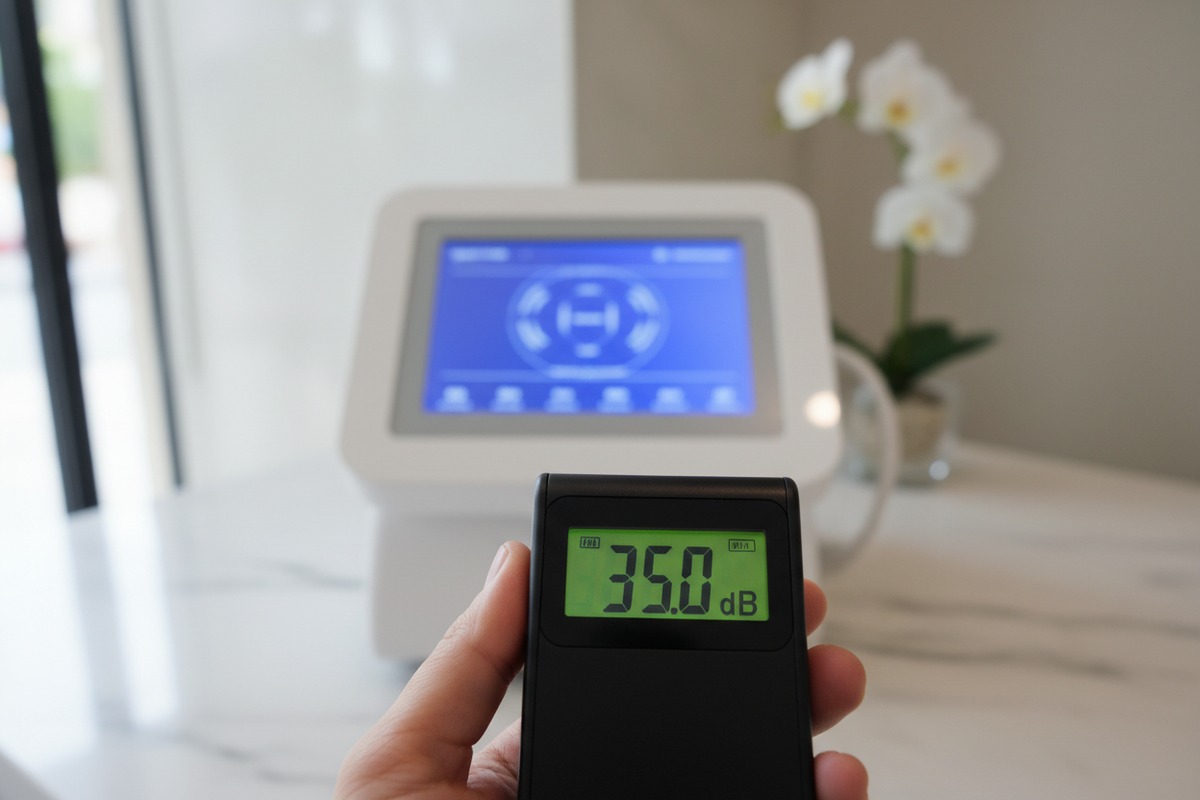
When we design pressotherapy equipment at our production facility, noise level is one of the first specs our R&D team optimizes calibrated sound level meter 1. Why? Because we hear the same concern from every spa owner: mechanical noise can ruin the relaxation experience. Even a seemingly quiet hum can distract clients during a lymphatic drainage session 2. This is not just about comfort—it affects your brand reputation and client retention.
To evaluate pressotherapy machine noise levels for a luxury spa, target units operating at ≤45 dB(A) at one meter distance. Premium machines achieve 35 dB or less. Request decibel specifications from your supplier, verify them during pre-shipment inspection using a calibrated sound meter, and assess compressor type, vibration isolation, and internal soundproofing features before placing your order.
In this guide, we will break down the exact decibel benchmarks 3 you should demand, how to verify noise claims at the factory, what causes pump vibration issues, and how to request OEM soundproofing modifications. Let’s get started.
What decibel range should I look for to ensure my pressotherapy machine meets luxury spa standards?
When our engineering team develops machines for export to the US and European markets, we test every unit against strict acoustic benchmarks. The problem is, many suppliers list "quiet operation" without any actual dB rating. That vague claim leaves you guessing—and your clients complaining.
For luxury spa environments, prioritize pressotherapy machines with noise levels ≤45 dB(A) measured at one meter distance. This level matches quiet library ambient noise. Ultra-premium models operate at 35 dB or less, ideal for evening treatments and extended sessions where client tolerance for background noise decreases significantly.
Understanding Decibel Levels in Context
Decibels are not linear. A 10 dB increase means the sound is perceived as roughly twice as loud. So a machine at 55 dB is dramatically louder than one at 45 dB. Here is a quick reference:
| Decibel Level | Comparable Sound | Spa Suitability |
|---|---|---|
| 30–35 dB | Quiet whisper, rustling leaves | Excellent—ultra-premium |
| 40–45 dB | Quiet library, soft conversation | Good—luxury standard |
| 50–55 dB | Moderate rainfall, quiet office | Marginal—may disturb relaxation |
| 60–70 dB | Normal conversation, background traffic | Unacceptable for spa use |
Why 45 dB Is the Baseline
The World Health Organization 4 recommends that bedroom noise levels be kept below 30 decibels at night. Noise above this level, even if it doesn't fully wake you up, may disrupt sleep and pose health risks. Snoring is considered disruptive when it's louder than 40 to 45 decibels. Applying similar logic to spa treatments, clients enter a parasympathetic state 5 during pressotherapy. Noise above 45 dB can trigger stress responses, defeating the purpose of the treatment.
Premium Machines Set the Standard
Some manufacturers highlight "super silent compressor" technology because "noise is a nightmare for most patients." The unit is designed with super silent compressor. It can release uniform power, but with the lowest sound. When sourcing, ask suppliers to provide documented dB ratings rather than marketing phrases.
Compressor Type Matters
Generally, some of the louder compressors are among the reciprocating variety 6, which can emit noises of up to 85 decibels. Machines such as these should only be operated in isolated work spaces. Rotary screw compressors are generally quieter, because sound-proof enclosures are incorporated into the design. At their loudest, rotary screw units can range from 70 to 75 decibels. For pressotherapy, the compressors are smaller, but the principle holds: design and enclosure quality determine noise output.
How can I verify the actual operating noise level during my supplier's pre-shipment inspection?
At our facility, we conduct pre-shipment inspection 7s on every batch before export. But noise testing is often overlooked by buyers who focus only on visual defects and functionality. The reality? A machine that looks perfect can still hum like a refrigerator.
To verify operating noise during pre-shipment inspection, request a functional test with a calibrated sound level meter. The inspector should measure decibels at one meter from the machine during full operation—including when all chambers are inflating. Document readings at startup, mid-cycle, and peak pressure. Compare results against the supplier's stated specifications.

What Pre-Shipment Inspection Covers
A pre-shipment inspection is a detailed, on-site product review conducted when at least 80% of an order is complete. It verifies product quality, specifications, labeling, packaging, and quantity before the goods leave the factory. For pressotherapy machines, this should include operational testing—not just visual checks.
Adding Noise Verification to Your Checklist
Common machinery inspections include checking the noise made by the machinery during operation. Other common inspections include monitoring the condition of the machinery by checking the heat it produces, solid contaminants inside the machinery, touching the machinery to sense any abnormal vibrations. When working with your third-party inspector or supplier QC team, add these specific items to the checklist:
| Inspection Point | Method | Acceptance Criteria |
|---|---|---|
| Noise at 1 meter | Calibrated sound meter | ≤45 dB(A) or as specified |
| Noise at startup | Measure first 10 seconds | No spikes above spec |
| Noise at peak pressure | All chambers inflated | No rattling or abnormal sounds |
| Vibration check | Manual touch and visual | No excessive vibration |
| Compressor integrity | Listen for abnormal sounds | No clicking, grinding, or whining |
Using Third-Party Inspection Services
Pre-shipment inspections conducted by a neutral third party are industry standard for ensuring your product meets your quality specifications. Defective or subpar products could lead to customer complaints, returns, lost sales, and damage to your company's reputation. With our pre-dispatch inspection, you get peace of mind that your order has been fulfilled correctly before shipping.
Companies like QIMA 8, SGS, or TÜV Rheinland can add noise testing to their standard machinery inspection protocols. Vibration & Noise Level Test: Measures vibration and noise levels during operation, ensuring compliance with workplace safety standards. Control & Safety Feature Check: Verifies the functionality of control panels, emergency stop buttons, and safety alarms.
Recording Evidence
Request photos and video of the sound meter readings during operation. This creates documentation you can reference if the machine arrives noisier than specified. During the inspection, photos are taken to document the procedure. These are then carefully checked against product specifications and other testing requirements.
Will the air pump's vibration frequency disrupt the relaxing atmosphere of my treatment rooms?
In our production testing, we have seen machines that meet decibel specs but still create an unpleasant atmosphere due to vibration. The low-frequency hum transfers through floors and walls, creating a drone that clients feel more than hear. This is the hidden noise problem.
Yes, air pump vibration can disrupt treatment room ambiance even when decibel levels appear acceptable. Low-frequency vibrations travel through building structures and create a pervasive hum. To prevent this, source machines with built-in vibration dampening, rubber isolation mounts, and properly balanced compressors. Additionally, install the machine on anti-vibration pads and avoid placing it directly on hard floors.

Why Vibration Is Different From Noise
67 dB is more like constant traffic noise or the sound of running your hoover. It also tends to be a low-frequency hum which can be more stressful to listen to than louder higher frequency noises. Low-frequency sounds are harder to block with standard soundproofing materials. They require mass and isolation to control effectively.
Sources of Vibration in Pressotherapy Machines
The air compressor is the main culprit. When it cycles on and off, it creates vibration that can transfer to:
- The machine casing
- The floor or table surface
- The hoses and garments
- Adjacent walls
In the second case, vibration can come from the equipment located under the spa cabinet. Circulation pumps and jet pumps are the usual suspects, check that the base bolts are tight on each pump, or install them if they are missing. Alternatively, you can place a thick rubber mat underneath to dampen pump vibration noises.
Solutions for Vibration Control
| Solution | Implementation | Effectiveness |
|---|---|---|
| Rubber isolation feet | Factory-installed or aftermarket | High—reduces structure-borne transmission |
| Anti-vibration pads | Place under machine on floor | Medium to high—absorbs vibration |
| Floating platform | Isolate machine from floor entirely | Very high—eliminates floor transfer |
| Compressor balancing | Factory quality control | High—prevents imbalanced rotation |
| Internal dampening | OEM modification | High—reduces vibration at source |
Evaluating Vibration During Sourcing
A general rule of thumb is that higher quality swim spas will be quieter than the cheaper models. A lot of this has to do with the type and amount of insulation used. If noise is a worry for you, ensure you purchase a unit that maximizes the amount of insulation surrounding the motor. The same principle applies to pressotherapy machines—premium builds include better vibration management.
When requesting samples or conducting factory visits, place your hand on the machine during operation. You should feel minimal vibration. If the entire unit shakes or hums noticeably, the compressor mounting needs improvement.
Room Placement Considerations
Outdoor wood decks act like a drum and resonate a low frequency that sounds like a constant drone, even with pumps on low speed. The sound can be amplified as it conducts through nearby fences or reflects off exterior walls. To correct this situation, the wood deck can be cut-out to fit the spa, with a 4" thick reinforced concrete slab poured for the spa to rest on. Another option would be to place thick rubber mats underneath. While this advice refers to hot tubs, the physics apply equally to any vibrating equipment in a spa setting.
Can I request internal soundproofing modifications from my OEM manufacturer to minimize mechanical noise?
When we receive custom development requests from brand owners, soundproofing modifications are increasingly common. Clients want machines tailored for high-end spa environments where every detail matters. The good news: most factories can accommodate these requests—if you ask correctly.
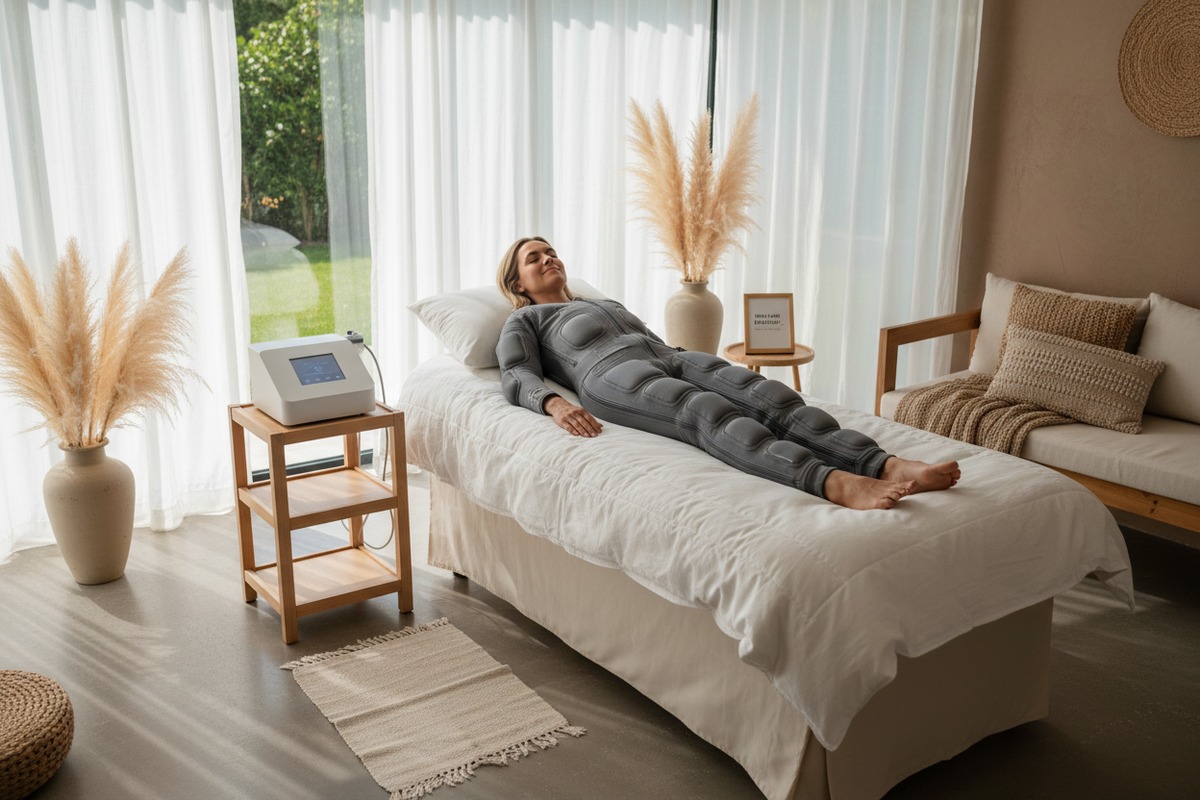
Yes, you can request internal soundproofing modifications from your OEM manufacturer. Common modifications include adding acoustic foam lining inside the machine housing, installing intake silencers on the compressor, upgrading to quieter compressor models, adding vibration isolation mounts, and incorporating sound-dampening materials around the air pump. These modifications typically add 5-15% to unit cost but can reduce noise by 10-20 dB.
What Soundproofing Modifications Are Possible
Adding acoustic foam increases the noise reduction performance of a standard OEM enclosure significantly. Acoustical foams are designed to provide maximum absorption of airborne sound with minimum thickness and weight.
Based on industry practices and our own manufacturing experience, here are the most effective modifications:
| Modification Type | Noise Reduction | Cost Impact | Complexity |
|---|---|---|---|
| Acoustic foam lining 9 | 5–10 dB | Low | Simple |
| Intake silencer | 10–15 dB | Low to medium | Moderate |
| Upgraded quiet compressor | 10–20 dB | Medium to high | Requires redesign |
| Vibration isolation mounts | 3–5 dB (structure-borne) | Low | Simple |
| Mass-loaded vinyl barrier | 5–8 dB | Medium | Moderate |
| Serpentine ventilation | 5–10 dB | Medium | Complex |
Acoustic Foam and Sound-Absorbing Materials
For this reason we built a solid-wood enclosure for the compressor. Then we lined the interior surfaces of the enclosure with the acoustically highly effective noise absorption foam soni WAVE 50 mm, with self-adhesive rear face. In conjunction with the solid wood of the enclosure, the soni WAVE sound protection panels now ensure optimum acoustic insulation of our air compressor.
While this example describes workshop compressors, the principle applies to OEM equipment. Manufacturers can line internal housings with acoustic foam that absorbs mid and high-frequency noise without significantly increasing unit size.
Intake Silencers
An enclosure will help with the "mechanical" noise. But the overwhelming percentage of dB's comes from the intake. For pressotherapy machines, adding a silencer to the compressor intake is one of the most cost-effective modifications. It muffles the rushing air sound without affecting performance.
Ventilation Considerations
Any soundproofing modification must account for heat dissipation. Whatever you choose to do, make sure not to restrict the airflow around the compressor, or it will overheat and possibly cause burn out or catch fire. You'll will need to provide adequate ventilation by installing an exhaust fan or other means to pull in cooler air and exhaust the heat produced by the compressor.
You will note that the sound curtain enclosures with a roof have ventilation hoods of baffles for cooling equipment. For air compressor applications, we typically utilize passive ventilation (no forced air fan). The concept is that you locate silenced air intake as low as possible on the side wall and also locate the silenced air discharge on the roof. As the hot air rises and exits out the discharge vent, it draws fresh air through the intake vent.
How to Request Modifications
When working with your OEM supplier, provide clear specifications:
- State your target dB level (e.g., ≤40 dB at 1 meter)
- Specify measurement conditions (all chambers operating, maximum pressure)
- Request documentation (test reports showing before/after modification results)
- Discuss MOQ implications (custom modifications may require higher order quantities)
- Confirm thermal safety (modifications must not cause overheating)
Most reputable factories will provide prototype units for your approval before full production. Test these prototypes thoroughly to verify noise performance.
Conclusion
Evaluating pressotherapy machine noise for a luxury spa requires specific benchmarks: target ≤45 dB for standard luxury applications, ≤35 dB for ultra-premium environments. Verify claims through pre-shipment inspection with calibrated meters. Address vibration separately from airborne noise. Request OEM soundproofing modifications when standard specs fall short. These steps protect your spa's ambiance and your clients' experience.
Footnotes
1. Explains what a sound level meter is and its use in measuring sound pressure levels. ↩︎
2. Explains what lymphatic drainage is and its purpose in therapy. ↩︎
3. Provides a comprehensive chart of common sounds and their decibel levels. ↩︎
4. References WHO recommendations for safe listening levels and noise exposure. ↩︎
5. Replaced HTTP 405 with a highly authoritative .gov source (NCBI Bookshelf) explaining the parasympathetic nervous system. ↩︎
6. Provides an overview of reciprocating compressors, including their operation and characteristics. ↩︎
7. Details the process and importance of pre-shipment inspections for quality control. ↩︎
8. Provides information about QIMA as a leading provider of inspection and quality control services. ↩︎
9. Replaced HTTP 404 with an authoritative source from Wikipedia explaining acoustic foam. ↩︎

 English
 Español de México
 Deutsch
 Français
 العربية
 Русский
