

At our Guangzhou production facility, we ship pressotherapy machines 1 to salons across Europe and North America every week. The question clients ask most often? Rail or sea freight 2. This single decision shapes your landed cost, your inventory timing, and whether your spa launch stays on schedule.
Choose rail freight for pressotherapy machine shipments when you need delivery to Europe in 15–20 days and can accept 30–50% higher costs. Choose sea freight when shipping large volumes, accept 30–45 day transit times, and want the lowest possible per-unit cost. Your volume threshold and urgency level determine the best option.
Below, we break down each factor you need to consider DDP shipping service 3. We cover cost comparisons, product protection, inventory planning, and logistics management. Let’s help you make the right call for your business.
How do I decide if the cost savings of sea freight are worth the longer wait for my pressotherapy machine shipments?
When our team runs cost analyses for clients ordering 20–100 units, the math surprises them. Sea freight looks cheaper on paper. But when you add holding costs, missed sales, and capital tied up in transit, the picture shifts.
Sea freight from China to Europe remains the most cost-effective option for large shipments, while rail freight from China to Europe offers a balance between cost and transit time, making it an increasingly attractive choice for medium-sized shipments. For pressotherapy machines priced at $200–$800 per unit, sea freight savings justify the wait only when shipping 20 CBM or more.

Understanding Current Freight Rates
The 2026 freight market has stabilized compared to the volatile 2024–2025 period. As of early 2026, spot container rates 4 from Shanghai to major European ports such as Rotterdam are around 2,000 to 2,200 USD per 40ft container. Spot rates on Asia–Europe trade routes continued to decline, with rates on Shanghai–Rotterdam falling 2% to $2,127 per 40ft container.
Rail costs remain higher. Based on our shipping records and industry data, expect to pay $5,000–$7,500 for a 40ft equivalent on the China-Europe Railway Express 5 routes.
Transit Time Comparison
| Shipping Method | Transit Time (Port/Station to Port/Station) | Door-to-Door Total |
|---|---|---|
| Sea Freight (China to Europe) | 25–40 days | 35–55 days |
| Rail Freight 6 (China to Europe) | 15–20 days | 25–35 days door-to-door |
| Sea Freight (China to US West Coast) | 15–25 days | 25–35 days |
The Volume Threshold Calculation
Here's the key question: At what volume does sea freight make sense?
For pressotherapy machines weighing 50–200 kg per unit, a standard 20ft container 7 holds approximately 200–400 units depending on packaging dimensions. Our experience shows:
- Under 5 CBM (roughly 10–25 machines): Rail or air freight wins on simplicity and total landed cost when factoring inventory carrying costs 8.
- 5–15 CBM (25–75 machines): Evaluate case-by-case. Rail offers faster stock turnover.
- Over 15 CBM (75+ machines): Sea freight becomes clearly more economical.
Cost Per Unit Analysis
| Order Size | Sea Freight Cost/Unit | Rail Freight Cost/Unit | Sea Transit | Rail Transit |
|---|---|---|---|---|
| 20 units | $45–65 | $80–120 | 35–45 days | 20–28 days |
| 50 units | $30–45 | $55–85 | 35–45 days | 20–28 days |
| 100 units | $20–35 | $40–65 | 35–45 days | 20–28 days |
| 200+ units (FCL) | $12–20 | $30–50 | 35–45 days | 20–28 days |
The hidden cost most importers miss? Capital tied up for extra 15–25 days. If your average pressotherapy machine sells at $1,500–$3,000 retail, those days matter.
Which shipping method provides the best protection to ensure my customized beauty machines arrive in perfect condition?
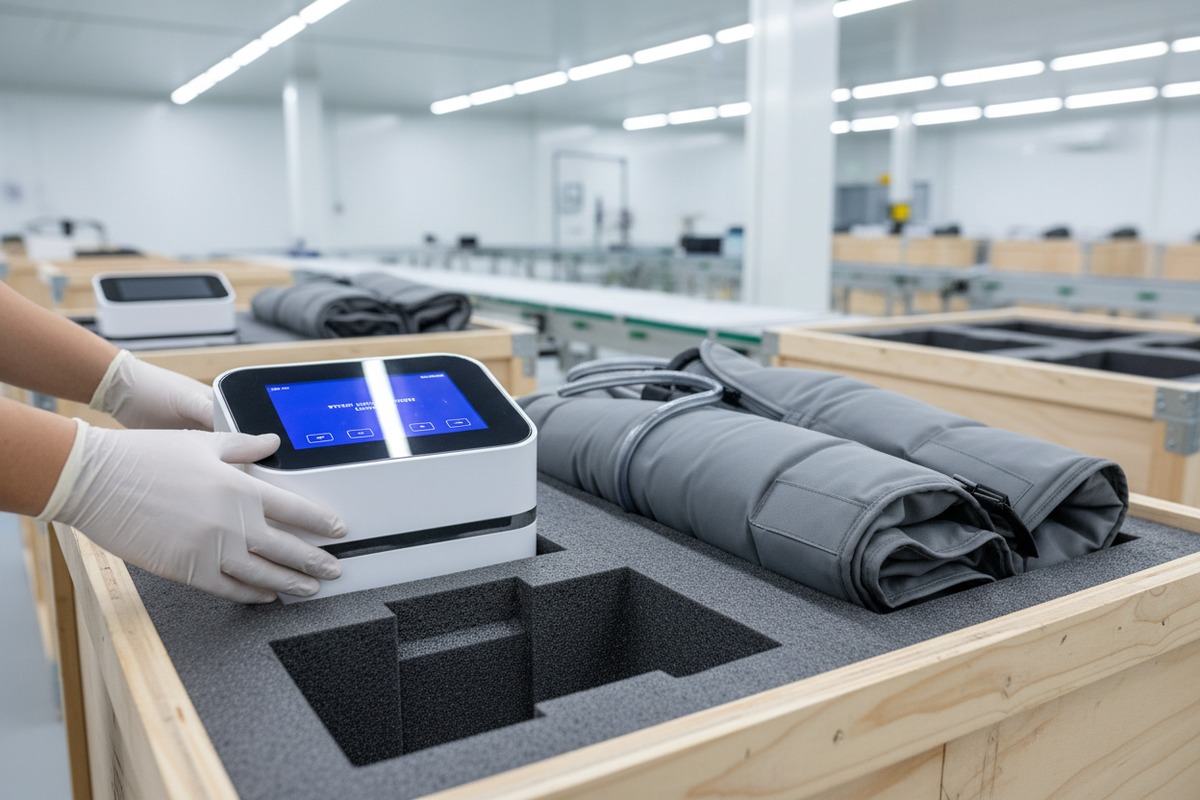
Our engineers test every pressotherapy unit before it leaves our factory. But the journey from Guangzhou to your salon is where damage happens. Electronic control units, inflatable compression suits, and LCD screens all face different risks on rail versus sea routes.
Rail offers fixed departures, multimodal hubs, and transit times of 14–18 days—making it suitable for a wide range of products, from electronics and auto parts to temperature-sensitive goods. For pressotherapy machines with sensitive electronic components and inflatable airbags, rail transport often provides more controlled environments with fewer handling points than sea freight.
Understanding Pressotherapy Machine Vulnerabilities
Your pressotherapy system contains several components that require careful shipping consideration:
| Component | Risk Factor | Sea Freight Risk | Rail Freight Risk |
|---|---|---|---|
| Control Unit (LCD/Electronics) | Vibration, moisture | Higher moisture exposure | Lower moisture, some vibration |
| Air Compressor/Pump | Shock impact | Port handling shocks | Smoother continuous transit |
| Inflatable Compression Suit | Puncture, compression | Container stacking pressure | Less stacking pressure |
| Airbag Connections | Corrosion | Salt air exposure (35+ days) | Minimal exposure |
| Power Supply Unit | Humidity | Condensation risk | Lower humidity variance |
Sea Freight Protection Challenges
Sea freight exposes your machines to unique conditions:
- Moisture and salt air: Container transit across oceans creates humidity fluctuations. Electronic components can develop corrosion over 30–45 day voyages.
- Port congestion handling: Global schedule reliability dropped in October to just 61.4% with much disruption being caused by Port Congestion and Strikes at major European ports. Each delay means additional handling.
- Container stacking: Your 20ft or 40ft container may sit under 6–8 other containers. Inflatable components compress under sustained pressure.
Rail Freight Protection Advantages
Rail transport offers different characteristics:
- Consistent movement: Unlike sea vessels that rock constantly, trains provide more linear motion. This reduces stress on electronic solder joints.
- Fewer handling points: Customs Delays: Multiple border checks (China, Kazakhstan, Belarus, EU) exist, but physical handling remains minimal once loaded.
- Climate control options: Some rail services offer temperature-controlled containers for sensitive electronics.
Our Recommended Packaging Protocol
At our facility, we apply different packaging standards based on shipping method:
For Sea Freight:
- Double-wall corrugated cartons with moisture barrier film
- Wooden crate base for heavy control units (over 30 kg)
- Silica gel packets (minimum 500g per unit)
- Anti-static bags for electronic components
- Foam corner protectors rated for 3G shock absorption
For Rail Freight:
- Standard double-wall corrugated cartons
- Palletized grouping (easier for rail loading)
- Basic moisture protection
- Foam inserts for control panels
The extra packaging for sea freight adds approximately $15–30 per unit in materials and labor.
How will my choice between rail and sea freight impact my ability to keep my salon customers' orders in stock?
In our conversations with US and European distributors, stockouts kill relationships faster than any other problem. When a salon orders pressotherapy equipment for a grand opening or seasonal promotion, they need it on time. Your freight choice directly shapes your ability to meet these commitments.
Depending on your specific origin and destination points in China and Europe, we estimate that a China to Europe rail service can deliver your freight in 13–25 days versus 35–50 days on the water. This 22–25 day difference allows distributors to operate with leaner safety stock while maintaining higher service levels for salon customers.

The Inventory Planning Challenge
Beauty equipment distributors face a unique inventory challenge. Demand spikes around:
- Spa grand openings (unpredictable timing)
- Seasonal wellness promotions (January, spring)
- Trade show follow-up orders
- Competitor equipment failures (replacement orders)
Each scenario demands fast fulfillment. Let's examine how freight choice affects your response capability.
Safety Stock Calculation by Freight Method
Your required safety stock depends directly on replenishment lead time. Here's a simplified formula:
Safety Stock = (Maximum Daily Sales × Maximum Lead Time) − (Average Daily Sales × Average Lead Time)
| Freight Method | Average Lead Time | Maximum Lead Time | Required Safety Stock Multiplier |
|---|---|---|---|
| Sea Freight | 40 days | 55 days | 2.5–3.0× monthly demand |
| Rail Freight | 22 days | 30 days | 1.5–2.0× monthly demand |
| Air Freight | 7 days | 12 days | 0.75–1.0× monthly demand |
For a distributor selling 20 pressotherapy units monthly at $500 average cost:
- Sea freight safety stock: 50–60 units = $25,000–$30,000 tied up
- Rail freight safety stock: 30–40 units = $15,000–$20,000 tied up
- Air freight safety stock: 15–20 units = $7,500–$10,000 tied up
The Multimodal Strategy
Smart distributors don't choose just one method. With ocean routes still subject to disruption, interest continues to grow in rail services between China and the UK. Hemisphere offers both FCL and LCL rail solutions, providing a viable alternative for customers seeking faster transit times than ocean freight and more cost-effective options than air.
We recommend this approach to our clients:
- Base inventory: Ship via sea freight quarterly or bi-monthly. Large FCL orders at lowest cost.
- Buffer stock: Use rail freight monthly to top up fast-moving SKUs.
- Emergency orders: Reserve air freight for urgent individual unit requests.
Seasonal Planning Considerations
Chinese New Year 2026 will tighten Asia–Europe capacity, push up freight rates and extend lead times for European importers from early January through at least mid-March. For European shippers, this means a 6–8 week window of potential disruption.
Plan your orders with these windows in mind:
| Event | Impact Period | Action Required |
|---|---|---|
| Chinese New Year | Late Jan – Mid Mar | Order 8–10 weeks ahead |
| Summer Peak (EU) | May – July | Stock up in March–April |
| Q4 Holiday Rush | Oct – Dec | Secure space by August |
Can I rely on my Chinese supplier to handle the full door-to-door logistics for both rail and sea freight?
When clients first contact our team, many assume they need to arrange their own freight forwarding. They're surprised when we explain our full supply chain service. Not all Chinese suppliers offer this. But the capability gap between manufacturers matters enormously for your operations.
DDP shipping service is door to door. We can help you pick up the goods from your factory in mainland China, or you can notify the factory to send the goods to our warehouse in Shenzhen. Reputable Chinese pressotherapy machine manufacturers can coordinate complete door-to-door logistics for both rail and sea freight, including export customs, transit management, import clearance, and final delivery—when they partner with experienced freight forwarders.

What Door-to-Door Service Actually Includes
In DDP (Delivered Duty Paid) or Door to Door shipping terms, all processes from A to Z are handled by the shipping company or freight forwarder. This includes pickup, export procedures, loading, customs clearance at the destination, and final delivery, all arranged by the shipping agent.
For pressotherapy machine shipments, a complete service covers:
Step-by-Step Door-to-Door Process
| Stage | What Happens | Who Handles It |
|---|---|---|
| 1. Factory Pickup | Equipment collected from production facility | Supplier's logistics partner |
| 2. Export Customs | Documentation, declaration, inspection | Supplier/freight forwarder |
| 3. Port/Station Loading | Cargo loaded onto vessel or train | Freight forwarder |
| 4. Transit | Sea voyage or rail journey | Carrier |
| 5. Destination Arrival | Cargo reaches port/terminal | Carrier |
| 6. Import Customs | Documentation, duty payment, clearance | Freight forwarder's destination agent |
| 7. Last Mile Delivery | Transport to your warehouse/salon | Local trucking partner |
DDP vs DDU: Understanding Your Options
In transactions where the DDP (Delivered Duty Paid) Incoterm 9 is selected, the seller bears most of the responsibilities, while the buyer's obligations are considerably reduced. This specific Incoterm states that the seller must ensure the goods are delivered to a predetermined location, cleared for import, and ready for the buyer to unload.
| Incoterm | Import Duties | Customs Clearance | Risk Transfer Point |
|---|---|---|---|
| DDP (Delivered Duty Paid) | Seller pays | Seller arranges | Buyer's door |
| DDU (Delivered Duty Unpaid) | Buyer pays | Buyer arranges | Before customs |
| DAP (Delivered at Place) | Buyer pays | Buyer arranges | Buyer's door |
| CIF (Cost, Insurance, Freight) | Buyer pays | Buyer arranges | Destination port |
Evaluating Supplier Logistics Capabilities
When selecting a pressotherapy machine supplier, ask these questions:
- Do you have in-house logistics coordination? Look for dedicated staff managing shipments.
- Which freight forwarders do you partner with? DDPCHAIN operates three offices across China in Shenzhen, Guangzhou, and Changsha ready to handle your shipments. Established forwarders have regional presence.
- Can you provide rail freight to Europe? Our rail freight service offers one of the best shipping solutions from China to Europe and Russia, with daily departures and competitive rates from major Chinese cities like Shenzhen, Shanghai, Ningbo, Yiwu.
- What tracking visibility do you offer? Real-time updates matter for planning.
- How do you handle delays or issues? Proactive communication signals service quality.
Rail-Specific Logistics Considerations
Work with forwarders offering consolidation services in Chinese hubs (Xi'an, Chengdu, Chongqing). For Guangzhou-based manufacturers like us, goods first truck to these inland rail hubs—an important coordination step your supplier should manage seamlessly.
Rail transport demands extremely consistent documentation (CIM/SMGS waybills). Passing through Kazakhstan, Russia, Belarus, and other countries, even a single incorrect HS code can hold a container at the border for weeks.
This documentation complexity is precisely why working with an experienced supplier-forwarder team matters.
Conclusion
Choosing between rail and sea freight for your pressotherapy machines comes down to three factors: volume, urgency, and service level requirements. Sea freight wins for bulk orders over 75 units where you can plan 6–8 weeks ahead. Rail freight serves distributors needing faster inventory turns and tighter stock management. The smartest approach combines both methods—sea for base stock, rail for replenishment. Work with a supplier who coordinates the full logistics chain, and your pressotherapy equipment will arrive safely, on time, and at the right cost for your business.
Footnotes
1. Explains what pressotherapy is and how the machines work. ↩︎
2. Defines sea freight and its role in global logistics. ↩︎
3. Defines Delivered Duty Paid (DDP) shipping and its responsibilities. ↩︎
4. Explains what spot rates are in the context of container shipping. ↩︎
5. Replaced HTTP unknown with an authoritative Wikipedia page providing an overview of the China-Europe Railway Express. ↩︎
6. Provides a comprehensive overview of rail freight transport. ↩︎
7. Details the standard dimensions and capacity of a 20ft shipping container. ↩︎
8. Explains the definition and components of inventory carrying costs. ↩︎
9. Provides an official explanation of Incoterms and their purpose. ↩︎

 English
 Español de México
 Deutsch
 Français
 العربية
 Русский
