
When we first started exporting pressotherapy machines 1 from our Guangzhou factory, a common pattern emerged—buyers would place one or two orders, face a quality hiccup or delivery delay, and disappear. The frustration was real. Without a stable partnership, neither side wins. Both buyers and manufacturers waste time, money, and energy on endless supplier searches and repeated onboarding cycles.
Building long-term partnerships with pressotherapy machine suppliers requires verifying quality control systems, aligning on OEM and private labeling expectations, ensuring reliable door-to-door logistics, and maintaining clear, transparent communication. These four pillars create trust, reduce risk, and deliver consistent results for both parties over time.
In this guide, I will break down exactly how to achieve each of these goals FDA clearance or 510(k) status 2. You will learn what to ask, what to look for, and how to avoid the common mistakes that derail promising supplier relationships.
How can I verify that my pressotherapy machine supplier maintains consistent quality control standards?
Our production floor sees dozens of pressotherapy units assembled each week. Yet even with years of experience, we know that buyers cannot simply take our word for quality. You need proof. The real problem? Many suppliers claim certifications they do not actually hold, or they pass factory audits once and then let standards slip.
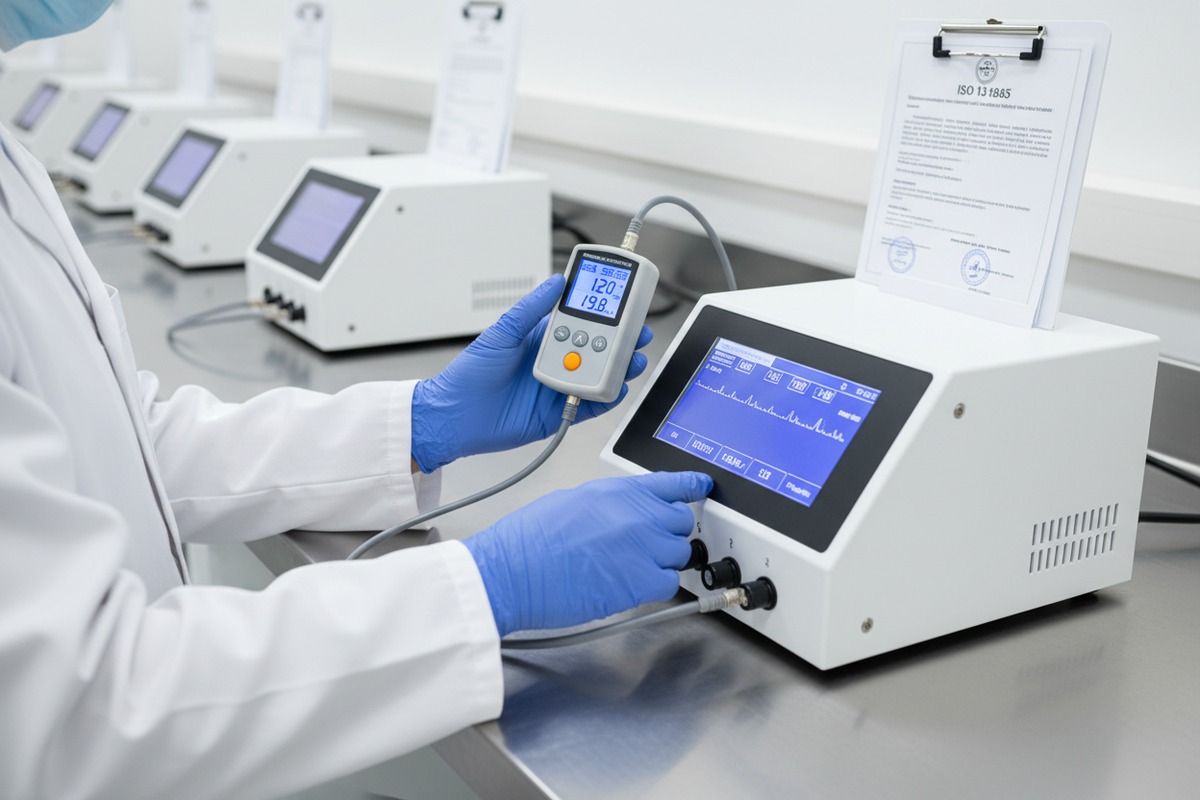
Verify quality control by requesting certifications like CE marking and ISO 13485, reviewing batch traceability records, asking for incoming inspection reports, and scheduling pre-shipment inspections. A supplier with consistent QC will openly share documentation and welcome third-party audits.
Why Certifications Matter
Certifications provide third-party validation that a factory meets recognized standards. For medical applications, prioritize devices with CE marking 3 and, if used in the U.S., FDA clearance or 510(k) status for specific indications. These certifications confirm that the pressotherapy machine meets safety and performance requirements in key markets. A supplier without these credentials may cut corners on materials, safety voltage, or pressure calibration.
Key Documents to Request
When evaluating a supplier, do not settle for verbal assurances. Ask for the following:
| Document | Purpose | Red Flag If Missing |
|---|---|---|
| CE Certificate | Confirms EU compliance | Cannot legally sell in Europe |
| ISO 13485 4 | Medical device quality management | Weak internal QC system |
| Incoming Inspection Reports | Proves raw materials are checked | Quality variability likely |
| Batch Traceability Records | Tracks components from source | Hard to identify defect causes |
| Final Test Records | Confirms each unit passes QC | Defective units may ship |
Insist on factory-level quality control: incoming inspection reports, IPC standards for electronics, batch traceability, and device final test records. These documents prove the supplier has embedded QC into daily operations—not just during audits.
Schedule Pre-Shipment Inspections
Even with solid documentation, issues slip through. That is why pre-shipment inspections matter. You can hire a third-party inspector or visit the factory yourself. Check that:
- Pressure ranges match specifications (commonly 40–187 mmHg for professional units)
- 36V human safety voltage is confirmed on all wearable components
- Airbag chambers inflate and deflate evenly
- Packaging protects the unit during transit
Ask About Ongoing QC Processes
A one-time audit tells you little about long-term performance. To ensure quality, check if the manufacturer complies with international safety and quality standards. Look for certifications, read customer reviews, and inquire about the materials used. Ask the supplier:
- How often do you recalibrate testing equipment?
- What is your defect rate over the past six months?
- How do you handle returned units?
If a supplier hesitates to answer, move on. Trustworthy manufacturers are transparent because they have nothing to hide.
What steps should I take to ensure my OEM and private labeling requirements are handled professionally?
Our engineering team has handled hundreds of private label projects—some smooth, some chaotic. The difference almost always comes down to how clearly the buyer communicates requirements upfront. When expectations are vague, misunderstandings follow. When specs are precise, the finished product matches the vision.
Ensure professional OEM and private labeling by providing detailed specifications, confirming the supplier’s customization capabilities, signing a manufacturing contract that covers branding and IP protection, and requesting samples before mass production begins.

Define Your Requirements Clearly
Before contacting any supplier, document exactly what you need:
- Logo placement (startup screen, machine body, packaging)
- Color scheme and material preferences
- Pressure settings and chamber count
- Language options on the interface
- Accessories (sleeves, boots, arm cuffs)
We understand the importance of brand identity, which is why we offer personalized customization services. Your logo can be elegantly integrated into the device's startup screen and etched onto the machine's body. A capable supplier will accommodate these requests—but only if you specify them clearly.
Confirm Customization Capabilities
Not every supplier can deliver true OEM or ODM services. Some only swap logos. Others can redesign circuits, adjust pressure algorithms, or create unique accessories. Ask:
- Do you have an in-house R&D team?
- Can you provide formulation or feature adjustments?
- What is your minimum order quantity (MOQ) for customized units?
| Customization Level | What It Includes | Typical MOQ |
|---|---|---|
| Logo Only | Logo on screen and body | 10–50 units |
| Cosmetic Customization | Logo + color + packaging | 50–100 units |
| Functional Customization | Adjusted pressure, chambers, accessories | 100–500 units |
| Full ODM | New design from scratch | 500+ units |
For a typical private-label launch: select 4–6 core SKUs, validate samples, negotiate MOQ and tooling rights, secure certifications for target markets, and plan a phased roll-out. Many China medical device manufacturers support private-label programs but require minimum volumes.
Sign a Comprehensive Manufacturing Contract
Verbal agreements lead to disputes. A solid contract should specify:
- Exact product specifications and tolerances
- Branding elements and placement
- Intellectual property ownership 5
- Confidentiality clauses
- Penalties for non-compliance
- Payment terms and delivery milestones
We can sign the Confidentiality Agreement to ensure that client's interests are well-protected. Your products or formulas will not be disclosed. This protection is essential if you invest in custom features or unique designs.
Request and Validate Samples
Never skip the sample phase. Order prototypes before committing to mass production. Check that:
- Branding matches your design files
- Components function as specified
- Packaging protects the unit adequately
If the sample falls short, request revisions. A professional supplier will iterate until the product meets your standards.
How do I evaluate a supplier's ability to manage my door-to-door logistics and prevent delivery delays?
Our service team coordinates dozens of international shipments each month. We have seen containers stuck at customs, missing documentation, and last-mile delivery disasters. The frustration for buyers is real—delayed inventory means lost sales and unhappy downstream customers. The root cause is often a supplier who treats logistics as an afterthought.
Evaluate logistics capability by asking about the supplier’s freight partnerships, confirming their experience with Incoterms like DDP, requesting tracking systems and documentation support, and reviewing their track record for on-time deliveries.

Understand Door-to-Door Service
The door-to-door service manages the entire logistics chain, from pickup at the supplier to final delivery at your warehouse or home. In contrast, port-to-port service only covers transport between two terminals, excluding handling, customs clearance, and intermediate transport. If you want a hands-off experience, ensure your supplier offers true door-to-door support.
Key Questions to Ask
Before signing, clarify:
- Do you handle customs clearance on both ends?
- Which freight forwarders or shipping companies do you partner with?
- Can you provide DDP (Delivered Duty Paid) pricing?
- How do you handle shipment tracking and status updates?
We can get the best prices and guaranteed shipping schedules in China's main ports Shanghai, Ningbo, Shenzhen, Guangzhou, Qingdao, and Xiamen. Provide customers with door-to-door one-stop logistics services. A supplier with established port relationships can offer faster transit times and better rates.
Documentation and Customs Support
Plan for freight-forwarder coordination, HS codes, and packaging suitable for heavy or sensitive equipment. For wholesale orders, negotiate Incoterms (FOB, CIF, DDP) 6. Ask suppliers about crating, pallet dimensions, and export documentation to prevent delays at customs. Missing or incorrect paperwork is one of the top causes of shipment delays. Confirm that your supplier provides:
| Document | Purpose |
|---|---|
| Commercial Invoice 7 | Declares value for customs |
| Packing List | Details contents and weight |
| Certificate of Origin | Confirms manufacturing country |
| Bill of Lading / Airway Bill | Proof of shipment |
| HS Code Classification 8 | Ensures correct tariff treatment |
Track Record and Communication
Ask for references from existing clients. Inquire about:
- Average transit time to your destination
- Percentage of on-time deliveries in the past year
- How they handle delays or lost shipments
LeadBeauty International promises fast and efficient delivery as all products—machines, equipment, and parts—reach customers within 5–7 days. Professional and responsible staff takes care of timely and safe delivery of products. A supplier that tracks delivery performance and responds quickly to issues will protect your sales pipeline.
Packaging for Safe Transit
Pressotherapy machines contain sensitive electronics and delicate airbag systems. We organize local transport of your cargo to the nearest export terminal and handle all local operations—handling, additional packaging if necessary. Confirm that the supplier uses:
- Foam inserts to cushion the control unit
- Double-wall cartons or wooden crates for heavier units
- Moisture barriers for sea freight
What communication strategies will help me build a more collaborative and transparent partnership with my manufacturer?
In our experience exporting to the US and Europe, the strongest buyer relationships are built on open communication. When a client shares their market challenges, sales forecasts, and feedback openly, we can adjust production schedules, recommend product improvements, and prioritize their orders. The opposite also happens—silent buyers get average service.
Build collaborative partnerships by establishing clear communication channels, scheduling regular check-ins, sharing demand forecasts, providing honest feedback, and treating the supplier as a strategic partner rather than a transactional vendor.

Establish Clear Communication Protocols
Establish a clear plan for how to communicate with suppliers at the very beginning of a new relationship. This ensures an effective business partnership—fewer shortages, more on-time deliveries, less rush shipping costs. From the first order, agree on:
- Primary contact person on each side
- Preferred communication channels (email, WhatsApp, video calls)
- Response time expectations
- Escalation procedures for urgent issues
Schedule Regular Check-Ins
Do not wait for problems to arise. It's important to set up clear lines of supplier communication and to meet regularly, even when things are going smoothly. That will help keep operations running when a disruption inevitably occurs. Monthly or quarterly calls to review:
- Order status and upcoming shipments
- Quality performance and defect trends
- Market feedback and product improvement ideas
- Forecasts for upcoming demand
| Meeting Frequency | Agenda Focus | Outcome |
|---|---|---|
| Weekly | Order status, urgent issues | Rapid issue resolution |
| Monthly | Quality metrics, forecast updates | Proactive planning |
| Quarterly | Strategic review, product roadmap | Long-term alignment |
Share Demand Forecasts
Cultivating strong supplier relationships fosters collaboration, trust and transparency between buyers and suppliers. This collaborative environment enables timely communication, information sharing and joint problem-solving. When you share your sales forecasts, the supplier can:
- Reserve production capacity
- Order raw materials in advance
- Reduce lead times on your orders
Even rough estimates help. A supplier with visibility into your pipeline can prioritize your orders over last-minute requests from other buyers.
Provide Honest Feedback
Sharing risk with suppliers through open communication and transparency sets the stage for resolving concerns and mutually addressing them through supplier performance management and supplier development. The result is stronger partnerships that are better equipped to overcome challenges collaboratively. If a shipment arrives with defects, report it clearly and promptly. If a product performs well in your market, share that too. Honest feedback helps the supplier improve—and demonstrates that you are invested in the relationship.
Treat the Supplier as a Strategic Partner
Supplier collaboration isn't just about shaking hands and signing contracts—it's about building real, strategic partner 9ships that drive mutual success. Instead of a one-off transaction, it's like a long-term business relationship where both parties invest in each other's growth. The best partnerships go beyond price negotiations. Explore:
- Joint marketing initiatives
- Co-development of new features
- Shared quality improvement goals
- Volume commitments in exchange for priority service
When both sides win, the partnership lasts.
Conclusion
Long-term supplier partnerships do not happen by accident. They require verified quality systems, clear OEM agreements, reliable logistics, and open communication. When you invest in these four pillars, you reduce risk, improve product consistency, and build a relationship that benefits both sides for years to come.
Footnotes
1. Provides general information about pressotherapy machines and their medical applications. ↩︎
2. Explains the FDA’s regulatory pathway (510(k) clearance) for medical devices in the U.S. ↩︎
3. Found a working, authoritative URL from the European Union’s official ‘Your Europe’ portal, which provides comprehensive information on CE marking requirements. ↩︎
4. The original ISO.org link was inaccessible. Replaced with a detailed explanation of ISO 13485 from Advisera, a reputable source for ISO standard guidance, as an official ISO ‘about’ page was not readily available and the direct standard page was blocked. ↩︎
5. Clarifies the importance of intellectual property ownership and its protection in business. ↩︎
6. Provides information on Incoterms rules, including DDP, for international trade and shipping. ↩︎
7. Describes the role and requirements of a commercial invoice for customs clearance. ↩︎
8. Explains the purpose and structure of Harmonized System (HS) codes for customs classification. ↩︎
9. Highlights the benefits and characteristics of treating suppliers as strategic partners. ↩︎


 English
 Español de México
 Deutsch
 Français
 العربية
 Русский
Join the Conversation
Have a question or insight to share? We read every comment — whether you're a distributor, salon owner, or just curious about the technology. Your real-world experience helps others make better decisions. Drop your thoughts below.