

Last year, our engineering team spent three months troubleshooting a pressotherapy device that looked perfect on paper. The problem? The supplier’s FDA 510(k) documents 1 didn’t match the actual machine shipped to our U.S. distributor. That $100,000 mistake taught us exactly what documentation matters—and what to demand upfront.
When sourcing FDA 510(k) cleared pressotherapy machines, you must request the 510(k) clearance letter, predicate device comparison, device master file, performance testing reports (including IEC 60601 electrical safety and EMC testing), biocompatibility data per ISO 10993, labeling samples, quality management system certificates, and manufacturing facility registration proof. These documents verify regulatory compliance and protect your supply chain.
The difference between a smooth FDA inspection and a warning letter often comes down to documentation. Let me walk you through exactly what files to request, how to verify them, and the common gaps that trip up importers.
What specific technical files should I request from my supplier to verify their FDA 510(k) clearance?
When we ship pressotherapy systems to North American partners, the first question is always about proof of clearance. Many buyers accept a clearance letter alone—that's not enough.
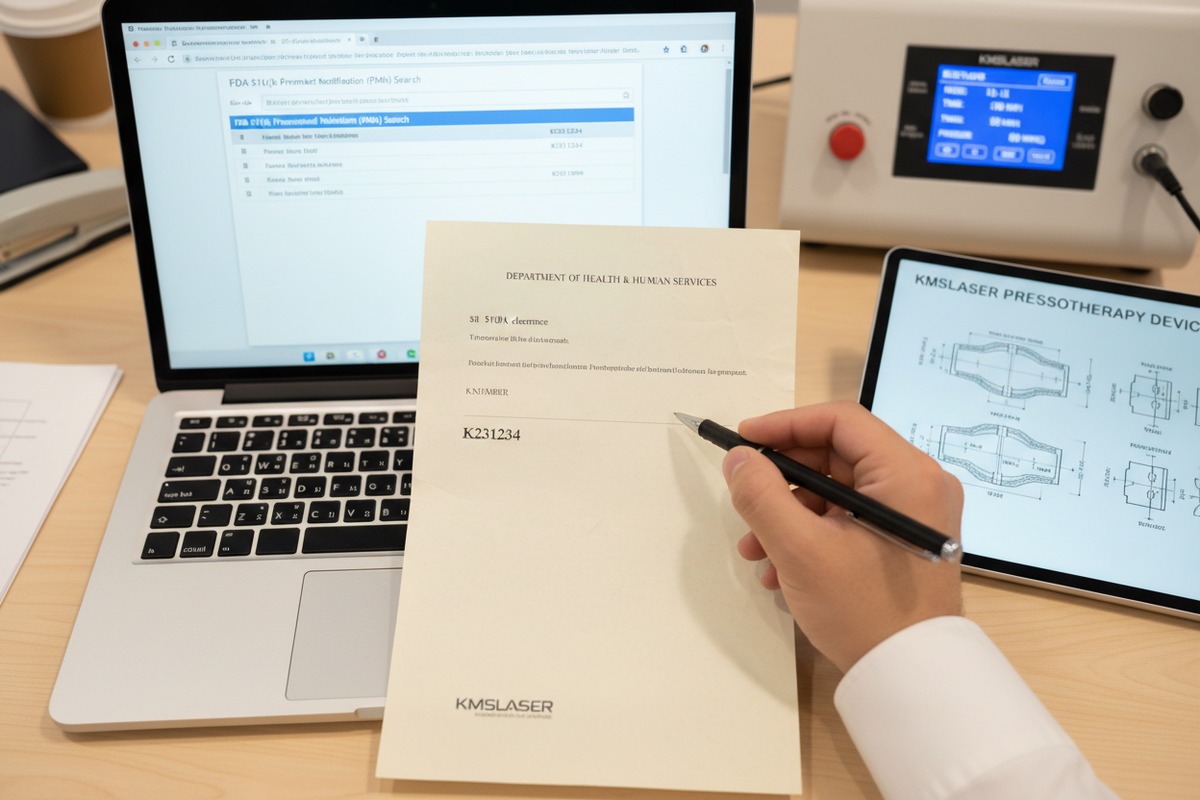
Request your supplier's complete 510(k) submission package including the clearance letter with K-number, 510(k) summary, predicate device comparison table, device description with engineering drawings, indications for use statement (FDA Form 3881), performance testing summaries, and labeling specimens. Cross-reference the K-number in FDA's public database to confirm authenticity.
The Core Documentation Package
Every legitimate 510(k) cleared pressotherapy device comes with a standard documentation set. Medical device companies must submit detailed information on the device's design, materials, intended use, and performance testing results. For pressotherapy machines—typically classified as Class II devices under 21 CFR 890.5975 for pneumatic compression systems—this documentation is substantial.
Here's what your supplier must provide:
| Document Type | Purpose | Verification Method |
|---|---|---|
| 510(k) Clearance Letter 2 | Confirms FDA authorization | Search FDA 510(k) database |
| 510(k) Summary | Public overview of device claims | Request from FDA or supplier |
| Predicate Comparison Table | Shows substantial equivalence basis | Review for matching specs |
| Device Master Record 3 | Complete technical specifications | Supplier provides under NDA |
| FDA Form 3881 (Indications for Use) | Defines permitted claims | Match against marketing materials |
| Registration & Listing Proof | Facility compliance | Verify via FDA FURLS database 4 |
How to Verify the Clearance is Authentic
"A 510(K) is a premarket submission made to FDA to demonstrate that the device to be marketed is as safe and effective, that is, substantially equivalent, to a legally marketed device." The FDA maintains a searchable database where you can confirm any K-number.
Our quality team always takes these steps:
- Search the FDA 510(k) database at accessdata.fda.gov
- Confirm the clearance holder matches your supplier's legal entity name
- Verify the device name and product code match what you're purchasing
- Check the clearance date—older clearances may have outdated predicates
Understanding the Predicate Device Strategy
"The legally marketed device(s) to which equivalence is drawn is commonly known as the 'predicate.' predicate device comparison 5 Although devices recently cleared under 510(k) are often selected as the predicate to which equivalence is claimed, any legally marketed device may be used as a predicate."
For pressotherapy devices, common predicates include earlier pneumatic compression systems with established safety records. Ask your supplier to explain their predicate selection—if they cannot articulate why their predicate demonstrates substantial equivalence, that's a red flag.
Critical Registration Requirements
The manufacturer should be prepared for an FDA quality system (21 CFR 820) inspection at any time after 510(k) clearance. quality management system certificates 6 This means your supplier must maintain both facility registration and device listing.
An owner or operator of an establishment who is engaged in the manufacture, preparation, propagation, compounding, assembly, or processing of a medical device intended for human use is generally required to register the establishment and submit listing information for all devices in commercial distribution.
How can I confirm that the machine's internal components match the original FDA submission?
During production audits at our Guangzhou facility, we've seen buyers shocked to discover their supplier changed components after clearance. The device they ordered doesn't match the one FDA reviewed.
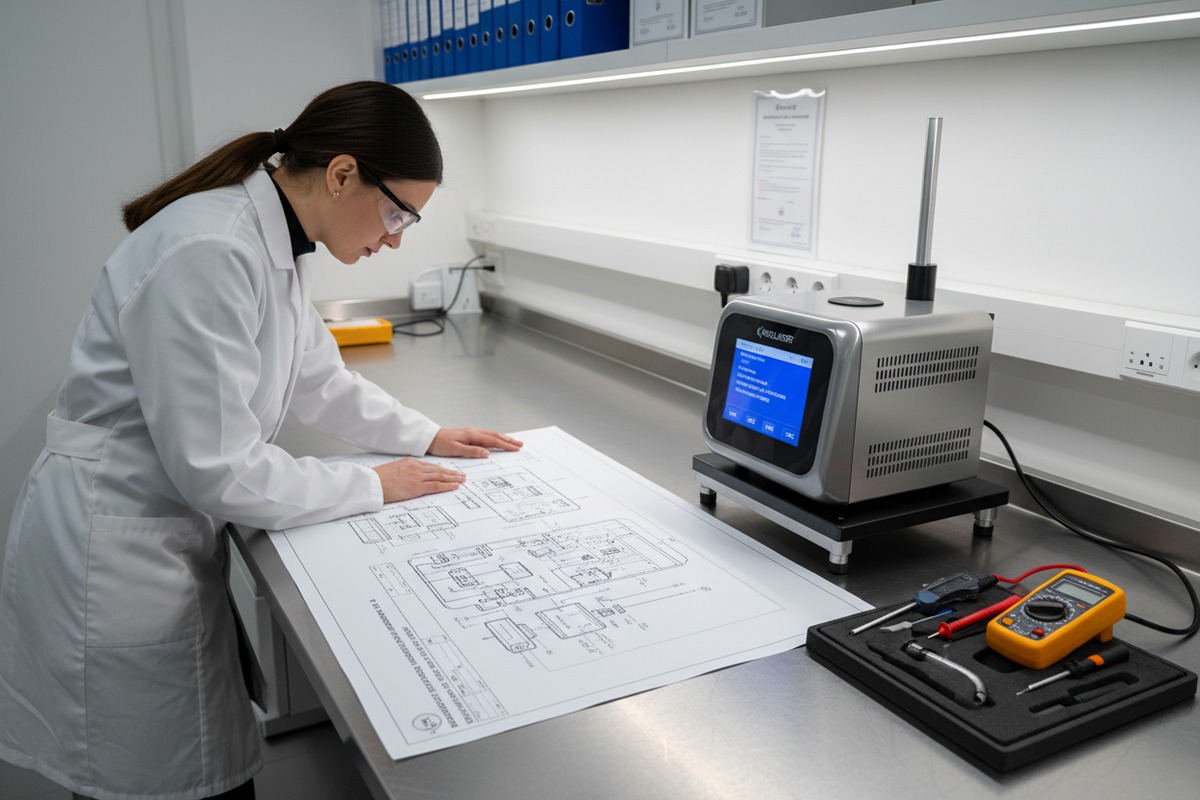
To confirm component consistency, request the Design History File (DHF), Bill of Materials (BOM) tied to the 510(k) submission, change control records showing any post-clearance modifications, and comparison photos of the cleared device. Any material change to components, software, or manufacturing process may require a new 510(k) submission.
Why Component Traceability Matters
A device is substantially equivalent if, in comparison to a predicate it: has different technological characteristics and does not raise different questions of safety and effectiveness; and the information submitted to FDA demonstrates that the device is as safe and effective as the legally marketed device. If components change, this equivalence may no longer hold.
The pressotherapy machine you're sourcing should match these specifications from the original 510(k):
| Component Category | Documentation Required | Change Threshold for New 510(k) |
|---|---|---|
| Compression chambers | Materials specs, pressure ratings | Material change or >10% pressure variation |
| Control unit electronics | Circuit diagrams, software version | Any hardware or software modification |
| Air compressor/pump | Specifications, manufacturer | Different manufacturer or model |
| Tubing/connectors | Material composition, dimensions | Patient-contacting material changes |
| Power supply | Electrical ratings, certifications | Voltage/current specification changes |
The Design History File Deep Dive
Your device description should include your key technical information: Design History File 7, design outputs, drawings, specs, dimensions, and so on. The DHF is where you'll find the definitive record of what FDA actually reviewed.
Our engineering team requests these DHF elements:
- Engineering drawings with revision dates matching clearance
- Component specifications and approved vendor list
- Risk analysis documents (per ISO 14971)
- Design verification and validation test protocols
- Final device specifications signed off before submission
Understanding Post-Clearance Change Control
A new submission may also be necessary when modifications are made to an existing, legally marketed device. In practice, the classification of the medical device will typically determine which route to market is appropriate.
Ask your supplier for their change control procedure documentation. A legitimate manufacturer will have:
- Written procedures for evaluating changes against 510(k) requirements
- Records of all changes since original clearance
- Documentation showing which changes were determined to not require a new 510(k)
- Evidence of any supplemental 510(k) submissions for significant changes
Red Flags in Component Documentation
Watch for these warning signs:
- BOM dates after the clearance date with no change control records
- Missing revision history on engineering drawings
- Software version numbers that don't match submission documents
- Supplier certificates showing different material compositions
- Pressure specifications that vary from the 510(k) summary
What documentation do I need if I want to private label a 510(k) cleared pressotherapy device under my brand?
Our team fields this question weekly. U.S. brand owners want to import pressotherapy machines, apply their logo, and sell under their name. The documentation requirements are specific—and often misunderstood.
For private labeling a 510(k) cleared pressotherapy device, you need a written private label agreement with the 510(k) holder, updated device listing showing your brand name in FDA's FURLS database, compliant labeling per 21 CFR 801.1 showing "Manufactured for" or "Distributed by" your company, a quality agreement defining responsibilities, and—if you're the initial U.S. importer—establishment registration proof.

The Private Label Structure Explained
There is no formal process for "getting a private label." The entire private label process is negotiated between the distributor and the OEM with no involvement of the FDA. However, this doesn't mean documentation is optional.
However, in the listing of devices within the FDA FURLS database, all brand names of the device must be identified. Therefore, the OEM will need to add the new brand name used by the distributor to their listing for the 510(k) cleared product.
| Party | Required Registration | Key Responsibilities |
|---|---|---|
| Foreign Manufacturer (510(k) holder) | Establishment registration as manufacturer | Maintains design control, quality system |
| U.S. Initial Importer | Establishment registration as initial importer | Complaint handling, MDR reporting |
| U.S. Distributor Only | None (if not initial importer) | Forward complaints to manufacturer |
Labeling Requirements for Private Label
"As required under 21 CFR 801.1(c), where a device is not manufactured by the person whose name appears on the label, the name shall be qualified by a phrase that reveals the connection such person has with such device; such as, 'Manufactured for ABC Company,' 'Distributed by ABC Company,' or any other wording that expresses the facts."
Your labeling documentation package must include:
- Device labels showing correct relationship statement
- Instructions for Use (IFU) with your brand name
- Packaging artwork compliant with FDA requirements
- UDI (Unique Device Identifier) information for GUDID submission
Two Common Private Label Scenarios
If the initial importer owns the 510(k), then the manufacturer outside the USA is identified as the "contract manufacturer," and the initial importer is identified as the "specifications developer." Both companies must register their establishments with the FDA, and there needs to be a quality agreement between the two companies defining roles and responsibilities.
If the manufacturer owns the 510(k), then the manufacturer outside the USA is identified as the "specifications developer" and the "manufacturer," while the initial importer will be identified as the "initial importer."
Quality Agreement Essentials
The quality agreement between you and the 510(k) holder should document:
- Who maintains the Design History File
- Complaint handling procedures and escalation paths
- Medical Device Reporting 8 (MDR) responsibilities
- Change notification requirements
- Audit rights and frequency
- Supply chain documentation requirements
Does the Private Labeler Need Their Own 510(k)?
Do I need to submit a 510(k)? No, the manufacture should submit the 510(k), if required for the device. As long as you're not modifying the device beyond labeling, the existing clearance covers your private label version.
You may place a label on the device, "Distributed by ABC Firm" or "Manufactured for ABC Firm," and sell it to end users without submission of a 510(k). In most cases, if you are a repackager or a relabeler and the existing labeling or condition of the device is not significantly changed.
Which testing reports must my supplier provide to guarantee the machine meets my internal quality standards?
At our facility, we run every pressotherapy unit through performance testing before shipment. But we also provide complete third-party test documentation—because that's what serious buyers demand.
Require your supplier to provide IEC 60601-1 electrical safety test reports, IEC 60601-1-2 EMC (electromagnetic compatibility) testing, ISO 10993 biocompatibility evaluation for patient-contacting materials, pressure accuracy and cycling tests, software validation documentation if applicable, and risk analysis per ISO 14971. All reports should come from accredited laboratories with ISO 17025 certification.

The Essential Testing Suite
Testing also verifies that a device meets recognized standards, including ISO 10993 for biocompatibility, IEC 60601 for electrical safety and EMC, ISO 11607 for sterile packaging, IEC 62366 for usability, and IEC 62304 for medical software.
For pressotherapy machines, here are the non-negotiable test reports:
| Test Category | Standard | What It Verifies |
|---|---|---|
| Electrical Safety | IEC 60601-1 | Protection against electrical shock, fire hazards |
| EMC Testing | IEC 60601-1-2 | No interference with/from other equipment |
| Biocompatibility | ISO 10993 series | Patient-contacting materials are safe |
| Pressure Performance | Device-specific protocols | Accurate pressure delivery, cycle reliability |
| Software Validation | IEC 62304 | Software functions safely and reliably |
| Risk Management | ISO 14971 | Hazards identified and mitigated |
IEC 60601 Electrical Safety Requirements
The IEC 60601-1-2 standard applies to the basic safety and performance of medical electrical equipment and systems. IEC 60601 electrical safety 9 The IEC 60601-1-2 standard specifies test limits for emissions, immunity, electrostatic discharge (ESD), radiated radio-frequency electromagnetic fields, bursts, and surges.
Your supplier's IEC 60601 test report should document:
- Classification of the device (Class I or II, Type B, BF, or CF applied parts)
- Protection against electric shock testing results
- Mechanical hazards assessment
- Temperature limits for patient-contacting surfaces
- Marking and documentation compliance
EMC Testing Documentation
Intertek provides EMC Testing solutions for Medical Devices to meet your compliance needs for IEC 60601-1-2 and the new IEC 60601-1-2 4.1 published in September 2021.
At the end of the testing process, you will receive a test report which documents the requirements of IEC 60601-1-2 and outlines what testing is required. Part of what makes IEC 60601-1-2 testing difficult is not primarily the EMC measurements, but it is adapting to the language and thought process of IEC 60601 and applying the concepts of Risk Management under ISO 14971.
EMC test reports must include:
- Emissions testing (conducted and radiated)
- Immunity testing for various electromagnetic phenomena
- Essential performance criteria under EMC stress
- Test configurations documented with photos
- Pass/fail determination for each test
Biocompatibility Requirements
The extent of biocompatibility testing required for FDA 510(k) submission depends on the category of the device, how it contacts the body, and the contact duration, with more invasive devices generally requiring more extensive testing. ISO 10993 biocompatibility data 10 Endpoint selection is based on ISO 10993-1 and FDA biocompatibility guidance.
For pressotherapy devices with skin contact, typical biocompatibility tests include:
| Test Type | ISO Standard | Purpose |
|---|---|---|
| Cytotoxicity | ISO 10993-5 | Evaluates cell-level toxicity |
| Sensitization | ISO 10993-10 | Assesses allergic reaction potential |
| Irritation | ISO 10993-23 | Tests for skin irritation |
| Chemical Characterization | ISO 10993-18 | Identifies extractable chemicals |
Performance and Reliability Testing
Beyond regulatory requirements, demand these performance verifications:
- Pressure Accuracy Testing: Verify actual pressure matches displayed values (typically ±5-10 mmHg tolerance)
- Cycle Testing: Document performance over thousands of inflation/deflation cycles
- Durability Testing: Compression garment material strength and seam integrity
- Timer Accuracy: Verification of treatment duration precision
Accepting Test Reports from FDA-Recognized Standards
"The most straightforward way to conduct testing for a 510(k) submission is to follow FDA-recognized consensus standards, whenever available. While voluntary, this typically reduces both submission review time and the amount of documentation required, as a detailed description of the test procedure can be replaced with a reference to the standard."
When reviewing test reports, confirm:
- The testing laboratory holds ISO 17025 accreditation
- Test protocols reference current FDA-recognized standards
- Test dates are recent (within product shelf life claims)
- Sample identification matches your device model/version
- Reports include complete methodology, not just pass/fail summaries
Conclusion
Sourcing FDA 510(k) cleared pressotherapy machines requires thorough documentation verification—from clearance letters and predicate comparisons to test reports and quality agreements. Taking time upfront to request and verify these documents protects your business from regulatory complications, recalls, and supply chain disruptions. When your documentation is solid, FDA compliance becomes a competitive advantage rather than a liability.
Footnotes
1. HTTP 404 – Replaced with the current FDA Premarket Notification (510(k)) page. ↩︎
2. HTTP 404 – Replaced with the current FDA Premarket Notification (510(k)) page, which describes the clearance process and letter. ↩︎
3. Official FDA definition and requirements for a Device Master Record (DMR). ↩︎
4. Official FDA information on how to register facilities and list devices, including FURLS. ↩︎
5. HTTP 404 – Replaced with the current FDA Premarket Notification (510(k)) page, which includes information on substantial equivalence and predicate devices. ↩︎
6. Explains FDA’s Quality System Regulation (21 CFR Part 820) for medical devices. ↩︎
7. Official FDA information on design controls, which mandate the Design History File (DHF). ↩︎
8. Official FDA guidance on Medical Device Reporting (MDR) for adverse events. ↩︎
9. Provides information on the international standard for basic safety and essential performance of medical electrical equipment. ↩︎
10. Official FDA guidance on biocompatibility assessment for medical devices, referencing ISO 10993. ↩︎

 English
 Español de México
 Deutsch
 Français
 العربية
 Русский
