As the manufacturer, I often get asked by distributors: “How long can your machine run non-stop?” It’s a smart question—runtime determines clinic throughput, maintenance frequency, and reliability, and it links directly to the shockwave therapy handpiece lifespan measured in total impacts 1.
Shockwave therapy machines are rated by total pulse count and duty cycle, not by continuous hours. Under full load (25 Hz), the handpiece typically sustains 50–60 minutes of cumulative treatment before a cool-down phase, translating to about 55 hours of total lifetime operation at maximum output.
Understanding runtime correctly ensures safe usage, prevents overheating, and preserves warranty coverage.
How do manufacturers define maximum runtime for continuous use?
As the manufacturer, we define “maximum operating time” using both pulse-based and thermal-based criteria. Every pulse produces mechanical stress and heat, so runtime limits are set to keep internal temperatures within safe limits and in line with treatment pulses per session commonly used in ESWT protocols 2.
Manufacturers define maximum runtime as the duration of continuous shockwave emission the handpiece or generator can sustain before exceeding thermal thresholds, typically 5–15 minutes per treatment cycle followed by a cooling interval of 5–20 minutes depending on power, frequency, and ventilation, similar to the typical 10–30 minute session durations in clinical ESWT 3.
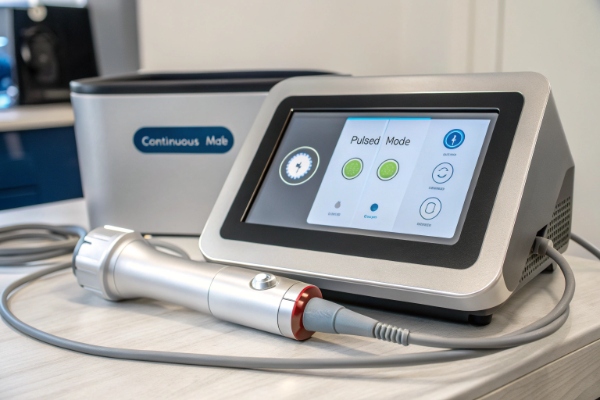
Why pulse count matters
Unlike devices measured in minutes, ESWT systems specify lifespan by pulse count because:
- Shock energy output is discrete and measurable per pulse.
- Lifespan correlates directly to mechanical wear, not just clock time.
- At 25 Hz (25 pulses /sec), 5 million pulses ≈ 55 hours continuous use.
Table 1 — Typical runtime definitions by manufacturer
| Criterion | Example value | Corresponds to |
|---|---|---|
| Max continuous treatment | 5–10 min at high energy | 2,500–10,000 pulses |
| Cooling period | 10–15 min | Fan or passive dissipation |
| Handpiece lifetime | 5 million pulses | ≈ 55 hours at 25 Hz |
| Console lifetime | 50 million pulses | ≈ 555 hours at 25 Hz |
Most manufacturers validate runtime through Highly Accelerated Life Testing (HALT) 4 and confirm thermal stability against IEC 60601-1 maximum temperature design requirements 5.
What cooling or duty-cycle limitations may apply to extended sessions?
As the manufacturer, I include temperature sensors and firmware limits to prevent damage from overuse. Continuous use generates heat in the projectile chamber, coils, and seals, so smart cooling is essential and must respect the system’s defined duty cycle 6.
Every high-frequency or high-energy treatment must respect a duty cycle—typically 70% operation and 30% rest—to prevent thermal overload. Premium systems add active cooling (fans, heat sinks, or vented casings) that extend continuous runtime without manual pauses, and their parameters are chosen with frequency versus treatment-duration behavior of shockwave machines 7 in mind.
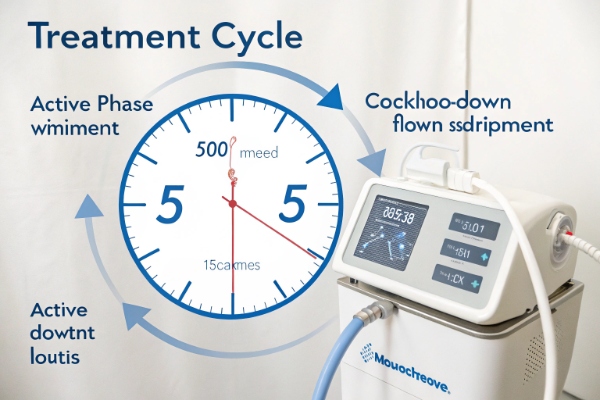
Built-in cooling measures
- Active fan systems: Circulate air through the handpiece chamber.
- Passive metal sinks: Radiate heat away from solenoids and bearings.
- Temperature sensors: Trigger auto-shutdown when exceeding 45–50 °C.
- Firmware countdowns: Display “Cooling required” with remaining time.
Table 2 — Cooling and duty-cycle examples
| Feature | Typical spec | Function |
|---|---|---|
| Auto-cooling fan | Activates > 42 °C | Extends runtime 2–3× |
| Temperature cutoff | 50 °C | Prevents seal deformation |
| Recommended duty cycle | 10 min on / 10 min off | Maintains optimal temp |
| Ambient limit | 10–30 °C | Required for rated performance |
Ignoring these parameters accelerates component fatigue and voids the handpiece warranty.
How should buyers evaluate suitability for high-volume clinic usage?
As the manufacturer, I tailor machine selection by daily treatment load. Clinics running 20+ sessions/day need industrial-grade cooling and high-cycle durability, similar to dual-channel shockwave platforms designed for heavy clinic use 8.
To assess suitability for high-volume use, buyers should examine pulse lifespan, cooling design, maintenance cycle, and spare-part logistics—machines rated ≥ 50 million pulses with active cooling are ideal for continuous clinic throughput.

Evaluation checklist
- Pulse capacity: ≥ 50 million for console, ≥ 5 million for handpiece (some therapy sources guarantee up to 5 million pulses of lifespan 9).
- Cooling system: Active fan + ventilation slots > passive only.
- Service interval: Clear documentation (e.g., every 1 million pulses).
- Spare handpieces: Quick-swap design for rotation during cooldown.
- Thermal monitoring: Display of live temperature or auto-cooling prompt.
- Ambient tolerance: Stable performance 10–30 °C, 35–65 % RH.
- Warranty alignment: Pulse-based, not time-based coverage.
Table 3 — Clinic suitability guide
| Daily sessions | Recommended pulse rating | Cooling type | Maintenance |
|---|---|---|---|
| < 10 | 5 million handpiece | Passive | Annual check |
| 10–25 | 10 million handpiece | Active fan | Semi-annual service |
| 25 + | 15–20 million + | Active + vented casing | Quarterly inspection |
High-volume buyers should request engineering validation data proving that the device can maintain energy output stability (< ±10 %) across full thermal cycles.
Does prolonged operation affect warranty or maintenance needs?
As the manufacturer, I warranty my devices by pulse usage, not hours, because it reflects mechanical wear and coil fatigue more accurately, and it ties directly to how you clean and maintain your shockwave handpiece 10.
Prolonged or improper continuous operation accelerates wear on projectile chambers, bearings, and O-rings—potentially voiding warranty if pulse-limit or cooling guidelines are ignored. Proper maintenance (handpiece rebuilds every 1–2 million pulses) ensures stable output and protects warranty validity.

Warranty structure (typical)
- Console: 3 years or 50 million pulses, whichever first.
- Handpiece: 1 year or 5 million pulses.
- Exclusions: Overheating from blocked vents or skipped cooldowns.
- Maintenance kit: Includes bullet, sleeve, O-ring replacement after 1–2 million pulses.
Table 4 — Maintenance interval guide
| Component | Service interval | Action | Benefit |
|---|---|---|---|
| Handpiece | Every 1–2 million pulses | Replace wear kit | Restores energy output |
| Cooling fan/filter | Every 6 months | Clean/replace | Prevents thermal shutdowns |
| Cable & connectors | Annually | Inspect for wear | Avoids energy loss |
| Firmware | As released | Update | Improves temp control |
| Calibration | Every 12 months | Verify output accuracy | Retains compliance |
Regular preventive service minimizes downtime, extends lifetime beyond rated pulses, and ensures the energy per shock remains consistent with clinical protocols.
Conclusion
As the manufacturer, I advise clients to view “maximum operating time” through pulse and thermal management rather than minutes alone. Follow rated pulse life, duty cycles, and cooling intervals—and your machine will deliver stable energy for years of high-volume, trouble-free operation.
Footnotes
1. Explains how handpiece lifespan is defined in total shock impacts. ↩︎
2. MDPI article summarizing ESWT protocols and typical pulse counts per session. ↩︎
3. ESWT information site describing typical 10–30 minute treatment durations. ↩︎
4. Overview of Highly Accelerated Life Testing (HALT) for reliability. ↩︎
5. Blog on designing to IEC 60601-1 surface temperature limits. ↩︎
6. Definition of duty cycle as work-time to total-time ratio. ↩︎
7. Article on how machine frequency affects treatment duration and loading. ↩︎
8. Product page describing a radial device for heavy daily clinical use. ↩︎
9. Device listing highlighting handpiece lifespan up to 5 million pulses. ↩︎
10. Maintenance guide on cleaning and caring for shockwave handpieces. ↩︎

 English
  Español de México
  Deutsch
  Français
  العربية
  Русский