

Few things ruin a luxury salon treatment faster than a fastener popping open under pressure. In our production line, we see how weak Velcro turns a high-end suit into a liability.
To test Velcro effectively, you must use a Universal Testing Machine to measure peel and shear strength according to ASTM D5170 and D5169. Additionally, run 5,000-cycle fatigue tests and evaluate adhesive stability against heat and moisture to ensure the suit remains secure during high-pressure inflation.
Understanding these technical benchmarks is the only way to avoid costly returns and complaints from your salon clients. Let’s look at the specific testing protocols we use.
How do I accurately measure the initial peel and shear strength of Velcro on pressotherapy suits?
During our quality control phase, we often find that "feeling" the grip by hand is never enough. Imprecise fasteners lead to suit failure when the internal air bladders reach peak pressure.
Measure peel strength using a T-peel test (ASTM D5170) and shear strength with a lateral pull test (ASTM D5169). A high-quality suit should withstand 1.5 to 2.0 N/cm for peel and at least 10 to 15 N/cm² for shear force.

Understanding Peel vs. Shear Strength
When we evaluate fasteners, we distinguish between two main forces. Peel strength 1 is the force required to pull the hook and loop apart from one end. Shear strength 2 is the resistance to sliding the two surfaces across each other. In pressotherapy, shear strength is more critical. As the air bladders inflate, they push outward, trying to slide the Velcro panels apart.
The Testing Protocol
We use a Universal Testing Machine 3 (UTM) for these measurements. We cut one-inch strips of the Velcro used on the suit. These are clamped into the machine's jaws. For the peel test, the machine pulls the strips apart at a constant rate of 12 inches per minute. For the shear test, the strips are overlapped and pulled in opposite directions.
Why Precision Matters
If the initial strength is too low, the suit will burst open during a 40-minute session. If it is too high, the therapist will struggle to adjust the suit for the patient. We aim for a "sweet spot" where the bond is secure but ergonomic.
Comparative Strength Requirements
The following table outlines the standard requirements we look for in medical-grade pressotherapy garments.
| Test Type | Metric | Minimum Requirement | Recommended for High Pressure |
|---|---|---|---|
| Peel Strength | N/cm | 1.2 | 1.8+ |
| Shear Strength | N/cm² | 8.0 | 12.5+ |
| Tension Strength | N/cm² | 5.0 | 7.5+ |
How can I test if the Velcro will maintain its grip after hundreds of salon treatment cycles?
In our experience exporting to the US, durability is the number one concern for distributors. A suit that works on day one but fails after a month is a financial disaster for your brand.
Perform cycle life testing by opening and closing the fasteners at least 5,000 times using an automated fatigue tester. After these cycles, the Velcro must retain at least 50% of its original shear and peel strength to be considered salon-grade.

Simulating Real-World Fatigue
A busy salon might use a pressotherapy suit 10 times a day. Over a year, that is over 3,000 cycles. When we calibrate our equipment, we simulate this rapid wear. An automated fatigue tester 4 (like the AVENO AF07) mimics the human hand by repeatedly pressing and pulling the Velcro.
The Roller Compression Method
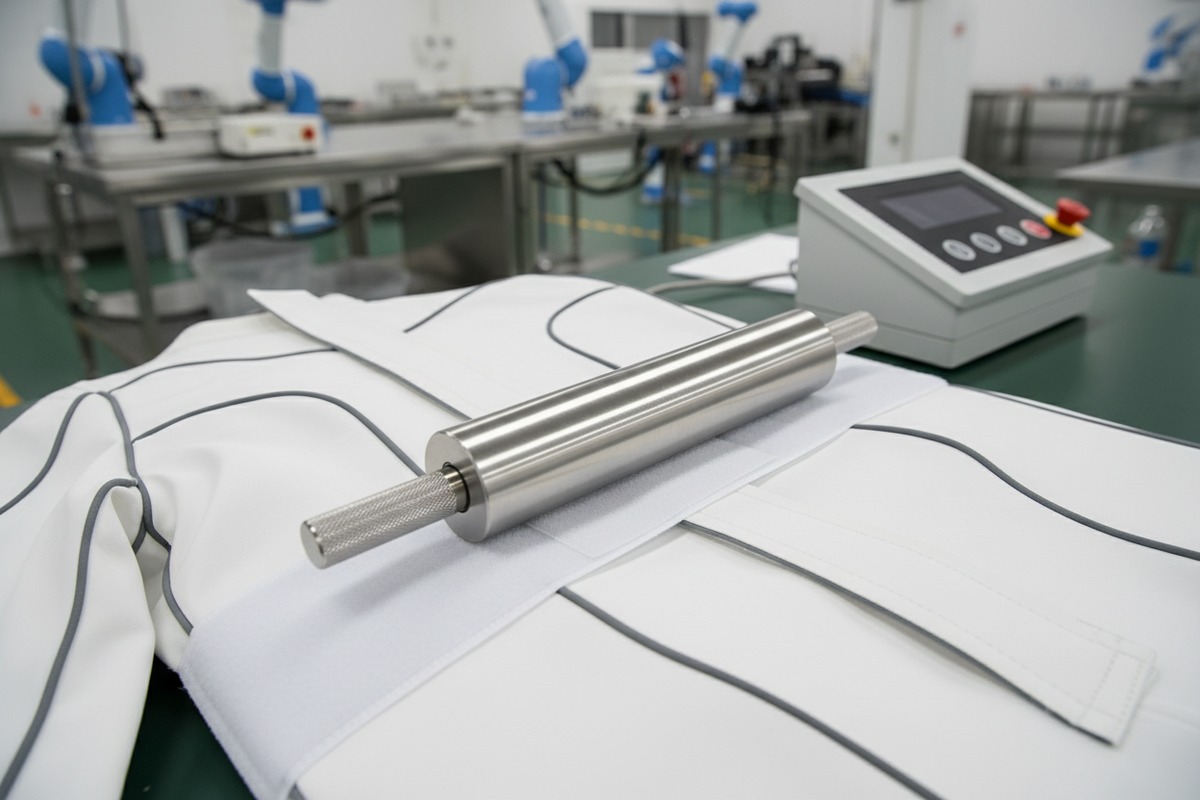
It isn't enough to just pull the Velcro apart. To get accurate data, you must apply consistent pressure when closing it. We use a standardized weighted roller. This ensures the hooks are fully engaged with the loops before the next pull cycle begins. This mimics the therapist smoothing the fastener down on the patient's leg or arm.
Environmental Stressors
Durability isn't just about mechanical wear. Pressotherapy suits are exposed to body heat, sweat, and cleaning chemicals. We often perform "accelerated aging" by placing the Velcro in a climate chamber at 140°F (60°C) with 90% humidity for 48 hours before re-testing its strength.
Performance Decay Benchmarks
The table below shows how much performance loss is acceptable over time.
| Number of Cycles | Acceptable Peel Retention | Acceptable Shear Retention | Status |
|---|---|---|---|
| 0 (Initial) | 100% | 100% | Pass |
| 1,000 | 85% | 90% | Excellent |
| 5,000 | 50% | 60% | Industry Standard |
| 10,000 | 30% | 40% | Premium Grade |
What is the best way to evaluate Velcro material quality to prevent snagging and debris buildup?
When we source raw materials for our suit panels, we look for "low-lint" properties. Traditional fasteners are famous for catching hair, skin cells, and lint, which quickly clogs the hooks and reduces their effectiveness.
Select injection-molded plastic hooks instead of traditional woven hooks to minimize snagging. Use a debris-resistance test by pressing the fastener into a standardized felt cloth; high-quality hooks should release the felt without retaining significant fibers.

Hook Design and Material Choice
Traditional "woven" hooks are made from nylon thread that is cut to create a hook shape. These are very strong but very abrasive. They can damage the expensive Lycra or Neoprene fabrics used in pressotherapy suits. At our factory, we prefer injection-molded hooks 5. These are smoother, flatter, and far less likely to snag on the patient’s clothing or the suit’s inner lining.
The "Debris Challenge"
In a salon environment, the floor is often covered in small particles. If the Velcro drops, it can become a magnet for dirt. We test this by applying the Velcro to a messy surface and seeing how easily it can be cleaned. If the hooks are too deep, the debris stays trapped, and the suit will no longer close properly.
Adhesive Backing Selection
The way the Velcro is attached to the suit is just as important as the hooks themselves. We recommend water-based acrylic adhesives. Unlike rubber-based glues, acrylics do not turn "gooey" when exposed to the high temperatures found in some therapy rooms. They also meet EU REACH regulations, which is vital if you are exporting to Europe.
Adhesive Type Comparison
Choosing the right bonding method ensures the Velcro stays on the suit, not in the therapist's hand.
| Feature | Rubber-Based PSA | Acrylic-Based PSA | Solvent-Activated |
|---|---|---|---|
| Initial Tack | Very High | Medium | Low |
| Heat Resistance | Poor | Excellent | Best |
| Moisture Resistance | Medium | High | High |
| Cure Time | 1 Hour (80%) | 24 Hours (Full) | Immediate after heat |
Which professional testing standards should I require my manufacturer to follow for Velcro durability?
When you are auditing a factory in China, you need more than their word. You need certificates. In our facility, we align our internal QC with international standards to ensure our partners in the US and Canada can sell with confidence.
Require your manufacturer to provide test reports for ISO 22776 (shear strength), ASTM D5170 (peel strength), and SATRA TM123. For medical-grade safety, ensure the materials also comply with ISO 13485 and FDA biocompatibility requirements.
ISO 22776: The International Benchmark
This is the gold standard for footwear and apparel fasteners. It specifically outlines how to measure the loss of strength after repeated use. If a supplier cannot show you an ISO 22776 6 report, they likely aren't testing for long-term durability. We find this standard provides the most consistent results across different batches of material.
SATRA TM123: The Real-World Test
SATRA is an independent research and testing organization. Their TM123 standard is specifically designed for hook-and-loop fasteners used in high-stress environments. SATRA TM123 7 It includes a "partial adhesion" test, which evaluates how well the Velcro holds when it is only partially engaged—a common scenario when a therapist is rushing to wrap a patient's legs.
Regional Standard Harmonization
Different markets use different names for similar tests. In China, the standard is often GB/T 3903.20. It is nearly identical to ISO 22776. When we work with American clients, we provide the ASTM equivalent to make their legal compliance easier. Always ask for the raw data sheets, not just a "Pass" or "Fail" summary.
Essential Standards Checklist
Use this list when reviewing your supplier's capabilities to ensure they meet professional benchmarks.
| Standard Code | Focus Area | Relevance to Pressotherapy |
|---|---|---|
| ASTM D5170 | Peel Strength | Measures vertical resistance. |
| ISO 22776 | Cycle Fatigue | Tests long-term durability over 5,000+ uses. |
| SATRA TM123 | Functional Adhesion | Simulates real-world application on garments. |
| GB/T 3903.20 | Chinese National Std | The local equivalent to ISO for factory audits. |
| ISO 10993 | Biocompatibility | Ensures Velcro doesn't irritate the patient's skin. |
Conclusion
Testing Velcro adhesion is the difference between a durable medical device and a cheap garment. By prioritizing shear strength, 5,000-cycle fatigue testing, and ISO standards, you ensure your pressotherapy suits perform perfectly every time.
Footnotes
1. Provides details on peel strength and how it’s measured. ↩︎
2. Defines shear strength and its importance in material resistance. ↩︎
3. Replaced with an authoritative manufacturer’s page explaining Universal Testing Machines. ↩︎
4. Replaced with a product page for an automated fatigue tester, directly matching the anchor text. ↩︎
5. Explains the technology and benefits of injection-molded plastic hooks. ↩︎
6. Details the international standard for determining shear strength of fasteners. ↩︎
7. Outlines the SATRA standard for testing closure strength of touch and close fasteners. ↩︎

 English
 Español de México
 Deutsch
 Français
 العربية
 Русский
