
Setting up a wellness center in a remote jungle or coastal retreat is exciting DDP (Delivered Duty Paid) terms 1. However, fragile electronics often fail when handled poorly during the long journey to isolated destinations.
To install pressotherapy machines at remote South American resorts, you must verify local voltage stability, ensure proper ventilation, and follow a systematic air-duct connection sequence. Commissioning requires running dual inflation cycles at 200 mmHg without a patient to verify that all compression chambers inflate evenly and safely.
Managing these technical steps ensures your guests receive high-quality lymphatic drainage treatments 2 from day one.
How do I handle the technical installation of pressotherapy machines at my remote South American resort?
When we assemble these units in our factory, we focus on modular durability to survive rough transit. If you do not prepare your space, even the best engineering will face operational hiccups.
Technical installation requires placing the control unit on a stable, vibration-free base with at least 15cm of rear clearance for cooling. You must match the voltage (110V/220V) to the machine’s internal transformer and securely click each air hose into its designated port.

Site Preparation and Airflow
The first rule of installation is environment control. Remote resorts in South America often deal with high humidity and dust. We design our enclosures with cooling fans located at the back. If you push the machine against a wall, it will overheat. Ensure the room has a stable temperature between 18°C and 26°C.
Electrical Safeguards
Power grids in remote areas can be unstable. Our production team recommends using a dedicated voltage regulator 3 for each machine. This prevents "dirty power" from frying the sensitive pneumatic valves inside the unit.
Connecting the Compression Suit
The suit consists of several "chambers" or "cells." Each hose must be connected in a specific order, usually starting from the feet and moving upward.
| Installation Component | Requirement | Purpose |
|---|---|---|
| Floor Surface | Level and Hard | Prevents internal pump vibration |
| Rear Clearance | 15cm (Minimum) | Ensures heat dissipation from fans |
| Power Source | Grounded Outlet | Protects against electrical surges |
| Air Hoses | "Click" Verification | Ensures airtight seal for pressure |
Final Assembly Checks
Before turning the power on, double-check that the suit's zippers are functional. If a zipper is caught, the air pressure might burst the seam. We test every zipper under high load before shipping, but local humidity can make them stiff. Apply a small amount of wax if they stick.
What steps should I follow to commission my new beauty equipment and ensure it meets my performance standards?
Our engineers always perform a "dry run" before any machine leaves the facility. You should do the same once the machine arrives at your resort to confirm no internal damage occurred during shipping.
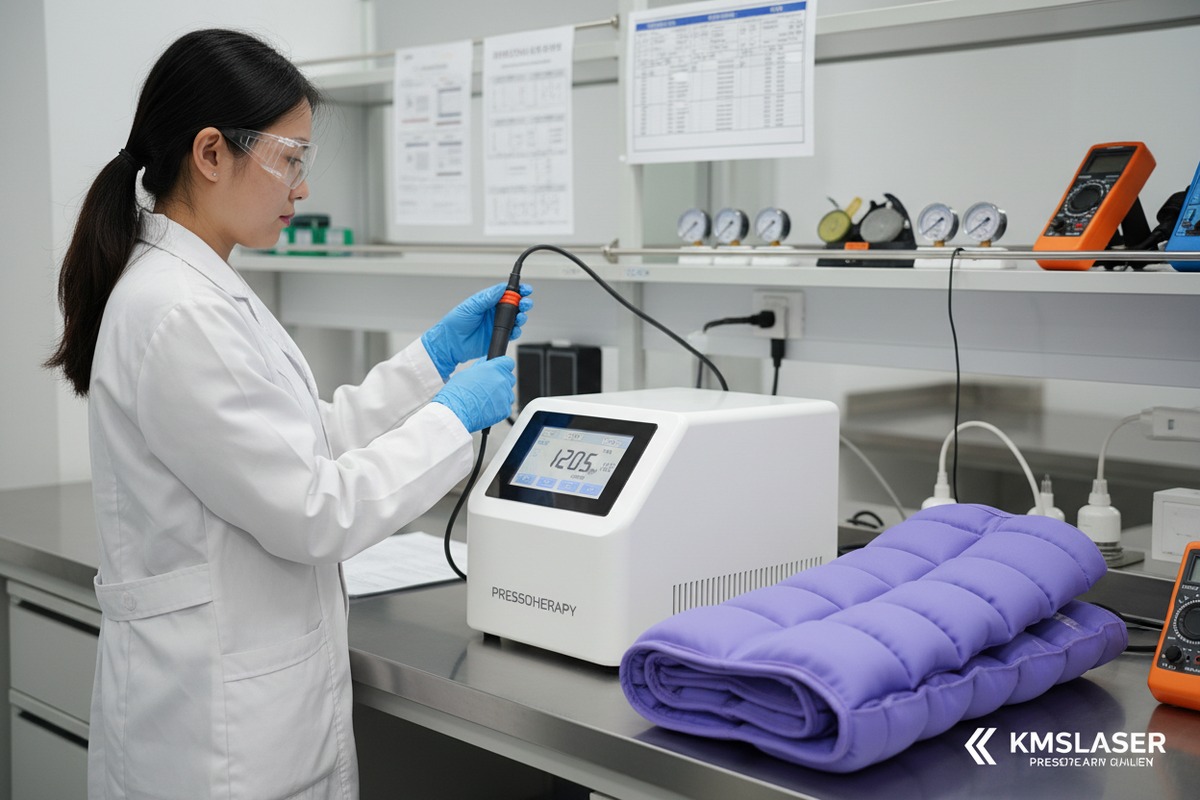
Commissioning involves a 200 mmHg pressure test in "Global Massage" mode without a body inside the suit. Conduct two full inflation cycles to ensure all chambers fill evenly. This validates that the internal valves, sensors, and air-tight seals are functioning within factory specifications.

The Pre-Client Testing Protocol
Never test the machine on a guest first. Lay the suit flat on the treatment table. Turn the machine on and select the highest pressure setting. This stresses the system enough to reveal any small leaks.
Setting Treatment Parameters
Modern machines offer various modes, such as Lymphatic Drainage, Slimming, and Relax. During commissioning, cycle through each mode. Check if the "Wave" mode actually moves sequentially from the feet to the torso.
| Test Category | Expected Result | Action if Failed |
|---|---|---|
| Inflation Speed | 8-12 seconds per chamber | Check for hose kinks |
| Pressure Accuracy | Reaches set mmHg +/- 5% | Recalibrate via control panel |
| Emergency Stop | Immediate deflation | Check safety valve connection |
| Heating (Infrared) | 39°C to 45°C range | Verify cable connection to suit |
Verifying the Interface
Ensure the software is set to the correct language (Spanish or Portuguese for South American staff). We include multi-language support in our firmware to help resort teams avoid operational errors caused by language barriers.
Troubleshooting Initial Issues
If a chamber does not inflate, it is usually a loose plug. Our air connectors use a dark gray plug that must "click." If you don't hear the click, the air will bypass the chamber, and the machine might throw an error code.
How can I manage the logistics and door-to-door delivery of my machines to isolated international locations?
Shipping to the Andes or the Amazon requires more than just a standard courier. In our experience managing global supply chains 4, we find that "last-mile" delivery is where most damage occurs if the packaging is weak.
Successful delivery involves using double-walled export cartons, internal foam molding, and hiring freight forwarders experienced in South American customs. You should request DDP (Delivered Duty Paid) terms to ensure the supplier handles all import taxes and local transport hurdles.

Specialized Packaging
Standard cardboard is not enough for international travel. We use custom-molded EPE foam that cradles the control unit. This prevents the heavy internal pump from shifting. For remote resorts, we often recommend wooden crating to protect against moisture and rough handling at small regional airports.
Navigating South American Customs
Customs in countries like Brazil, Argentina, or Peru can be difficult. We work with local agents who understand the specific beauty equipment codes. This prevents your machine from sitting in a humid warehouse for weeks while paperwork is sorted out.
| Shipping Method | Pros | Cons |
|---|---|---|
| Air Freight (DDP) | Fast, safe, includes taxes | Most expensive option |
| Sea Freight | Cost-effective for bulk | Long transit, high humidity risk |
| Local Trucking | Essential for remote sites | Requires specialized cargo insurance |
Insurance and Documentation
Always ensure the shipment is insured for its full replacement value. We provide a detailed packing list and commercial invoice that matches the machine’s serial numbers. This transparency speeds up the clearance process at the border.
Tracking the Journey
Use a supplier that provides real-time tracking. When the machine reaches the local hub in a city like Quito or Bogotá, you need to coordinate with the local courier for the final leg to your resort. This prevents the machine from being left in an open truck under tropical rain.
What remote training and support can I get from my supplier to keep my pressotherapy systems running smoothly?
Distance should not mean a lack of support. When we design our service systems, we prioritize video-based training and modular spare parts because we know a technician cannot always fly to a remote rainforest.
Suppliers provide remote support through HD video tutorials, live WhatsApp technical sessions, and "spare part kits" included with the order. Effective training covers daily cleaning, basic fuse replacement, and teaching staff how to troubleshoot air-leak codes without professional assistance.

Video-Based Staff Training
We provide step-by-step videos that show exactly how to fit the suit on a guest. This is crucial for pressotherapy because an improperly fitted suit will not provide effective lymphatic drainage. Staff should learn how to check for contraindications like deep vein thrombosis 5 before starting.
Preventive Maintenance Schedules
A pressotherapy machine is a pneumatic system 6. Like any pump, it needs regular checks. We provide a maintenance checklist that staff can follow monthly.
- Weekly: Wipe down the inside of the suits with medical-grade, non-alcohol wipes.
- Monthly: Check all hose connectors for cracks or brittle plastic.
- Quarterly: Clean the rear air intake filter to ensure the motor stays cool.
The "On-Site Tech" Concept
Because your resort is remote, we recommend designating one staff member as the "Technical Lead." We provide this person with deeper training on how to open the case and swap out a modular pump or a control board if needed. This reduces downtime from weeks to hours.
Digital Manuals and Multilingual Support
Paper manuals get lost. We provide digital copies in Spanish and English that can be accessed via QR codes on the machine. If a problem arises, your team can send us a video on WhatsApp, and our engineers can diagnose the issue instantly.
Conclusion
Installing pressotherapy machines in remote resorts requires careful site preparation, rigorous testing, and robust logistics. By following these steps, you ensure long-term performance and guest satisfaction in any South American location.
Footnotes
1. Clarifies international shipping responsibilities, including import taxes and customs clearance. ↩︎
2. Explains the medical procedure and its benefits for swelling reduction. ↩︎
3. Defines the device and its role in maintaining stable power supply. ↩︎
4. Provides authoritative context on international logistics and interconnectedness of production. ↩︎
5. Offers essential medical information on a critical contraindication for pressotherapy. ↩︎
6. Found an authoritative explanation of how a pneumatic system works from Fluid Controls. ↩︎


 English
 Español de México
 Deutsch
 Français
 العربية
 Русский
Join the Conversation
Have a question or insight to share? We read every comment — whether you're a distributor, salon owner, or just curious about the technology. Your real-world experience helps others make better decisions. Drop your thoughts below.