

When we receive inquiries from distributors in Brazil or Colombia, the first conversation often circles back to the nightmare of customs detention 1. You have likely heard horror stories of expensive equipment sitting in a warehouse at the Port of Santos because a single document was missing. We understand that finding a reliable partner is not just about the machine’s price; it is about ensuring the equipment actually arrives at your door without incurring massive fines.
To evaluate supplier qualifications effectively, you must verify their adherence to specific South American regulations like ANVISA or INVIMA rather than just accepting generic CE certificates. Request proof of past successful shipments to your region, inspect their ability to provide a Certificate of Origin for tariff reduction, and audit their financial stability through bank references to ensure long-term after-sales support.
Let’s examine the specific criteria you need to check to avoid regulatory pitfalls and ensure a smooth supply chain 2.
How do I verify if a supplier’s certifications are valid for importing pressotherapy machines into South America?
Our regulatory team spends countless hours ensuring our documentation aligns with the strict requirements of health ministries across Latin America, knowing that a minor error can freeze a shipment. We have seen many buyers lose capital by assuming a European certificate automatically grants entry into markets like Argentina or Peru.
You must cross-reference the supplier’s ISO 13485 documentation with specific regional requirements like Brazil’s ANVISA GMP or Colombia’s INVIMA registration. Request redacted Bills of Lading from previous South American shipments to prove their certifications have successfully cleared customs and legal barriers in your specific target market.
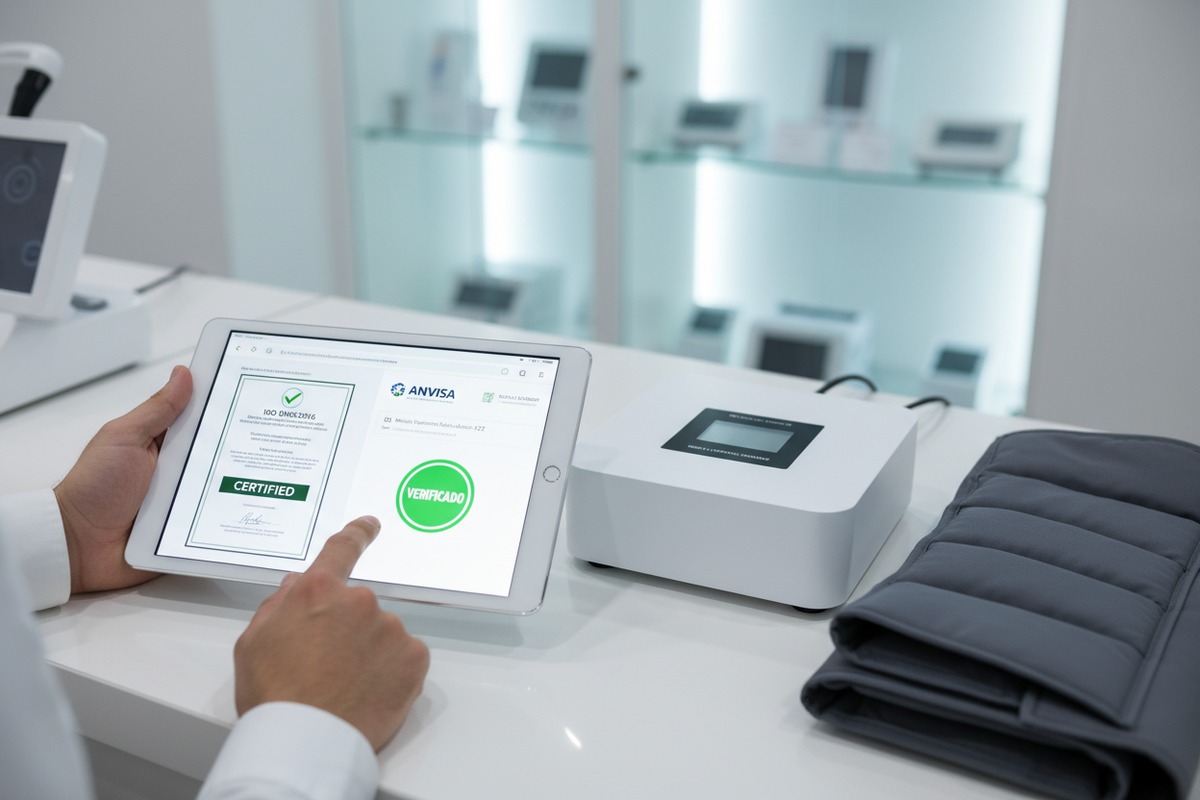
Navigating the regulatory landscape of South America is significantly more complex than importing into the United States or Europe. While many suppliers in China will present a CE mark or an FDA registration, these are often insufficient for direct importation into countries with sovereign health vigilance agencies 3.
Understanding Local Health Agency Requirements
You need to ask the supplier if they have experience cooperating with local Authorized Representatives. In Brazil, for instance, foreign manufacturers cannot register products directly with ANVISA; we must work through a local holder of the registration. If your potential supplier does not understand this distinction or refuses to provide the technical dossiers required for your local registration, they are likely inexperienced in this market.
For Colombia, INVIMA requires a detailed technical file that includes clinical evaluation reports and risk management files. When we prepare these for our partners, it involves translating technical specs into Spanish and ensuring the classification (often Class IIa for pressotherapy) matches local rules.
Verification Checklist
Do not take a PDF certificate at face value. Photoshop is easy to use. Instead, take the certification number provided by the supplier and verify it on the issuing body's official website. For ISO 13485, ensure the registrar is accredited by the IAF (International Accreditation Forum) 4.
Regulatory Breakdown by Country
The following table outlines the specific agencies and requirements you must discuss with your supplier:
| Country | Regulatory Body | Key Requirement for Pressotherapy |
|---|---|---|
| Brazil | ANVISA | Good Manufacturing Practices (GMP) inspection and local registration holder. |
| Colombia | INVIMA | Sanitary Registration (Registro Sanitario) requiring technical and legal dossiers. |
| Argentina | ANMAT | PM (Producto Médico) registration; strict limits on unauthorized imports. |
| Peru | DIGEMID | Sanitary Registration; often requires Free Sale Certificate from the country of origin. |
If a supplier claims that "shipping via courier" avoids these regulations, be extremely cautious. While small personal items might slip through, commercial quantities of medical aesthetic equipment 5 will almost certainly be flagged, leading to seizure.
What specific quality control steps should my manufacturer take to prevent product malfunctions during long-distance shipping?
We know that a pressotherapy machine traveling from Guangzhou to Santiago faces extreme conditions, including high humidity and rough handling during container transfers. Our engineers have redesigned packaging multiple times specifically to combat the "drop and shock" risks inherent in ocean freight.
Your manufacturer should implement rigorous vibration testing and drop tests to simulate rough sea freight conditions. They must use reinforced flight cases or double-wall corrugated boxes with custom foam inserts. Additionally, demand 48-hour aging tests on all electronic components to ensure stability before the goods leave the factory floor.
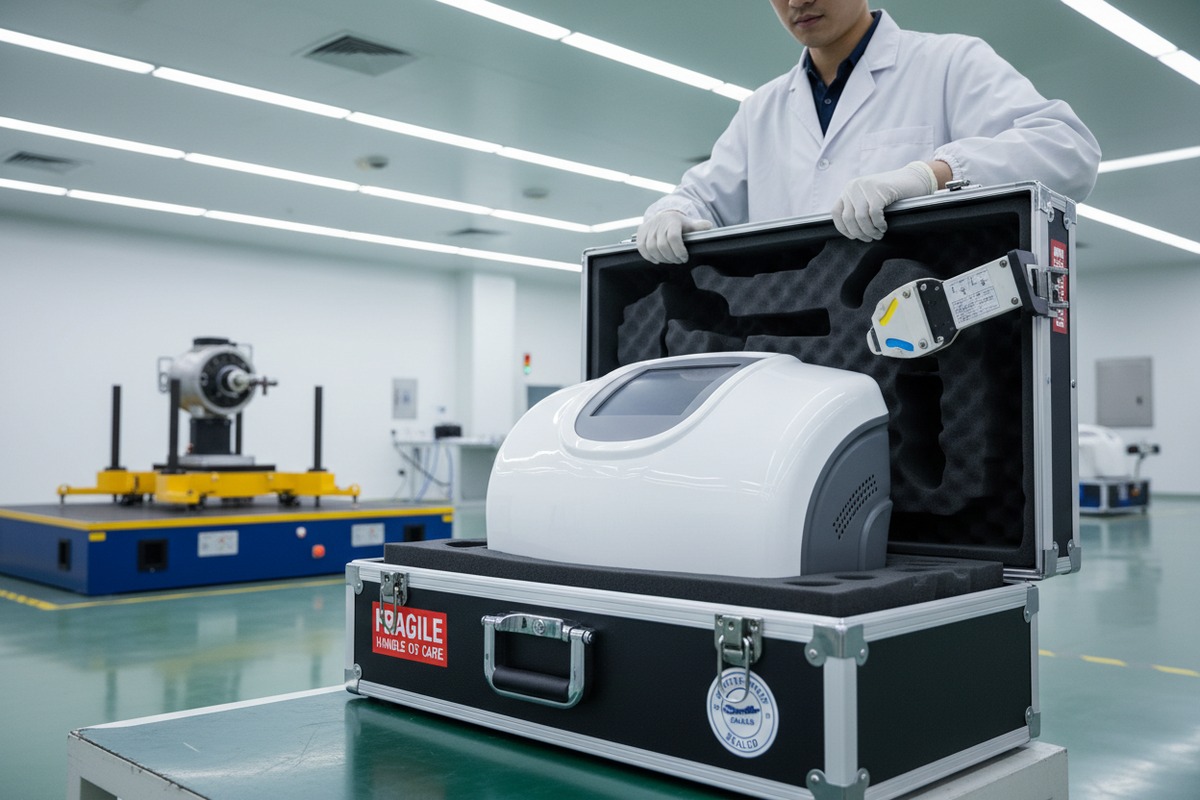
The physical journey from China to South America is long and arduous. Shipping containers can experience internal temperatures exceeding 50°C (122°F) crossing the equator and high humidity levels that corrode electronic contacts.
Climate and Electrical Stress Tests
We insist on "aging tests 6" for every single unit. This means the machine is turned on and runs a continuous cycle for at least 48 hours. This process weeds out early-life failures in the air pumps or the control motherboard. For the South American market, specific attention must be paid to voltage. Brazil, for example, has a dual voltage system where some states use 127V and others use 220V. A reliable supplier must offer dual-voltage machines or strictly verified specific-voltage units to prevent the device from burning out upon first use.
Packaging Integrity
Standard cardboard boxes are rarely enough. We use a "box-in-box" method or heavy-duty flight cases for premium models. You should ask your supplier for photos of their packaging before shipment. Look for:
- Custom-molded foam: Not just loose peanuts, which shift during transit.
- Moisture protection: Silica gel packets and plastic wrapping to prevent condensation damage.
- Corner guards: Hard cardboard or plastic corners to protect the box structure.
Quality Control Protocol
Ask your supplier to fill out a QC report for your specific order. Below is what a standard QC checklist should look like for pressotherapy devices:
| QC Step | Purpose | Passing Criteria |
|---|---|---|
| Air Pressure Calibration | Ensure compression levels match settings. | Deviation within ±5 mmHg of target pressure. |
| Air Leakage Test | Verify integrity of suit chambers. | No pressure drop over 10 minutes of static hold. |
| Vibration Test | Simulate transport shocks. | No loose screws or rattled components after 1 hour. |
| Voltage Stability | Ensure safety in unstable grids. | Operates normally at ±10% of rated voltage. |
If the supplier cannot provide a video or report of these tests being conducted on your batch, they are likely skipping steps to save costs.
Can I trust a supplier’s OEM capabilities to customize pressotherapy machine features for my specific brand needs?
When we collaborate with brand owners to develop exclusive models, we find that the biggest gap is often in software logic and linguistic accuracy. It is frustrating for a buyer to receive a machine where the Portuguese interface is poorly translated or the design does not fit the local aesthetic.
Trust is established by reviewing their portfolio of previous customizations and requesting a prototype or digital mockup before mass production. Assess their engineering team’s ability to modify software interfaces into Spanish or Portuguese and their flexibility in adjusting pressure settings to meet local therapeutic preferences.

OEM (Original Equipment Manufacturer) services 7 are the lifeblood of building a unique brand in a competitive market. However, "customization" means different things to different factories. Some simply stick a logo on a generic machine, while others, like us, can modify the internal airflow logic or the exterior casing design.
Software and Language Localization
South America is a diverse region linguistically. A machine destined for Brazil must have a flawless Portuguese interface, while one for Chile needs Spanish. Relying on Google Translate leads to embarrassing errors (e.g., translating "Start" as "Begin" in a way that sounds unnatural).
You should demand a video walk-through of the interface. Check if the font sizes are readable and if the terminology used (e.g., "Lymphatic Drainage" vs. "Massage") aligns with professional medical standards in your country.
Functional Customization
Beyond aesthetics, therapeutic needs vary. Some markets prefer higher pressure settings for sports recovery (up to 240 mmHg), while others focus on gentle cosmetic drainage (max 120 mmHg). A capable OEM supplier will allow you to tweak:
- Chamber inflation sequence: Wave, Peristaltic, or Sequential modes.
- Treatment timer: Default settings that match standard appointment times (e.g., 30 or 45 minutes).
- Suit compatibility: Ensuring the machine works with both pants and jackets simultaneously if needed.
The Prototype Phase
Never go straight to a 50-unit order with a new customization. Pay for a single prototype. Yes, it costs more per unit, but it saves you from receiving a container of machines with the wrong shade of white or a logo that rubs off.
How do I assess a supplier’s experience with South American logistics and customs to avoid delivery delays?
In our daily operations, we constantly monitor changes in tariff codes and shipping routes because a delay in Panama or a strike in a Chilean port can disrupt an entire quarter's sales. We have learned that a supplier who leaves logistics entirely to the buyer is often a recipe for disaster.
Assess their experience by asking for specific examples of past shipments to your region and their knowledge of HS codes for medical devices. Ensure they can provide essential documents like the Certificate of Origin and commercial invoices that match the strict formatting required by South American customs authorities.

South American customs are notoriously bureaucratic. A minor discrepancy between the Commercial Invoice and the Packing List can lead to fines or indefinite delays. A supplier experienced in this region will proactively ask you for your TAX ID (CNPJ in Brazil, RUT in Chile/Colombia) before shipping.
Documentation Accuracy
The most critical test of a supplier is their paperwork. For example, Brazil and Argentina often require the freight cost to be listed separately on the invoice to calculate taxes correctly. If a supplier lumps everything into "FOB price," your local broker may reject the documents.
Furthermore, free trade agreements exist between China and countries like Chile and Peru. A knowledgeable supplier will provide a Certificate of Origin (Form F or Form R), which can significantly reduce or eliminate import duties. If they don't mention this, you might be overpaying taxes by 6% to 19%.
The Role of Freight Forwarders
We strongly recommend using a freight forwarder who specializes in the China-South America lane. While we offer Door-to-Door (DDP) services for some regions to simplify things for clients, understanding the Incoterms 8 is vital.
- CIF (Cost, Insurance, and Freight): We handle shipping to your port, but you handle customs.
- DDP (Delivered Duty Paid): We handle everything, including taxes. This is popular but risky if the supplier doesn't have a strong local logistics partner.
Essential Documents Checklist
Before finalizing an order, verify the supplier can generate these documents in the exact format your customs broker requires:
| Document | Purpose in South America | Critical Detail |
|---|---|---|
| Commercial Invoice | Tax calculation. | Must show Incoterms, HS Code, and separate freight cost. |
| Packing List | Physical verification. | Must match invoice perfectly (net weight/gross weight). |
| Certificate of Origin | Duty reduction. | Must be officially stamped by Chinese authorities (CCPIT). |
| Bill of Lading (BL) | Title of ownership. | NCM/HS code must be listed on the BL for Brazil. |
Conclusion
Successfully importing pressotherapy machines into South America requires more than just finding a factory with a good price. It demands a partner who understands the intricate web of ANVISA, INVIMA, and various customs regulations. By verifying certifications, insisting on robust quality control for ocean freight, testing OEM flexibility, and auditing logistics expertise, you protect your investment. A qualified supplier acts not just as a vendor, but as a strategic ally in navigating the complexities of international trade.
Footnotes
1. Defines customs detention and its legal implications in trade. ↩︎
2. Authoritative and comprehensive definition of a supply chain. ↩︎
3. Outlines the framework and tools for health product vigilance. ↩︎
4. Provides information about the International Accreditation Forum and its role. ↩︎
5. Defines medical aesthetic devices and their regulatory classification. ↩︎
6. Explains the importance and methodology of aging tests for electronics. ↩︎
7. Authoritative and comprehensive definition of Original Equipment Manufacturer. ↩︎
8. Provides an overview of Incoterms and their significance in international trade. ↩︎

 English
 Español de México
 Deutsch
 Français
 العربية
 Русский
