
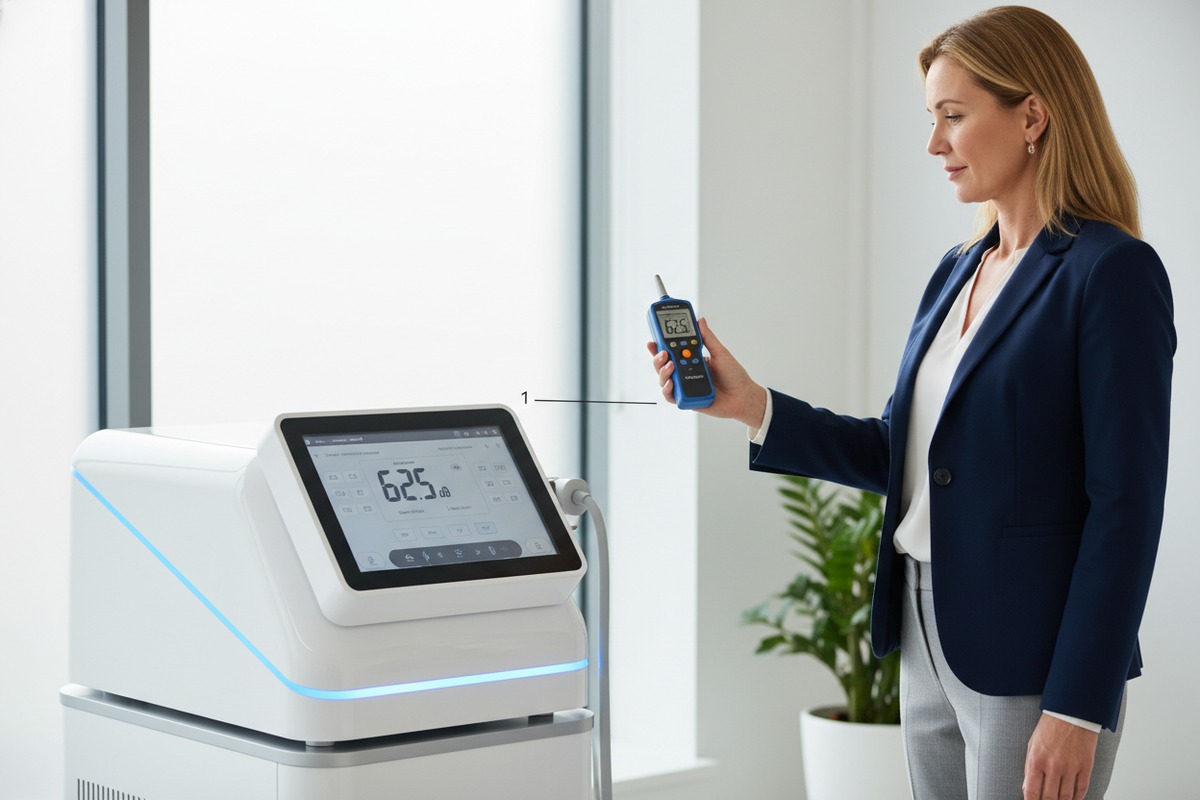
When our engineering team first tested pneumatic shockwave devices 1 for video demonstrations, the loud piston sounds ruined every take. This common frustration drives many content creators to abandon otherwise excellent machines simply because they cannot record clean audio alongside treatments.
To evaluate shockwave therapy machine noise for instructional videos, request manufacturer-provided decibel specifications measured at one meter using A-weighted scales, compare technology types (focused piezoelectric at 60-75 dB versus pneumatic radial at 88-110 dB), and conduct live video demonstrations to assess real-world audio interference before purchasing.
This guide breaks down every factor you need to consider A-weighted scales 2. We will cover remote verification methods, compressor noise impacts, internal components, and sound-dampening features that make filming professional content possible.
How can I verify the actual decibel levels of a shockwave machine through a remote video demonstration?
Remote purchasing creates unique challenges when you cannot physically test equipment IEC or ANSI S1.4 standards 3. Our export team handles these requests weekly from US and European buyers who need accurate noise data before committing to large orders.
Request live video calls where the supplier operates the machine at maximum intensity while a calibrated sound level meter displays real-time readings at exactly one meter distance. Compare A-weighted decibel measurements against manufacturer specifications and ask for documentation conforming to IEC or ANSI S1.4 standards.

Why Standard Specifications Often Mislead Buyers
Manufacturers measure noise under ideal laboratory conditions. These numbers rarely match real-world performance. Hard floors, bare walls, and small rooms amplify sound dramatically. A machine rated at 85 dB in a factory test chamber might hit 95 dB in your studio.
When we calibrate machines before shipping, we test in multiple environments. This gives buyers realistic expectations. Always ask where and how measurements were taken.
Setting Up an Effective Remote Test
First, schedule a video call using platforms with good audio quality. WhatsApp works well for quick checks. Zoom captures better detail for critical evaluations.
Ask the supplier to position their phone or camera exactly one meter from the handpiece. Request they use a dedicated sound level meter 4 app or professional device. Free apps like NIOSH SLM provide surprisingly accurate readings.
| Test Parameter | What to Request | Why It Matters |
|---|---|---|
| Distance | Exactly 1 meter | Standardizes comparison |
| Weighting | A-weighted (dBA) | Matches human hearing perception |
| Mode | Maximum intensity | Shows worst-case scenario |
| Duration | 30+ seconds continuous | Reveals sustained noise, not just peaks |
| Environment | Room dimensions disclosed | Explains acoustic amplification |
Critical Questions for Your Supplier
Ask these specific questions during remote demonstrations:
- What is the peak decibel reading versus average?
- Does the compressor cycle on and off during treatment?
- Are there quieter operational modes?
- Can you demonstrate at different intensity levels?
If a supplier cannot provide this information, consider it a red flag. Professional manufacturers like our facility in Guangzhou maintain testing equipment specifically for buyer verification.
Comparing Results Against Industry Benchmarks
Use this table to evaluate what you observe:
| Technology Type | Expected Range | Video-Friendly? |
|---|---|---|
| Piezoelectric Focused 5 | 60-75 dB | Yes |
| Electromagnetic Focused | 65-80 dB | Usually |
| Pneumatic Radial | 88-110 dB | Challenging |
| Mechanical Vibration | 50-65 dB | Yes |
If a pneumatic radial machine claims to operate below 85 dB, request additional proof. Physics dictates that compressed air impact mechanisms generate substantial noise. Claims of "silent radial" technology often indicate compromised power output.
Will the compressor noise in this shockwave device ruin the audio quality of my training videos?
Every week, our customer service team receives calls from frustrated buyers who overlooked compressor noise. The treatment handpiece seemed acceptable, but the background drone destroyed their recordings.
Yes, external compressors in pneumatic shockwave devices can severely degrade training video audio, producing continuous 70-85 dB background noise that overwhelms speech and creates post-production challenges. Electromagnetic and piezoelectric systems without compressors eliminate this problem entirely, while built-in compressor models vary significantly in noise isolation quality.

Understanding Compressor Types and Their Sound Profiles
Pneumatic radial shockwave machines require compressed air. This air comes from either built-in or external compressors. Each type creates different audio challenges.
External compressors are the loudest option. They sit on the floor, vibrating and humming continuously. Even placing them in another room may not solve the problem if sound travels through walls or air ducts.
Built-in compressors vary widely. Cheap models use basic components with minimal insulation. Premium designs incorporate sound-dampening enclosures and vibration-isolated mounting. During our quality control process, we specifically test compressor noise isolation before approving units for export.
The Two Types of Noise You Must Consider
Compressor systems generate two distinct noise types:
Continuous background noise: The motor runs constantly during operation, creating a steady hum. This is easier to filter in post-production but still requires significant audio editing.
Cyclic pump noise: Many compressors pulse on and off to maintain pressure. This creates unpredictable spikes that are nearly impossible to edit cleanly.
| Noise Type | Character | Post-Production Fix | Difficulty |
|---|---|---|---|
| Continuous hum | Steady drone | Noise gate/reduction | Moderate |
| Cyclic pumping | Irregular spikes | Manual editing | Very high |
| Vibration transfer | Low rumble | EQ filtering | Moderate |
| Air exhaust | Hissing bursts | Nearly unfixable | Extreme |
Practical Solutions for Compressor-Equipped Units
If you must use a pneumatic system, consider these approaches:
Place external compressors in separate rooms with the air line running through walls. Use acoustic panels around built-in compressor housings. Position your microphone as far from the base unit as practical while maintaining audio quality.
Lavalier microphones 6 on the instructor capture voice clearly while rejecting distant compressor noise. Directional shotgun microphones pointed away from the machine base help isolate desired audio.
When to Choose Compressor-Free Technology
For serious instructional video production, electromagnetic or piezoelectric focused shockwave systems offer fundamental advantages. Electromagnetic Focused 7 These technologies generate shockwaves electronically without compressed air.
Our engineers often recommend these systems specifically for clients producing educational content. The upfront cost is typically higher, but elimination of compressor noise justifies the investment for professional productions.
The absence of mechanical air compression means no background drone. Treatments sound cleaner on camera. Your narration remains clear throughout demonstrations.
What internal components should I look for to ensure my private-label machine runs quietly?
Private-label buyers need confidence their branded equipment will perform silently. When we develop OEM products for US distributors, noise engineering receives significant attention from our design team.
Look for machines featuring high-quality solenoid assemblies with rubber dampening mounts, precision-machined projectile channels, dense chassis materials that absorb vibration, sound-absorbing internal foam lining, and isolated motor mounting systems. These components collectively determine whether your private-label device operates quietly or generates excessive treatment noise.

The Solenoid Assembly: Heart of Electromagnetic Quiet
In electromagnetic shockwave systems, the solenoid creates the therapeutic pulse. Cheap solenoids with loose tolerances rattle and buzz. Quality units feature tight windings, precise cores, and rubber isolation mounts.
When our production line assembles handpieces, we individually test each solenoid. Units exceeding noise thresholds get rejected. This quality control step costs money but ensures consistent quiet operation across production runs.
Projectile Channel Precision Matters
Radial shockwave machines fire small projectiles against the applicator tip. The channel guiding this projectile must be perfectly machined. Any wobble creates rattling that amplifies through the handpiece.
Premium manufacturers use CNC-machined channels with mirror-smooth internal surfaces. Budget producers cast these parts with visible seams and rough surfaces. The difference shows immediately in operational noise.
Chassis Construction and Vibration Transfer
The main body of your machine either absorbs or amplifies vibration. Consider these material differences:
| Chassis Material | Vibration Behavior | Noise Impact |
|---|---|---|
| Thin ABS plastic | Amplifies vibration | Louder |
| Dense ABS with ribs | Moderate absorption | Average |
| Metal-reinforced plastic | Good absorption | Quieter |
| Aluminum with rubber feet | Excellent isolation | Quietest |
During our factory tours with visiting buyers, we demonstrate this difference directly. Knocking on chassis panels reveals density and construction quality instantly.
Internal Sound Dampening Features
Open a well-designed shockwave machine and you will find sound-absorbing materials strategically placed. Acoustic foam 8 lines the compressor compartment in pneumatic units. Rubber grommets isolate vibrating components from the chassis.
These materials add manufacturing cost. Some factories skip them entirely to hit lower price points. The result is machines that transmit every internal vibration to external surfaces, creating unnecessary noise.
Motor and Compressor Mounting Systems
How internal motors attach to the chassis determines vibration transfer. Direct hard mounting transmits every vibration. Rubber-isolated mounting absorbs and dampens mechanical energy.
Our standard models include four-point rubber isolation for all motors. Custom ODM projects can specify additional dampening based on specific quiet operation requirements.
Ask your potential supplier to provide internal photos or detailed specifications about mounting systems. Reluctance to share this information suggests cost-cutting in construction quality.
How do I evaluate if a supplier's machine has the sound-dampening features needed for my professional filming?
Identifying genuine sound-dampening features requires knowing what to look for and which questions to ask. Our sales team walks international buyers through this evaluation regularly.
Evaluate sound-dampening capability by requesting detailed internal photographs showing acoustic foam placement, rubber isolation mounts, and chassis thickness measurements. Ask for comparative decibel testing data at multiple intensity levels, inquire about specific dampening materials used, and request references from other video-producing customers who can verify real-world quiet performance.

Visual Inspection Checklist
When reviewing machine internals, look for these specific features:
Acoustic foam: Should line the compressor compartment and cover internal walls near vibrating components. Cheap machines have bare plastic interiors.
Rubber grommets: Every screw connecting vibrating parts to the chassis should pass through rubber isolation. Metal-to-metal contact transmits noise.
Sealed compartments: Compressor areas should be enclosed rather than open to the main cavity. This contains noise at the source.
Heavy base construction: Lift the machine. Light weight often indicates thin materials that vibrate easily.
Questions That Reveal True Capabilities
Generic marketing claims like "quiet operation" mean nothing. Ask specific questions:
- What is the decibel reading at intensity level 1 versus maximum?
- What acoustic dampening materials are installed and where?
- Can you provide the material specification sheet for chassis components?
- What is the wall thickness of the main housing?
Suppliers who cannot answer these questions likely have not engineered for quiet operation. They simply assembled components without acoustic consideration.
Requesting Meaningful Test Documentation
Professional manufacturers maintain testing records. Our facility documents decibel measurements for each production batch. This data demonstrates consistency and allows tracing specific units if issues arise.
| Documentation Type | What It Shows | Red Flag If Missing |
|---|---|---|
| Batch testing records | Production consistency | Quality varies unit-to-unit |
| Material specifications | Component quality | Unknown internal parts |
| Before/after dampening tests | Improvement achieved | No acoustic engineering |
| Third-party verification | Independent confirmation | Only self-reported data |
Real-World Verification Methods
The best evaluation happens through actual use. Request trial units before large orders. Many suppliers, including our company, offer sample programs for serious buyers.
During your trial, record video under your actual conditions. Test at multiple intensity settings. Capture audio with your standard microphone setup. This reveals true compatibility with your production workflow.
If trial units are unavailable, ask for customer references. Contact other video producers who use the equipment. Their experience provides reliable insight into real-world performance.
Future-Proofing Your Investment
Noise standards are tightening. North American markets increasingly demand focused machines under 80 dB and radial machines under 95 dB. Machines meeting these standards today will remain compliant tomorrow.
Investing slightly more in genuinely quiet equipment protects against future regulatory changes and customer complaints. The premium for proper acoustic engineering typically adds 10-15% to base cost but delivers lasting value.
Conclusion
Evaluating shockwave machine noise requires systematic verification of decibel specifications, compressor impact, internal components, and dampening features. Focus on standardized measurements, real-world demonstrations, and documented engineering for successful instructional video production.
Footnotes
1. Explains how pneumatic shockwave therapy works and its characteristics. ↩︎
2. Replaced HTTP 404 with an authoritative Wikipedia page explaining A-weighting. ↩︎
3. Provides information on the ASA standards working group for sound level meters. ↩︎
4. Comprehensive overview of what a sound level meter is and its uses. ↩︎
5. Explains the mechanism and characteristics of piezoelectric shockwave therapy. ↩︎
6. Provides a general definition and uses of lavalier microphones. ↩︎
7. Details the principle and applications of electromagnetic shockwave therapy. ↩︎
8. Defines acoustic foam and its function in sound absorption. ↩︎

 English
 Español de México
 Deutsch
 Français
 العربية
 Русский
