

When we first developed our pressotherapy systems 1 at the factory, many buyers asked the same question. They wanted to know if our machines could truly adapt to their specific treatment needs detailed technical specifications 2. This concern is valid. The market is full of suppliers who claim “customizable presets” but deliver rigid, unchangeable programs. You invest thousands of dollars only to discover the machine cannot match your clinic’s unique protocols.
To confirm a supplier offers genuine customizable treatment presets, request detailed technical specifications showing adjustable pressure ranges, intensity levels, and chamber configurations. Ask for a live demonstration of the programming interface. Verify their engineering team can modify presets to your exact requirements before purchase.
Below, we break down the exact steps you should take when evaluating any pressotherapy machine supplier engineering department 3. Each section addresses a critical verification point that separates reliable manufacturers from those making empty promises.
How do I verify if the supplier's engineers can program my specific treatment protocols into the machine?
When our engineering team receives customization requests from overseas clients, we often notice a gap between expectations and reality QC agreement 4. Many buyers assume all pressotherapy machines accept custom programming. This is not true. Some machines use fixed firmware that cannot be modified after production. You need clear proof that the supplier's technical team can actually implement your protocols.
Request a direct meeting or video call with the supplier's engineering department. Ask them to explain how they will translate your treatment protocols into machine settings. Reputable suppliers will provide a technical specification sheet showing programmable parameters like pressure output, sequence timing, and zone activation patterns.

Understanding What "Programmable" Actually Means
Not all customization is equal. Some suppliers offer only preset selection. You choose from existing programs but cannot change them. True customization means the engineering team can write new compression sequences based on your clinical requirements.
Our production line uses control systems with open architecture 5. This allows our engineers to adjust multiple parameters for each treatment zone. When a client needs a specific lymphatic drainage protocol 6, we can program exact pressure levels for each of the 16 or 20 air chambers independently.
Key Technical Parameters to Discuss
Before placing an order, confirm these specifications with the supplier's engineers:
| Parameter | What to Ask | Why It Matters |
|---|---|---|
| Pressure Range | What is the exact range in Mpa or Kg/cm²? | Determines treatment intensity options |
| Chamber Independence | Can each chamber be programmed separately? | Enables targeted zone treatment |
| Sequence Timing | Can compression timing be adjusted per chamber? | Affects lymphatic flow simulation |
| Memory Slots | How many custom programs can be saved? | Limits your protocol variety |
| Firmware Updates | Can programs be modified after delivery? | Ensures long-term adaptability |
Questions That Reveal Engineering Capability
Ask the supplier these direct questions:
- Can you show me documentation of a previous custom programming project?
- What software do your engineers use to modify treatment sequences?
- How long does it take to program a custom protocol from scratch?
- Will you provide the programming source files after delivery?
A supplier with genuine engineering capability will answer these questions with specific details. Vague responses like "our machines are very flexible" should raise concerns.
Getting Written Confirmation
Always request written confirmation of custom programming services. This should include a detailed scope of work, timeline, and testing procedures. At our facility, we provide clients with a programming specification document before production begins. This document lists every parameter that will be customized and the exact values to be implemented.
Can I request a live demo to see how my custom presets appear on the machine's interface?
In our experience shipping machines to North American distributors, the demo stage often reveals critical differences between supplier claims and actual functionality. A live demonstration is not just helpful. It is essential. You need to see exactly how your custom presets will appear and function on the control panel before committing to a purchase.
Yes, you should always request a live demonstration before ordering. Ask the supplier to show real-time adjustment of pressure levels, treatment zones, and timing sequences on the actual machine interface. A seven-inch touch screen with intuitive controls indicates genuine customization capability.

What the Demo Should Include
A proper demonstration covers more than just turning the machine on. The supplier should walk you through the entire user experience 7. This includes accessing saved presets, modifying parameters in real time, and switching between treatment modes.
Our sales team conducts video demonstrations for international clients regularly. We show how each preset appears on the control panel. We demonstrate adjusting pressure from 0 to 0.1 Mpa. We show zone selection for different body areas. This level of detail gives buyers confidence in their purchase.
Interface Quality Indicators
The control panel reveals a lot about the machine's true capabilities. Look for these features during the demo:
| Interface Feature | Basic Machine | Advanced Machine |
|---|---|---|
| Screen Type | LED display | 7-inch touch screen |
| Preset Display | Numbered codes only | Named programs with settings visible |
| Real-time Adjustment | Not available | Yes, with live feedback |
| Language Options | Chinese only | Multiple languages |
| User Profiles | Not available | Save custom profiles per client |
How to Conduct a Remote Demo
If visiting the factory is not possible, request a video call demonstration. Prepare a list of specific actions you want to see:
- Show the main menu and navigation structure
- Select a preset and display all its parameters
- Modify one parameter and save the change
- Create a new preset from scratch
- Demonstrate zone selection on the body suit diagram
Record the demonstration if the supplier permits. This gives you reference material for later comparison.
Red Flags During Demonstrations
Watch for these warning signs during any demo:
- The salesperson avoids showing certain menu sections
- Parameters cannot be changed once a preset is selected
- The interface language cannot be changed to English
- The supplier claims the "demo unit is different from production units"
- They refuse to demonstrate features you specifically requested
When we conduct demos at our showroom, we encourage clients to operate the machine themselves. This hands-on approach builds trust and reveals any usability issues immediately.
What steps should I take to ensure the factory's quality control team tests my customized settings?
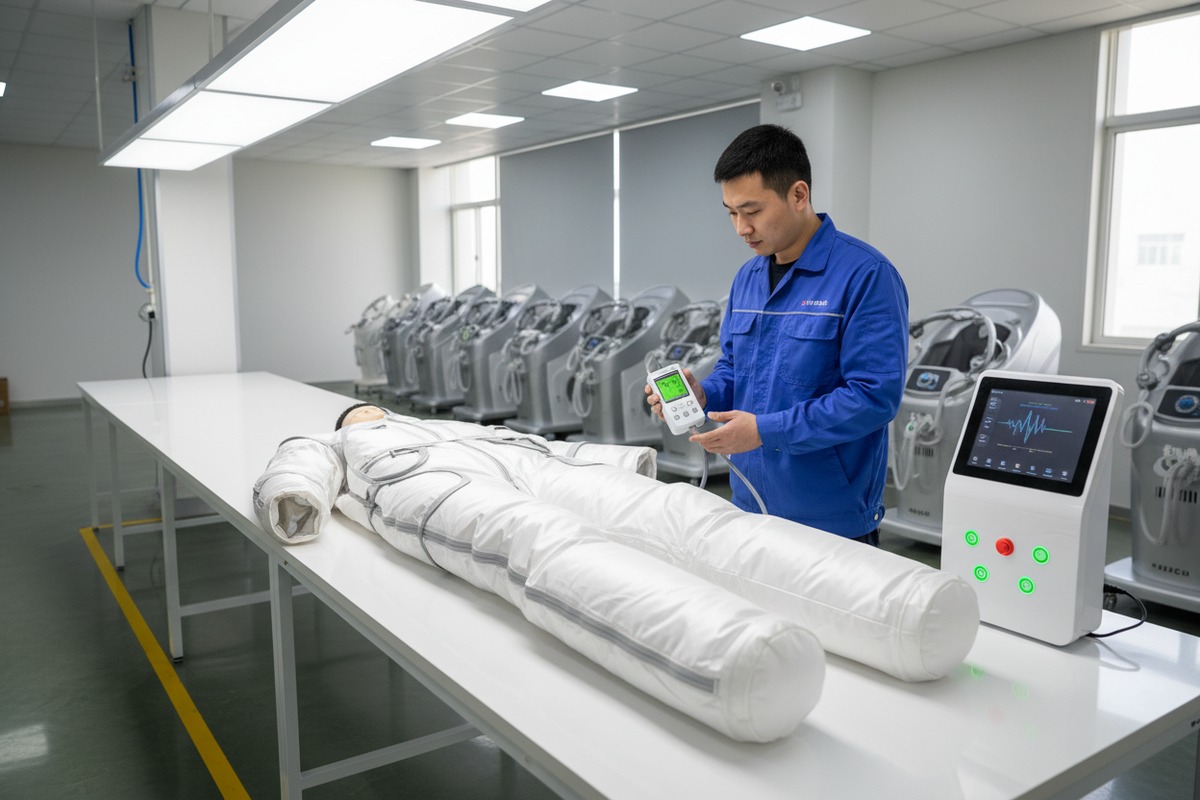
Our quality control department handles dozens of customized orders each month. We have learned that buyers who establish clear QC requirements before production always receive better results. Quality control for customized pressotherapy machines requires specific testing protocols that go beyond standard checks.
Establish a written QC agreement with the supplier that includes testing of all custom parameters. Request video documentation of QC tests showing your specific presets functioning correctly. Insist on a pre-shipment inspection where custom settings are verified against your original specifications.
Creating a QC Specification Document
Before production begins, create a detailed QC document that lists every custom setting. This document becomes the testing checklist for the factory's QC team.
Include these elements in your QC specification:
| Custom Parameter | Specified Value | Test Method | Pass/Fail Criteria |
|---|---|---|---|
| Preset 1 Pressure | 0.06 Mpa | Pressure gauge reading | Within ±5% of target |
| Zone 3 Timing | 8 seconds | Stopwatch measurement | Within ±0.5 seconds |
| Temperature Setting | 45°C | Infrared thermometer | Within ±2°C |
| Compression Sequence | Feet to thighs | Visual observation | Correct order confirmed |
| Interface Language | English | Screen display check | All text in English |
Requesting Video Documentation
Ask the supplier to record the QC testing process. This video should show:
- The machine powered on with your custom interface
- Each preset activated and running
- Pressure readings displayed on testing equipment
- All custom parameters verified against the specification sheet
- The QC inspector's sign-off on camera
At our facility, we provide video documentation as standard practice for OEM orders. This gives overseas clients confidence without requiring them to visit the factory.
Pre-Shipment Inspection Options
Consider these inspection approaches:
Self-inspection via video: The supplier conducts testing while you watch via video call. You can request specific tests in real time.
Third-party inspection: Hire an inspection company to visit the factory. Provide them with your QC specification document. They verify all custom settings before shipment approval.
On-site inspection: If the order value justifies travel, visit the factory yourself. Bring the original specification document and test each parameter personally.
Establishing Accountability
Include QC requirements in your purchase contract. Specify consequences for non-compliance. For example, if custom presets do not match specifications upon arrival, the supplier agrees to provide remote reprogramming support or partial refund.
Document everything in writing. Email confirmations, QC reports, and video records create a paper trail that protects both parties.
How can I confirm the supplier will provide software support if I need to update my presets later?
When we deliver machines to distributors, the relationship does not end at shipment. Our clients often need to update treatment protocols as their business evolves. Software support 8 for preset updates is a critical factor that many buyers overlook during the purchasing process. Without this support, your machine becomes outdated quickly.
Confirm software support by requesting a written service agreement that covers post-purchase preset updates. Ask about remote update capabilities, response time guarantees, and whether updates require additional fees. Reputable suppliers provide ongoing technical support through remote diagnostics and software modification services.

Types of Software Support to Request
Different suppliers offer different levels of ongoing support. Understand what you need before negotiating:
Remote programming updates: The supplier can modify presets remotely through internet connection. This is the fastest and most convenient option.
Firmware upgrade packages: The supplier sends updated software files that you install locally. Requires some technical knowledge.
On-site service visits: A technician visits your location to update the machine. Most expensive option but necessary for complex changes.
Video-guided self-service: The supplier provides video instructions for simple preset modifications you can do yourself.
Service Agreement Essentials
Your service agreement should address these points:
| Support Element | What to Specify | Why It Matters |
|---|---|---|
| Response Time | Maximum hours to respond | Minimizes downtime |
| Update Frequency | How often updates available | Keeps machine current |
| Cost Structure | Free vs. paid updates | Budget planning |
| Support Duration | Years of coverage | Long-term value |
| Communication Channel | Email, WhatsApp, phone | Convenient contact |
Evaluating Remote Diagnostic Capabilities
Modern pressotherapy machines can connect to the internet for remote diagnostics. Ask the supplier:
- Does the machine have remote access capability?
- Can your engineers diagnose problems without physical access?
- Can presets be updated remotely?
- What security measures protect remote access?
Our machines include a remote support module. When clients report issues, our engineers can access the machine remotely to diagnose and often fix problems immediately. This eliminates shipping delays and reduces downtime.
Long-Term Relationship Considerations
Consider the supplier's stability and commitment to long-term support:
- How long has the company been manufacturing pressotherapy machines?
- Do they have a dedicated technical support team?
- Can they provide references from clients who have received ongoing support?
- What happens to support if your main contact leaves the company?
A supplier who invests in long-term relationships will provide better support than one focused only on initial sales. At our company, we assign dedicated account managers to each client. This ensures continuity even when team members change.
Protecting Your Investment
Request documentation of the machine's software architecture. Understand whether updates require proprietary tools or can be done with standard equipment. Some suppliers use locked systems that only their engineers can modify. Others provide more open access.
Both approaches have advantages. Locked systems ensure consistency but create dependency. Open systems offer flexibility but require more technical knowledge from your team.
Conclusion
Confirming a pressotherapy machine supplier offers genuine customizable treatment presets requires direct verification at every stage. Request engineering documentation, demand live demonstrations, establish QC protocols, and secure long-term software support agreements. These steps protect your investment and ensure the machine truly meets your clinical needs.
Footnotes
1. Provides a comprehensive explanation of pressotherapy, a relevant health information source. ↩︎
2. FDA guidance on design controls emphasizes the importance of detailed technical specifications for medical devices. ↩︎
3. ISO 13485 outlines quality management system requirements for medical device manufacturers, including engineering responsibilities. ↩︎
4. ISO 13485 addresses quality control agreements and supplier management in medical device manufacturing. ↩︎
5. Provides a Wikipedia definition and explanation of Open Control Architecture, directly replacing the failed Wikipedia link. ↩︎
6. Wikipedia details manual lymphatic drainage, a common protocol for pressotherapy. ↩︎
7. FDA guidance on human factors and usability engineering is crucial for medical device user experience. ↩︎
8. This official FDA guidance document provides recommendations for postmarket management of cybersecurity in medical devices, including software updates and support. ↩︎

 English
 Español de México
 Deutsch
 Français
 العربية
 Русский
