
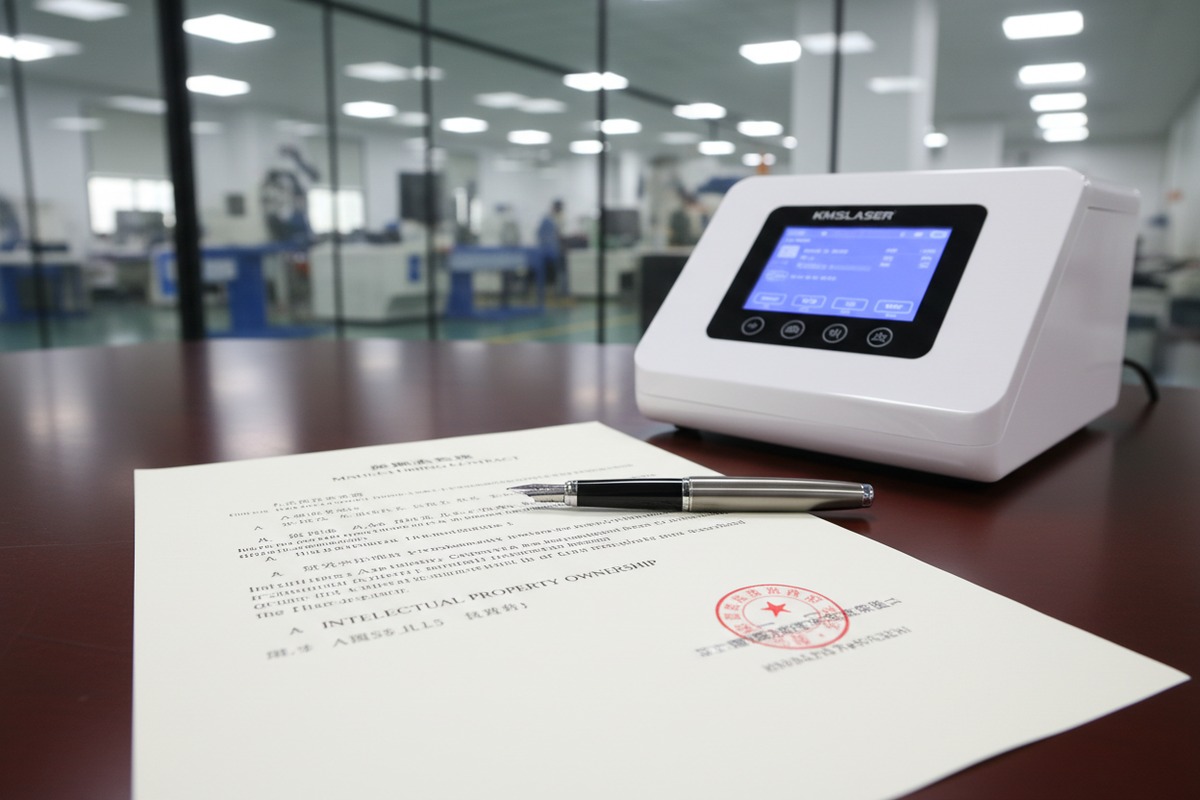
When our engineers developed the latest pressotherapy control unit, we had to share detailed technical drawings with partner factories. That single decision—without proper contracts—nearly cost us a major customer relationship. This risk is real for any brand sourcing custom beauty machines from China.
To clarify IP ownership in contracts when sourcing pressotherapy machines from China, you must register your IP with CNIPA before manufacturing begins, use China-specific NNN agreements drafted in Mandarin and governed by Chinese law, and include explicit ownership clauses for designs, molds, software, and improvements in your manufacturing contracts.
The details matter. Let me walk you through each critical step, from defining IP ownership during customization to preventing unauthorized sales of your private-label designs.
How do I define IP ownership in my contract when customizing a pressotherapy machine?
Our production team often collaborates with overseas brands to customize compression garments and control software. Without clear contract language, these joint efforts can create ownership disputes that take months to resolve.
To define IP ownership when customizing a pressotherapy machine, your contract must explicitly state that all designs, specifications, tooling, and derivative works created during manufacturing are your exclusive property. This clause should cover compression algorithms, garment patterns, pump configurations, and controller firmware.

Why Standard NDAs Fail in China
American-type NDAs are designed to protect against disclosure to the general public. In China, an unscrupulous person's goal is not to disclose secrets to the public. That person wants to use your IP to compete against you. Typical American NDA-type agreements are unenforceable in China.
The second fundamental problem with typical NDA agreements is that they are not enforceable in China. Chinese law allows for protecting trade secrets 1 and for contracts that provide NNN protections. But if such a contract is going to be effective in China it usually must be written in Chinese, governed by Chinese law, and exclusively enforceable in a Chinese court.
What Your IP Ownership Clause Must Include
The contract should unambiguously state that you are the sole owner of the IP, regardless of the first-to-file principle 2. This clause should cover all aspects of your IP, including designs, processes, trademarks, and patents.
For pressotherapy machines specifically, your clause should address:
| IP Element | Description | Risk if Not Covered |
|---|---|---|
| Compression algorithms | Software controlling pressure sequences | Factory can sell to competitors |
| Garment patterns | Cut designs for sleeves, pants, body suits | Knockoffs appear on Alibaba |
| Pump specifications | Airflow rates, valve configurations | Cloned hardware undercuts you |
| Controller firmware | User interface, treatment programs | Competitor gets same features |
| Mold designs | Housing shells, button panels | Factory uses molds for others |
The First-to-File Problem
In the realm of Chinese manufacturing contracts, the safeguarding of intellectual property stands as a paramount concern, especially given China's first-to-file system. This system, where the first party to file for a patent or trademark is granted ownership, can pose significant risks, particularly if a local manufacturer files for IP rights of foreign products.
Before negotiating manufacturing contracts, it is crucial to register your IP in China. Given the first-to-file system, securing your IP rights early can prevent a situation where a manufacturer might claim these rights. This preemptive step should be a priority in your IP strategy.
What clauses will protect my brand if I co-develop a new beauty machine with a Chinese supplier?
In our experience supporting brand development projects, co-development creates the most complex IP situations. When both parties contribute ideas, the question of who owns what becomes blurry—unless your contract draws clear lines from day one.
When co-developing a pressotherapy machine with a Chinese supplier, include clauses covering ownership of improvements, background IP separation, derivative works assignment, milestone-based IP transfers, and explicit prohibitions on the supplier filing patents or trademarks on jointly developed technology without your written consent.

The Co-Development Trap
Many companies lose technology through joint ventures, pilot projects, or "co-development" deals that quietly shift your know-how into the partner's systems. Treat every proof-of-concept or pilot as a mini-license: nail down the scope, deliverables, IP ownership, and whether they can reverse-engineer or benchmark your tech. Price co-development separately and reserve ownership of background IP and improvements unless fully compensated.
These agreements cover the cost and procedure for developing a product. Many companies fail to enter into this kind of agreement only to discover later that their foreign manufacturer owns "their" product IP or the molds or the tooling at the end of the process.
Essential Co-Development Clauses
| Clause Type | What It Does | Why It Matters |
|---|---|---|
| Background IP | Separates existing IP from new developments | Prevents factory claiming your prior tech |
| Foreground IP | Assigns all new IP to you | You own everything created together |
| Improvement ownership | Any upgrades belong to you | Factory cannot claim "enhanced" version |
| Filing prohibition | Factory cannot file patents/trademarks | Blocks bad-faith registrations |
| Liquidated damages 4 | Sets penalty amount for breaches | Creates real deterrent |
Structuring Payment for IP Protection
This prevents situations where a manufacturer claims they "improved" your design and therefore own the new version. Furthermore, this clause protects you in industries where iterative development is common.
Consider staged payments tied to IP milestones:
- 30% upfront for development initiation
- 40% upon formal IP transfer documentation
- 30% after production milestones are verified
Protecting Against Subcontractor Leaks
In China's manufacturing ecosystem, subcontracting is extremely common. However, many NNN agreements fail to explicitly extend obligations to subcontractors, affiliates, and third parties. Consequently, your Chinese partner can simply pass your confidential information to a subcontractor who then violates it.
Your contract must require:
- Written approval before any subcontracting
- Binding NNN agreements with all subcontractors
- Liability on your primary manufacturer for subcontractor breaches
How can I prevent my manufacturer from selling my private-label designs to my competitors?
Our QC team has seen this scenario too many times: a brand invests heavily in custom pressotherapy garments, only to find nearly identical products appearing on Alibaba six months later. Prevention requires multiple layers of protection.
To prevent your manufacturer from selling private-label designs to competitors, combine NNN agreements with explicit non-compete clauses, register your IP with China Customs (GACC) to block unauthorized exports, segment production across multiple suppliers so no single factory has your complete design, and include substantial liquidated damages provisions that create real financial deterrence.

Understanding the Three Ns
Non-Disclosure: Prevent the manufacturer from sharing your confidential information with third parties. Non-Use: Prohibit the manufacturer from using your IP for any purpose other than the agreed-upon production. Non-Circumvention: Stop the manufacturer from bypassing you to engage with your clients or markets directly or indirectly. This comprehensive approach offers more protection than a standard Non-Disclosure Agreement (NDA), which may not address unauthorized use or circumvention.
Without an NNN Agreement, there's little preventing an OEM or supplier from using your business secrets to create competing products, enter your markets, or cut you out of your supply chain altogether.
Liquidated Damages as Deterrent
Both parties may agree, in accordance with Chinese law, on the amount of liquidated damages or the method to calculate them. Specifying the amount is usually preferred, as it can help to avoid subsequent challenges of calculating damages. For instance, the liquidated damages could be 30% of the contract value, USD/CNY 1 million, etc. The amount can be adjusted upwards from the estimated damages caused by the breach, in order to properly bind the manufacturer.
China Customs Registration for Border Protection
IPR recordation 5 with the General Administration of China Customs (GACC) 6 is a precondition for the Customs to proactively take protection measures. IPR holders may file an application for recordation of their IPR with the GAAC. Companies registered in China or citizens of China can apply to GACC directly or entrust an agent located in mainland China to handle the recordation. Companies without a registered China office or individuals who are not citizens of mainland China need to entrust an agent located in mainland China to handle the recordation.
By using the system, IPR holders can record their IPRs on the system for local customs to take ex-officio actions, which are also referred to as proactive protection. Once shipments of suspected infringing goods are detected by local customs, the suspected infringing goods will be detained and IPR holders may decide to seize or release the goods. Moreover, IPR holders may record their own suppliers in China as authorized users of the IPRs, so that goods using relevant IPRs shipped by such recorded suppliers will not be detained by the customs.
Multi-Supplier Segmentation Strategy
Protect your complete design by splitting production:
| Component | Supplier Type | Information Shared |
|---|---|---|
| Control unit housing | Plastic molder A | Shell dimensions only |
| PCB assembly | Electronics factory B | Circuit boards, not software |
| Compression garments | Textile manufacturer C | Patterns without branding |
| Final assembly | Trusted integrator D | Assembly instructions only |
| Firmware programming | In-house or home country | Core algorithms protected |
This approach ensures no single supplier possesses your complete technology blueprint.
What documentation do I need to prove my ownership of the molds and software I paid for?
When we manufacture custom pressotherapy systems, our clients often assume that paying for molds automatically means they own them. Our legal team has seen this assumption lead to costly disputes when brands try to switch suppliers.
To prove ownership of molds and software you paid for, maintain separate invoices documenting tooling payments, signed mold ownership agreements in Mandarin stating you are sole owner, inventory forms with serial numbers and photographs, software assignment contracts transferring all code rights to you, and records of any design files or CAD drawings you provided.

Why Payment Alone Is Not Enough
As you pay for the molds, you may assume that they are by default owned by you. That said, the ownership is practically impossible to claim, unless it is written on paper. For example, you must state in the sales contract, that the mold is owned by your company, and can be collected at the supplier's facility with short notice.
If some molds, fixtures and tooling are needed for the production of your products, then it is necessary to define the ownership of the molds. Many customers presumably believe that they should rightfully own the molds since the molds or tooling are made at their expenses, and have the right to take it back or transfer to another supplier, but it is not always the case. This has to be clearly defined in the contract. Include a liquidated damage in this provision will help to avoid intentional delay of mold transfer from the manufacturers.
The Hostage Mold Problem
The buyer pays the supplier for fabricating the tooling for them. The buyer is expected to keep buying the plastic parts from the supplier, and that's where the supplier expects to make most of their profit. If the buyer decides to pull their tooling out (and start plastic part production somewhere else), the supplier will not allow it until an extra 15% is paid on top of the initial tooling price. (In some cases we've seen, it's even as high as 30%, not 15%). Unfortunately, we are seeing this increasingly often. It seems all plastic suppliers in China have now agreed to push for this type of requirement.
Essential Documentation Checklist
| Document Type | Purpose | Key Contents |
|---|---|---|
| Mold Ownership Agreement 7 | Legal proof of ownership | Explicit ownership statement, recovery rights, usage restrictions |
| Tooling Inventory Form | Asset tracking | Serial numbers, photos, location, specifications |
| Separate Tooling Invoice | Financial evidence | Payment amount, date, explicit "for mold ownership" language |
| CAD File Transfer Records | Design ownership proof | Timestamped file transfers, version histories |
| Software Assignment Contract 8 | Code ownership | Source code rights, compilation rights, modification rights |
What a Proper Mold Agreement Includes
In addition to general tooling contracts, our firm frequently drafts standalone Mold IP and Ownership Agreements. These agreements are designed to make your ownership rights unmistakably clear, and they typically include: Explicit language that the molds are your sole property, a prohibition on your factory using your molds for any purpose other than manufacturing your products, restrictions on sharing or replicating the mold design, a ban on using the molds to produce similar or derivative products for third parties.
First, we want to make clear that our client owns the molds/tooling, period. Our contracts typically provide that the overseas factory can use the molds only for producing our client's product and not for producing product for any other party. Second, we write our contracts to make clear that when our client chooses to move its production to a different factory, it will have the right to take its molds/tooling to the new manufacturing location.
Software Ownership Specifics
For pressotherapy machines, software ownership is equally critical. Your documentation should include:
- Source code escrow agreements 9
- Explicit assignment of all firmware rights
- Prohibition on manufacturer retaining copies
- Requirements for destruction certificates when relationship ends
The client shall own the design and content of the Tooling and all intellectual property related to the Tooling. By this Agreement, CONTRACTOR assigns all such intellectual property to the client. CONTRACTOR shall not make use of the Tooling design or any other intellectual property related to the Tooling for any purpose.
Conclusion
Protecting your IP when sourcing pressotherapy machines from China requires action before you share any designs. Register trademarks and patents with CNIPA 10 first. Use NNN agreements drafted in Mandarin. Include explicit ownership clauses for every design element. Document mold ownership separately. Register with GACC for border protection. The investment in proper contracts is minimal compared to the cost of losing your competitive advantage.
Footnotes
1. Official WIPO definition and explanation of trade secrets. ↩︎
2. Details how China’s first-to-file IP system works for trademarks. ↩︎
3. Explains the necessity and components of NNN agreements in China. ↩︎
4. Defines and explains the enforceability of liquidated damages in China contracts. ↩︎
5. Explains the process and benefits of IPR recordation with China Customs. ↩︎
6. Official website for China’s customs administration. ↩︎
7. Highlights the importance and key provisions of mold ownership agreements in China. ↩︎
8. Explains what a software rights assignment agreement is and its importance. ↩︎
9. Provides a comprehensive definition and explanation of source code escrow. ↩︎
10. Official website for China’s national intellectual property administration. ↩︎

 English
 Español de México
 Deutsch
 Français
 العربية
 Русский
