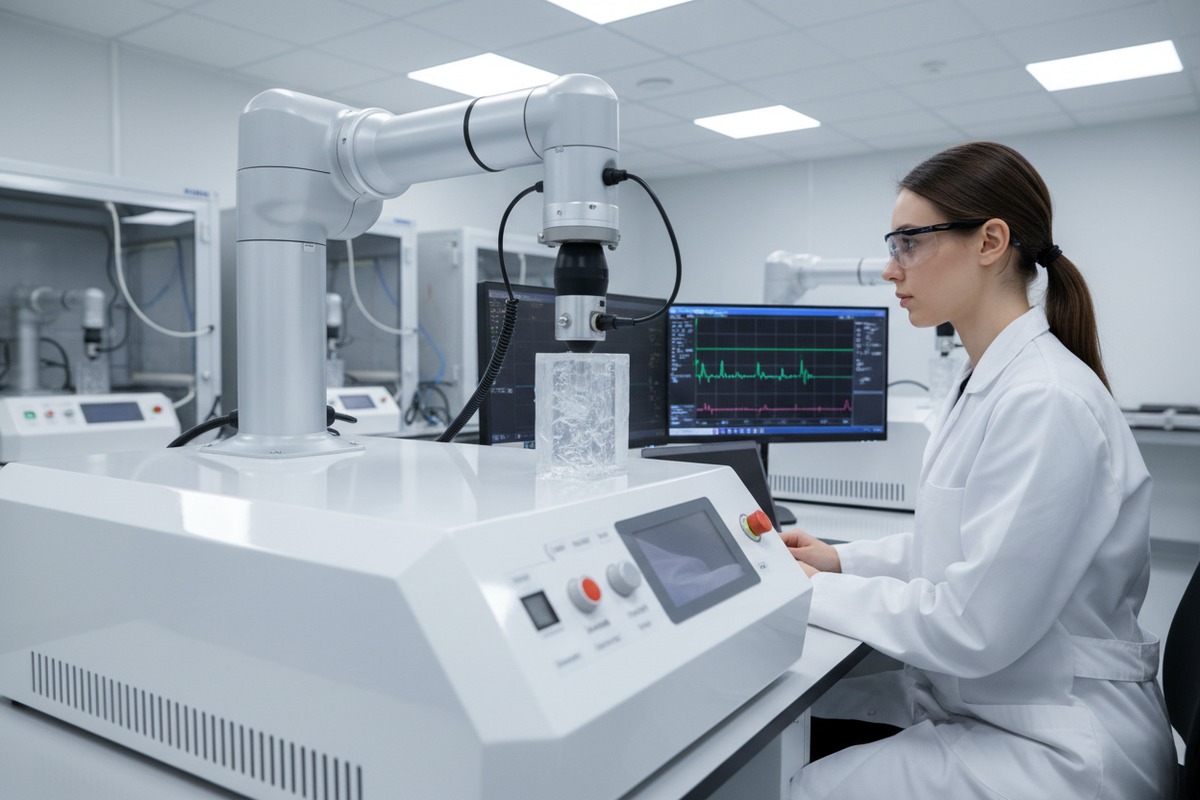
When our production team receives component shipments, we often find that a single unstable supplier can delay an entire batch of shockwave machines material certifications 1. Your brand reputation depends on machines that perform consistently from day one to year five. Without proper verification, you risk receiving units that fail under clinical pressure.
To verify upstream and downstream stability, audit your supplier’s component sourcing records, test energy output consistency across 500+ pulses, validate thermal performance through 8-hour duty cycles, and confirm regulatory documentation matches current device specifications. These steps protect your brand from quality failures and delivery disruptions.
This guide breaks down exactly how to evaluate every critical link in your supplier’s chain. Let’s start with the foundation: component supply chains 2.
How do I audit a manufacturer's component supply chain to ensure my shockwave machines are built for durability?
Last year, one of our key piezoelectric crystal suppliers 3 suddenly increased lead times by six weeks. This taught us that even trusted partners can become bottlenecks. Your shockwave machines are only as reliable as their weakest component.
Audit a manufacturer's component supply chain by requesting documentation of Tier 1 and Tier 2 suppliers, verifying material certifications for critical parts like transducers and capacitors, and confirming backup sourcing agreements exist. This process reveals hidden risks before they become your problem.

Why Component Traceability Matters
Every shockwave therapy machine contains hundreds of parts. The transducer converts electrical energy into acoustic waves. The power supply regulates voltage. The control board manages pulse frequency. If any single component fails, the entire machine becomes useless.
We maintain detailed records for every component in our machines. This includes supplier names, manufacturing locations, batch numbers, and quality test results. When you ask for these records, a trustworthy manufacturer provides them within days. Hesitation signals poor internal tracking.
Critical Components to Verify
| Component | Function | Key Quality Indicator |
|---|---|---|
| Piezoelectric Transducer | Generates shockwaves | Crystal purity, frequency accuracy |
| Power Capacitors | Store and release energy | Voltage rating, lifecycle count |
| Control PCB | Manages treatment parameters | Firmware version, component grade |
| Applicator Housing | Protects internal parts | Medical-grade plastic certification |
| Cooling System | Prevents overheating | Fan RPM, thermal paste quality |
Questions to Ask Your Supplier
Start with direct questions. Where do your transducers come from? How many backup suppliers do you have for critical parts? What happens if your primary capacitor supplier shuts down?
Good manufacturers have contingency plans. They keep 90-day inventory buffers for essential components. They maintain relationships with at least two qualified suppliers for high-risk parts. They test incoming materials before assembly begins.
Red Flags in Supply Chain Documentation
Watch for vague answers like "domestic supplier" or "various sources." Demand specifics. If a manufacturer cannot name their Tier 1 suppliers, they likely lack proper quality controls. Also verify that material certificates match actual shipment dates. Outdated certificates suggest lazy documentation practices.
Our engineers conduct incoming quality inspections on every component batch. This includes dimensional checks, electrical testing, and visual inspection. We reject approximately 3% of incoming materials due to specification deviations. This rejection rate is healthy—it shows active screening.
What criteria should I use to verify a supplier's logistics stability and prevent delivery delays for my brand?
We once shipped a container of machines to a US distributor. Customs held the shipment for three weeks because of incomplete documentation. Our customer lost a major trade show opportunity. Since then, we rebuilt our entire logistics verification process.
Verify logistics stability by examining the supplier's shipping history for the past 12 months, confirming they use established freight forwarders with customs expertise, and reviewing their packaging standards against international shipping requirements. Request references from existing customers in your target market.

Shipping History Analysis
Ask for shipping records to your specific region. A manufacturer with 50 successful US shipments understands FDA import requirements, customs broker selection, and port congestion patterns. A manufacturer with zero US shipments will learn these lessons using your orders as experiments.
Our shipping team tracks every container from factory departure to final delivery. We monitor customs clearance times, carrier reliability scores, and damage incident rates. This data helps us identify problems before they repeat.
Packaging Standards That Protect Your Investment
Shockwave machines contain sensitive electronics and precision components. Poor packaging leads to shipping damage, warranty claims, and angry customers. Verify that your supplier uses:
| Packaging Element | Minimum Standard | Premium Standard |
|---|---|---|
| Inner Protection | Molded foam inserts | Custom-fitted EVA foam |
| Outer Carton | Double-wall corrugated | Triple-wall with moisture barrier |
| Pallet Design | Standard wood pallet | Heat-treated ISPM-15 compliant |
| Humidity Control | Silica gel packets | VCI (Vapor Corrosion Inhibitor) bags |
| Documentation | Packing list only | Full customs paperwork included |
Documentation Completeness Checklist
Incomplete paperwork causes most shipping delays. Before any order ships, confirm these documents exist:
- Commercial invoice with accurate HS codes 4
- Packing list with serial numbers
- Certificate of Origin
- FDA product listing confirmation
- CE Declaration of Conformity
- User manual in destination country language
We prepare customs documentation packages 72 hours before scheduled pickup. This buffer allows time to correct errors before cargo moves. Rush corrections at the port cost time and money.
Freight Forwarder Qualifications
Your supplier's freight partner matters. Ask which forwarders they use regularly. Established forwarders with medical device experience understand cold chain requirements, lithium battery shipping rules, and destination country import procedures. New or general-cargo forwarders often make costly mistakes.
We work with three qualified forwarders for US shipments. Each has dedicated medical device teams. Each provides real-time tracking and proactive delay notifications. This redundancy means we always have options when one carrier faces capacity constraints.
How can I confirm that the shockwave therapy machines will meet the rigorous performance standards my salon customers expect?
Our quality engineers discovered that one production batch showed 2.3% energy variance between units. This exceeded our 1.2% tolerance. We scrapped 15 machines rather than ship inconsistent products. Your salon customers cannot afford machines that perform differently from unit to unit.
Confirm performance standards by requiring baseline Energy Flux Density testing on every unit, validating frequency accuracy with oscilloscope measurements, and demanding 8-hour duty cycle test reports that simulate real clinical conditions. These tests reveal whether machines maintain stable output under actual use scenarios.

Energy Flux Density: The Core Measurement
Energy Flux Density 5 measures the energy delivered per square millimeter at the focal point. This is the gold standard for comparing shockwave device stability. A stable machine shows less than 1.2% standard deviation across thousands of consecutive pulses.
Request actual test data, not just specification sheets. Factory test reports should include:
- Baseline EFD at Hour 0
- EFD after 500 pulses
- EFD after 5,000 pulses
- Standard deviation calculations
- Test equipment calibration certificates
The 8-Hour Shift Simulation
Salon environments are demanding. Machines run continuously for hours. They heat up. They cool down between clients. They face varying treatment protocols. A machine that performs perfectly for 10 minutes may fail after 4 hours.
We run every production unit through an 8-hour shift simulation before shipping:
| Test Phase | Time Window | Protocol | Pass Criteria |
|---|---|---|---|
| Morning Baseline | 08:00-08:30 | 500 pulses at 3 Bar / 10 Hz | Record baseline EFD |
| Standard Operation | 08:30-12:00 | Intermittent use, 10 sessions | EFD within ±2% of baseline |
| Lunch Recovery | 12:00-13:00 | Machine powered off | Complete thermal recovery |
| Afternoon Stress | 13:00-16:00 | High-intensity 4 Bar / 15 Hz | No thermal throttling |
| End-Day Validation | 16:00-17:00 | Repeat baseline test | EFD within ±3% of original |
Frequency Accuracy Verification
Modern shockwave machines offer variable frequency settings. Your salon customers select 5 Hz, 10 Hz, or 15 Hz based on treatment protocols. If the machine delivers 8 Hz when set to 10 Hz, treatments become inconsistent.
Oscilloscope testing 6 measures actual pulse intervals. Place a pressure sensor against the applicator. Fire the machine at stated frequency. Measure milliseconds between pressure peaks. Calculate actual frequency using the formula: Frequency = 1000 / Time interval.
Acceptable deviation is ±2%. Machines exceeding 5% deviation have control system problems requiring firmware updates or hardware replacement.
Software Interface Responsiveness
Skeletal diagram interfaces let practitioners select body regions. Each region has preset frequencies. When staff select "shoulder" followed by "lower back," the machine should switch settings within 2-3 seconds.
Test this transition repeatedly. A 10-second lag during busy clinic hours frustrates staff and slows patient throughput. Software stability matters as much as hardware stability for clinical efficiency.
How do I evaluate a supplier's quality control process to ensure consistency across my private-label orders?
When we started private-label production, we learned that branding adds complexity. Different packaging, different manuals, different compliance labels. Each variation creates opportunities for errors. Your quality control evaluation must extend beyond the machine itself.
Evaluate quality control by requesting process documentation including incoming inspection protocols, in-line testing procedures, and final assembly verification steps. Visit the factory if possible, or request video tours of QC stations. Verify that private-label orders receive identical testing to standard production runs.

Multi-Stage Quality Gates
Effective quality control happens at multiple stages, not just final inspection. We implement five quality gates during production:
| Gate | Stage | Tests Performed | Rejection Action |
|---|---|---|---|
| Gate 1 | Incoming Materials | Dimensional, electrical, visual | Return to supplier |
| Gate 2 | Sub-Assembly | Component function tests | Rework or scrap |
| Gate 3 | Main Assembly | System integration check | Disassemble and repair |
| Gate 4 | Burn-In Testing | 4-hour continuous operation | Full diagnosis |
| Gate 5 | Final Inspection | Cosmetic, packaging, documentation | Hold for correction |
Private-Label Specific Controls
Your branded machines need additional verification. Does your logo appear correctly? Are serial numbers in your preferred format? Does packaging match your brand guidelines?
We create private-label control documents for each customer. These specify exact Pantone colors, logo placement dimensions, and packaging materials. Inspectors verify every branded element against these specifications before sealing cartons.
Testing Equipment Calibration
Quality control is only as accurate as the testing equipment. Request calibration certificates for all measurement devices. These certificates should show:
- Calibration date (within past 12 months)
- Accredited calibration laboratory
- Measurement uncertainty values
- Traceability to national standards
Our hydrophone calibration occurs annually through an ISO 17025 accredited laboratory 7. Our oscilloscopes receive quarterly verification. This discipline ensures our measurements remain accurate and comparable over time.
Defect Rate Tracking
Ask for historical defect rate data. Healthy manufacturing operations track defects by category:
- Critical defects (safety issues): Target 0%
- Major defects (function issues): Target <0.5%
- Minor defects (cosmetic issues): Target <2%
We share monthly quality reports with key customers. These reports show defect trends, root cause analyses, and corrective action status. Transparency builds trust and demonstrates commitment to continuous improvement.
Field Failure Correlation
The ultimate quality test happens in your customers' hands. Ask how your supplier tracks warranty claims and field failures. Do they trace failures back to production batches? Do they implement corrective actions based on field data?
Our warranty database links every claim to original production records. When patterns emerge, we investigate root causes and update processes. This feedback loop prevents repeat failures and improves long-term reliability.
Conclusion
Verifying upstream and downstream stability requires systematic evaluation of components, logistics, performance, and quality control. The time invested before placing orders prevents costly problems after machines reach your customers. Start with documentation requests, progress to test data analysis, and build long-term partnerships with suppliers who demonstrate transparency and consistent results.
Footnotes
1. Details the significance of material certificates for quality assurance and compliance in industries. ↩︎
2. Explains the fundamental components and importance of effective supply chain management. ↩︎
3. Lists and describes manufacturers and suppliers of piezoelectric crystals for various applications. ↩︎
4. Describes Harmonized System (HS) codes for classifying traded products in international import/export. ↩︎
5. Replaced with the Wikipedia page for ‘Energy flux’, which includes the definition and context for ‘Energy Flux Density’ and is an authoritative source. ↩︎
6. Provides fundamental information on oscilloscopes, their operation, and use in signal analysis. ↩︎
7. Explains ISO/IEC 17025 as an international standard for the competence of testing and calibration laboratories. ↩︎
8. Provides an overview of different types and benefits of shockwave therapy machines. ↩︎
 English
 Español de México
 Deutsch
 Français
 العربية
 Русский
Join the Conversation
Have a question or insight to share? We read every comment — whether you're a distributor, salon owner, or just curious about the technology. Your real-world experience helps others make better decisions. Drop your thoughts below.