Every year, our production team sees European distributors lose thousands of euros because they overlooked critical warranty clauses. One client from Spain shipped back an entire batch after voltage mismatches voided their coverage. The problem? They assumed all warranties work the same across borders. They don’t.
When sourcing pressotherapy machines for Europe, you should demand a minimum 2-year warranty covering the main unit, motors, and labor. Verify CE marking compliance under EU MDR 2017/745, confirm warranty start dates align with delivery, and ensure your supplier offers door-to-door part replacement or localized service within the EU.
In this guide, we will break down the exact warranty terms you need to evaluate before signing any supplier agreement. You will learn what to demand, what to avoid, and how to protect your business from costly post-sale failures.
What Standard Warranty Duration Should I Demand for High-End Pressotherapy Machines Sold in Europe?
Distributors often ask our export team about warranty norms. In our experience shipping to Germany, France, and Spain, we have noticed a dangerous gap between what suppliers promise and what EU regulations actually require. Many buyers accept a 12-month warranty without realizing they might be entitled to more protection.
For high-end pressotherapy machines sold in Europe, demand a minimum 24-month warranty on the main device and motors. Top-tier suppliers now offer up to 36 months. Ensure the warranty starts from delivery date, not the manufacturing or shipment date, and covers both parts and labor.

Understanding EU Legal Warranty Requirements
The European market has specific legal protections that affect your sourcing decisions. EU law stipulates that you must give the consumer a minimum 2-year guarantee (legal guarantee 1) as a protection against faulty goods, or goods that don't look or work as advertised. This applies primarily to B2C sales. However, the standard heavily influences what professional buyers should expect from quality suppliers.
The legal guarantee of conformity is at least 2 years from delivery in most European countries (in France for example) but it can be longer: 3 years in Sweden for example. Some countries even extend this based on product lifespan. Several countries also take into account the average lifespan of the product to determine the duration of the guarantee (up to 5 years in Iceland and Norway). The Netherlands use the expected average life of the product, its price, the type of shop it was purchased from or information from producers to determine the duration of the guarantee.
Warranty Durations Across Major Suppliers
| Supplier | Standard Warranty | Extended Option | Coverage Details |
|---|---|---|---|
| CarePump | 24 months | N/A | Device only, international with Poland service |
| Canta Esthetic | 36 months | Included | Full machine, lifetime client support |
| SureBeauty | 12 months | N/A | Main machine; 3 months for handles/screens |
| Zemits | 24 months | N/A | Full device coverage |
| Sensual SPA | 18 months | N/A | Device; 6 months for heads |
CarePump offers a warranty of 2 years for the device, manufacturer's, international, with service in Poland. Meanwhile, all Canta Esthetic machines go through a stringent quality control process and come with a 36-month warranty.
Key Duration Factors to Verify
When our engineers design equipment for European markets, we always recommend buyers clarify three points:
-
Start Date: The 2-year legal guarantee period starts on the day you receive the product, whether you take it immediately from a physical shop or have it delivered. Ensure this is written into your agreement.
-
Proof Requirements: Always keep your sales receipts and any delivery statements. Without documentation, enforcing warranty claims becomes nearly impossible.
-
Component-Specific Terms: Some suppliers offer 12 months of warranty time for the main machine and 3 months of warranty for the handle and screen. High-wear components often have shorter coverage periods.
How Do I Negotiate Warranty Terms That Include Door-to-Door Part Replacements for My European Clients?
When we handle warranty claims from our European partners, shipping logistics often cause more headaches than the actual repairs. Our warehouse manager in Guangzhou has seen countless cases where clients paid more in return shipping than the replacement part cost. Smart negotiation before purchase prevents these surprises.
To secure door-to-door part replacement terms, negotiate coverage of both outbound and return shipping in writing. Specify response timelines (48-72 hours for parts dispatch), designate EU-based service centers for faster turnaround, and include clauses for temporary replacement units during extended repair periods.
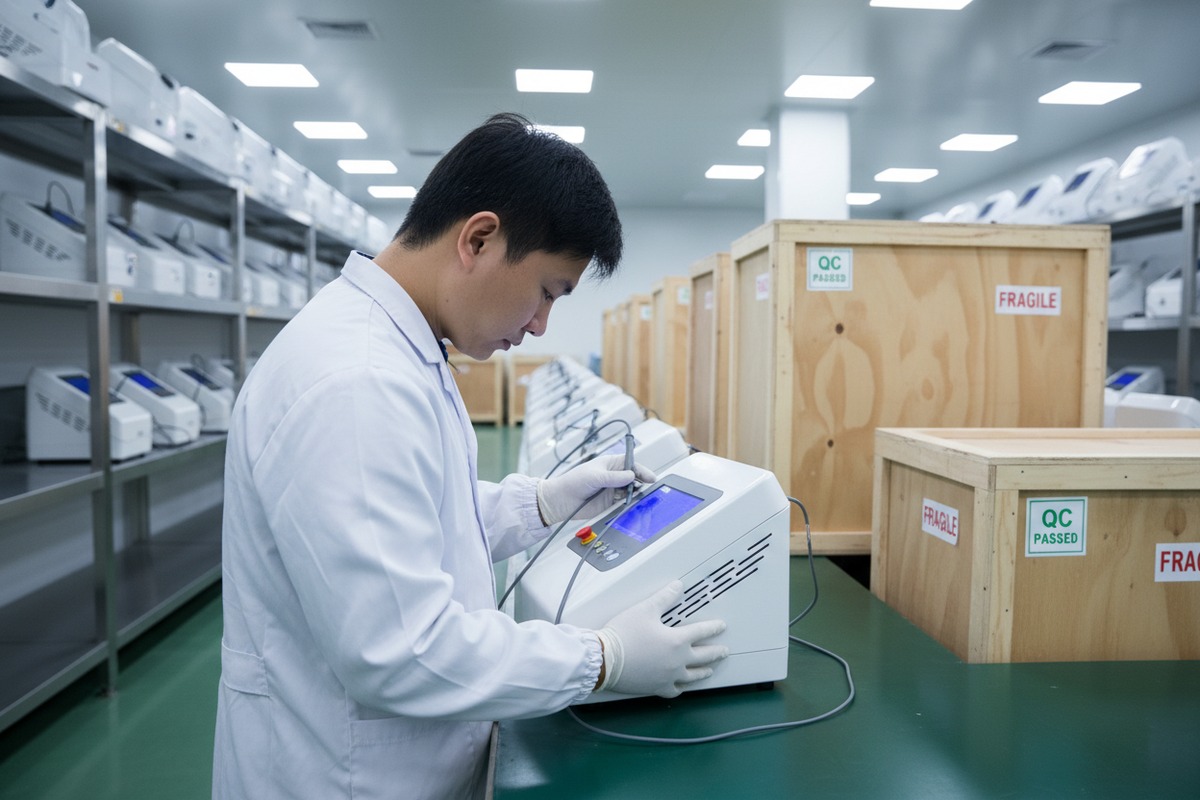
The Hidden Cost of Warranty Logistics
Many European distributors discover too late that "free warranty" doesn't mean "free service." Shipping a 25-35kg pressotherapy machine from Poland to China and back can cost €300-500. If your supplier requires you to pay outbound shipping, your "free repair" becomes expensive.
During the warranty period, all the broken accessories can be sent for free. Over warranty, suppliers can provide the replacement parts or repair for free, but the buyer needs to pay the parts and shipping cost.
Structuring Effective Logistics Agreements
| Service Level | Description | Who Pays Shipping | Typical Response Time |
|---|---|---|---|
| Basic | Customer ships to manufacturer | Customer pays outbound; supplier pays return | 2-4 weeks |
| Standard | Supplier sends prepaid shipping label | Supplier covers both ways | 1-2 weeks |
| Premium | Door-to-door pickup and delivery | Fully covered by supplier | 5-7 business days |
| On-Site | Technician visits customer location | Included in service | 48-72 hours |
Quality EU-focused suppliers offer support, maintenance, and repairs from within Europe, ensuring a quick and efficient response so that your machine is always operational. Their devices come with a full warranty and the backing of an established company.
Critical Clauses to Include in Your Agreement
Our legal team recommends these specific provisions:
1. Response Time Guarantees: Specify maximum hours before your supplier must acknowledge a claim. Industry standard is 24-48 business hours.
2. Parts Inventory Locations: Ask if your supplier stocks spare parts in Europe. Local inventory means faster replacements.
3. Loaner Equipment Provision: For clinic owners who depend on daily machine use, negotiate temporary replacement units during extended repairs.
4. Language Support: Confirm your supplier provides service support across multiple EU countries like USA, Canada, UK, Germany, France, Italy, Spain, Sweden, Denmark, Norway, Netherlands, Bulgaria, Belgium, Poland, Latvia, Czech Republic, and Switzerland.
Red Flags in Logistics Terms
Watch out for these warning signs:
- Vague phrases like "timely after-sales support" without specific timelines
- Requirements to ship equipment to overseas facilities without return shipping coverage
- No mention of EU-based authorized repair centers
- Absence of tracking requirements for warranty shipments
What Specific Clauses Should I Look for to Ensure My Supplier Handles Technical Failures After the Sale?
During our quality control inspections, we catch most defects before shipment. But even the best manufacturing processes cannot prevent every post-sale failure. Our after-sales team has documented the exact contract clauses that separate reliable suppliers from problematic ones. These clauses determine whether you get genuine support or endless excuses.
Your supplier agreement should include: explicit coverage of manufacturing defects versus user-caused damage, defined repair timelines (typically 90 days maximum for major issues), mandatory maintenance schedules that preserve coverage, clear escalation procedures, and provisions for firmware and software updates throughout the warranty period.

Essential Technical Support Clauses
The difference between good and bad warranty support lies in the contract details. Here's what our engineering team recommends you verify:
Manufacturing Defect Coverage: A product is non-compliant when it does not have the characteristics you agreed with the seller, does not fit the specific purpose communicated to the seller, or has a manufacturing defect. This guarantee does not cover apparent defects, deterioration due to abnormal use, or wear and tear.
Software and Firmware Provisions: Modern pressotherapy machines often include programmable algorithms and touch-screen interfaces. If a product comes with software, then the software falls under the guarantee. Software and Firmware Provisions 2 Software updates should ensure that the product remains usable and cyber-secure.
Common Warranty Exclusions to Understand
| Exclusion Type | Typical Wording | Your Protection Strategy |
|---|---|---|
| Voltage Mismatch | "Damage from improper power connection" | Verify voltage compatibility (EU: 220-240V) before purchase |
| Unauthorized Modifications | "Alterations by non-certified personnel" | Use only authorized technicians for any modifications |
| Missing Maintenance | "Failure to follow maintenance schedule" | Document all maintenance with dates and photos |
| High-Wear Components | "Screens, connectors, batteries excluded" | Negotiate extended coverage or separate terms |
| Environmental Damage | "Exposure to moisture, extreme temperatures" | Ensure proper installation conditions |
Maintenance Requirements That Preserve Coverage
Our production line engineers emphasize that many voided warranties stem from maintenance failures. Typical requirements include:
- Professional inspection every 4-6 months
- Calibration checks by certified technicians
- Documented cleaning of air chambers and connectors
- Timely replacement of wear items (tubing, cuffs)
Escalation and Dispute Resolution
Strong contracts include these provisions:
Step 1: Initial contact through designated support channel (email, phone, or ticketing system)
Step 2: Technical diagnosis within 48 business hours
Step 3: Repair authorization with quoted timeline
Step 4: If unresolved within 30 days, escalation to senior management
Step 5: Third-party mediation option for disputed claims
EU legislation foresees a hierarchy of remedies. In case of lack of conformity, you are entitled to request repair or exchange of the product from the seller within a reasonable period of time. If repair or exchange is impossible or not carried out within a reasonable period, you have the right to return the product and be refunded or keep the good and obtain a partial refund.
How Can I Protect My Business If the Pressotherapy Machine's Performance Doesn't Meet European Quality Standards?
In our testing lab, we verify that every machine meets CE marking requirements 3 before export. But we also know that not every supplier maintains these standards. Our quality assurance manager has helped European partners recover from deals with non-compliant equipment. Prevention costs far less than remediation.
Protect your business by verifying CE marking compliance under EU MDR (Regulation 2017/745) before purchase, requesting technical documentation and Declaration of Conformity, confirming your supplier has an appointed EU Authorized Representative, and documenting all performance specifications in your purchase agreement as measurable benchmarks.

CE Marking Requirements for Pressotherapy Equipment
If you want to sell medical devices in Europe, you must get the CE marking under the EU Medical Device Regulation (MDR, Regulation EU 2017/745). The CE mark shows that your device meets strict safety, performance, and regulatory requirements, and you can legally place it in the EU and EEA markets.
Pressotherapy machines typically fall under Class I or IIa categories depending on their intended use. For Class I (non-sterile, non-measuring), self-declaration is allowed. For Class IIa, IIb, III, you must involve a Notified Body 4 for review and certification.
Documentation You Must Request
| Document | Purpose | Why It Matters |
|---|---|---|
| EU Declaration of Conformity 5 | Manufacturer's statement of compliance | Legal requirement; proves regulatory status |
| Technical File | Design, testing, and risk analysis data | Verifies performance claims |
| CE Certificate | Third-party verification (Class IIa+) | Confirms Notified Body approval |
| UDI Registration | Unique Device Identifier | Enables traceability in EUDAMED |
| Instructions for Use (IFU) | Operating and safety guidelines | Ensures proper installation and use |
Appointing an EU Authorized Representative
If your company is not based in Europe, you must appoint an Authorized Representative 6 within the EU who will act as your legal contact for regulators. This representative becomes critical when issues arise.
Your supplier should either:
- Have their own EU-based subsidiary
- Work with an established EU Authorized Representative
- Provide you with their representative's contact details and registration status
If the manufacturer is based outside the EU, they must also appoint an EU Authorized Representative (EC REP), who assumes specific regulatory responsibilities and acts as the primary point of contact for European authorities.
Performance Specification Benchmarks
Our engineering specifications for European markets include:
Pressure Range: Professional units typically operate at 20-220 mmHg. Quality devices have 4 modes of operation developed by lymphological societies and generate pressure in the range of 20-220 mmHg.
Chamber Configuration: High-end models feature 8-24 chambers for gradient compression. Expert-level devices support 8-chamber cuffs, making the massage extremely effective.
Control Interface: Modern units include touch screens with programmable algorithms.
Electrical Compliance: EU voltage standards (220-240V, 50Hz) must be explicitly stated.
Legal Recourse Under EU Regulations
Under EU rules, if the goods you buy turn out to be faulty or do not look or work as advertised, the seller must repair or replace them at no cost. If this is impossible or the seller cannot do it within a reasonable time and without significant inconvenience to you, you are entitled to a full or partial refund.
The MDR is generally more stringent than previous Directives, especially in terms of risk classes 7 and oversight provided by notified bodies. There is also more emphasis on a life-cycle approach to safety, backed up by clinical data and post-market monitoring 8.
Your Pre-Purchase Verification Checklist
Before finalizing any order, confirm:
- Valid CE marking with Notified Body number (if required)
- Current Declaration of Conformity with your product's model number
- EU Authorized Representative contact information
- EUDAMED registration status
- Written performance specifications matching your advertised claims
- Post-market surveillance procedures in place
- Incident reporting protocols documented
Conclusion
Evaluating warranty terms requires attention to duration, logistics, technical clauses, and regulatory compliance. Demand at least 24 months of coverage, negotiate EU-based service support, verify CE marking documentation, and document all performance benchmarks in writing. These steps protect your investment and your European clients' trust.
## Footnotes

<span id="footnote-1">
1. Details consumer rights regarding legal guarantees and returns within the EU. <a href="#ref-1" class="footnote-backref">↩︎</a>
</span>

<span id="footnote-2">
2. Addresses the regulatory aspects of software as a medical device and its warranty implications. <a href="#ref-2" class="footnote-backref">↩︎</a>
</span>

<span id="footnote-3">
3. Explains the general principles and requirements for CE marking for products in the EU. <a href="#ref-3" class="footnote-backref">↩︎</a>
</span>

<span id="footnote-4">
4. Clarifies the function and importance of Notified Bodies in the EU medical device approval process. <a href="#ref-4" class="footnote-backref">↩︎</a>
</span>

<span id="footnote-5">
5. Provides information on the EU Declaration of Conformity for medical devices. <a href="#ref-5" class="footnote-backref">↩︎</a>
</span>

<span id="footnote-6">
6. Describes the role and responsibilities of an EU Authorized Representative under MDR. <a href="#ref-6" class="footnote-backref">↩︎</a>
</span>

<span id="footnote-7">
7. Explains the classification of medical devices based on their risk under EU MDR. <a href="#ref-7" class="footnote-backref">↩︎</a>
</span>

<span id="footnote-8">
8. Describes the requirements for post-market surveillance and monitoring under EU MDR. <a href="#ref-8" class="footnote-backref">↩︎</a>
</span>

<span id="footnote-9">
9. Provides the official text of the European Medical Device Regulation. <a href="#ref-9" class="footnote-backref">↩︎</a>
</span>

 English
  Español de México
  Deutsch
  Français
  العربية
  Русский