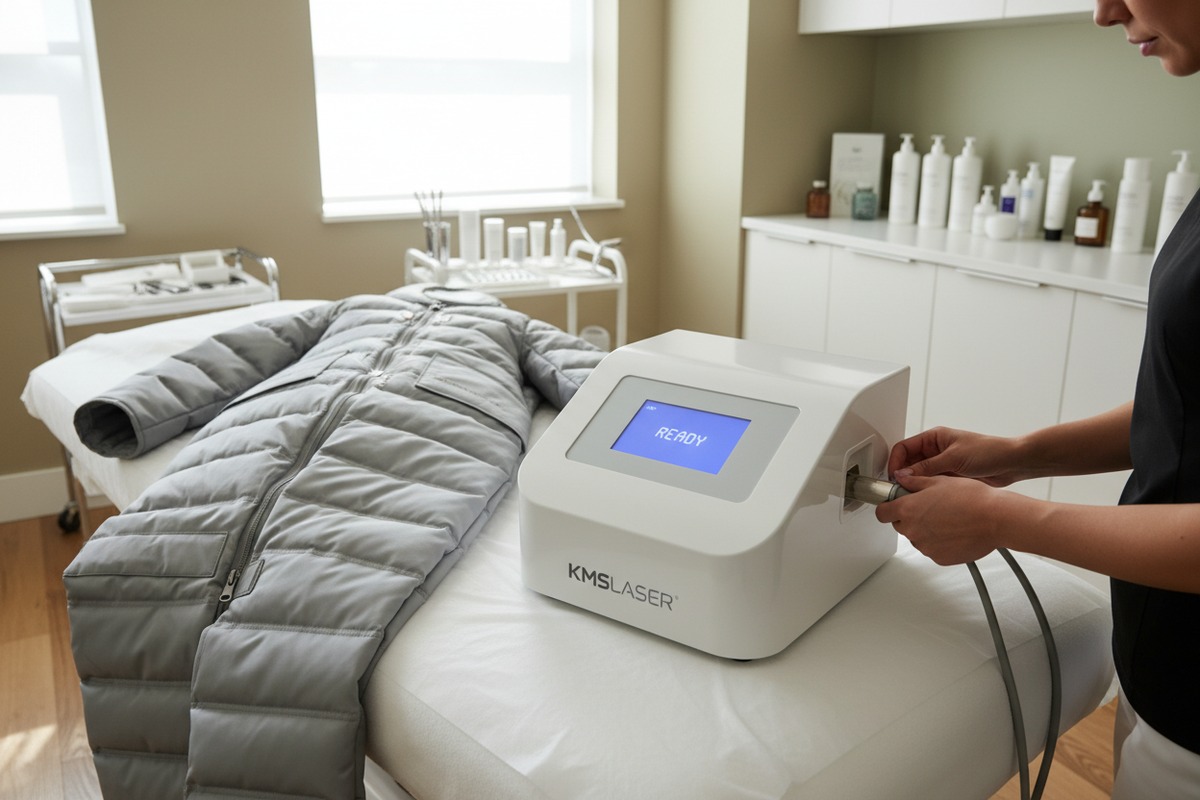
We often encounter spa owners who struggle with operational bottlenecks because their equipment requires too much fiddling between appointments quick-release connectors 1. When we design our systems in Guangzhou, our engineering team focuses heavily on eliminating these friction points to ensure your business runs smoothly.
To evaluate suit ease of use for faster turnover, prioritize machines with intuitive quick-release connectors, durable double-layered materials that wipe clean instantly, and pre-set one-touch programs. These features significantly reduce setup and sanitization time, allowing your staff to handle more clients efficiently without technical delays or extensive downtime.
Let’s examine the specific design elements that can speed up your daily operations and maximize your revenue per hour.
How can I determine if the suit design minimizes setup time for my salon clients?
Watching technicians struggle with tangled tubes during our site visits drove us to completely redesign our connection systems integrated air hoses 2. Complex setups not only look unprofessional but also waste valuable minutes that could be used for revenue-generating treatments.
You can determine if a design minimizes setup time by checking for color-coded, single-plug connectors rather than individual tubes. Look for suits with wide zipper openings and integrated overlapping chambers, which allow clients to slide in easily without needing extensive adjustments or assistance from your staff.
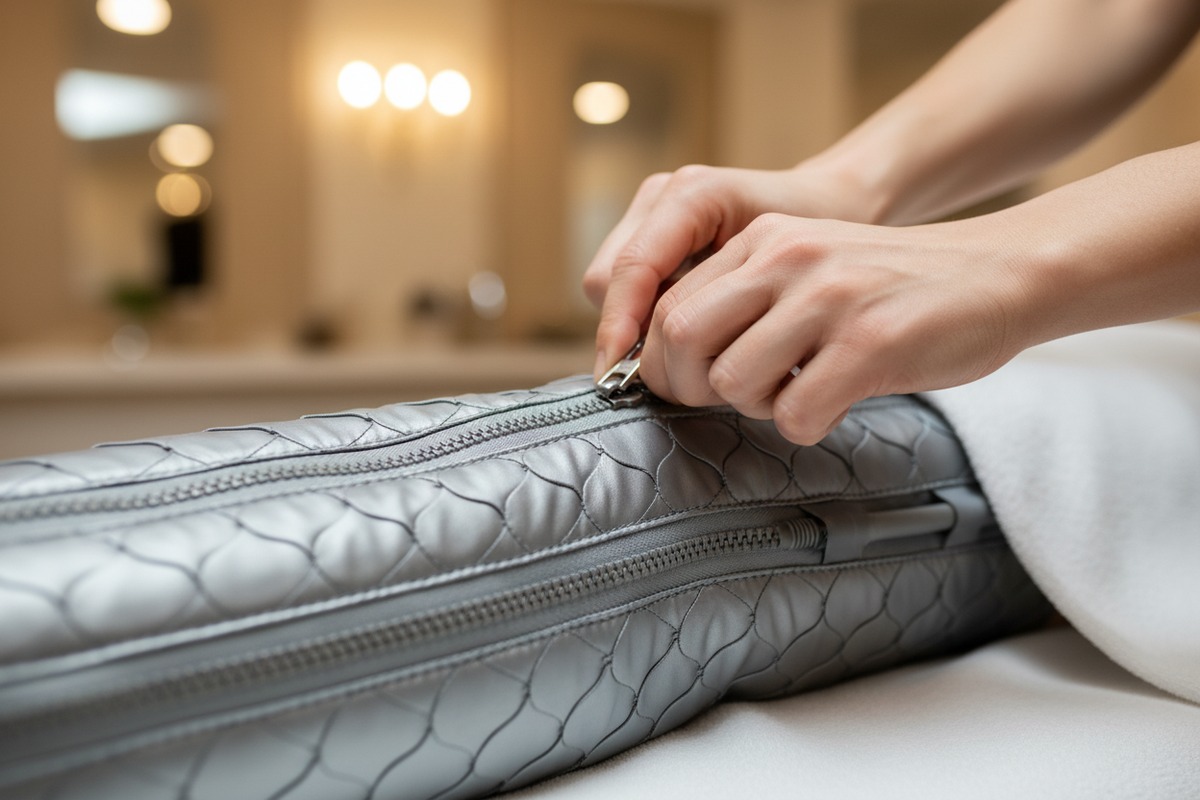
When evaluating a pressotherapy suit for professional use, the physical design of the garment is the primary factor in how quickly you can turn over a treatment room clinical protocols 3. In our manufacturing facility, we test "donning time"—the time it takes to put the suit on a mannequin or model. For a high-turnover salon, this process needs to be seamless Thermoplastic Polyurethane 4.
The Importance of Integrated Air Hoses
The biggest time-waster in older pressotherapy models is the "spaghetti junction" of air tubes. In traditional designs, each airbag chamber (often 16 to 24 per suit) has an individual tube running to the machine. This results in a tangled mess that technicians must sort out before every session.
Modern, high-efficiency suits use integrated cabling. The air tubes are sewn or fused into a protective sheath that runs along the side of the leg or arm cuffs. This "umbilical cord" design means your staff only handles one main cable bundle per limb, rather than six or eight separate tubes. This prevents tangling and reduces the visual clutter that can make clients anxious.
Zipper vs. Velcro Closure Systems
Another critical aspect is the closure mechanism. While Velcro allows for infinite adjustability, it is a nightmare for speed. Velcro straps 5 stick to everything—towels, bedding, and the client's clothes. They also wear out over time, losing their grip and popping open under high pressure.
We recommend high-quality, heavy-duty zippers (like YKK grade) with size-adjustable expanders. Zippers are binary: they are either open or closed. A technician can zip a client into a leg cuff in three seconds, whereas adjusting five Velcro straps can take over a minute per leg. If you have clients of varying sizes, look for suits that include "zipper expanders"—strips of fabric that zip between the main edges to widen the circumference—rather than relying on Velcro.
Anatomy of a Fast-Setup Suit
Below is a comparison of design features and their impact on setup speed.
| Feature | Standard Home/Low-End Suit | Professional High-Turnover Suit | Estimated Time Saved |
|---|---|---|---|
| Tube Management | Loose, individual tubes for each chamber | Bundled, sheathed cables | 3–5 Minutes |
| Connector Type | Individual plug for every tube | Single multi-pin "Click" connector | 2–3 Minutes |
| Closure System | Multiple Velcro straps | Full-length Zippers | 4 Minutes |
| Chamber Structure | Separate chambers (gaps possible) | Overlapping scales (smooth entry) | N/A (Comfort factor) |
Quick-Release Connectors
Finally, examine the connection point where the suit meets the machine. In a busy salon, you might need to swap an arm cuff for a waist belt quickly. Avoid machines that require you to screw in connectors or push tubes onto barbs manually. The industry standard for speed is a "Quick-Release" or "Snap-Lock" connector. These work like seatbelts; you push them in until they click, and press a button to release them. This allows for modular treatments—switching from a leg drainage session to an abdominal sculpting session—in seconds.
What interface features should I prioritize to ensure my team operates the machine without extensive training?
We constantly refine our software logic because we know high staff turnover in US salons makes training difficult. Complex menus lead to operational errors, frustrated technicians, and inconsistent treatment results for your clients.
Prioritize interfaces featuring large touchscreens with pre-set clinical protocols and visual body maps. These features allow operators to launch treatments with one tap, eliminating the need to manually adjust pressure or cycle times, and ensuring consistent results even with new or temporary staff members.
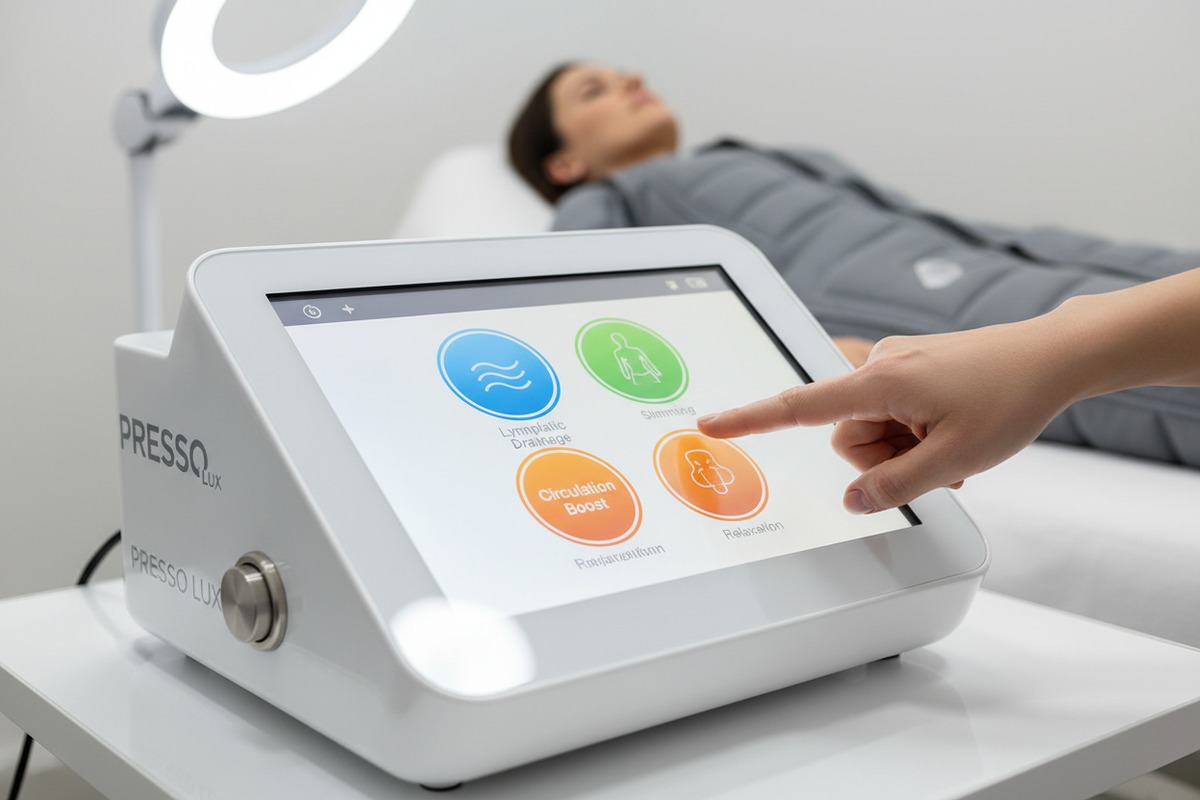
The control unit is the brain of your pressotherapy system. For a salon owner, the goal is "plug and play." You do not want your staff calculating pressure gradients or memorizing complex sequences. The machine should do the heavy lifting.
The Value of Visual Presets
When we program the logic boards for our export models, we include "Mode Presets." Instead of labeling modes as "A, B, C," effective professional machines label them by outcome: "Lymphatic Drainage," "Slimming," "Sports Recovery," or "Relaxation."
A visual body map on the screen is essential. When a technician selects "Legs," the screen should highlight the leg airbags. This provides immediate visual confirmation that the machine is set correctly. If a chamber is deactivated (for example, if a client has a knee injury and cannot tolerate pressure there), the interface should allow the technician to tap the specific chamber on the screen to turn it off. This intuitive "tap-to-skip" feature is far faster than scrolling through numbered menus.
Touchscreen Responsiveness and Durability
In a salon environment, technicians often have cream or oil on their hands. We test our touchscreens to ensure they respond accurately even with gloved hands or slightly residue-heavy fingers. A capacitive touchscreen 6 (like a smartphone) is generally better than a resistive one (which requires pressure), provided the sensitivity is calibrated correctly.
However, the interface must also be robust. It should be housed in a casing that protects it from accidental spills. A sleek, slanted design—like the ones found on modern tabletop units—is not just for aesthetics; it provides an ergonomic viewing angle that prevents glare and allows the technician to see the status from across the room.
Emergency Controls and Adjustability
While automation is key, manual override is necessary for safety and comfort. A prominent "Emergency Stop" button (either physical or a large always-on-top digital button) is non-negotiable.
Furthermore, "On-the-Fly" adjustability is a critical feature for ease of use. If a client complains that the pressure is too high mid-session, the technician should be able to turn a dial or tap a minus button to lower the pressure globally without pausing or restarting the program. Machines that require you to stop the treatment to change settings kill the flow of the experience and frustrate clients.
Interface Evaluation Checklist
Use this table to audit the interface of any machine you are considering purchasing.
| Interface Element | Poor Design (Avoid) | Good Design (Preferred) | Why it Matters |
|---|---|---|---|
| Program Names | Abstract (Mode 1, Mode 2) | Descriptive (Detox, Relax) | Reduces training time and errors. |
| Pressure Adjustment | Per-chamber only (tedious) | Global + Fine Tuning | fast adjustments for client comfort. |
| Active Feedback | Static numbers | Animation of inflating zones | Lets staff verify operation at a glance. |
| Error Messages | Codes (Error 04) | Plain Text (Check Leg Hose) | Speeds up troubleshooting. |
How do I evaluate if the suit materials allow for rapid sanitization between high-volume sessions?
During our material selection process, we reject porous fabrics that absorb oils and sweat, as these are impossible to clean quickly. Hygiene delays are the silent killer of profitability in high-volume beauty clinics, and we refuse to let our equipment be the cause.
Evaluate suit materials by testing their water resistance and surface texture; high-quality TPU or double-layered PU nylon should repel fluids immediately. Ensure the fabric is non-porous and seamless in contact areas, allowing your team to wipe down and disinfect the entire suit in under two minutes.
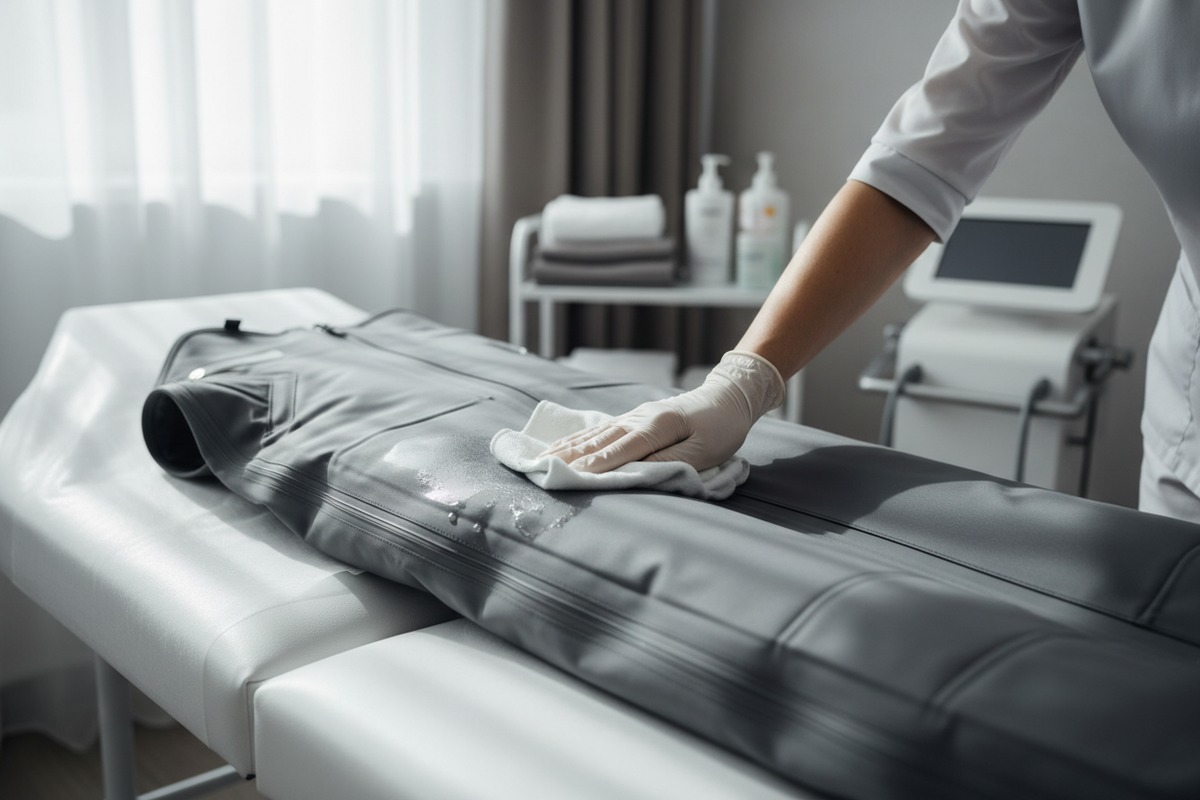
In the post-pandemic era, clients are hyper-aware of hygiene. If your staff spends 15 minutes scrubbing a suit between clients, you are losing money. The material of the pressotherapy suit dictates the speed of your turnover.
Material Science: TPU vs. Nylon vs. PVC
There are three main materials used in suit manufacturing:
- PVC (Polyvinyl Chloride): Often found in cheaper units. It feels like plastic pool floats. It cleans easily but is stiff, uncomfortable, and prone to cracking.
- Nylon Fabric: Comfortable and breathable, but often porous. If it is not heavily coated, it can absorb sweat and massage oils. This requires laundering (removing the air bladders and washing the sleeve), which is impossible between back-to-back clients.
- PU (Polyurethane) / TPU (Thermoplastic Polyurethane): This is the gold standard for professional turnover. High-density TPU coating on nylon provides a smooth, leather-like finish. It is completely impermeable to liquids.
The "Wipe and Dry" Test
To evaluate a suit, perform this simple test: Spray a hospital-grade disinfectant on the surface.
- Good Result: The liquid beads up and sits on the surface. One wipe with a paper towel removes it completely, leaving the surface dry.
- Bad Result: The liquid creates a dark spot, indicating absorption. This suit will stay damp, harbor bacteria, and eventually smell.
For high turnover, you want a "High-Frequency Welded 7" TPU suit. This means the seams are fused by heat, not stitched with thread. Thread creates thousands of tiny holes where bacteria can hide. Welded seams are completely smooth and can be sanitized in seconds.
Disposable Liners vs. Durable Surface
Some salon owners try to use disposable plastic liners (like giant bags for the legs) to speed up cleaning. While this works, it adds a recurring cost and creates waste. A high-quality suit designed for sanitization eliminates the need for disposables. The material should be resistant to common cleaning agents like quaternary ammonium 8 or alcohol-based wipes without degrading or peeling over time.
Cleaning Protocol Comparison
Understanding the time difference between maintaining different suit types is crucial for ROI calculations.
| Cleaning Step | Porous Fabric Suit | High-Grade TPU/PU Suit |
|---|---|---|
| Immediate Action | Spray and scrub | Spray and wipe |
| Drying Time | 15–30 Minutes (Air dry) | Instant (Towel dry) |
| Deep Cleaning | Weekly laundering required | Daily wipe-down sufficient |
| Odor Retention | High risk over time | Low risk |
| Turnover Time | 20+ Minutes | < 3 Minutes |
Can I customize the suit's connection points to prevent operational delays caused by frequent use?
Our engineering team analyzes return data to identify where stress points cause air leaks over time. We found that standard connections often fail under heavy salon usage, causing unexpected downtime that frustrates both owners and clients.
Yes, you can customize connection points by requesting reinforced, military-grade locking mechanisms or magnetic quick-connect ports from your supplier. Customizing these stress points prevents air leaks and plastic fatigue, ensuring reliable operation even with the repetitive connecting and disconnecting required in busy salons.
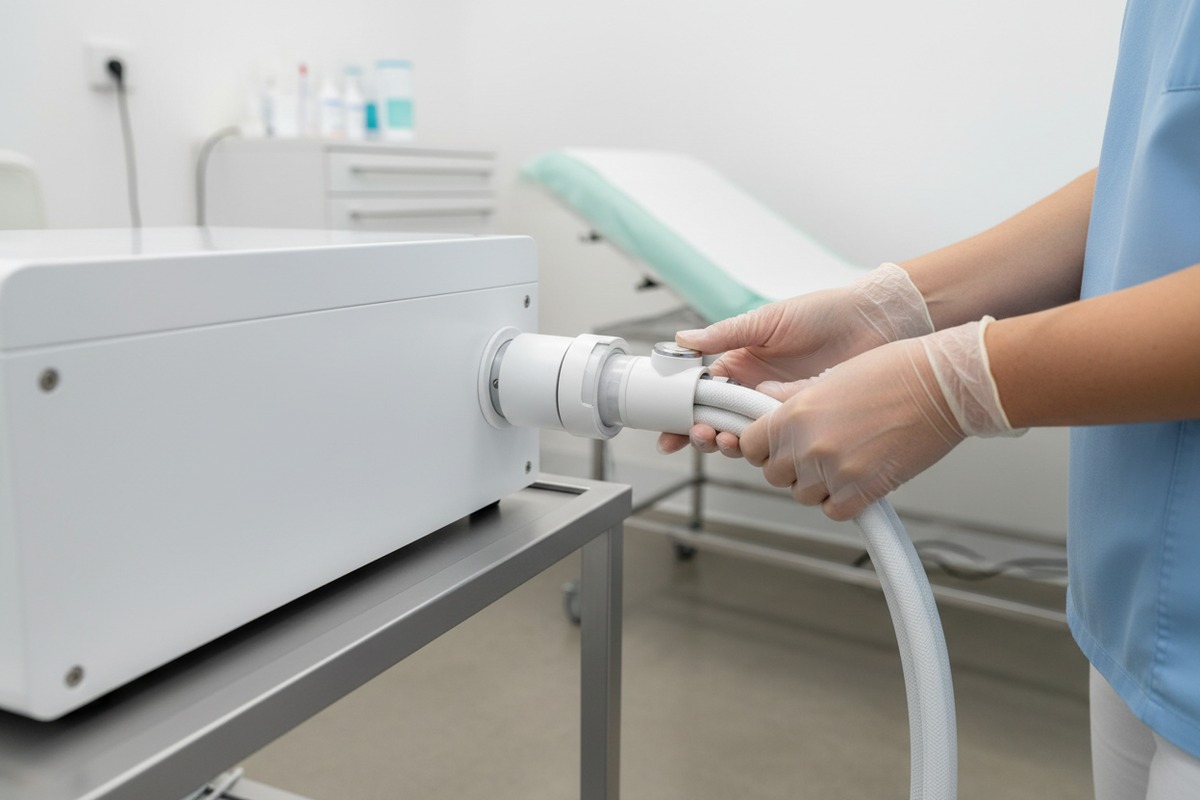
As a purchasing manager, you have the power to request modifications that extend the lifespan of your equipment. Standard "off-the-shelf" machines often use generic plastic fittings that are fine for home use but brittle under commercial stress.
Reinforcing the Weakest Links
The number one failure point in pressotherapy machine 9s is the connector—specifically the male/female joint where the air hose meets the machine or the suit. In a salon, this might be connected and disconnected 10 to 15 times a day. Standard plastic clips can snap, or the O-rings can dry out and crack, leading to air leaks. An air leak renders the machine useless because it cannot build the required pressure.
When ordering from an ODM (Original Design Manufacturer 10), you can specify "Industrial Grade" connectors. These might be made of denser ABS plastic or even lightweight aluminum. They often feature double O-rings for a better seal and metal springs in the release mechanism rather than relying on plastic flexibility.
Modular Replacement Design
Customization isn't just about making things stronger; it's about making them repairable. Ask for a "Modular Hose Architecture."
- Non-Modular: The hose is permanently glued inside the machine. If the hose breaks, you have to ship the entire unit back to China or a repair center.
- Modular: The hose connects to the front of the machine via a screw-on or click-in port. If a hose leaks, you simply buy a spare hose ($50-$100) and swap it out instantly.
We always recommend purchasing a spare set of hose bundles with your initial order. This "Redundancy Strategy" ensures that if a connector fails on a busy Saturday, you can swap it out in 10 seconds and keep working, rather than cancelling appointments.
Stationary vs. Mobile Connections
Another customization option is the mounting style of the tubes on the suit itself.
- Stationary Mounts: The tubes are permanently fused to the suit chambers. This is more durable because there are fewer connection points to fail, but it makes the suit heavier and harder to fold.
- Removable Mounts: You can detach the tubes from the suit leg. This makes storage easier but doubles the number of potential leak points.
For high-turnover salons, we actually recommend Stationary Mounts. Why? Because every time your staff connects or disconnects a tube, there is a risk of breakage. A permanently attached hose system is robust and requires less fiddling. The goal is to plug the entire suit into the machine at once, not to assemble the suit piece by piece.
Customization ROI Analysis
Requesting these features may increase the unit cost, but the long-term savings are substantial.
| Customization Feature | Initial Cost Impact | Operational Benefit | ROI Timeline |
|---|---|---|---|
| Metal-Reinforced Latches | +$20 – $40 / unit | Prevents snap breakage | < 1 Month (avoiding one repair) |
| Modular Hose Ports | +$10 – $30 / unit | Instant DIY repair | Immediate upon failure event |
| Double O-Ring Seals | Negligible | Maintains pressure accuracy | Continuous (Client satisfaction) |
Conclusion
Choosing the right pressotherapy system requires balancing advanced clinical features with practical usability. By prioritizing intuitive interfaces, durable and easy-to-clean materials, and robust connection systems, you ensure your equipment works as hard as you do. Efficient suits drive faster turnover, happier staff, and higher revenue for your salon business.
Footnotes
1. Describes the function and types of quick-release couplings. ↩︎
2. Explains components and principles of fluid delivery systems in medical devices. ↩︎
3. Defines and explains the importance of standardized procedures in healthcare. ↩︎
4. Describes the properties and applications of TPU material. ↩︎
5. Explains the mechanism and characteristics of hook-and-loop fasteners. ↩︎
6. Wikipedia offers an authoritative and detailed explanation of capacitive touchscreen technology, including its history and how it functions. ↩︎
7. Explains the process and benefits of high-frequency welding. ↩︎
8. Explains the chemical nature and use of quaternary ammonium compounds as disinfectants. ↩︎
9. Healthline provides a comprehensive and authoritative overview of pressotherapy, including how the machines work, benefits, and side effects. ↩︎
10. Wikipedia provides a clear and authoritative definition of an Original Design Manufacturer (ODM), distinguishing it from other manufacturing models. ↩︎


 English
 Español de México
 Deutsch
 Français
 العربية
 Русский
Join the Conversation
Have a question or insight to share? We read every comment — whether you're a distributor, salon owner, or just curious about the technology. Your real-world experience helps others make better decisions. Drop your thoughts below.