

Every week, our export team receives calls from worried importers. Their shockwave therapy machines sit at US customs. The reason? Missing or incorrect UDI labels. This costs them thousands in storage fees and lost sales.
To ensure FDA UDI compliance when sourcing shockwave therapy machines from China, you must verify your supplier’s FDA-accredited Device Identifier (DI) and Production Identifier (PI), confirm GUDID database registration, audit physical label durability for reusable devices, and obtain pre-shipment documentation proving full 21 CFR Part 801/830 compliance before export.
The stakes are high. Since December 2022, FDA enforces UDI requirements 1 for all device classes. Non-compliant imports face port refusals and seizures. Let me walk you through exactly what you need to check.
How can I verify that my Chinese manufacturer's UDI documentation is authentic and FDA-compliant?
When we ship our shockwave machines overseas, documentation errors cause the biggest headaches. Many importers trust supplier paperwork without verification. They discover problems only when CBP flags their shipment.
To verify authentic FDA-compliant UDI documentation, cross-reference your supplier's Device Identifier (DI) against the FDA's public GUDID database, confirm they use an FDA-accredited issuing agency like GS1 or HIBCC, and request original certificates showing their unique company prefix and device registration status.

Understanding What Makes UDI Documentation Valid
The UDI system has two main parts. The Device Identifier (DI) 2 is a fixed code. It identifies the manufacturer and specific device model. The Production Identifier (PI) 3 changes with each batch. It includes lot numbers, serial numbers, and expiration dates.
For Class II shockwave therapy machines, both DI and PI are mandatory. Our quality team always includes these elements on every unit we produce.
Key Documents to Request from Your Supplier
| Document Type | What It Proves | Red Flags to Watch |
|---|---|---|
| GS1 4 Company Prefix Certificate | Legitimate issuing agency membership | Expired dates, non-matching company names |
| GUDID Submission Confirmation | Data properly uploaded to FDA database | Missing submission dates, incomplete fields |
| 21 CFR 801.20 Compliance Statement | Label format meets FDA requirements | Vague language, no specific regulation references |
| Device Master Record Excerpt | UDI integrated into quality system | Handwritten notes, inconsistent formatting |
How to Cross-Check Information
Go directly to the FDA's AccessGUDID website. Enter your supplier's DI number. The database shows all registered device information. Compare this against what your supplier provided.
Look for exact matches on:
- Brand name spelling
- Device description
- Company name and address
- Sterilization status
- MRI safety information
Any mismatch signals a problem. Either the supplier gave you wrong information, or they never completed proper registration.
Working with Accredited Issuing Agencies
FDA only accepts UDIs from three accredited agencies: GS1, HIBCC, and ICCBBA. FDA-accredited issuing agency 5 Our facility uses GS1 because it dominates global markets. Your supplier cannot create their own numbering system.
Ask for their issuing agency certificate. Call that agency to confirm membership status. This extra step catches many fraudulent claims.
Chinese manufacturers sometimes use domestic UDI numbers. China has its own NMPA UDI system 6. These codes are not valid for US imports. Your supplier must have separate US-compliant UDIs.
What are my legal responsibilities for UDI registration when private-labeling shockwave machines from China?
In our experience working with US brand owners, many misunderstand who bears legal responsibility. They assume the Chinese factory handles everything. FDA sees it differently.
When private-labeling shockwave machines from China, you become the legal "labeler" under FDA regulations, making you fully responsible for obtaining your own Device Identifier, submitting complete GUDID data under your company name, ensuring all UDI elements appear on your branded labels, and maintaining ongoing compliance records.

The Legal Definition of "Labeler"
FDA defines the labeler as whoever places their name on the device label. legal "labeler" 8 When you private-label our shockwave machines with your brand, you become the labeler. This shifts major regulatory burdens to you.
You must:
- Obtain your own company prefix from an accredited issuing agency
- Create unique DIs for each device version you sell
- Submit GUDID data under your company's FDA establishment registration
- Respond to any FDA inquiries about your devices
The Chinese manufacturer's UDI does not transfer to your branded products. You need entirely new identifiers.
Registration and Submission Responsibilities
| Responsibility | Falls On Importer/Private Labeler | Falls On Chinese Manufacturer |
|---|---|---|
| FDA Establishment Registration | Yes | Only if selling under own brand |
| Device Listing | Yes | Only if selling under own brand |
| GUDID Data Submission | Yes | No, unless agreed contractually |
| Label Design Approval | Yes | Provides template only |
| Post-Market Surveillance | Yes | Manufacturing support only |
| Adverse Event Reporting | Yes | Must notify labeler |
Cost Implications You Must Budget For
Many importers underestimate compliance costs. Obtaining a GS1 company prefix costs between $250 and $2,100 annually depending on your revenue. GUDID submissions are free but require staff time and expertise.
Professional regulatory consultants charge $10,000 or more for full UDI implementation. This covers classification confirmation, issuing agency setup, GUDID data formatting, and label design review.
Our team can provide label templates that meet FDA placement and format requirements. But the registration fees and submissions remain your responsibility.
Ongoing Compliance Obligations
Your responsibilities do not end after initial registration. You must update GUDID records when:
- Device specifications change
- You discontinue a product
- New versions launch
- Company information changes
FDA conducts audits and issues warning letters for outdated or missing GUDID information. This was a top repeat violation in recent FDA inspection findings.
Contractual Protections with Your Supplier
Draft clear contracts with your Chinese manufacturer. Specify who handles each compliance element. Our standard agreements clearly state that:
- We provide technical specifications for GUDID fields
- We manufacture to your approved label designs
- We maintain production records for PI traceability
- You handle all FDA submissions and communications
Get these agreements reviewed by a regulatory attorney before signing.
How do I ensure the physical UDI labels on my imported machines meet FDA durability and placement standards?
Our production line runs strict quality checks on every label we apply. Yet we still see importers receive devices with labels that fail FDA standards. The issue often comes from unclear specifications during ordering.
Physical UDI labels must include both human-readable text and machine-readable AIDC format (usually barcodes), use YYYY-MM-DD date formatting, remain legible throughout the device's expected service life, and for reusable shockwave machines, require permanent direct marking on the device itself that withstands repeated cleaning and sterilization.

Direct Marking Requirements for Reusable Devices
Shockwave therapy machines are reusable devices 9. FDA requires permanent direct marking on the device—not just the packaging. This means the UDI must survive:
- Multiple cleaning cycles
- Disinfection procedures
- Normal wear from clinical use
- The full expected device lifespan
At our facility, we use laser etching on metal components. This creates permanent marks that resist fading, scratching, and chemical exposure. Adhesive labels alone do not meet requirements for reusable devices.
Label Format Specifications
| UDI Element | Format Requirement | Common Errors |
|---|---|---|
| Date Format | YYYY-MM-DD only | Using MM/DD/YYYY or DD/MM/YYYY |
| Barcode Type | Linear or 2D (GS1-128, DataMatrix) | Low resolution, poor contrast |
| Human Readable | Plain text near barcode | Text too small, obscured placement |
| Direct Mark Location | Visible, accessible area | Hidden under components |
| Durability | Readable through device lifetime | Fading ink, peeling labels |
Testing Label Durability Before Mass Production
Request durability testing reports from your supplier before approving production. Our quality control team performs these tests:
Abrasion Test: Rub labels with standard cleaning cloths for specified cycles. Check readability after each cycle.
Chemical Resistance: Expose labels to common hospital disinfectants. Verify barcode scanning still works.
Temperature Cycling: Subject labels to storage temperature extremes. Inspect for cracking or fading.
Aging Simulation: Accelerated aging tests predict label condition after years of use.
Ask for photos and test data documenting these procedures. Reputable manufacturers maintain these records as standard practice.
Barcode Quality Standards
Your UDI barcode must scan reliably. FDA references ISO/IEC standards for barcode quality. The barcode needs:
- Minimum contrast ratio between bars and spaces
- Correct quiet zones (blank space around barcode)
- Proper dimensions for the symbology used
- Verification grade of C or better
Our production team uses barcode verifiers—not just scanners—to confirm quality. A scanner only tells you if a code reads. A verifier measures quality against ISO standards.
Placement Rules on Device and Packaging
The UDI must appear on:
- The device itself (direct marking)
- The device package
- Any higher-level packaging
For shockwave machines, place the direct mark where users can easily see it during normal operation. Avoid locations that get covered during use or cleaning.
Package labels need clear visibility when the box sits on a shelf. Our design team positions UDIs on the front or top panel for easy scanning.
Can my supplier manage the GUDID data submission and pre-shipment inspection to prevent customs issues?
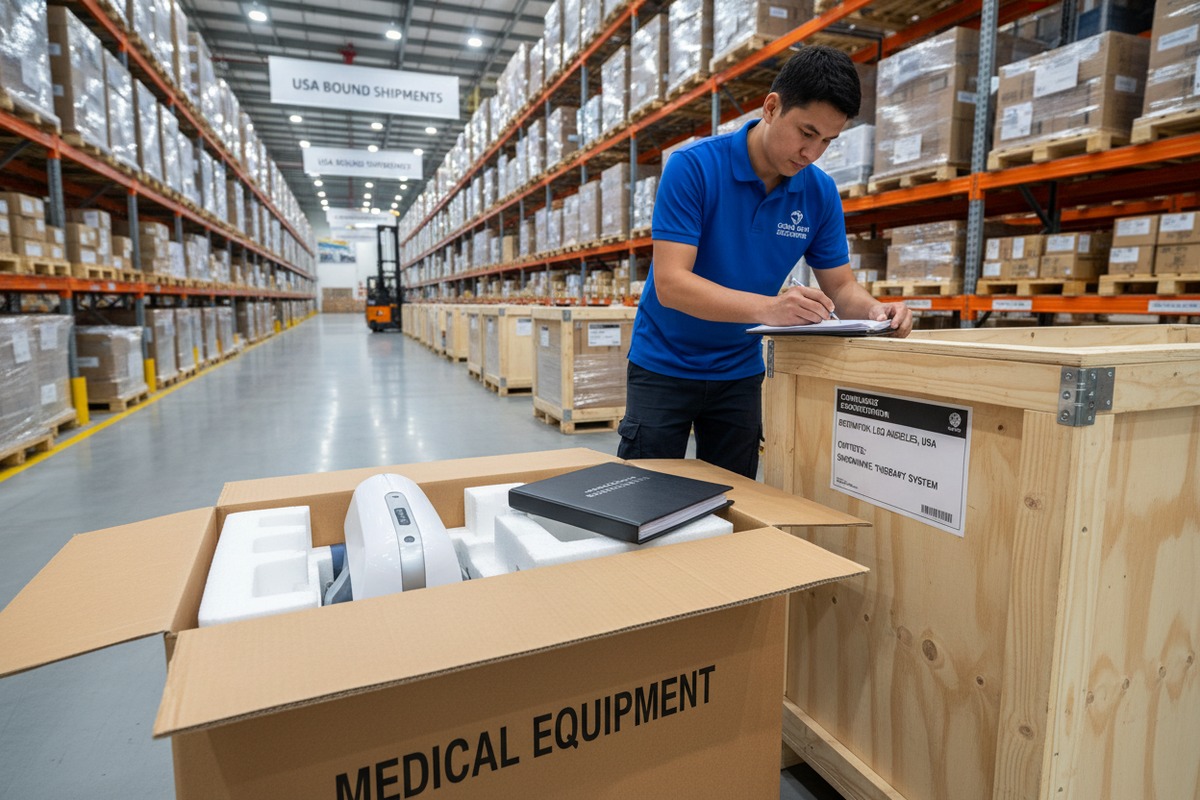
When our team prepares export shipments, we coordinate closely with importers on documentation. Smart buyers establish inspection protocols before production starts. This prevents costly surprises at US ports.
Yes, qualified Chinese suppliers can manage GUDID data submission and pre-shipment inspection through contractual agreements, but you must verify their submission capabilities, establish detailed inspection checklists covering UDI presence and scannability, require photo documentation of every label, and obtain written confirmation that all devices passed UDI verification before shipping.
What Suppliers Can and Cannot Do
Chinese manufacturers can technically submit GUDID data for products they produce. However, practical limitations exist. If you are the private labeler, GUDID submissions must list your company—not the manufacturer. This requires your FDA establishment registration number.
| Service | Supplier Can Provide | You Must Provide |
|---|---|---|
| GUDID Data Entry | Template preparation, formatting | Company registration, authorization |
| Pre-Shipment Inspection | Physical verification, photos | Inspection checklist criteria |
| Documentation Package | Certificates, test reports | FDA entry forms, broker instructions |
| Label Production | Printing, application, verification | Approved artwork, UDI numbers |
| Customs Clearance Support | Commercial documents | Import bond, broker relationship |
Structuring an Effective Pre-Shipment Inspection
A thorough inspection protocol catches problems before they become customs holds. Our standard pre-shipment inspection for UDI compliance includes:
Label Presence Check: Every unit inspected has all required labels in correct positions.
Barcode Scanning Test: Each barcode scanned with a verification-grade reader. Results documented.
Human Readable Verification: Text compared against approved artwork. Font size measured.
Direct Mark Inspection: Permanent marks checked for clarity, position, and durability indicators.
Photography Protocol: Individual photos of each unique label configuration. Wide shots showing label placement on device.
Documentation Package for Customs Clearance
Prepare these documents before your shipment leaves China:
Commercial Invoice: Includes detailed device descriptions matching GUDID entries.
Packing List: Unit counts, serial numbers, lot numbers for PI verification.
Certificate of Conformity: States compliance with 21 CFR 801.20 and 21 CFR 830.
GUDID Submission Confirmation: Printout showing successful database entry.
Pre-Shipment Inspection Report: Photos, scan results, inspector certification.
Having this package ready speeds customs processing. If FDA questions arise, you have immediate documentation to respond.
Contingency Planning for Customs Holds
Even with perfect preparation, holds can happen. Know the FDA-766 form process. This form requests permission to relabel non-compliant devices at a designated facility.
The process takes time and costs money. Storage fees accumulate daily. Some importers maintain relationships with FDA-registered relabeling facilities near major ports.
Our recommendation: invest in getting it right the first time. The cost of proper UDI implementation is far less than emergency relabeling fees plus delayed revenue.
Building Long-Term Supplier Relationships
Work with suppliers who understand FDA requirements deeply. At our facility, we invest in ongoing regulatory training. Our export team monitors FDA guidance updates. We alert customers to changes that affect their products.
Ask potential suppliers about their FDA compliance experience. Request references from US customers. Verify they have successfully exported Class II devices without customs issues.
The cheapest quote often comes from suppliers who cut corners on compliance. That low price becomes expensive when your shipment sits at port for weeks.
Conclusion
FDA UDI compliance requires active verification at every step. Check your supplier's documentation against the GUDID database. Understand your legal responsibilities as a private labeler. Inspect physical labels for durability and proper formatting. Establish pre-shipment protocols before production begins. These steps protect your business from costly customs delays.
Footnotes
1. Explains FDA’s UDI system and requirements for medical devices. ↩︎
2. Defines the Device Identifier (DI) as a mandatory UDI component. ↩︎
3. Defines the Production Identifier (PI) as a variable UDI component. ↩︎
4. Explains GS1’s role in supporting UDI implementation for medical devices. ↩︎
5. Lists and describes the FDA-accredited organizations for issuing UDIs. ↩︎
6. Details China’s National Medical Products Administration UDI system. ↩︎
7. Provides information about the FDA’s Global Unique Device Identification Database. ↩︎
8. Provides the FDA’s regulatory definition of a “labeler” for medical devices. ↩︎
9. Explains FDA requirements for direct marking UDIs on reusable medical devices. ↩︎

 English
  Español de México
  Deutsch
  Français
  العربية
  Русский