Every week, our production floor receives inquiries from distributors who bought shockwave machines that cannot reach their target tissues myofascial pain 1. The frustration is real. They invested heavily in equipment that fails to treat deep-seated conditions, leaving their clinic customers disappointed and demanding refunds.
To determine shockwave therapy machine penetration depth when purchasing, verify the 5 MPa treatment zone specifications rather than relying on marketing claims. Request pressure profile documentation, confirm transmitter head options for different depths, and conduct hands-on QC testing with calibrated measurement tools before finalizing your order.
This guide walks you through the exact verification methods we use in our manufacturing process. You will learn how bar pressure relates to penetration depth, which transmitter heads suit your clinical needs, and how to choose between radial and focused technology.
How can I verify if the bar pressure translates to the penetration depth my brand requires?
Our engineering team fields this question constantly from new OEM partners. Many buyers confuse bar pressure readings with actual tissue penetration capability. This misunderstanding leads to expensive mistakes.
Bar pressure indicates the force generated at the applicator surface, not the depth of tissue penetration. To verify actual penetration depth, request the manufacturer’s 5 MPa treatment zone documentation, which shows the absolute pressure threshold at specific tissue depths measured in centimeters.

Understanding the Pressure-Depth Relationship
Bar pressure and penetration depth are related but not equivalent. When our quality control engineers test devices, they measure pressure at multiple points within simulated tissue media. The pressure at the applicator surface always exceeds the pressure at depth because acoustic energy dissipates 2 as it travels through tissue.
For radial shockwave devices 3, a typical specification might show 4-6 bar at the handpiece. However, this surface pressure drops significantly within the first few centimeters. By the time the wave reaches 3-4 cm depth, the effective pressure may be only 20-30% of the surface reading.
Focused devices 4 work differently. They concentrate energy at a specific focal point. A focused device might generate lower surface pressure but deliver higher pressure at the focal zone located 5-10 cm beneath the skin.
Key Specifications to Request
| Specification | What It Tells You | Why It Matters |
|---|---|---|
| Surface Bar Pressure | Force at applicator tip | Initial energy output |
| 5 MPa Zone Depth | How deep therapeutic pressure reaches | Treatment capability |
| Energy Flux Density (mJ/mm²) | Energy concentration at focal point | Tissue stimulation intensity |
| Focal Zone Dimensions | Length and width of treatment area | Targeting precision |
The 5 MPa Standard Explained
Industry experts recommend evaluating the 5 MPa treatment zone 5 rather than the -6dB focal zone. The -6dB measurement is a relative value based on peak pressure. It does not tell you whether the pressure at depth is actually sufficient for therapeutic effect.
The 5 MPa zone represents an absolute pressure threshold. At 50 bar of pressure, biological effects consistently occur in tissue. When comparing devices from different manufacturers, this absolute measurement provides meaningful comparison.
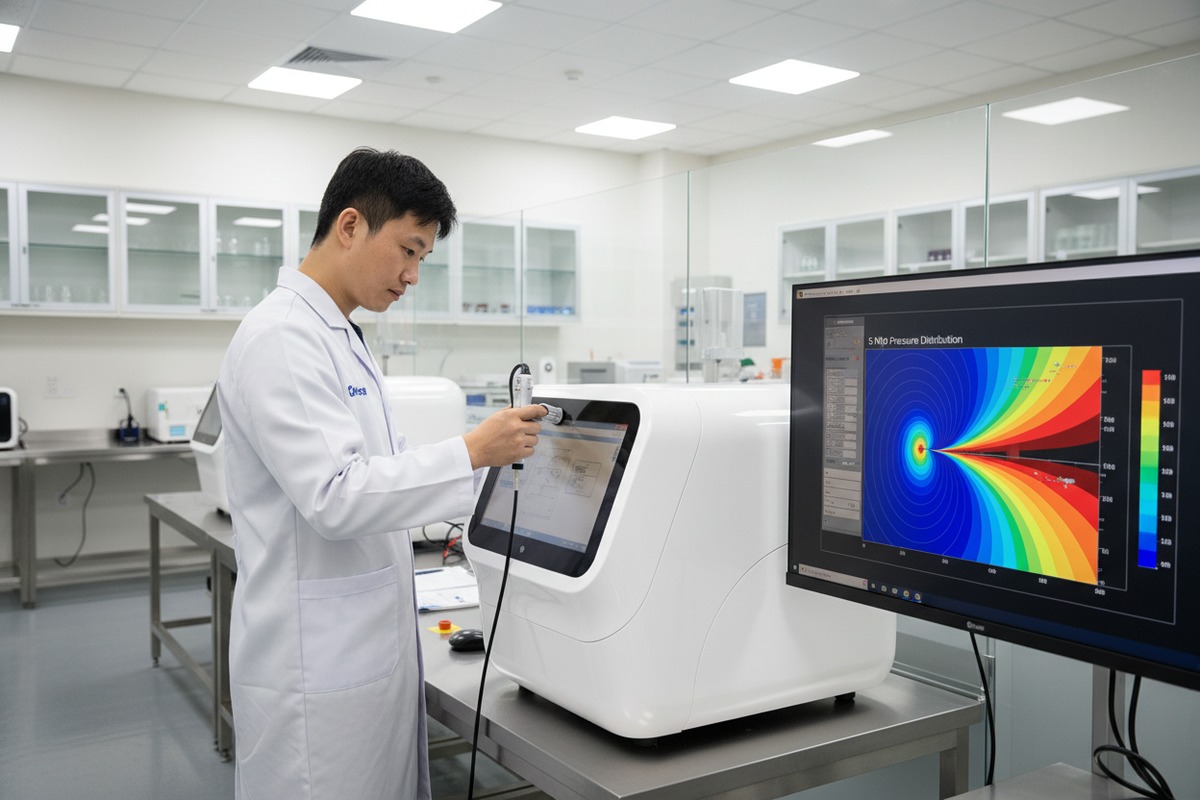
During our factory acceptance testing, we provide customers with pressure profile maps. These show penetration depth on one axis and pressure magnitude indicated by color coding. This visual documentation clarifies exactly where therapeutic energy concentrates.
Practical Verification Steps
Request a test session with the actual device. Use impedance-matched gel pads to simulate tissue. Some manufacturers use gel pad stacks of varying thickness (0-9 cm) to demonstrate wave propagation at different depths. The coupling medium must match tissue acoustic properties for accurate results.
Which transmitter heads should I include in my OEM order to target different tissue depths?
When configuring OEM orders in our facility, transmitter head selection determines your product's clinical versatility. The wrong combination limits your customers' treatment options. The right combination opens multiple market segments.
Include at least three transmitter head categories in your OEM order: shallow-depth heads (15mm focal depth) for superficial conditions, medium-depth heads (30-50mm) for standard musculoskeletal treatments, and deep-penetration heads (60-120mm) for chronic pathologies affecting deep structures like hip joints and lumbar spine.

Transmitter Head Categories by Depth
Our product line includes multiple transmitter configurations. Each serves specific clinical applications based on penetration requirements.
| Transmitter Type | Focal Depth Range | Best Applications |
|---|---|---|
| Superficial (D-Actor) | 0-25mm | Trigger points, skin tightening, cellulite |
| Standard (Classic) | 25-50mm | Plantar fasciitis, tennis elbow, Achilles tendinopathy |
| Deep Focus (Power+) | 50-90mm | Hip bursitis, rotator cuff, chronic calcifications |
| Ultra-Deep | 90-120mm | Bone non-unions, deep gluteal syndrome, spinal conditions |
Radial Transmitter Considerations
Radial transmitters disperse energy outward from the applicator. They cannot focus energy at depth. However, different head sizes and geometries affect the penetration pattern.
Larger diameter radial heads spread energy over a wider area. This works well for treating broad muscle groups. Smaller diameter heads concentrate energy in a tighter zone, creating slightly deeper effective penetration in localized areas.
For radial devices, we recommend including at least three head sizes: 6mm for precision work around bony prominences, 15mm for standard trigger point therapy, and 35mm for large muscle treatment areas.
Focused Transmitter Selection
Focused transmitters offer more dramatic depth variation. The focal zone geometry determines exactly where energy concentrates.
Applicators labeled with codes like F7G3 or F10G10 indicate specific focal parameters. The first number typically relates to focal depth, while the second indicates focal zone geometry. When we configure OEM orders, we explain each code's clinical significance.
Adjustable focal depth systems use stand-off attachments. These spacers shift the focal point closer to or further from the skin surface. Including a complete stand-off kit adds significant clinical flexibility without requiring additional handpieces.
Frequency Impact on Transmitter Performance
The same transmitter produces different penetration characteristics at different frequency settings. Lower frequencies (1-4 Hz) achieve greater penetration depth. Higher frequencies (8-15 Hz) deliver more superficial treatment with increased pulse density.
Our testing shows that visual effects indicating effective wave propagation appear most clearly at 8 Hz settings. However, clinical protocols often use varied frequencies throughout a single treatment session.
Building Your Transmitter Kit
| Clinical Focus | Recommended Kit Contents |
|---|---|
| Sports Medicine Clinic | 3 radial heads, 2 focused heads, full stand-off set |
| Orthopedic Practice | 2 radial heads, 4 focused heads, deep penetration specialty |
| General Physical Therapy | 4 radial heads, 2 focused heads, standard stand-offs |
| Specialty Urology/ED | Focused heads only, 60-120mm depth range |
When budgets are limited, prioritize the transmitters matching your primary treatment indications. You can always add specialty heads later. Our modular design philosophy ensures backward compatibility.
Should I choose radial or focused shockwave technology to meet my customers' treatment needs?
This question comes up in nearly every consultation call with new OEM partners. The answer depends entirely on your target market's clinical scope. Making the wrong choice means either overspending on capabilities you do not need or underdelivering on treatments your customers require.
Choose radial shockwave for practices treating primarily superficial conditions within 3-4 cm depth, including myofascial pain and superficial tendinopathies. Choose focused shockwave for practices treating deep pathologies at 10-12 cm depth, including bone non-unions, deep calcifications, and chronic tendinopathies. Many successful brands offer both technologies to maximize market coverage.
How Radial Technology Works
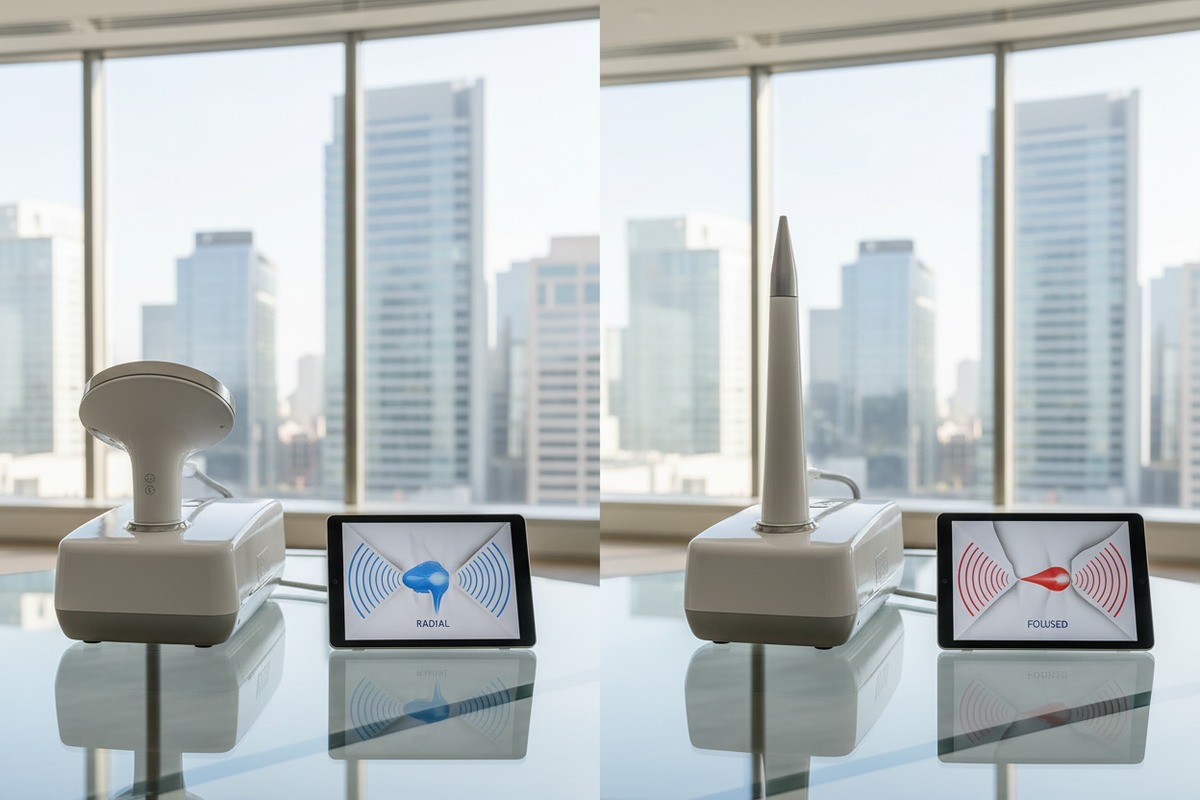
Radial shockwave devices generate pressure waves through a pneumatic mechanism. A projectile strikes the applicator tip, creating waves that spread outward from the contact point. Maximum energy exists at the skin surface. Energy decreases progressively with depth.
This dispersion pattern makes radial therapy ideal for treating broad areas of superficial tissue. The wave coverage creates a "massage-like" effect over larger treatment zones. Patient comfort is generally higher because energy is distributed rather than concentrated.
Our radial devices achieve penetration up to 3-4 cm in clinical use. Some research indicates effective treatment depth around 2.5 cm in dense human tissues. This capability suits many common conditions in physical therapy and sports medicine settings.
How Focused Technology Works
Focused shockwave devices use electromagnetic, electrohydraulic, or piezoelectric mechanisms to generate waves that converge at a specific focal point. Energy concentrates rather than disperses. The focal zone receives significantly higher pressure than surrounding tissues.
This concentration enables treatment of structures located 10-12 cm beneath the skin surface. Some clinical literature reports effective treatment at 8 cm depending on tissue composition. Deep tendons, bone surfaces, and calcific deposits become accessible targets.
The trade-off involves higher energy flux density at the focal zone. This concentration can cause increased patient discomfort. However, for deep pathologies, no alternative exists. Radial waves simply cannot deliver therapeutic energy to structures beyond 4 cm depth.
Clinical Application Comparison
| Condition | Recommended Technology | Depth Required |
|---|---|---|
| Myofascial trigger points (superficial) | Radial | 1-3 cm |
| Plantar fasciitis | Either (focused preferred) | 2-4 cm |
| Tennis elbow | Either | 2-3 cm |
| Achilles tendinopathy | Focused | 4-6 cm |
| Rotator cuff calcification | Focused | 5-8 cm |
| Hip trochanteric bursitis | Focused | 6-10 cm |
| Bone non-union | Focused | 8-12 cm |
| Erectile dysfunction | Focused | 3-5 cm |
The Hybrid Solution
Many of our OEM partners choose hybrid platforms offering both radial and focused capabilities. This approach provides maximum clinical versatility. A single device can address both superficial conditions requiring broad wave coverage and deep pathologies requiring focused energy concentration.
When configuring hybrid systems, we ensure the focused applicators achieve genuine deep penetration (10-12 cm) rather than compromised intermediate depths. Some competitors market "semi-focused" devices that fall short of true focused therapy capabilities. Our engineering standards maintain clear separation between technology categories.
Cost and Market Positioning Considerations
Radial-only devices cost less to manufacture and sell at lower price points. They suit budget-conscious clinics with primarily superficial treatment needs. Focused devices command premium pricing but open access to lucrative treatment markets like bone healing and deep chronic conditions.
Your brand positioning determines the optimal choice. Mid-market brands often succeed with radial-only offerings. Premium brands typically require focused or hybrid capabilities to justify higher pricing and compete effectively.
How do I ensure the manufacturer's penetration depth claims match the actual performance during my QC inspection?
Our quality control department handles this verification process daily. We have seen too many cases where published specifications do not match actual device performance. Protecting your brand requires rigorous inspection protocols.
During QC inspection, verify penetration depth using calibrated hydrophone measurements in standardized test media, compare results against the manufacturer’s documented pressure profiles, and test multiple units from the production batch to confirm consistency. Request IEC-compliant test reports and conduct independent third-party verification for high-value orders.

Essential QC Equipment and Methods
Professional verification requires specific testing equipment. Hydrophones measure acoustic pressure at precise locations within test media. hydrophone measurements 6 Oscilloscopes display waveform characteristics including rise time and peak pressure. Calibrated gel phantoms simulate tissue acoustic properties.
When we conduct factory acceptance testing for OEM partners, we use a standardized protocol. The device operates at specified settings. The hydrophone records pressure measurements at multiple depths. Results compare against documented specifications with acceptable tolerance ranges.
Step-by-Step Verification Protocol
First, confirm the testing environment meets standards. Temperature affects acoustic properties. Coupling gel quality impacts wave transmission. Eliminate variables that could skew results.
Second, position the hydrophone at the claimed focal depth. For a device claiming 60mm penetration, measure pressure at exactly 60mm depth in the test medium. Record the value.
Third, map the pressure profile by measuring at multiple depths. Create a curve showing pressure versus depth. This reveals the actual therapeutic zone, not just a single point measurement.
Fourth, test multiple units from the same production batch. Individual units can vary. Sampling three to five units provides confidence in batch consistency.
Red Flags During Inspection
| Warning Sign | What It Indicates | Your Response |
|---|---|---|
| Pressure drops sharply before claimed depth | Insufficient penetration capability | Request redesign or reject |
| Large variation between units | Poor manufacturing consistency | Increase sample size, tighten tolerances |
| No focal zone visible in profile | Radial device marketed as focused | Clarify technology classification |
| Coupling gel not impedance-matched | Inaccurate test conditions | Request proper test media |
Documentation Requirements
Request complete technical documentation before inspection. This includes IEC 61846:1999 7 or IEC 63045:2021 compliant test reports showing focal zone parameters. The axial and lateral extent of the treatment zone should be clearly specified.
Pressure profile maps provide visual confirmation. These show penetration depth on one axis and lateral spread on another, with pressure magnitude indicated by color coding. Compare the provided documentation against your actual measurements.
Third-Party Verification Options
For large orders or new supplier relationships, consider independent laboratory testing. Accredited testing facilities provide unbiased verification. The cost is typically 1-3% of order value but protects against significant quality failures.
We encourage our OEM partners to visit our facility for on-site verification. Seeing the production process, testing equipment, and quality control procedures builds confidence. We maintain an open-door policy for customer inspections.
Establishing Ongoing QC Standards
Document your inspection requirements in the purchase agreement. Specify acceptable tolerance ranges (typically ±10% for pressure measurements). Define the sampling protocol for production batches. Include provisions for re-testing if initial samples fail.
Regular supplier audits maintain quality over time. Initial production runs often receive more attention than subsequent batches. Periodic unannounced inspections ensure consistent standards.
Conclusion
Determining shockwave therapy machine 9 penetration depth requires understanding bar pressure relationships, selecting appropriate transmitter heads, choosing between radial and focused technologies, and implementing rigorous QC verification protocols. Your investment in proper evaluation protects your brand reputation and ensures your customers receive equipment that genuinely meets their clinical needs.
Footnotes
1. Explains the condition of myofascial pain syndrome, its symptoms, and causes. ↩︎
2. Explains the fundamental physical principle of acoustic energy loss as it travels through tissue. ↩︎
3. Describes the mechanism, applications, and characteristics of radial shockwave therapy. ↩︎
4. Explains the principles, generation methods, and applications of focused shockwave therapy. ↩︎
5. Explains the significance and measurement of the 5 MPa treatment zone in shockwave therapy. ↩︎
6. Details the use of hydrophones for accurate acoustic pressure measurement in medical devices. ↩︎
7. Provides information on the international standard for measuring and characterizing acoustic fields of therapeutic focused short pressure pulse sources. ↩︎
8. Replaced HTTP 404 link with an accessible page from iTeh Standards detailing the IEC 63045:2020 standard, which is the core standard referenced by the 2021 adopted version. ↩︎
9. Provides a general overview of extracorporeal shockwave therapy and its principles. ↩︎

 English
 Español de México
 Deutsch
 Français
 العربية
 Русский
Join the Conversation
Have a question or insight to share? We read every comment — whether you're a distributor, salon owner, or just curious about the technology. Your real-world experience helps others make better decisions. Drop your thoughts below.