
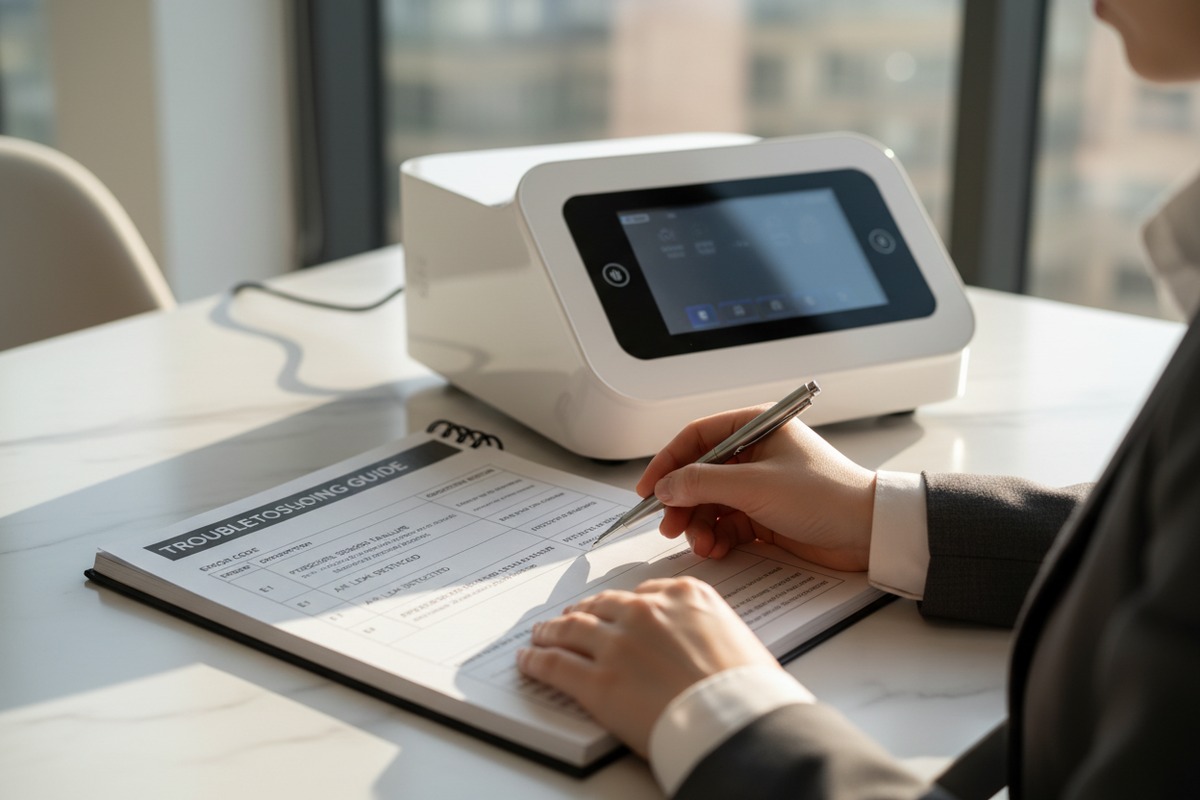
Working on our production lines in Guangzhou, I have seen firsthand how equipment buyers struggle with machines that break down without clear guidance 1 technical documentation 2. A spa owner contacts us in panic. Their pressotherapy machine 3 shows “E3” on the screen. The manual says nothing useful. Their clients are waiting. Revenue is lost. This story repeats too often in our industry.
To confirm your pressotherapy machine supplier provides a detailed error code manual, request a sample of the technical documentation before purchase. Look for a dedicated troubleshooting section with specific error codes, their meanings, causes, and step-by-step corrective actions. Verify the manual covers self-diagnostic features and includes service contact information for unresolved issues.
This guide walks you through the exact steps to evaluate supplier documentation quality MDSAP certifications 4. You will learn what to look for, what questions to ask, and how to avoid costly mistakes when sourcing pressotherapy equipment for your business.
How can I verify that my supplier's pressotherapy error code manual is detailed enough for my technicians?
When we ship our pressotherapy machines overseas, we always ensure the documentation matches what technicians actually need in the field Electrical Muscle Stimulation 5. Many buyers assume all manuals are equal. They are not. Some suppliers provide 50-page manuals. Others give you two pages with basic diagrams. The difference can cost your business thousands in downtime and repair bills.
To verify your supplier's error code manual is detailed enough, request a sample before ordering and check for these elements: a comprehensive error code table with numerical codes and meanings, step-by-step troubleshooting procedures, visual diagrams showing component locations, and clear escalation paths for when basic fixes fail. Professional manuals also include self-diagnostic test procedures and expected system behaviors.

Understanding What Makes a Manual "Detailed Enough"
A truly detailed error code manual goes beyond simple code listings. It provides context and actionable guidance. When our engineering team develops documentation, we include multiple layers of information for each potential issue.
The error code chart should list "all error codes, the associated problem, and suggested corrective action to be taken." This forms the foundation of any professional technical manual.
Key Elements to Check in Supplier Documentation
| Element | What to Look For | Red Flag if Missing |
|---|---|---|
| Error Code Table | Numerical codes with descriptions | Generic "contact service" messages only |
| Troubleshooting Steps | Sequential actions for each error | Vague instructions like "check connections" |
| Visual Aids | Diagrams showing parts and locations | Text-only descriptions |
| Self-Diagnostic Info | How to run startup tests | No mention of automatic checks |
| Escalation Path | When to contact support | No service contact information |
How to Request and Evaluate Sample Documentation
Ask your supplier directly: "Can you send me pages 15-25 of your user manual showing the troubleshooting section?" A legitimate manufacturer will comply. "Yes, we provide a manual and video for operation. We will send it to you via email after you place an order." But you should receive samples before committing to a purchase.
Compare manuals from at least three suppliers. Look at how they handle common scenarios like power failures, cuff inflation issues, and touch screen problems. "Safety features include emergency stop functions, pressure limiters, and automatic shut-off systems to prevent overuse. The garments are designed with reinforced seams and durable air chambers that maintain their integrity over numerous treatment cycles. Regular self-diagnostic routines ensure…" the system maintains performance standards.
Testing Your Supplier's Technical Knowledge
Call or email your supplier with a specific error scenario. Ask: "What does error code E3 mean on your pressotherapy machine?" "E3 means there's an issue with the electronics/motor." A professional supplier can answer this immediately. They know their products. If they hesitate or give vague responses, their documentation likely reflects the same quality.
What specific troubleshooting information should I look for in a professional pressotherapy machine manual?
In our factory, we test every pressotherapy unit through a rigorous quality control process 6 before shipping. When a machine passes our tests, we know exactly what scenarios might cause issues later. That knowledge goes directly into our manuals. Your supplier should demonstrate similar depth in their documentation.
A professional pressotherapy manual should include power system diagnostics (fuse checks, voltage verification, power supply testing), pneumatic system troubleshooting (cuff leakage detection, air duct inspection, connection verification), interface diagnostics (touch screen calibration, display errors, button responsiveness), and component-specific guides for handpieces, pumps, and sensors. Each section should include a decision tree for systematic fault isolation.

Power System Troubleshooting Requirements
Power issues represent the most common category of pressotherapy equipment problems. Your manual should address them thoroughly.
| Common Power Issue | What Manual Should Include | Expected Self-Test Behavior |
|---|---|---|
| No power at all | Fuse location, replacement specs, outlet verification | LED indicator sequence |
| Intermittent power | Internal connection points, wire harness inspection | Startup diagnostic completion time |
| Voltage fluctuation | Acceptable voltage range (100-240V 50/60Hz), surge protection | Error code for voltage out-of-range |
| Power cycling issues | Thermal cutout information, cooling period requirements | Automatic shutdown protocols |
"Safety features include emergency stop functions, pressure limiters, and automatic shut-off systems to prevent overuse. The garments are designed with reinforced seams and durable air chambers that maintain their integrity over numerous treatment cycles. Regular self-diagnostic routines ensure the system maintains optimal performance."
Pneumatic System Diagnostics
The pressotherapy system relies on precise air pressure delivery. pneumatic system 7 "E31: cuff missing or loose – there was no cuff connected to the device or the cuff may be too loose on the patient's arm · E32: cuff tubing clogged – the cuff is clogged or the rubber tube is broken · E33: cuff leaking or loose – there is a hole in the cuff or it is very loose on the patient's arm." These specific error code descriptions show what quality documentation looks like.
Self-Diagnostic Features to Verify
Modern pressotherapy devices run automatic startup diagnostics. "The machine's advanced sensors continuously monitor pressure levels, automatically adjusting to maintain therapeutic effectiveness while ensuring user comfort and safety. This intelligent pressure management system allows for personalized treatment intensities."
Your supplier's manual should explain:
- What the self-diagnostic tests check
- How long the startup sequence takes
- What display indicators mean during testing
- What to do if diagnostics fail
Component-Specific Troubleshooting Sections
Professional manuals break down troubleshooting by component. Each section addresses:
- Air Pump Issues: Unusual noises, reduced pressure output, overheating
- Cuff Problems: Uneven inflation, air leaks, zipper failures
- Control Unit: Screen malfunctions, button unresponsiveness, software freezes
- Connections: Hose detachment, port damage, electrical connector issues
"Common issues that tend to arise with massage gun use include battery, charging, motor, and even electrical product defects. To address these issues, make sure to follow the tips outlined in this article for proper maintenance of your device." While this refers to massage guns, the principle applies: manuals should anticipate real-world failure modes.
How do I ensure the error codes provided align with the custom features of my private-label equipment?
Our OEM team works closely with brand owners who want customized pressotherapy machines. We have learned that standard documentation rarely fits modified equipment. When you change pressure ranges, add infrared modules, or integrate EMS functions, the error codes change too. Your supplier must adapt documentation to match.
For private-label equipment, ensure error codes align with custom features by requesting model-specific documentation that references your exact configuration. Verify the manual includes codes for all added features (infrared, EMS, custom pressure ranges). Request a documentation review meeting where the supplier walks through each customized element and its corresponding error handling. Get written confirmation that documentation updates will be provided when firmware changes occur.

Why Standard Manuals Fall Short for Private-Label Equipment
"This Pressotherapy machine, which includes a pump supplying air to specialized garments, boasts three primary functions: Air Pressure, Far Infrared 8, and EMS (Electrical Muscle Stimulation). The system uses air bags that regularly inflate and deflate." A multi-function device requires documentation covering each feature's potential error states.
When you private-label equipment, consider these documentation requirements:
| Customization Type | Documentation Requirement | Verification Question |
|---|---|---|
| Custom pressure ranges | Error codes for out-of-range values | What code appears if pressure exceeds my specified max? |
| Added infrared module | Heating element failure codes | How does the system alert operators to IR malfunction? |
| EMS integration | Electrical stimulation error handling | What happens if EMS leads disconnect during treatment? |
| Custom software interface | Screen-specific error messages | Will error codes display in my custom UI language? |
| Modified chamber count | Chamber-specific inflation errors | Can the system identify which specific chamber fails? |
Requesting Model-Specific Documentation
Before finalizing your OEM order, ask your supplier these specific questions:
- "Will my private-label manual be based on a template or written specifically for my configuration?"
- "Who reviews the technical accuracy of customized documentation?"
- "How long after hardware changes will I receive updated documentation?"
- "Can my technicians contact your engineering team directly for error code questions?"
"To ensure exceptional quality, all Canta Esthetic machines go through a stringent quality control process and come with a 36-month warranty. If you have any technical issues, you can always contact our expert team." This level of support should extend to documentation quality.
Documentation Update Protocols
Your private-label agreement should include documentation maintenance terms. When firmware updates change error codes or add new diagnostics, your manuals need updating too.
Professional suppliers provide:
- Version-controlled documentation with change logs
- Digital access to latest manual versions
- Notification when updates become available
- Training materials for new features
"Product Name: Vertical 3-in-1 Pressotherapy Lymphatic Drainage Machine Technology: Pressotherapy + Far Infrared + EMS Application: Commercial Use After-Sales Service: Online support and video technical support provided." This indicates the supplier offers ongoing support, which should include documentation updates.
Validating Your Custom Documentation
Before accepting delivery, conduct a documentation validation:
- Review every error code listed and verify it can actually be triggered on your unit
- Test each troubleshooting procedure on the actual machine
- Confirm all custom features have dedicated troubleshooting sections
- Verify that component part numbers in the manual match your hardware
- Check that contact information routes to technical support, not just sales
Can I request a sample of the technical documentation to evaluate my supplier's engineering standards?
When distributors visit our Guangzhou facility, we always show them our documentation process alongside our production lines. Engineering standards show up in documentation quality. A supplier who cannot produce clear, accurate technical manuals likely has similar gaps in their manufacturing discipline. Documentation requests reveal more than you might expect.
Yes, you should always request sample technical documentation before committing to a supplier. Professional suppliers provide documentation samples willingly because they understand it demonstrates their engineering standards. Request the complete troubleshooting section, error code reference chart, and maintenance schedule. Evaluate the documentation for technical accuracy, clarity of instructions, professional formatting, and completeness. A supplier's reluctance to share documentation samples signals potential quality concerns.

What Documentation Samples to Request
Request specific sections that reveal documentation quality:
| Document Section | What It Reveals | Quality Indicators |
|---|---|---|
| Error Code Chart | Engineering thoroughness | Specific codes vs. generic messages |
| Troubleshooting Flowcharts | Problem-solving methodology | Decision trees vs. simple lists |
| Maintenance Schedule | Product lifecycle understanding | Detailed intervals vs. "as needed" |
| Safety Warnings | Regulatory compliance awareness | Specific hazards vs. boilerplate text |
| Wiring Diagrams | Technical depth | Component-level detail vs. basic blocks |
Evaluating Documentation Against Industry Standards
"All IPC devices meet industry safety and performance standards, holding certifications from the FDA 9, NRTL, CE, and Health Canada. Our manufacturing facility has achieved ISO13485 10 and MDSAP certifications." Certified manufacturers produce documentation that meets corresponding standards.
Compare your supplier's documentation against these benchmarks:
- Clarity: Can a technician with basic training follow the instructions?
- Completeness: Are all scenarios covered, not just common issues?
- Accuracy: Do part numbers and specifications match the actual equipment?
- Currency: Is the documentation version dated and revision-controlled?
- Accessibility: Is it available in formats your team can use (digital, print)?
Red Flags in Supplier Documentation
Watch for these warning signs:
- Generic content: The same text appears for different models
- Poor translation: Grammatical errors that create confusion
- Missing sections: No troubleshooting or only brief mentions
- Outdated information: References to discontinued components
- No contact information: Cannot reach technical support through the manual
"One of the best ways to prevent any issues with your massage gun is to read the user manual before using it. This will help you understand all the safety features and settings of your device, as well as provide you with massage gun safety tips for maintenance and troubleshooting. High-quality massage guns like the Fusion Elite usually come with detailed user manuals."
Conducting a Documentation Quality Assessment
Create a scoring system for comparing suppliers:
| Criteria | Weight | Scoring (1-5) |
|---|---|---|
| Error code completeness | 25% | Based on number of codes documented |
| Troubleshooting depth | 25% | Step detail and decision support |
| Visual quality | 15% | Diagram clarity and relevance |
| Language clarity | 15% | Readability and accuracy |
| Support integration | 20% | Links to training, updates, contacts |
Building Documentation Requirements into Your Contract
Your purchase agreement should include documentation specifications:
- Manual delivery format (print, PDF, online access)
- Language requirements (English, plus local language if needed)
- Update provision terms (how and when updates arrive)
- Customization scope (what must be model-specific)
- Training material inclusion (videos, quick-reference cards)
"With each piece of Canta Esthetic Equipment our customers receive FREE Training. And of course along with the training you receive a full manual package: *Detailed User's Manual *A 'Certificate of Completion' when training is complete." This represents the comprehensive approach you should expect.
Conclusion
Verifying your pressotherapy supplier's documentation quality protects your investment and ensures your team can handle equipment issues efficiently. Request samples before purchase. Check for complete error code tables and step-by-step troubleshooting. Confirm documentation matches your specific configuration. These steps separate reliable suppliers from those who will leave you struggling when problems arise.
Footnotes
1. Explains CE marking requirements for medical devices in the European market. ↩︎
2. Explains the requirements and importance of technical documentation for medical devices. ↩︎
3. Provides a comprehensive overview of pressotherapy, its benefits, and how it works. ↩︎
4. Official FDA page explaining the Medical Device Single Audit Program (MDSAP). ↩︎
5. Explains what Electrical Muscle Stimulation (EMS) is, its uses, benefits, and risks. ↩︎
6. Details the quality control process in medical device manufacturing and its significance. ↩︎
7. Discusses the use and importance of pneumatic systems in various medical devices. ↩︎
8. Describes Far Infrared therapy, its benefits, and applications in health and wellness. ↩︎
9. Replaced with an official and accessible FDA.gov page providing an overview of medical device regulation, maintaining the authoritative source. ↩︎
10. Defines ISO 13485 as the international standard for quality management systems in medical devices. ↩︎

 English
 Español de México
 Deutsch
 Français
 العربية
 Русский
