
Every week, our production team fields calls from chiropractic clinic owners asking the same question musculoskeletal conditions 1. They invested in shockwave therapy machines 2 but chose the wrong power level. Now, some machines sit idle because treatments take too long. Others break down under heavy patient loads. This mismatch costs clinics thousands in lost revenue and frustrated patients.
To choose the right shockwave therapy machine power for your chiropractic clinic, match your weekly patient volume to specific energy outputs. Low-volume clinics under 10 patients weekly need 60-100 mJ radial units. Mid-volume clinics treating 20-50 patients weekly require adjustable 100-185 mJ machines. High-volume clinics exceeding 50 patients weekly benefit from 5 bar systems with pre-programmed protocols.
This guide breaks down exact power specifications, durability requirements, and customization options. You will learn how to calculate your ideal machine capacity and avoid costly purchasing mistakes.
How do I determine the ideal power output for my high-volume chiropractic clinic?
Running a high-volume practice demands equipment that keeps pace with patient flow. In our experience manufacturing shockwave devices for busy US clinics, we see the same pattern. Clinics buying underpowered machines face treatment bottlenecks, longer wait times, and unhappy patients.
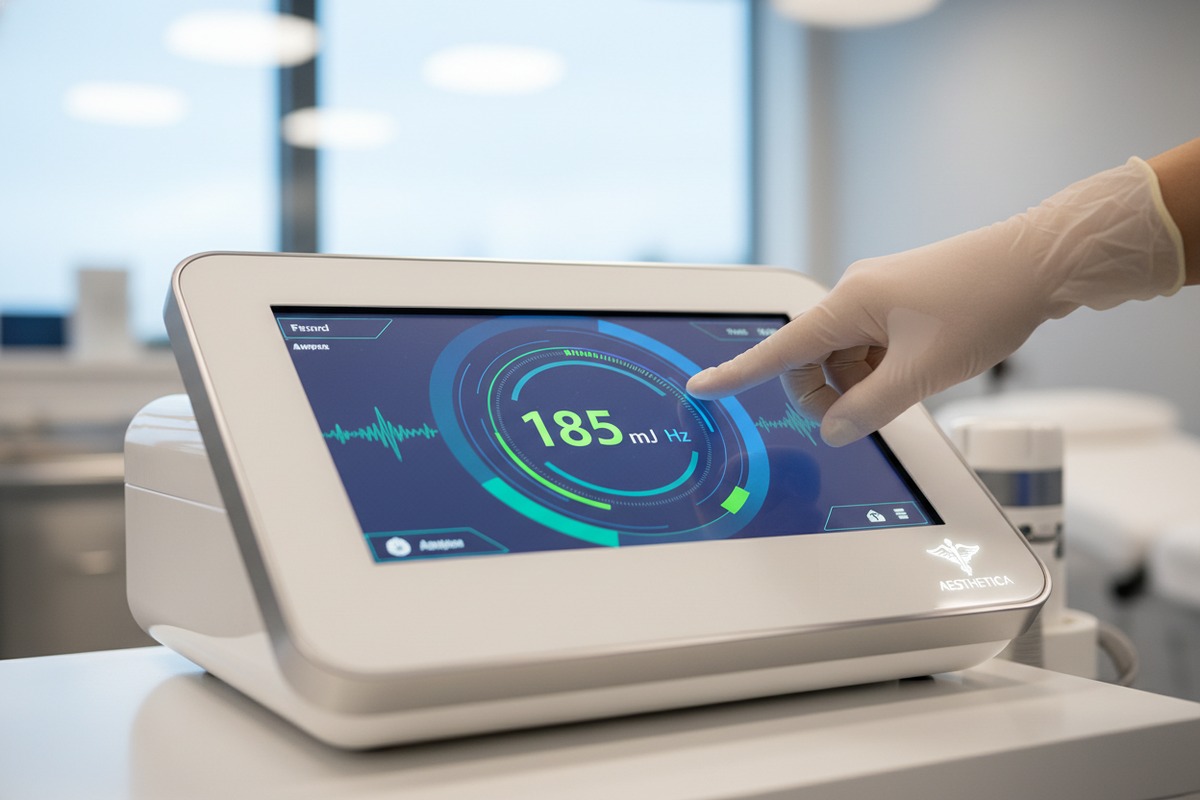
For high-volume chiropractic clinics treating 50 or more patients weekly, the ideal power output ranges from 185 mJ to 5 bar effective pressure with frequency capabilities of 17-22 Hz. This combination enables 5-10 minute treatments per session while delivering therapeutic energy to depths of 4-6 cm for most musculoskeletal conditions.

Understanding Energy Metrics That Matter
Shockwave therapy machines measure power in different ways. This causes confusion for many buyers. Let me clarify the key metrics.
Radial pressure wave devices 3 measure energy in millijoules (mJ) or bar pressure. Clinical-grade machines start at 60 mJ minimum. High-volume clinics need 185 mJ maximum output. Bar pressure ranges from 0.3 to 5 bar, though most treatments rarely exceed 2.6 bar effective.
Focused shockwave devices 4 use energy flux density, measured in mJ/mm². These range from 0.01 to 0.8 mJ/mm². Focused machines penetrate deeper, reaching 12.5 cm, but cost significantly more.
Patient Volume Assessment Framework
Before selecting power specifications, calculate your actual treatment capacity needs.
| Weekly Patient Volume | Recommended Power Range | Typical Session Duration | Daily Machine Runtime |
|---|---|---|---|
| Under 10 patients | 60-100 mJ / 0.3-2 bar | 15-20 minutes | 1-2 hours |
| 10-20 patients | 100-150 mJ / 2-3 bar | 10-15 minutes | 2-4 hours |
| 20-50 patients | 150-185 mJ / 3-4 bar | 8-12 minutes | 4-6 hours |
| 50+ patients | 185 mJ / 4-5 bar | 5-10 minutes | 6-8 hours |
High-volume clinics benefit from machines offering frequency independence from energy. When our engineers calibrate devices, they ensure maximum frequency remains available at peak energy. Some competitors drop from 10 Hz to 2 Hz at high energy settings. This slows treatments considerably.
Matching Power to Treatment Depth
Different chiropractic conditions require different penetration depths. Superficial muscle tension responds well to radial waves at 2-3 cm depth. Deep fascia and paraspinal issues need 4-6 cm penetration.
For a busy clinic treating varied conditions, adjustable power proves essential. Your staff should switch between 2 bar for sensitive areas and 4 bar for deeper tissue work. Fixed power machines limit treatment versatility and force compromises.
The frequency range matters equally. Radial devices offering 1-22 Hz provide maximum flexibility. Lower frequencies around 4-6 Hz work better for pain-sensitive patients. Higher frequencies of 15-22 Hz speed up treatments for standard protocols.
Will a standard power setting be durable enough for my daily patient load?
When we test machines on our production line, durability under continuous use concerns us most. A device performing well in a low-volume setting may fail quickly when treating 50 patients daily. Standard power settings create specific stress patterns that affect component longevity.
Standard power settings of 2-3 bar or 100-150 mJ are typically durable for clinics treating up to 30 patients daily. However, clinics exceeding this volume need machines engineered for continuous duty cycles with reinforced compressors, industrial-grade applicators, and minimum 2-year warranties covering intensive use.
Duty Cycle and Continuous Operation
Duty cycle 5 determines how long a machine runs before requiring rest. Consumer-grade devices have 20-30% duty cycles. Clinical machines need 70-80% minimum.
In practical terms, a 30% duty cycle means 18 minutes of rest after every 6 minutes of treatment. This destroys patient flow in busy clinics. When we design machines for high-volume export to US clinics, we engineer 80% duty cycles as standard.
The compressor system matters most for durability. Pneumatic systems 6 generate pressure through repeated compressions. Cheap compressors overheat quickly. Industrial compressors maintain consistent output throughout full clinic days.
Component Lifespan by Usage Level
Different components wear at different rates. Understanding these patterns helps you predict maintenance needs.
| Component | Low Volume Lifespan | High Volume Lifespan | Replacement Cost |
|---|---|---|---|
| Applicator tip | 500,000 shots | 300,000 shots | $200-400 |
| Compressor | 5+ years | 2-3 years | $800-1,500 |
| Handpiece cable | 4+ years | 1-2 years | $150-300 |
| Control board | 7+ years | 5+ years | $400-700 |
| Pressure seals | 3+ years | 1 year | $50-100 |
High-volume clinics should budget for accelerated wear. A machine rated for 1 million total shots sounds impressive. At 2,000 shots per day in a busy practice, that equals 500 treatment days or roughly 2 years of use.
Warning Signs of Inadequate Durability
From our quality control inspections, certain problems indicate machines unsuited for heavy use. Watch for these issues during evaluation.
Inconsistent pressure delivery suggests worn seals or weak compressors. The machine may display 4 bar but deliver only 2.5 bar effective pressure. This extends treatment times and reduces outcomes.
Overheating during extended sessions indicates inadequate cooling systems. The machine should operate continuously for 6-8 hours without thermal protection shutdowns.
Applicator wobble or looseness develops faster in cheap constructions. Precision machined metal applicators outlast plastic alternatives significantly.
When evaluating machines, ask suppliers for duty cycle specifications in writing. Request documentation of stress testing under continuous operation. Quality manufacturers provide this data willingly.
Can I customize the energy range on my private-label machines to suit my clinic's specific needs?
Many US distributors and clinic chains want machines branded with their identity. Our OEM team handles these requests regularly. Beyond cosmetic branding, power customization offers strategic advantages for specific practice models.
Yes, reputable manufacturers offer energy range customization on private-label shockwave machines. Common customizations include pre-set protocol libraries tailored to chiropractic conditions, adjustable energy limits for safety compliance, locked maximum outputs for franchise standardization, and custom frequency ranges optimized for specific treatment modalities.

Types of Power Customization Available
Energy customization falls into several categories. Understanding options helps you negotiate effectively with suppliers.
Software-based customization is most accessible. This includes custom protocol libraries 7, interface language, treatment parameter presets, and usage logging features. Most manufacturers accommodate these requests with minimal additional cost.
Hardware-based customization requires engineering involvement. Changing maximum output, modifying frequency ranges, or adding applicator compatibility involves component changes. Expect longer lead times and higher minimum order quantities.
| Customization Type | Typical Lead Time | Minimum Order | Cost Impact |
|---|---|---|---|
| Logo and branding | 2-3 weeks | 5-10 units | 5-10% increase |
| Protocol presets | 3-4 weeks | 10-20 units | 10-15% increase |
| Interface customization | 4-6 weeks | 20-50 units | 15-20% increase |
| Energy range modification | 8-12 weeks | 50-100 units | 25-40% increase |
| Custom applicators | 12-16 weeks | 100+ units | 40-60% increase |
Chiropractic-Specific Protocol Libraries
Standard shockwave machines often come with protocols designed for general physiotherapy or orthopedics. Chiropractic applications have unique requirements.
When we develop protocol libraries for chiropractic distributors, we focus on conditions like cervical dysfunction, thoracic outlet syndrome, piriformis syndrome, and sacroiliac joint dysfunction. These require specific energy densities and application angles different from tennis elbow or plantar fasciitis protocols.
Pre-programmed protocols for 25 or more chiropractic conditions eliminate guesswork. Staff training simplifies considerably. Treatment consistency improves across multiple practitioners.
Consider requesting protocols that specify not just energy levels but also treatment zones, pulse counts, and frequency progressions. Comprehensive protocols include patient positioning guidance and contraindication warnings.
Quality Control for Custom Orders
Custom machines require rigorous verification before shipping. Our pre-shipment inspection process catches problems before they reach your clinic.
Energy output verification uses calibrated measurement equipment. Each machine should deliver specified power within 5% tolerance across its entire range. Some manufacturers skip this step, leading to inconsistent devices within the same order.
Protocol functionality testing confirms all custom presets operate correctly. Interface elements display properly. Locked features remain inaccessible.
Documentation for custom orders should include detailed specifications, test reports, and calibration certificates. This protects both parties and supports any warranty claims.
How does the machine's power capacity impact my treatment efficiency and patient turnover?
Treatment efficiency determines clinic profitability. In conversations with US practice owners, we hear consistent concerns about patient throughput and revenue per treatment hour. Power capacity directly affects these metrics.
Machine power capacity impacts treatment efficiency through session duration, energy delivery rate, and protocol flexibility. Higher power machines with 185 mJ output and 17-22 Hz frequency complete standard treatments in 5-8 minutes versus 15-20 minutes for lower power alternatives. This enables 6-8 patients per hour versus 3-4 patients, effectively doubling potential revenue.

Calculating Revenue Impact of Power Differences
Let me show you concrete numbers. These calculations help justify equipment investment decisions.
Assume a standard 8-hour treatment day. A lower-power machine treating patients in 20-minute sessions handles 24 patients maximum. A higher-power machine completing 8-minute treatments handles 60 patients maximum.
At $75 per treatment, daily revenue potential jumps from $1,800 to $4,500. Over a 250-day work year, this equals $450,000 versus $1,125,000 in potential treatment revenue.
Of course, actual patient volume depends on demand. But inadequate machine capacity creates artificial ceilings on growth. Investing in appropriate power capacity removes equipment as a limiting factor.
Treatment Time Breakdown by Power Level
Understanding where time goes during treatments reveals power efficiency impact.
| Treatment Phase | Low Power (60-100 mJ) | Medium Power (150 mJ) | High Power (185 mJ) |
|---|---|---|---|
| Setup and prep | 2 minutes | 2 minutes | 2 minutes |
| Energy delivery | 12-15 minutes | 8-10 minutes | 4-6 minutes |
| Cool down and reset | 3 minutes | 2 minutes | 1 minute |
| Total session | 17-20 minutes | 12-14 minutes | 7-9 minutes |
| Patients per hour | 3-3.5 | 4-5 | 6-8 |
Energy delivery time scales directly with power output. Higher millijoule ratings mean more therapeutic energy per pulse. Fewer pulses are needed to achieve clinical effect. Higher frequency settings also accelerate delivery without reducing energy.
Soft Protocols and Patient Retention
Raw power alone does not guarantee efficiency. Patient comfort affects completion rates significantly.
High-power treatments can cause discomfort that makes patients reluctant to return. Dropout rates increase. Your 6-session treatment plans become 2-session disappointments.
The solution involves soft protocols. These start at lower energy levels and gradually increase as tissue adapts. Modern machines automate this progression. First session may use 2 bar at 10 Hz. Subsequent sessions ramp to 3.5 bar at 17 Hz.
Soft protocols slightly extend individual session times but dramatically improve completion rates. A patient who finishes all 6 sessions generates more revenue than one who drops out after 2 sessions despite faster individual treatments.
When we configure machines for high-volume clinics, we recommend balancing speed with comfort settings. The goal is maximum completed treatment plans, not maximum patients started.
Integration with Other Treatment Modalities
High-power shockwave machines increasingly pair with complementary technologies. Class 4 laser therapy 8 and shockwave combination protocols show promising results.
Integration capabilities extend the value of your shockwave investment. Machines designed with expansion in mind accept additional handpiece types. Software platforms accommodate protocol combinations.
For busy chiropractic practices, integration simplifies workflow. Patients receive multi-modal treatments in single visits. Equipment ROI improves through broader application.
Conclusion
Choosing shockwave therapy machine power requires honest assessment of your patient volume, treatment goals, and growth plans. Match specifications to actual needs rather than buying maximum power you may never use. Focus on durability, customization potential, and efficiency metrics that affect your bottom line. The right machine becomes a revenue engine. The wrong choice becomes an expensive paperweight.
Footnotes
1. Discusses shockwave therapy as a non-surgical treatment for various musculoskeletal conditions. ↩︎
2. Provides a comprehensive overview of extracorporeal shockwave therapy and its mechanisms. ↩︎
3. Explains the mechanism and application of radial pressure wave devices. ↩︎
4. Describes focused shockwave therapy and its distinct physical properties. ↩︎
5. Replaced with a clear definition of ‘duty cycle’ in electronics from GeeksforGeeks. ↩︎
6. Details the role and applications of pneumatic systems in medical and healthcare. ↩︎
7. Provides best practices and clinical application guidelines for shockwave therapy protocols. ↩︎
8. Provides a detailed explanation of Class 4 laser therapy principles and applications. ↩︎
 English
 Español de México
 Deutsch
 Français
 العربية
 Русский
Join the Conversation
Have a question or insight to share? We read every comment — whether you're a distributor, salon owner, or just curious about the technology. Your real-world experience helps others make better decisions. Drop your thoughts below.