

When our team first started exporting shockwave therapy machines 1 overseas, we quickly learned that sending cold emails rarely worked. Buyers wanted instant responses. They wanted to see our factory floor. They wanted proof we could deliver. Without direct messaging apps, deals stalled for weeks.
To build rapport when sourcing shockwave therapy machines from China, prioritize WeChat as your primary communication tool since WhatsApp is largely blocked in mainland China. Create a professional WeChat profile, share your brand introduction with clear specifications, engage with suppliers’ Moments posts, and use voice messages to establish trust before discussing orders.
This guide walks you through the exact steps we use to communicate with international buyers daily ISO 13485 certification 2. You will learn how to introduce your brand, verify machine quality, coordinate OEM branding, and track your logistics—all through direct messaging.
How should I introduce my brand on WhatsApp to ensure I get a professional response from a shockwave machine manufacturer?
Our export team receives dozens of inquiries every week FDA 510(k) Clearance 3. Most messages are vague. They say things like "send me your price list." These messages rarely lead to real partnerships. The buyers who get our fastest, most detailed responses are those who introduce themselves properly.
When introducing your brand on WhatsApp or WeChat, include your company name, website, target market, annual purchase volume, and specific product requirements. Attach a PDF with your brand guidelines and certifications. This shows manufacturers you are a serious buyer, not a casual browser, and earns you priority attention.

Why Your First Message Matters
Chinese suppliers receive hundreds of messages daily. They must quickly decide who deserves their time. A professional introduction separates you from tire-kickers. At our facility in Guangzhou, we flag well-structured inquiries for immediate follow-up.
Your first message should answer these questions:
- Who is your company?
- What products do you sell?
- Where do you sell them?
- How many units do you need annually?
- What specific shockwave machine features do you require?
The Ideal Brand Introduction Format
Keep your message concise but complete. Here is a template that works:
| Element | Example |
|---|---|
| Greeting | Hello, I found your company through Alibaba |
| Company Name | I am Elizabeth from BeautyTech Solutions |
| Website | Our website is www.example.com |
| Market | We distribute aesthetic equipment across the US |
| Volume | We purchase 200-500 units yearly |
| Product Need | We need pneumatic shockwave machines with 6 bar pressure |
| Request | Please share your catalog and MOQ |
Platform Selection: WhatsApp vs WeChat
WhatsApp works well for initial contact if your supplier has international offices. However, once you engage with mainland China 4 factories, you must switch to WeChat. WhatsApp was removed from Chinese app stores in 2024. Over 1.3 billion people use WeChat in China. It handles 90% of B2B communications there.
We recommend this approach:
- Start on WhatsApp if the supplier responds there
- Ask for their WeChat ID within the first conversation
- Move all ongoing communication to WeChat
What to Attach in Your First Message
Send a PDF attachment with:
- Your company profile (one page)
- Your logo in high resolution
- Target product photos or sketches
- Required certifications (FDA, CE, etc.)
- Your brand guidelines for private labeling
This saves time. It shows you understand the sourcing process. Suppliers like us respond faster when we see buyers have done their homework.
What technical evidence should I request via WeChat to verify the quality of my shockwave therapy machines?
In our production facility, we test every shockwave machine before shipping. But not every manufacturer does this. Some buyers discover quality problems only after containers arrive at their warehouse. By then, returns cost thousands of dollars. The solution is requesting evidence upfront.
Request these technical documents via WeChat: ISO 13485 certification, CE or FDA registration, factory audit reports, calibration certificates, product testing videos, and sample inspection photos. Ask suppliers to share real-time production images and third-party lab results to verify shockwave machine quality before committing to large orders.

Essential Documents to Request
Before placing any order, gather these documents through WeChat file sharing:
| Document Type | Purpose | Red Flag if Missing |
|---|---|---|
| ISO 13485 Certificate | Proves medical device quality management | Yes |
| CE Marking Certificate 5 | Required for European markets | Yes |
| FDA 510(k) Clearance | Required for US medical devices | Yes |
| Calibration Report | Shows machine accuracy testing | Yes |
| Factory Audit Report | Third-party quality verification | Moderate |
| Product Liability Insurance | Protects against defect claims | Moderate |
How to Use WeChat for Quality Verification
WeChat offers features beyond simple texting. Use them strategically:
Voice Messages: Ask your supplier to explain test procedures verbally. This reveals their technical knowledge. At our factory, we welcome these requests because it shows buyers care about quality.
Video Calls: Request a live factory tour. We regularly show buyers our assembly lines via WeChat video. You can see workers, equipment, and storage conditions in real time.
File Sharing: WeChat allows large file transfers. Ask for:
- Product specification sheets
- Wiring diagrams
- Pressure output test results
- Component sourcing certificates
Third-Party Inspection Options
Do not rely only on supplier-provided documents. Hire independent inspectors. Services like SGS, Bureau Veritas, or Intertek 6 operate throughout China. They send engineers to factories and share reports via WeChat within days.
For shockwave therapy machines, inspectors check:
- Energy output consistency
- Handpiece durability
- Electrical safety compliance
- Packaging integrity
Questions to Ask About Quality Control
Send these questions via WeChat:
- What is your defect rate per thousand units?
- Do you perform 100% testing or sample testing?
- Can you share your quality control checklist?
- Who manufactures your key components?
- What warranty do you offer?
Honest suppliers answer these questions directly. Evasive answers signal risk. Our team always provides detailed responses because transparency builds trust.
How can I use instant messaging to coordinate my private label requirements and OEM branding for shockwave machines?
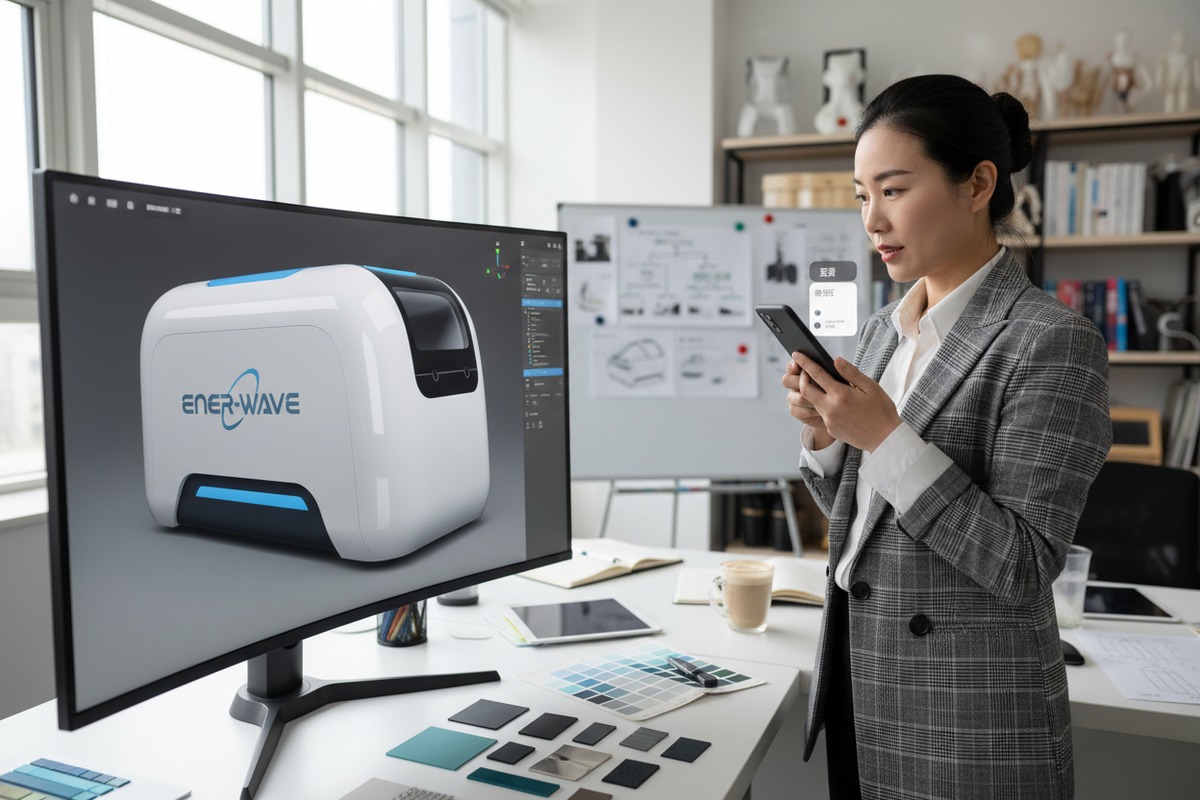
When buyers ask us to put their logo on our shockwave machines, the details matter enormously. The wrong Pantone color ruins brand consistency. Misplaced labels look unprofessional. Poor packaging damages products during shipping. Coordinating these requirements through instant messaging requires structure.
Use WeChat or WhatsApp to share your brand assets (logos, colors, fonts), approve mockups via photo sharing, confirm packaging specifications through voice discussions, and request pre-production samples. Create dedicated group chats with your supplier's design and production teams to streamline OEM coordination and prevent miscommunication.
Setting Up Your OEM Communication Channel
We recommend creating a WeChat group specifically for your private label project. Include:
- Your purchasing manager
- The supplier's sales representative
- The supplier's design engineer
- The supplier's production manager
This ensures everyone sees the same information. Nobody can claim they missed an update.
Brand Assets to Share via WeChat
Prepare these files before starting discussions:
| Asset | Format | Purpose |
|---|---|---|
| Primary Logo | AI or EPS vector file | Machine branding and packaging |
| Secondary Logo | PNG with transparency | User manual and accessories |
| Brand Colors | Pantone codes 7 | Consistent color matching |
| Typography | OTF or TTF font files | Packaging and documentation |
| Product Photos | High-resolution JPG | Marketing materials |
| Brand Guidelines | PDF document | Overall brand standards |
The Approval Workflow
Follow this sequence through WeChat:
Step 1: Share all brand assets in the group chat. Confirm the supplier downloaded them correctly.
Step 2: Request design mockups within 3-5 business days. The supplier should show your logo placement on the machine body, control panel, and packaging.
Step 3: Review mockups carefully. Use WeChat's image annotation feature to mark corrections directly on photos.
Step 4: Approve final designs in writing. Send a clear message: "Design version 3 approved for production."
Step 5: Request a pre-production sample. Examine it via video call before full manufacturing begins.
Common Private Label Mistakes to Avoid
Our design team sees these errors frequently:
Color mismatch: Screen colors differ from printed colors. Always specify Pantone codes, not RGB values.
Logo distortion: Suppliers sometimes stretch logos to fit spaces. Provide clear aspect ratio requirements.
Material quality: Cheap printing fades quickly. Specify UV-resistant inks for machine labels.
Packaging fragility: Beautiful boxes mean nothing if products arrive damaged. Discuss cushioning materials and drop-test standards.
Using Voice Notes for Complex Discussions
Some requirements are hard to explain in text. Use WeChat voice messages for:
- Describing desired textures or finishes
- Explaining your market positioning
- Clarifying technical specifications
- Building personal rapport with your contact
We find that buyers who use voice notes build stronger relationships. It feels more human than endless typing.
How do I manage my order status and door-to-door logistics updates through direct communication with my supplier?
Once we confirm an order, our buyers want updates constantly. When will production finish? When will the container ship? When will it clear customs? These questions deserve quick answers. Direct messaging makes tracking easy if you establish the right system.
Manage order status via WeChat by requesting weekly production photos, shipping documents (bill of lading, packing list, commercial invoice), and tracking numbers. Ask your supplier to share logistics milestones proactively. Set expectations for response times and create a shared spreadsheet to track multiple orders efficiently.

Establishing Update Schedules
At our company, we send updates at these milestones:
- Order confirmation received
- Production started
- Production 50% complete
- Production finished
- Quality inspection passed
- Container loaded
- Vessel departed
- Vessel arrived at destination port
- Customs cleared
- Delivery completed
Ask your supplier to commit to similar milestones. Put it in writing via WeChat.
Documents to Request for Each Shipment
| Document | When to Request | Purpose |
|---|---|---|
| Proforma Invoice | Before payment | Confirms order details and pricing |
| Commercial Invoice | After shipment | Required for customs clearance |
| Packing List | After shipment | Itemizes carton contents |
| Bill of Lading 8 | After vessel departure | Proves ownership of goods |
| Certificate of Origin | After shipment | May reduce import duties |
| Insurance Certificate | Before shipment | Protects against transit damage |
Tracking Your Shipment in Real Time
Once your supplier provides the bill of lading number, you can track the vessel yourself. Share this information via WeChat so both parties see the same status.
Useful tracking websites:
- MarineTraffic.com
- VesselFinder.com
- Your freight forwarder's portal
For door-to-door shipments, ask your supplier for:
- Air waybill number (for air freight)
- Container number (for sea freight)
- Trucking company contact (for final delivery)
Handling Delays and Problems
Delays happen. Ports get congested. Customs raises questions. How you communicate during problems determines your relationship quality.
When issues arise:
- Ask for specific details via voice message
- Request documentation of the problem
- Discuss solutions collaboratively
- Confirm revised timelines in writing
Never blame your supplier publicly in group chats. This causes "loss of face" in Chinese culture and damages trust permanently.
Time Zone Considerations
China operates on Beijing Time (UTC+8). If you are in the US Eastern Time zone, China is 12-13 hours ahead. Respect these differences:
- Send non-urgent messages during their business hours
- Use voice messages they can listen to later
- Avoid expecting instant responses at midnight their time
- Be patient during Chinese holidays (Chinese New Year, National Day)
Our team appreciates buyers who acknowledge time differences. It shows cultural awareness and builds goodwill.
Conclusion
Building rapport through WeChat or WhatsApp takes effort but delivers results. Professional introductions earn better responses. Quality verification protects your investment. Clear OEM communication prevents costly mistakes. Structured logistics tracking reduces stress. Follow these practices, and your shockwave therapy machine sourcing will become smoother with every order.
Footnotes
1. Provides a comprehensive overview of extracorporeal shockwave therapy and its medical applications. ↩︎
2. Official standard for quality management systems in the medical device industry. ↩︎
3. Provides official details regarding the FDA’s Premarket Notification 510(k) process for medical devices. ↩︎
4. Explains internet censorship and restrictions on foreign apps within mainland China. ↩︎
5. Official information on the mandatory CE marking for products sold in the European Economic Area. ↩︎
6. Replaced HTTP 404 with a working and authoritative page on inspection services from Intertek. ↩︎
7. Explains the Pantone Color Systems for consistent color communication in design and manufacturing. ↩︎
8. Defines the Bill of Lading as a crucial legal document in international trade and shipping. ↩︎

 English
  Español de México
  Deutsch
  Français
  العربية
  Русский