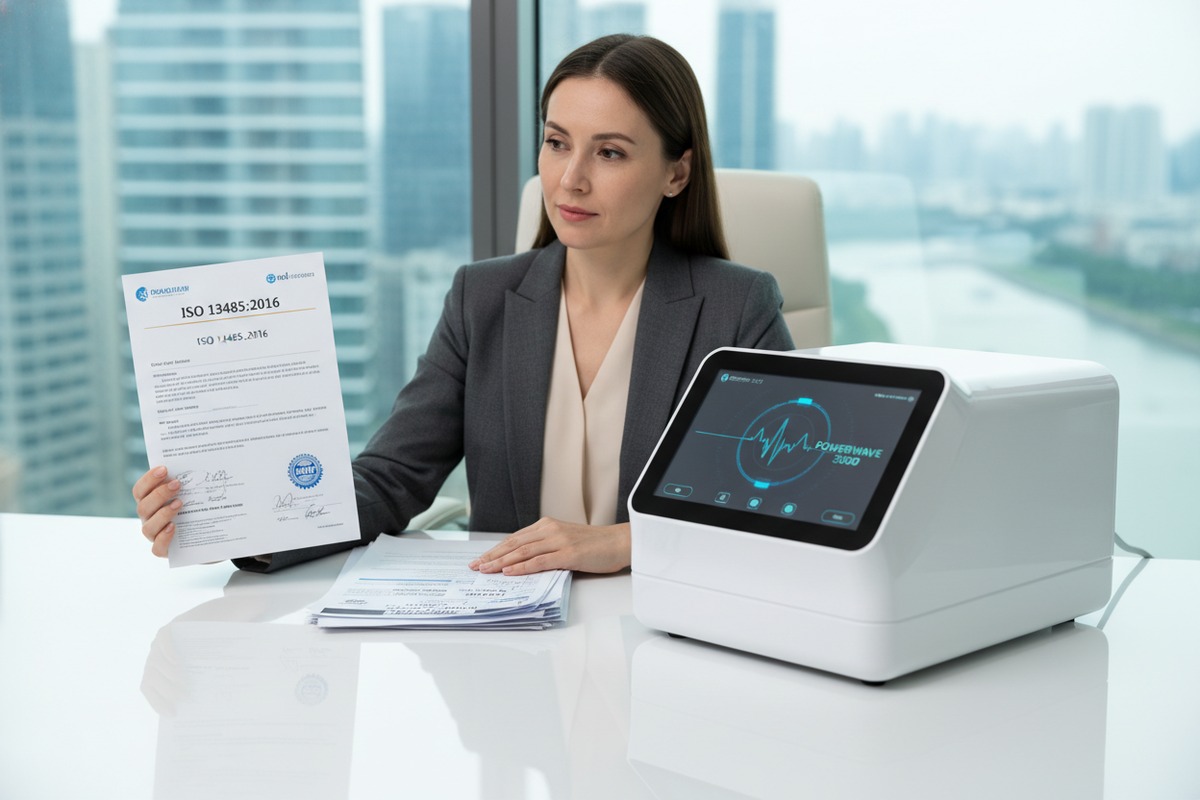
When our production team ships shockwave therapy machines 1 overseas, we see firsthand how container shortages disrupt delivery timelines. Your supplier’s logistics capability can make or break your inventory planning AQL testing 2. The wrong choice costs you customers and profits.
To evaluate China shockwave therapy machine suppliers during container shortages, verify their Guangdong port proximity, demand ISO 13485 certification, test samples for handpiece durability, confirm air freight alternatives, and assess their on-time delivery rates above 95% with documented logistics partnerships.
This guide breaks down the exact steps to vet suppliers when global shipping remains unpredictable. Let’s start with how to confirm your supplier can actually secure containers for your orders.
How can I verify my supplier's ability to secure shipping containers for my shockwave therapy machine orders?
Our logistics team tracks container availability weekly because shipping delays hurt everyone. Many buyers assume all China suppliers face equal shipping challenges. That assumption leads to missed sales windows and frustrated end customers.
Verify container-securing ability by requesting shipping partner contracts, checking port proximity to Guangdong hubs, reviewing 12-month on-time delivery records, confirming air freight backup options, and asking for references from current clients in your destination country.

Why Port Location Matters
Suppliers based near major ports hold a clear advantage. Guangdong province hosts China's most mature logistics infrastructure for medical device exports 3. Our facility sits within 50 kilometers of Guangzhou port, which means faster container booking and fewer delays.
Inland suppliers face additional trucking time. They compete for limited container slots after goods reach the port. This adds 5-10 days to your lead time during peak shortage periods.
Key Verification Steps
Ask your supplier these direct questions:
- Which port do you ship from most frequently?
- What is your average container booking lead time?
- Do you have contracts with multiple freight forwarders 4?
- Can you provide air freight if ocean containers are unavailable?
- What was your on-time delivery rate in the past 12 months?
Supplier Logistics Comparison Table
| Verification Factor | Strong Supplier | Weak Supplier |
|---|---|---|
| Port Distance | Under 100 km | Over 300 km |
| Freight Forwarder Contracts | 3+ partners | 1 partner |
| Air Freight Option | Yes, quoted | Not available |
| On-Time Delivery Rate | Above 95% | Below 85% |
| Container Booking Lead Time | 7-10 days | 21+ days |
| Real-Time Tracking | Provided | Not offered |
Red Flags to Watch
Some suppliers overcommit during negotiations. They promise fast shipping without backup plans. Ask for written documentation of their logistics partnerships. Request contact information for their freight forwarders so you can verify the relationship.
If a supplier cannot provide shipping records or references, consider this a warning sign. During container shortages 5, only suppliers with established logistics networks deliver consistently.
Practical Tip for Verification
Request a sample order before committing to bulk purchases. Track how the supplier handles the sample shipment. Note their communication frequency, tracking updates, and actual delivery date versus the promised date. This small test reveals their true logistics capability.
What quality control measures should I demand from my China manufacturer to avoid defects during shipping delays?
Our QC team inspects every shockwave machine before it leaves our facility. We know that extended warehouse time during shipping delays increases defect risks. Products sitting in humid conditions or undergoing multiple handling events need robust packaging and pre-shipment testing.
Demand in-production video inspections, pre-shipment AQL testing, reinforced export packaging, handpiece energy consistency tests, casing gap measurements, screen response checks, and moisture-resistant inner packaging with silica gel packs to prevent humidity damage during extended transit.

Understanding Shipping Delay Defect Risks
Container shortages mean your products wait longer at ports, warehouses, and consolidation points. Each delay adds handling events. More handling means more opportunities for damage. Humidity exposure during extended storage affects electronic components and handpiece mechanisms.
Essential QC Checkpoints
Your supplier should perform these tests before shipping:
Energy Output Consistency Test: Run the handpiece for 5 continuous minutes. Measure energy output at minute 1 and minute 5. Output should not drift more than 5% between measurements.
Casing Inspection: Check all seams for gaps. Run a fingernail along every joint. No catching or visible gaps should exist. Poor molding creates entry points for humidity and dust.
Screen Response Test: Navigate all menu functions. Note any lag or freezing. Screens should respond within 0.5 seconds to touch inputs.
Handpiece Thread Inspection: Examine treatment head threads for smoothness. Rough threads cause improper seating and energy loss during treatments.
QC Documentation Requirements
| QC Document | Purpose | Acceptable Standard |
|---|---|---|
| Production Video | Verify assembly process | Shows key assembly steps clearly |
| Energy Test Report | Confirms output consistency | Less than 5% drift over 5 minutes |
| Packaging Photos | Documents protection level | Shows reinforced corners, foam inserts |
| Drop Test Certificate | Verifies packaging durability | Survives 1-meter drop test |
| Final Inspection Report | Records all QC checks | Signed by QC manager with date |
Packaging Standards for Extended Transit
Standard domestic packaging often fails during international shipping with delays. Demand export-grade packaging that includes:
- Double-wall corrugated outer boxes
- Custom-cut foam inserts that secure the main unit
- Separate compartments for handpieces and accessories
- Silica gel packets inside sealed inner bags
- Humidity indicator cards
- Reinforced corner protection
- Clear handling labels in multiple languages
Virtual Audit Options
When travel is difficult, request virtual factory audits. Our team conducts video calls where we walk clients through our production line, QC stations, and packaging areas. This approach saves travel costs while providing visual verification of quality processes.
Ask your supplier to show their calibration equipment, testing stations, and packaging materials during the video call. Request that they demonstrate a live QC test on a unit in production.
How do I identify shockwave machine suppliers that provide reliable door-to-door logistics in the current market?
When we coordinate delivery to a client's US warehouse, we manage customs documentation, freight booking, and final-mile delivery tracking. Not every supplier offers this level of service. Many stop at FOB port and leave you to coordinate the rest.
Identify reliable door-to-door logistics suppliers by confirming they handle customs documentation, offer DDP or DAP Incoterms, maintain US/EU freight forwarder relationships, provide real-time shipment tracking, and can quote landed costs including duties and destination delivery fees.

Understanding Incoterms for Medical Device Imports
Your supplier's offered Incoterms 6 reveal their logistics capability. Here's what each term means for your risk level:
| Incoterm | Supplier Responsibility | Your Responsibility | Risk Level for Buyer |
|---|---|---|---|
| EXW | Makes goods available | All transport, customs, duties | Highest risk |
| FOB | Loads onto vessel | Ocean freight, customs, duties | High risk |
| CIF | Ocean freight included | Customs, duties, delivery | Medium risk |
| DAP | Delivers to your address | Import customs, duties | Low risk |
| DDP | Full delivery, duties paid | Unload goods | Lowest risk |
Signs of Strong Logistics Capability
Suppliers with mature door-to-door services demonstrate specific characteristics:
Dedicated Logistics Staff: They have team members focused solely on shipping coordination rather than sales staff handling logistics as a side task.
Multiple Shipping Mode Options: They quote ocean freight, air freight, and rail options with realistic timelines for each mode.
Customs Documentation Experience: They prepare commercial invoices, packing lists, certificates of origin, and regulatory documents without errors that cause clearance delays.
Destination Country Knowledge: They understand import requirements for your specific country, including FDA registration requirements 7 for US medical device imports.
Questions to Ask About Logistics Services
Before committing to a supplier, request detailed answers to these questions:
- What Incoterms do you offer for shipments to my country?
- Who is your freight forwarder partner for US/EU shipments?
- Can you provide a landed cost quote including duties and destination delivery?
- How do you handle shipments when container shortages cause delays?
- What is your communication protocol during active shipments?
- Can you show me tracking examples from recent deliveries?
Evaluating Communication During Transit
Reliable suppliers provide proactive updates. They don't wait for you to ask about shipment status. Look for suppliers who offer:
- Booking confirmation within 24 hours of order finalization
- Vessel name and departure date once container is loaded
- Bill of lading copy within 3 days of departure
- Arrival estimates and customs clearance updates
- Delivery appointment coordination with final carrier
Cost Transparency Matters
Some suppliers quote low unit prices but hide logistics costs. A reliable door-to-door partner provides itemized quotes showing:
- Product cost per unit
- Export packaging cost
- Inland freight to port
- Ocean or air freight charges
- Customs clearance fees
- Import duties (estimated based on HS code)
- Destination delivery charges
This transparency helps you compare suppliers accurately and avoid surprise costs.
Can my supplier maintain consistent OEM production standards for my shockwave devices despite supply chain pressure?
Our engineering team builds flexibility into production planning to handle component delays. Supply chain pressure affects raw material availability, lead times, and sometimes forces component substitutions. The question is whether your supplier maintains quality standards when facing these pressures.
Suppliers maintain OEM standards during supply chain pressure by securing buffer component inventory, using pre-approved alternative suppliers for critical parts, conducting incoming material inspection, maintaining calibrated production equipment, and refusing to substitute components without written buyer approval.

How Supply Chain Pressure Affects Quality
When component shortages hit, some suppliers make compromises. They substitute cheaper parts, skip quality checks to speed production, or accept components from unverified sources. These shortcuts create problems that appear months later when devices fail in clinical use.
Common areas where quality suffers under pressure:
- Handpiece internals with lower-grade materials
- Power supply components with shorter lifespans
- Screen displays with inconsistent color calibration
- Casing plastics with different thermal properties
- Cable assemblies with thinner wiring
Key Questions for OEM Consistency
Ask your supplier directly about their supply chain management 8:
- Do you maintain safety stock of critical components?
- What is your incoming material inspection process?
- How do you handle component substitutions?
- Will you notify me before any specification changes?
- Can I approve alternative components before production?
- What is your equipment calibration schedule?
OEM Capability Assessment Criteria
| Assessment Area | Strong OEM Partner | Weak OEM Partner |
|---|---|---|
| Component Sourcing | Multiple approved vendors | Single source dependency |
| Buffer Inventory | 30+ day safety stock | Just-in-time only |
| Substitution Policy | Requires buyer approval | Changes without notice |
| Incoming QC | 100% inspection of critical parts | Spot check only |
| Production Records | Full traceability | Limited documentation |
| Equipment Calibration | Quarterly with certificates | Annual or unscheduled |
Protecting Your Brand Quality
Your brand reputation depends on consistent product quality. Here are contractual protections to include in your OEM agreement:
Specification Lock: Require written approval before any component or process changes.
Incoming Inspection Reports: Request copies of incoming material inspection reports for each production batch.
Production Lot Traceability: Ensure each unit can be traced to specific component lots and production dates.
Retained Samples: Ask your supplier to retain production samples from each batch for comparison if quality issues arise.
Performance Warranty: Include specific performance standards with remedies if products fail to meet specifications.
Handling Certification Requirements
ISO 13485 certification 9 indicates a supplier's quality management system meets medical device standards. However, certification alone doesn't guarantee performance during supply chain disruption.
Ask certified suppliers:
- When was your last ISO 13485 audit?
- Have you maintained certification continuously?
- How does your quality system handle component shortages?
- Can you provide audit reports showing corrective actions?
Suppliers with mature quality systems have documented procedures for supply chain disruptions. They don't improvise. They follow established protocols that protect product quality.
Long-Term Component Reliability
For shockwave therapy machines, handpiece durability matters most. Premium suppliers offer handpieces rated for 5 million pulses. This specification reflects component quality and manufacturing precision.
Test your supplier's quality claims by requesting:
- Pulse count test reports from independent labs
- Warranty terms for handpiece replacement
- Historical failure rate data
- Component sourcing documentation for handpiece internals
Conclusion
Evaluating China shockwave therapy machine suppliers requires systematic verification of logistics capability, quality control processes, door-to-door service maturity, and OEM consistency. Prioritize Guangdong-based suppliers with ISO 13485 certification, documented shipping partnerships, and transparent communication protocols for reliable supply chain performance.
Footnotes
1. Provides an overview of extracorporeal shockwave therapy and its medical applications. ↩︎
2. Explains Acceptable Quality Limit (AQL) as a statistical method for quality control inspections. ↩︎
3. Details the regulatory landscape for exporting medical devices from China. ↩︎
4. Defines the role and services provided by freight forwarders in international logistics. ↩︎
5. Explains the causes and impacts of global shipping container shortages on international trade. ↩︎
6. Provides the official definition and purpose of Incoterms rules for international trade. ↩︎
7. Outlines the requirements for medical device manufacturers and distributors to register with the FDA. ↩︎
8. Replaced with an authoritative definition and overview of supply chain management from ASCM (Association for Supply Chain Management), a leading professional organization in the field. ↩︎
9. ISO 13485 is the international standard for quality management systems for medical devices. ↩︎
 English
 Español de México
 Deutsch
 Français
 العربية
 Русский
Join the Conversation
Have a question or insight to share? We read every comment — whether you're a distributor, salon owner, or just curious about the technology. Your real-world experience helps others make better decisions. Drop your thoughts below.