
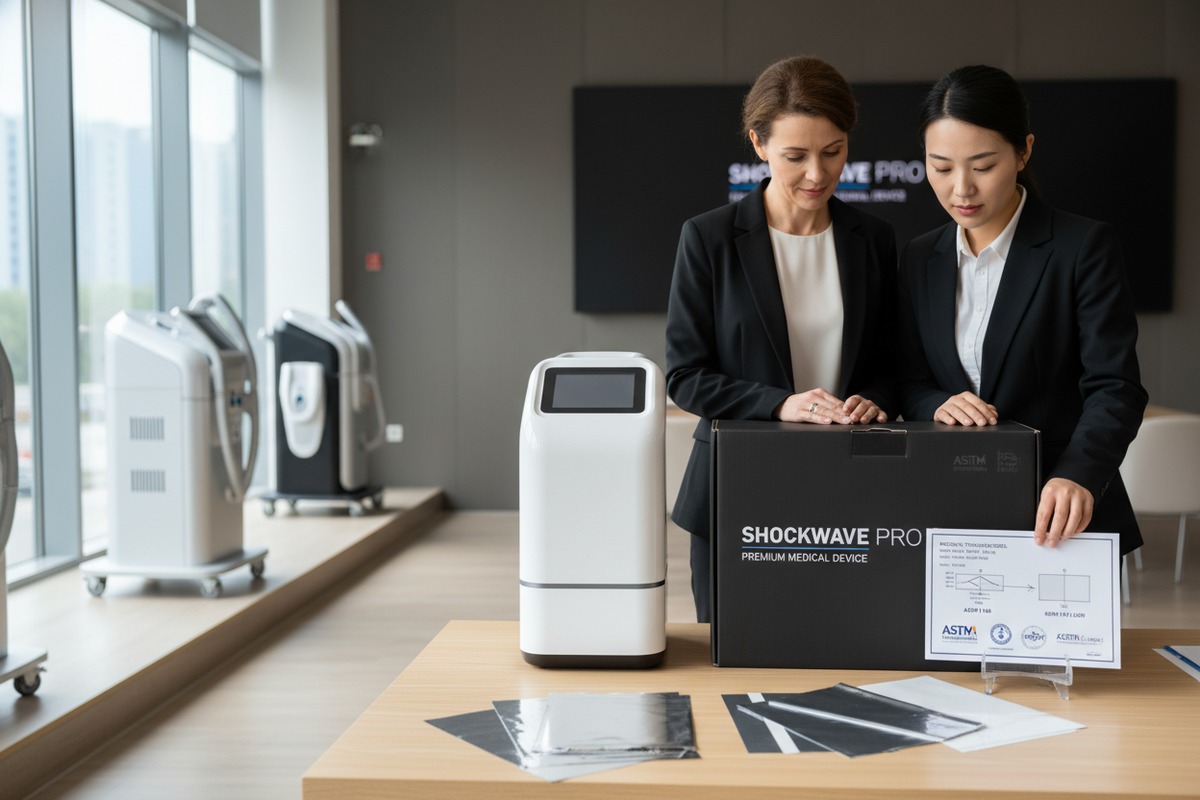
Every week, our quality control team 1 inspects returned units from overseas. The pattern is clear. Damaged packaging leads to damaged machines. Hairline cracks in casings, misaligned handpieces, and calibration drift all trace back to one root cause: inadequate lamination during transit.
When sourcing shockwave therapy machines, discuss lamination by asking suppliers about barrier properties, material thickness in microns, ASTM certification for drop tests, and compatibility with your casing materials like medical-grade ABS. Request sample packaging, verify UV stabilization, and confirm moisture resistance ratings before placing bulk orders.
This guide breaks down exactly what questions to ask, what specifications to demand, and how to verify your supplier delivers premium laminated packaging ISO 11607 medical device packaging standards 2. Let us walk through each critical aspect together.
How do I choose the best lamination finish for my branded shockwave therapy machine packaging?
Selecting the right finish feels overwhelming at first. Our engineering team spent months testing different lamination options before settling on our current specifications. The wrong choice costs more than money—it costs your brand reputation.
Choose matte or gloss lamination based on your brand aesthetics, then prioritize barrier properties. For shockwave machines, select multi-layer laminates combining PET, foil, and polyethylene. Ensure minimum 75-micron thickness for moisture protection and request UV-stabilized options if shipping internationally through varying climates.
Understanding Lamination Types for Medical Devices
Lamination serves two purposes for shockwave therapy machines 3. First, it protects the external packaging from environmental damage. Second, it creates barriers against moisture, oxygen, and microbial contamination that could affect sensitive internal components.
Three main lamination types dominate medical device packaging:
| Lamination Type | Best For | Cost Level | Barrier Properties |
|---|---|---|---|
| Gloss PE Film | Basic protection, budget orders | Low | Minimal moisture barrier |
| Matte PET/Foil | Premium branding, moderate protection | Medium | Good moisture and oxygen barrier |
| Multi-layer PET/Foil/PE | High-value devices, international shipping | High | Excellent all-around protection |
When we package our shockwave units, we use multi-layer lamination exclusively. The reason is simple. Shockwave therapy machines contain precision components—bullet applicators rated for 3 million shock cycles, titanium-alloy transmitters, and calibrated energy systems delivering 5-200mJ. These components cannot tolerate humidity fluctuations or physical impact.
Matching Lamination to Your Casing Material
Your lamination choice must complement your machine's casing. Medical-grade ABS plastic 4, the gold standard for shockwave devices, requires specific consideration. ABS resists chemicals and impacts well, but it becomes brittle when exposed to UV radiation during extended shipping times.
Our recommendation: Always pair UV-stabilized lamination with ABS casings. Yes, this adds 15-20% to packaging costs. However, it prevents the yellowing and micro-cracking that occurs when non-stabilized packages sit in sunny warehouses or on exposed loading docks.
Polycarbonate-blend casings offer more flexibility under stress, but they scratch easily. For these machines, request lamination with enhanced abrasion resistance. The film should withstand repeated handling without transferring marks to the underlying carton or case.
Asking the Right Questions
Before confirming any order, ask your supplier these specific questions:
- What is the exact lamination structure, layer by layer?
- What micron thickness does each layer provide?
- Can you provide ASTM D4169 drop test certification 5?
- Does the lamination include UV stabilizers?
- What is the moisture vapor transmission rate 6?
Any reputable supplier will answer these without hesitation. If they cannot, consider this a red flag.
Which lamination options will ensure my equipment boxes arrive without scuffs or water damage?
Our logistics team tracks every shipment from Guangzhou to final destination. Water damage claims spike during monsoon seasons and winter months. Scuff marks appear most on shipments with multiple handling points. Both problems share one solution: proper lamination specification.
To prevent scuffs and water damage, specify lamination with minimum 100-micron total thickness, sealed seams, and abrasion-resistant outer layers. Request heat-sealed edges rather than adhesive bonding, and ensure the lamination extends fully around all package corners where damage occurs most frequently.
The Physics of Transit Damage
Shockwave therapy machines face harsh conditions during international shipping. Ocean freight containers experience temperature swings from -10°C to 60°C. Humidity levels fluctuate between 20% and 95%. Handling involves multiple drops, slides, and stacking pressures.
Standard packaging fails under these conditions. We have seen cartons arrive with visible water staining, crushed corners, and torn surfaces. Inside, the damage is worse—corroded connectors, moisture in display units, and loosened calibration screws.
Effective lamination addresses each threat:
| Threat | Lamination Solution | Specification |
|---|---|---|
| Moisture intrusion | Foil barrier layer | <1 g/m²/day MVTR |
| Surface scuffing | Abrasion-resistant top coat | >500 cycles Taber test |
| Corner crushing | Reinforced lamination overlap | 150% thickness at edges |
| Temperature cycling | Stable film with wide tolerance | -20°C to 70°C rated |
Heat-Sealed vs. Adhesive Bonding
Two methods exist for applying lamination: heat sealing and adhesive bonding. For shockwave therapy packaging, heat sealing wins every time.
Heat-sealed lamination 7 creates continuous barriers without weak points. The film bonds directly to itself under controlled temperature and pressure. No gaps exist for moisture to penetrate.
Adhesive bonding relies on glue layers between film and substrate. Over time, especially under humidity stress, these adhesives can delaminate. We have received competitor samples where the lamination peeled away cleanly, leaving the carton exposed and wet.
Secondary Protection: Aluminum Cases
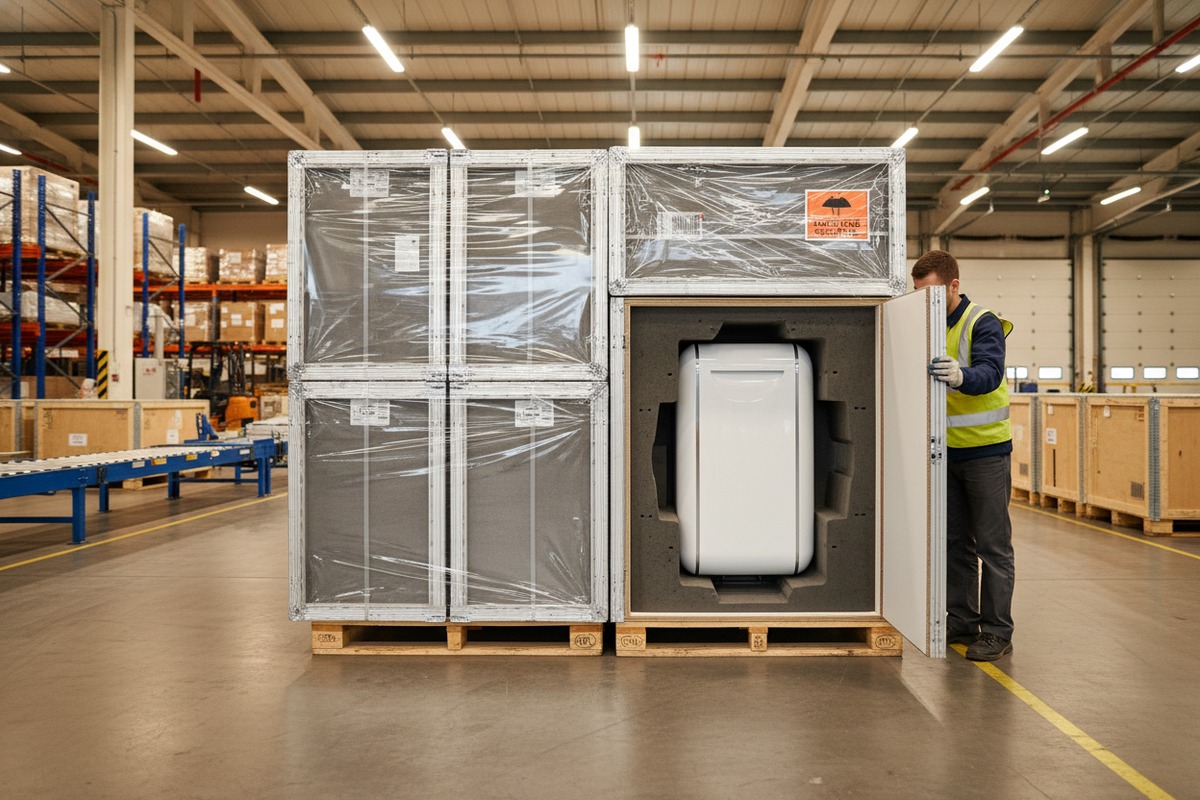
For premium shockwave models—particularly those weighing 8-38 lbs with complete accessory sets—laminated cartons alone may not suffice. Our recommendation includes aluminum carrying cases as secondary protection.
These cases provide:
- Rigid structure preventing compression damage
- Lockable closures for security
- Custom foam inserts cradling each component
- Wheeled options for units exceeding 25 lbs
The laminated carton protects during warehouse storage and initial handling. The aluminum case protects during final-mile delivery and ongoing transport between treatment rooms.
Standard dimensions work well for most configurations: 11.5″W × 13.5″L × 6″H accommodates the main unit plus five transmitter heads and two bullet applicators. Custom sizing is available for units with expanded accessory packages.
Testing Before Committing
Never accept lamination claims at face value. Request these tests:
- Cobb water absorption test (measures moisture uptake)
- ASTM D4169 distribution cycle simulation
- TAPPI T803 puncture resistance
- Humidity chamber exposure at 95% RH for 72 hours
We conduct these tests on every packaging batch. The investment pays for itself in reduced damage claims and happier customers.
Trust but verify. This principle guides every supplier relationship we maintain. Private-label orders deserve extra scrutiny because your brand name appears on the packaging. Quality failures reflect on you, not your supplier.
Verify premium lamination by requesting material datasheets with micron specifications, asking for third-party test certificates from accredited labs, demanding pre-production samples for inspection, and conducting unannounced factory audits. Compare specifications against ISO 11607 medical device packaging standards and FDA guidelines.
Document Requirements
Start with paperwork. Premium lamination comes with documentation. Budget lamination does not. Request these documents before approving any production run:
| Document | What It Proves | Red Flag If Missing |
|---|---|---|
| Material datasheet | Exact composition and thickness | Cannot verify specifications |
| Certificate of Analysis | Batch-specific test results | No quality control |
| ISO 11607 compliance | Meets medical device standards | May not be suitable for medical devices |
| ASTM test reports | Performance verification | Claims unsubstantiated |
| Resin supplier certificates | Raw material quality | Unknown supply chain |
Our quality team reviews these documents for every order. We have rejected suppliers who could not produce complete documentation, even when their prices seemed attractive.
Physical Verification Methods
Documents can be falsified. Physical verification cannot. When samples arrive, conduct these tests:
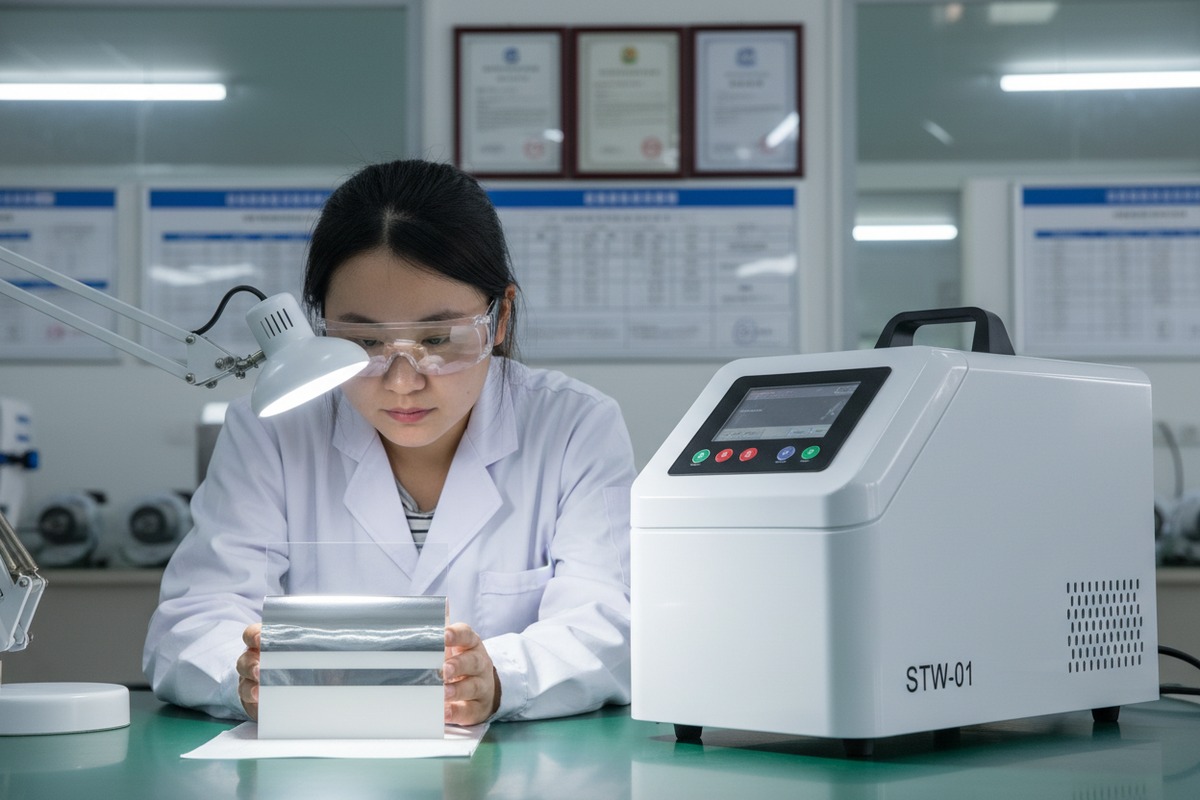
Visual inspection: Premium lamination appears uniform without bubbles, wrinkles, or thin spots. Hold the sample to light—inconsistencies become visible as variations in light transmission.
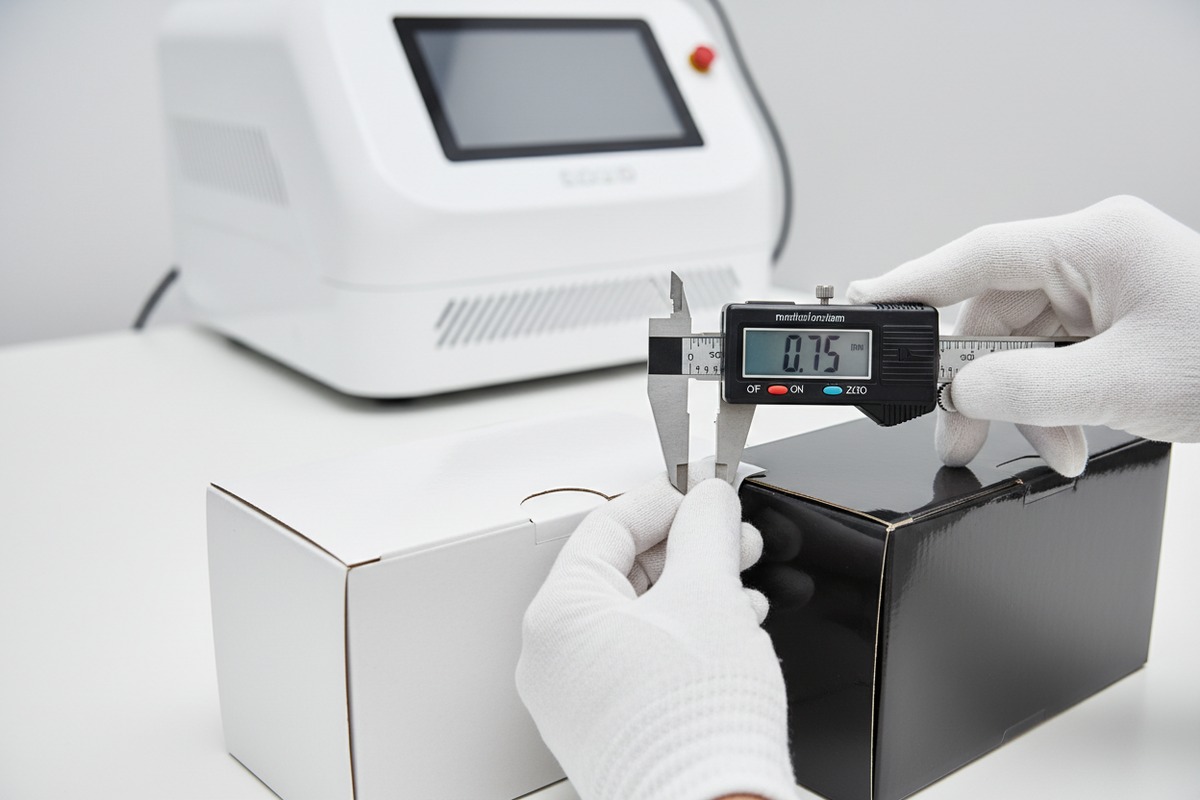
Thickness measurement: Use a micrometer to verify stated specifications. Measure at multiple points including corners and seams. Variance should not exceed 10% of stated thickness.
Adhesion test: Apply tape to the laminated surface, press firmly, then remove quickly. Premium lamination stays intact. Budget lamination lifts or tears.
Water drop test: Place water droplets on the surface and observe for 30 minutes. Premium lamination shows complete beading with no absorption. Budget lamination allows some penetration.
Factory Audit Checklist
If possible, visit the factory. If not, hire a third-party inspection service 8. Our team conducts audits using this checklist:
- Lamination equipment age and maintenance records
- Raw material storage conditions (temperature and humidity controlled)
- In-process quality checks at each lamination stage
- Finished goods storage environment
- Sample retention system for batch traceability
- Staff training records for equipment operators
Pay attention to details. A factory that maintains clean, organized lamination areas likely maintains quality throughout. A factory with scattered materials and dusty equipment probably cuts corners elsewhere too.
Red Flags to Watch
Experience has taught us warning signs. These issues suggest lamination quality problems:
- Supplier cannot name their lamination film supplier
- Specifications change between quote and production
- "Equivalent" materials substituted without approval
- No quality control documentation available
- Price significantly below market average
- Resistance to factory visits or third-party audits
When we encounter these red flags, we walk away. The short-term savings never justify long-term quality problems.
What specific lamination details should I include in my OEM shockwave therapy machine specifications?
Specifications prevent misunderstandings. Our OEM contracts run 15-20 pages because we learned this lesson early. Vague requirements produce vague results. Detailed specifications produce consistent quality.
Include these lamination details in OEM specifications: material composition with layer-by-layer breakdown, total thickness in microns, moisture vapor transmission rate, UV stabilizer requirements, seam sealing method, corner reinforcement specifications, test standards required for acceptance, and packaging artwork registration tolerance.
Essential Specification Elements
Your OEM specification document should address every lamination variable. Missing details allow suppliers to make substitutions that affect quality. Complete specifications eliminate this risk.
Here is the framework we use:
| Specification Element | Required Detail | Example |
|---|---|---|
| Base material | Film type and grade | Medical-grade PET |
| Barrier layer | Material and position | 12-micron aluminum foil |
| Sealant layer | Type and thickness | 50-micron LDPE |
| Total thickness | Minimum and maximum | 100-120 microns |
| MVTR | Maximum rate | <0.5 g/m²/day |
| Oxygen transmission | Maximum rate | <1 cc/m²/day |
| UV stabilizer | Concentration | Minimum 0.3% by weight |
| Sealing method | Process specification | Heat sealed at 180°C |
| Test standards | Required certifications | ASTM D4169, ISO 11607 |
Tying Lamination to Machine Specifications
Shockwave therapy machines have specific packaging needs based on their operating parameters. Machines delivering 200W power with energy ranges of 5-200mJ and frequencies of 1-22Hz contain precision components that demand protection from vibration, moisture, and contamination.
Your specification should explicitly connect lamination requirements to machine characteristics:
"The lamination system shall provide vibration dampening sufficient to protect bullet applicators rated for 3 million shock cycles during standard ASTM D4169 distribution cycle testing."
"The moisture barrier shall maintain internal package humidity below 60% RH when exposed to external conditions of 95% RH for 72 hours, protecting titanium-alloy transmitter heads from oxidation."
"The UV stabilization shall prevent yellowing or embrittlement of the outer surface when exposed to UV-A radiation equivalent to 6 months of warehouse storage under mixed natural and artificial lighting."
Sustainability Considerations for 2026 and Beyond
Regulatory pressure is shifting lamination toward sustainability. EU regulations on single-use plastics now affect medical device packaging. Specify your sustainability requirements now to avoid forced changes later.
Options include:
- Biodegradable PET/PLA blend laminates
- Recyclable mono-material structures
- Recycled-content films meeting FDA food-contact standards 9
- Take-back program participation requirements
These sustainable options typically add 10-25% to lamination costs. However, they satisfy increasingly strict import requirements and appeal to environmentally conscious distributors.
Acceptance Testing Requirements
Your specification must define how conformance is verified. Include:
- Pre-production sample approval process
- In-production testing frequency
- Final inspection sampling plan
- Test methods and acceptance criteria
- Documentation requirements for each batch
- Non-conformance handling procedures
Specify that test results accompany each shipment. Require that samples from each production lot be retained for 12 months minimum. These provisions protect you if quality disputes arise after delivery.
Artwork and Printing Specifications
Private-label packaging includes your branding. Lamination affects print quality. Specify:
- Print registration tolerance (typically ±1.5mm)
- Color matching standards (Pantone reference)
- Lamination application after printing to protect inks
- Gloss or matte finish effects on color appearance
- Overprint varnish requirements if applicable
Poor lamination causes printing defects including bubbling over ink layers, color shifts from film tint, and registration errors at seams. Detailed specifications prevent these problems.
Conclusion
Packaging lamination directly affects whether your shockwave therapy machines arrive in perfect condition. Specify materials, verify suppliers, and document everything. Your customers deserve machines that work flawlessly from the first treatment.
Footnotes
1. Replaced HTTP 403 with an authoritative Wikipedia page on Quality Control, which defines the role of a quality control team. ↩︎
2. Official ISO standard for packaging of terminally sterilized medical devices. ↩︎
3. Provides an overview of extracorporeal shockwave therapy as a medical treatment. ↩︎
4. Describes the properties and uses of medical-grade ABS plastic in device manufacturing. ↩︎
5. Official ASTM standard for performance testing of shipping containers and systems. ↩︎
6. Defines MVTR and its relevance in packaging for moisture-sensitive products. ↩︎
7. Explains the process and benefits of heat sealing in various packaging applications. ↩︎
8. Describes the role and benefits of independent third-party inspection services for quality assurance. ↩︎
9. Provides information on FDA regulations for food contact substances, relevant for packaging. ↩︎

 English
 Español de México
 Deutsch
 Français
 العربية
 Русский
