
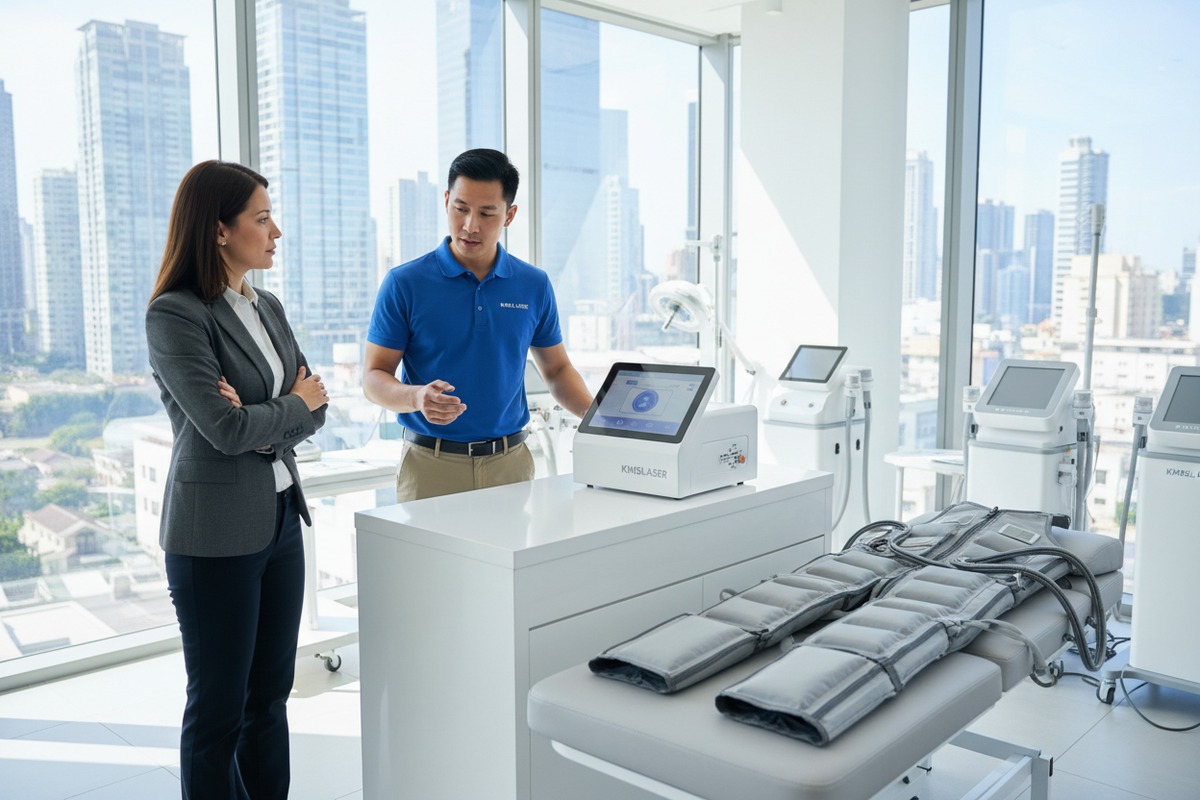
We recently received a panicked call from a spa owner whose client was stuck in a suit that wouldn’t deflate properly due to a valve jam modular independent cell designs 1. It was a nightmare scenario for their business reputation. At our facility in Guangzhou, we design our пневматических систем 2 specifically to prevent these high-stress situations, because we understand that equipment reliability is the backbone of your distribution network.
To ensure easy airbag replacement, ask suppliers about modular independent cell designs, tool-free quick-release connectors, and the availability of specific spare parts. Verify if the system supports individual chamber swaps versus full suit replacement and request detailed maintenance manuals to minimize operational downtime for your clients.
Here are the specific questions you need to ask to secure a reliable, easy-to-maintain fleet for your market.
How can I verify that your airbag design allows for quick, tool-free replacement by my technicians?
We often see technicians struggle with glued-shut casings during our competitor analysis sessions 3, which turns a five-minute fix into a total unit replacement. When we engineer our suits, we prioritize zipper-based accessibility because we know your spa clients cannot afford to wait weeks for a repair.
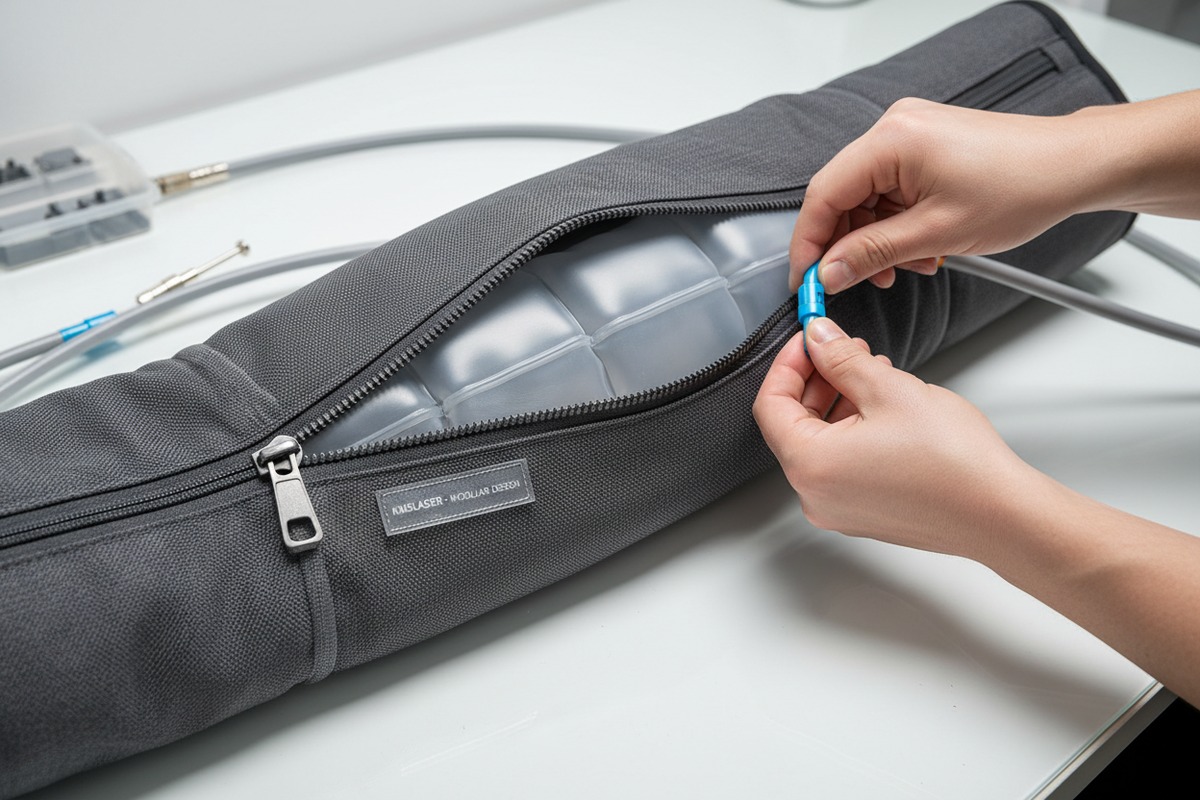
Request video demonstrations showing a technician swapping a single airbag cell in under ten minutes without screwdrivers or heat guns. Confirm the use of zipper-accessible chambers and quick-release air hose connectors, which indicate a truly modular design intended for rapid, on-site maintenance.
The Importance of True Modularity
When you are sourcing pressotherapy machines for professional use, the definition of "modular" can vary significantly between suppliers ISO standards 4. In the context of our industry, true modularity 5 means that each air chamber (or "cell") functions as an independent unit within the sleeve or trouser leg. Many entry-level models feature "integrated" airbags where the cells are heat-welded directly into the nylon fabric of the suit. If one cell leaks in an integrated design, the entire limb section—or sometimes the whole suit—must be discarded.
For your business, this difference is financial. Replacing a single damaged cell might cost your company $15 to $20 in parts. Replacing a full leg sleeve could cost $150 or more. You need to verify that the manufacturer uses a "shell and bladder" construction. This means there is an outer durable fabric shell with zippers, and inside, the TPU (Thermoplastic Polyurethane) 6 airbags are inserted individually.
Identifying Quick-Release Mechanisms
The second part of this inquiry involves the connection points. Time is money for your technicians. We utilize a color-coded, quick-release system in our premium lines. You should look for air hoses that connect to the main unit and the suit using "click-in" plugs rather than barbed fittings that require force or pliers to remove.
H3: Connector Types and Efficiency
A robust system will have distinct connectors for different zones to prevent setup errors. For example, a foot connector should not physically fit into a waist port. This "Poka-Yoke" (mistake-proofing) design is crucial for your end-users who may not be technical experts. Poka-Yoke (mistake-proofing) design 7
The table below outlines the differences you will find between standard home-use designs and the professional modular designs we recommend for your distribution network.
| Характеристика | Integrated Design (Home/Low-End) | Modular Design (Professional/High-End) |
|---|---|---|
| Airbag Fixation | Heat-welded to the outer shell | Inserted into zipper pockets |
| Replacement Tool | Scissors/Heat Gun (Destructive) | Hands only (Non-destructive) |
| Hose Connection | Fixed/Glued | Quick-release Plug/Socket |
| Repair Time | Impossible (Must replace whole unit) | 5–10 Minutes per cell |
| Cost Efficiency | Low (High replacement cost) | High (Low spare part cost) |
Verifying the "Tool-Free" Claim
When a supplier claims "tool-free," you must test this. Ask them to send a video of a cell swap. Watch closely:
- Does the operator need to cut any fabric?
- Do they struggle to pull the air tube out of the manifold?
- Is the zipper heavy-duty, or does it look like it might snag?
We use industrial-grade YKK zippers in our high-traffic models to ensure that the access points don't become failure points themselves. Your inquiry should confirm that the mechanism to access the airbag is as durable as the machine itself.
What quality control standards do you use to ensure the airbag valves won't leak after repeated use?
Nothing frustrates a distributor more than a batch of “Dead on Arrival” units that damage credibility with local salons. In our testing lab, we run rigorous 72-hour stress cycles to catch potential valve failures and seal weaknesses before they ever reach the shipping container.
Ask for proof of specific pressure retention tests, such as 72-hour continuous inflation cycles and sequential valve stress testing. Reliable manufacturers should provide quality control reports confirming that valves meet CE or ISO standards for air tightness and durability under high-frequency clinical usage.

Understanding Valve Fatigue and QC Protocols
The heart of any pressotherapy machine is the pneumatic pump and the solenoid valves 8 that control the airflow. In a professional setting, these valves cycle thousands of times a week. A "leak" isn't always a hole in the bag; often, it is a valve that fails to close completely, allowing air to escape back into the machine or into the wrong chamber. This results in weak pressure and ineffective treatment.
When inquiring about QC, do not settle for "we check everything." You need to know the methodology. We employ a rigorous aging test where the machine is left running in a specific sequence mode for 72 hours continuously. This heat and pressure stress test exposes weak soldering points on the mainboard and seals in the valves that might otherwise fail after a month of use.
H3: Intelligent Leak Detection Systems
Modern pressotherapy units, including the ones we are currently developing, are moving toward intelligent diagnostics. You should ask if the machine has a built-in "Air Pressure Sensor" or "Leak Detection Mode."
An intelligent system monitors the time it takes to reach the target pressure (e.g., 120 mmHg). If the machine pumps for 30 seconds and the pressure only reaches 40 mmHg, the system should trigger an alarm and identify the specific channel (e.g., "Error: Leg Channel 3 Leak"). This feature is invaluable for your customers, as it isolates the problem immediately, preventing them from sending the whole machine back when only one $15 airbag is faulty.
Material Durability: TPU vs. PVC
The quality of the airbag material itself is a major factor in leak prevention.
- PVC (Polyvinyl Chloride): Common in cheaper units. It is stiffer, can crack over time, and has a strong plastic smell.
- TPU (Thermoplastic Polyurethane): The gold standard for medical and high-end beauty devices. It is flexible, odorless, highly resistant to oil and bacteria, and can withstand high pressure without deforming.
Table: Valve and Material Quality Indicators
The following table helps you distinguish between standard and premium quality control indicators.
| QC Indicator | Standard/Low-End | Premium/Medical Grade |
|---|---|---|
| Материал | PVC (stiff, potential smell) | 420D Nylon + TPU Coating (flexible, durable) |
| Valve Type | Mechanical Rotary | High-precision Solenoid Valves |
| Test Duration | Spot check (15 mins) | 72-Hour Continuous Aging Test |
| Leak Detection | Manual (Soap water test) | Digital Pressure Sensors (Auto-stop) |
| Диапазон давления | Often inaccurate | Precise (e.g., +/- 5 mmHg accuracy) |
Requesting the "QC Report"
For your B2B orders, you can make it a requirement that a QC report accompanies the shipment. This report should list the serial number of each machine and the specific pressure values recorded during the final test. This forces the assembly team to be accountable for every single unit. We find that when buyers demand this level of documentation, the defect rate drops to near zero because the factory knows the buyer is auditing the process.
Will my private-label order include detailed maintenance guides to help my customers manage their own repairs?
We understand that you are the face of the brand to your customers, and you need to maintain that professional image. When we prepare OEM packages, we include unbranded, step-by-step visual guides so you can empower your clients to fix minor issues without ever revealing your supplier source.
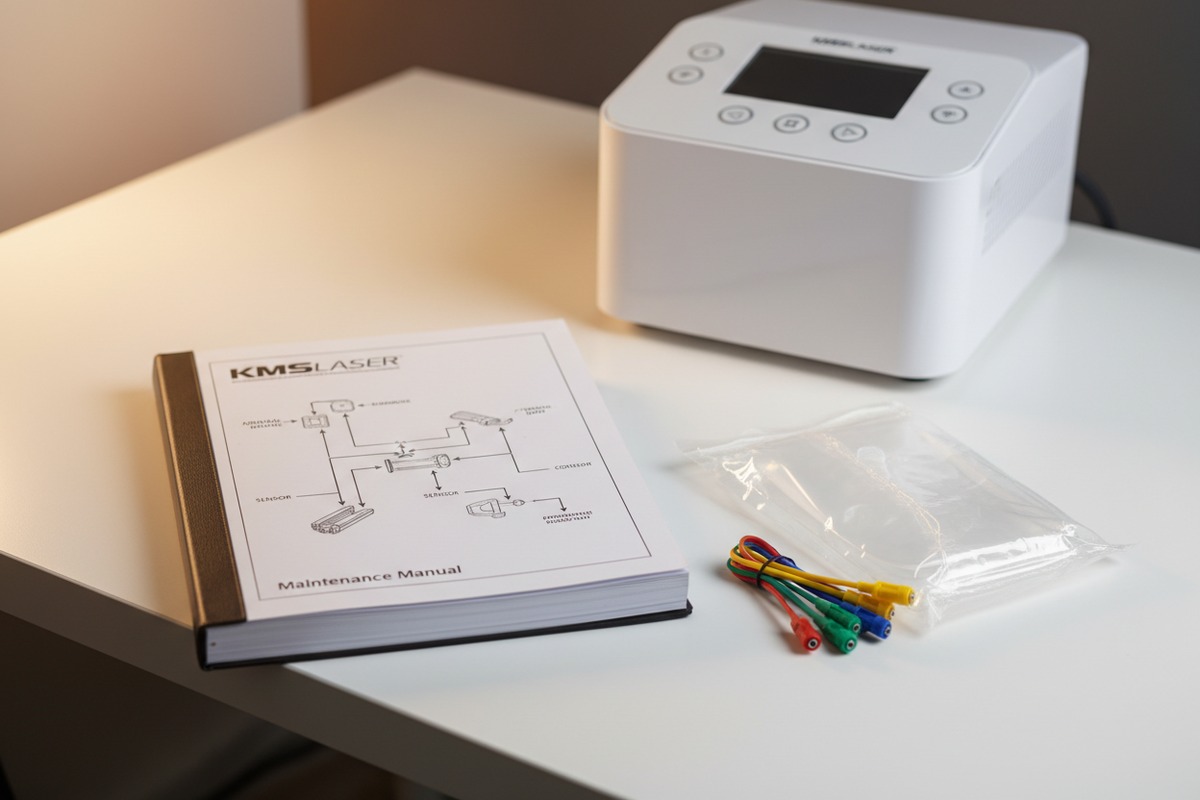
Specify that your private-label contract requires unbranded, white-label digital and physical manuals covering step-by-step airbag replacement. Ensure these guides include high-resolution diagrams and troubleshooting flowcharts, allowing your end-users to resolve minor issues independently without needing your direct intervention.
The Value of Unbranded Support Assets
As a distributor, your biggest bottleneck is customer support. If a salon owner calls you every time a hose needs reconnecting, your margins will vanish in support hours. The solution is comprehensive, "White Label" documentation. White Label documentation 9
When we work with partners like you, we don't just put a logo on the machine; we can provide the "Service Ecosystem." This includes PDF manuals that have no manufacturer contact info—only placeholders for your support email. You must verify that the supplier is willing to provide editable source files (like InDesign or Word), not just a locked PDF. This allows you to translate the text or tweak the instructions to match your specific branding voice.
H3: Essential Content for Self-Service Repair
A generic user manual usually only covers how to turn the machine on. A Maintenance Guide is different. When negotiating your order, insist that the documentation includes:
- Exploded View Diagrams: Visuals showing exactly how the suit is constructed.
- Color-Coded Maps: Matching the hose colors (Blue/Black/Yellow) to the specific ports.
- Step-by-Step Swap Guide: Photos showing the zipper opening, the disconnection of the tube, and the insertion of the new cell.
- Error Code Glossary: If the screen says "E4," the manual must say "Check Abdominal Airbag Connection," not just "Call Service."
Video Assets for Your Website
In 2026, nobody wants to read a text manual. We have started providing our clients with "raw" video footage. These are high-quality videos of our engineers performing repairs, filmed against a clean white background with no talking and no logos.
You can take these files, add your own voiceover or subtitles in English, add your intro logo, and upload them to a private YouTube playlist for your customers. Ask your potential supplier: "Do you have unbranded maintenance videos available?" If they say no, you will have to film them yourself, which is costly and time-consuming.
Table: Maintenance Documentation Checklist
Use this checklist to grade the support materials provided by the manufacturer.
| Asset Type | Basic Supplier Provision | Preferred Partner Provision |
|---|---|---|
| Manual Format | Printed Booklet (Chinese/English) | Editable Digital File (Word/PDF) |
| Брендинг | Supplier Logo everywhere | White Label (No logos/contacts) |
| Visuals | Low-res B&W photos | High-res Diagrams & Vectors |
| Troubleshooting | General "Contact Dealer" | Specific "Try X, then Y" Flowchart |
| Video Support | None or Chinese-only links | Raw MP4 files for rebranding |
By securing these assets upfront, you transform your customer from a helpless user into a capable operator. This reduces your return rate and increases customer satisfaction, as they feel empowered to solve problems instantly.
How can I secure a reliable supply of replacement airbags to prevent downtime for my distribution network?
Supply chain disruptions can paralyze a distribution business, especially when a client is waiting on a critical part. We always advise our partners to stock critical spares based on our historical wear-and-tear data, ensuring you are never left waiting weeks for an air shipment from China.
Negotiate a spare parts agreement that includes a guaranteed stock percentage, such as 5% extra airbags with every major order. Additionally, confirm the manufacturer’s lead time for emergency air shipments and verify if they use standardized components that remain available even if a specific machine model is updated.
The "Safety Stock" Strategy
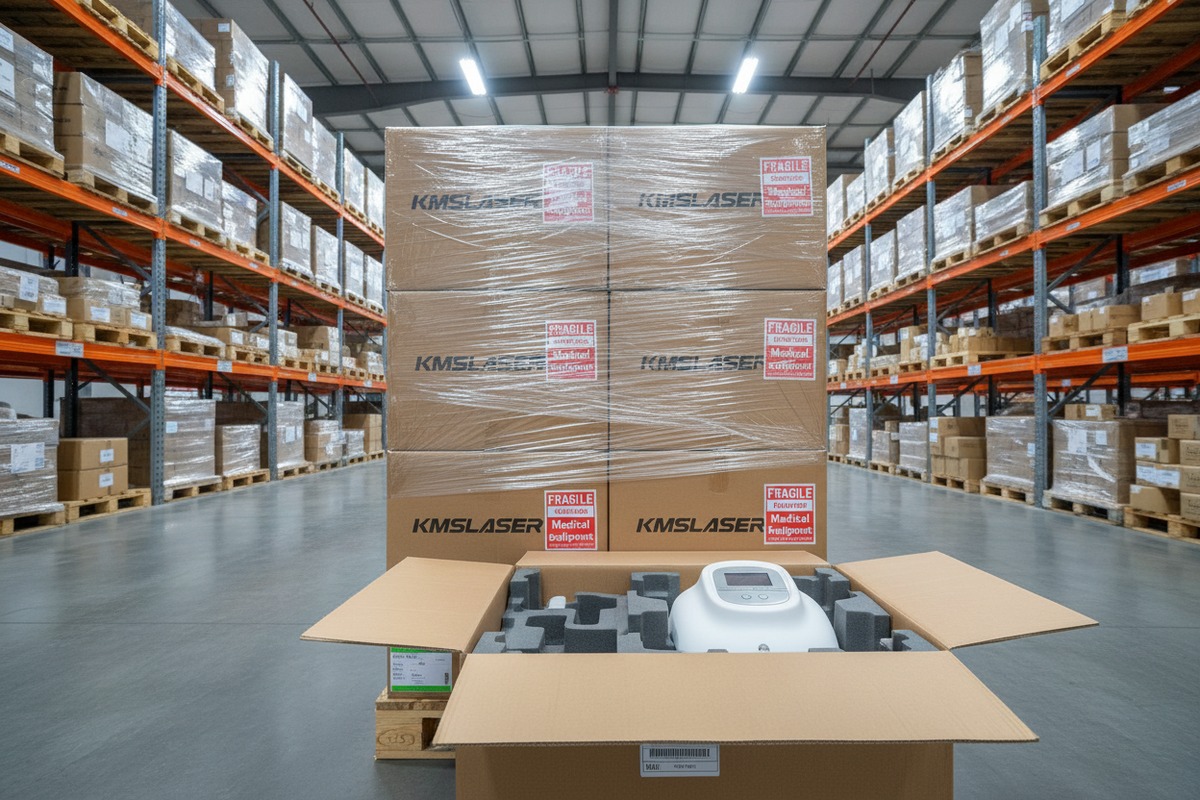
It is risky to rely on "Just-in-Time" shipping for spare parts when sourcing internationally. If a salon in New York has a broken machine, they cannot wait 7 days for a DHL package from Guangzhou. You must act as the local warehouse.
We recommend the "5% Rule" to our distributors. For every 100 machines you order, you should purchase 5 full sets of replacement airbags and hose kits. This initial investment is minimal compared to the cost of expedited shipping later. When inquiring, ask the supplier to provide a "Recommended Spare Parts List" (RSPL) based on their failure rate data. If they cannot provide this, it suggests they do not track their quality control data closely.
H3: Standardization and Future-Proofing
One of the biggest risks in the beauty equipment industry is model obsolescence. A manufacturer might update the casing design and change the connector shape, rendering your stock of spare parts useless.
You must ask: "Are the airbag connectors and dimensions standardized across your 2024, 2025, and 2026 models?"
We strive to keep the internal pneumatics consistent even if the external shell changes. This backward compatibility is crucial. You should also verify if they use proprietary connectors or industry-standard pneumatic fittings. If they use standard fittings, you could theoretically source emergency replacements from a local industrial supplier like Grainger or McMaster-Carr in a pinch, although OEM parts are always preferred.
Logistics: Air vs. Sea for Spares
Airbags are lightweight but voluminous. Shipping them by air is expensive because you pay for "dimensional weight 10," not actual weight.
- Стратегия: Ship your "Safety Stock" via sea freight along with your main machine order. This costs almost nothing in shipping.
- Emergency: Reserve air shipping only for urgent, out-of-stock situations.
Negotiating the "Right to Repair"
Ensure your contract states that the manufacturer will supply parts for at least 3 to 5 years after a model is discontinued. This is a standard requirement for medical devices but often overlooked in the beauty sector. Without this clause, you could be left with a warehouse of machines that cannot be repaired if the factory decides to stop making that specific airbag shape.
Table: Spare Parts Inquiry Checklist
| Категория вопроса | Key Question to Ask | Desired Answer |
|---|---|---|
| Availability | "What is the lead time for 50 spare airbags?" | "In stock, ships in 24 hours." |
| Compatibility | "Are these airbags compatible with last year's model?" | "Yes, we use universal connectors." |
| Longevity | "How long will you manufacture parts for this model?" | "Minimum 5 years post-discontinuation." |
| MOQ | "Is there a Minimum Order Quantity for spares?" | "No MOQ for existing distributors." |
By securing the supply chain upfront, you are selling your customers reliability, not just a machine. This is what separates a top-tier distributor from a generic reseller.
Заключение
Successfully importing pressotherapy machines requires looking beyond the glossy brochure and focusing on the practicalities of long-term ownership. By asking tough questions about modularity, QC testing, maintenance documentation, and supply chain security, you protect your margins and your reputation. A reliable manufacturing partner will welcome these questions, as they demonstrate your seriousness and set the stage for a professional, long-term collaboration.
Сноски
1. Defines modular design concepts relevant to product construction and engineering. ↩︎
2. Explains the principles and applications of pneumatic systems. ↩︎
3. Explains the strategic importance and methodology of competitor analysis in business. ↩︎
4. Provides information on the International Organization for Standardization and its various standards. ↩︎
5. Discusses the concept and benefits of true modularity in product design and engineering. ↩︎
6. Provides a comprehensive overview of Thermoplastic Polyurethane’s characteristics and applications. ↩︎
7. Replaced with an authoritative Wikipedia article on Poka-Yoke (mistake-proofing) design, which is accessible via HTTPS and is not a PDF or forum. ↩︎
8. Describes the function and operation of solenoid valves in controlling fluid flow. ↩︎
9. Defines white-label products and services, including associated documentation and branding. ↩︎
10. Explains how dimensional weight is calculated and its impact on shipping costs. ↩︎

 English
 Español de México
 Deutsch
 Français
 العربية
 Русский
