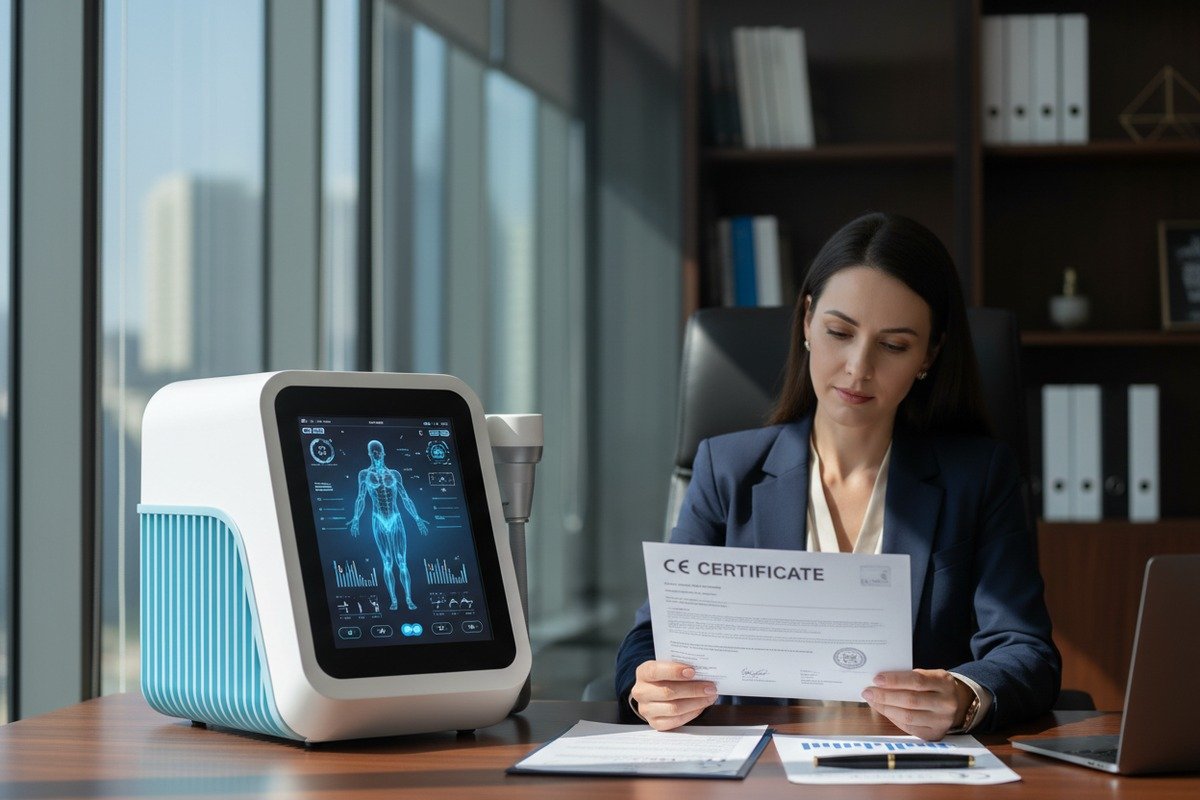
L'année dernière, notre équipe d'exportation a reçu un appel préoccupant d'un partenaire européen Directive RoHS 2011/65/UE 1. Son expédition entière de machines à ondes de choc a été retenue à la douane. La raison ? Documentation CE invalide. Cette erreur coûteuse aurait pu être évitée avec une vérification appropriée des certificats.
Lors de l'importation de machines de thérapie par ondes de choc en Europe, vérifiez les détails du certificat CE suivants : le numéro de l'organisme notifié à quatre chiffres, la déclaration UE de conformité valide faisant référence au MDR 2017/745, la classification correcte de l'appareil (généralement Classe IIa ou IIb), l'enregistrement EUDAMED et les rapports de tests techniques accompagnant, y compris la documentation de conformité IEC 61846 ou IEC 63045.
Comprendre ces points de contrôle critiques protège votre entreprise contre les saisies, les amendes et les retards sur le marché Directive DEEE 2012/19/UE 2. Laissez-moi vous guider à travers chaque étape de vérification basée sur notre décennie d'expérience d'expédition sur les marchés européens.
Comment vérifier l'authenticité du certificat CE de mon fournisseur pour les machines à ondes de choc ?
Notre équipe de contrôle qualité a examiné des centaines de certificats CE de divers fabricants Directive sur les équipements radio 2014/53/UE 3. La différence entre la documentation authentique et frauduleuse se cache souvent dans de petits détails que les yeux non entraînés manquent.
Pour vérifier l'authenticité du certificat CE, croisez le numéro de l'organisme notifié à quatre chiffres avec la base de données NANDO de l'UE, vérifiez que le titulaire du certificat correspond à l'enregistrement EUDAMED, confirmez que la date d'émission du certificat se situe dans les périodes de validité, et vérifiez que le champ d'accréditation de l'organisme notifié couvre les dispositifs médicaux sous MDR 2017/745.
Commencez par le marquage CE lui-même
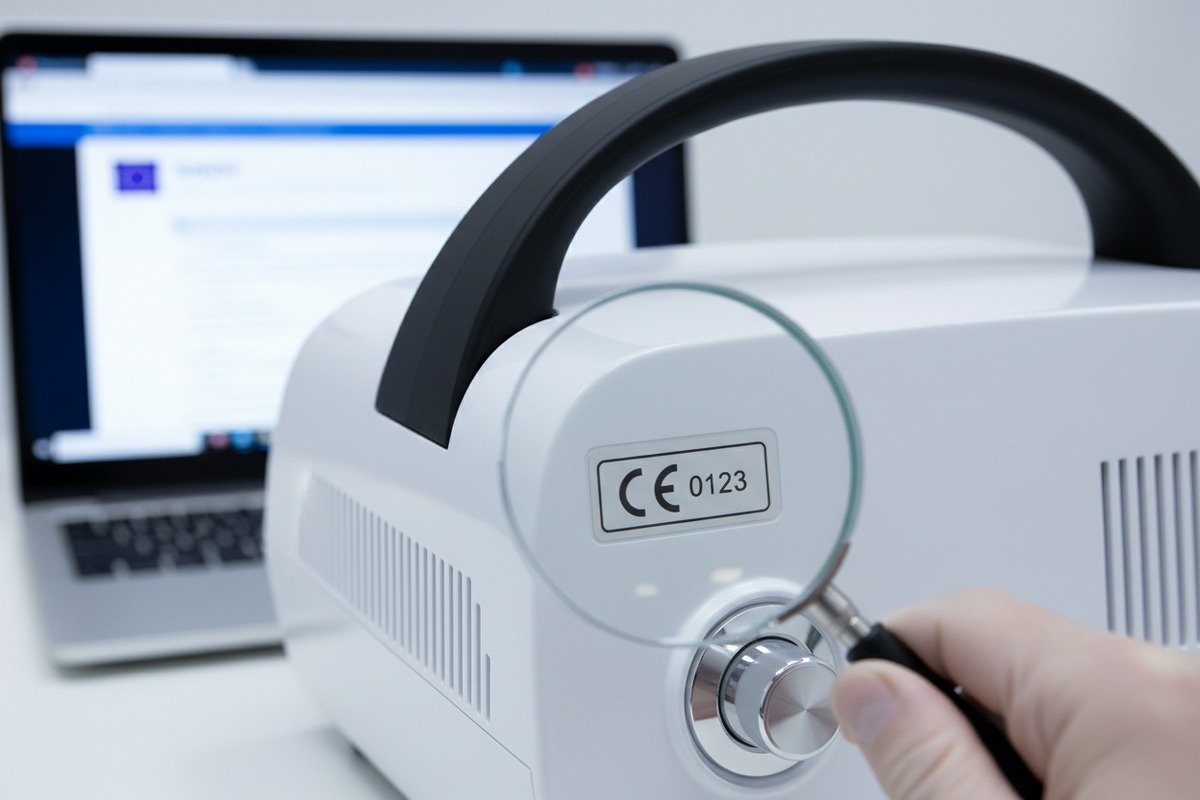
Le marquage CE physique sur votre appareil à ondes de choc raconte une histoire importante. Un marquage CE légitime suit des exigences visuelles strictes. Les lettres doivent conserver des proportions spécifiques : le C et le E forment deux demi-cercles avec une relation précise.
| Exigence du marquage CE | Conforme | Non conforme |
|---|---|---|
| Hauteur minimale | 5 mm ou plus | Inférieur à 5 mm |
| Proportions | C et E de même hauteur | Lettres déformées |
| Visibilité | Clair, lisible, permanent | Décoloré, amovible, caché |
| Emplacement | Appareil, emballage et IFU | Manquant à tout endroit |
| Numéro NB | Quatre chiffres directement sous le CE | Pas de numéro ou mauvais format |
Pour les appareils de lithotripsie classés comme Classe IIa ou IIb, un numéro d'Organisme Notifié à quatre chiffres doit apparaître directement sous ou à côté du marquage CE. Lors de l'inspection de la documentation entrante des usines partenaires, c'est notre premier point de contrôle.
Utilisez la base de données NANDO
La Commission européenne maintient la base de données NANDO (New Approach Notified and Designated Organisations). Cet outil en ligne gratuit vous permet de vérifier instantanément tout numéro d'Organisme Notifié.
Entrez le code à quatre chiffres et confirmez trois choses :
- L'organisme notifié existe et est actuellement actif
- Leur portée d'accréditation comprend MDR 2017/745 4
- Ils sont autorisés pour le niveau de classification de votre appareil
Lors de nos inspections avant expédition, nous avons découvert qu'environ 15 à 20 % des certificats provenant de fournisseurs inconnus font référence à des organismes notifiés inactifs ou inexistants. Ce signal d'alarme immédiat évite à nos partenaires des erreurs coûteuses.
Vérification par rapport à EUDAMED
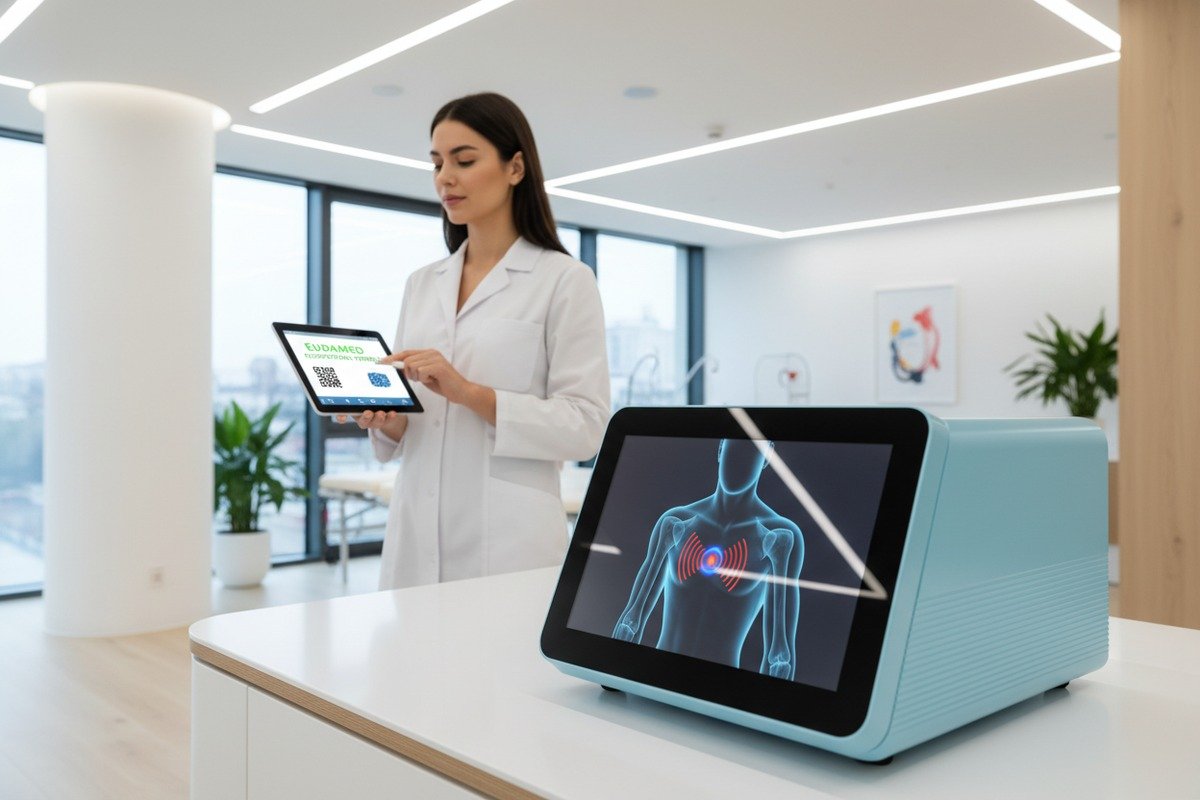
EUDAMED, la base de données européenne sur les dispositifs médicaux, est devenue de plus en plus importante depuis 2025. Lorsque les modules sont devenus pleinement opérationnels, les importateurs ont obtenu un accès direct pour vérifier les enregistrements des dispositifs, les informations UDI et le statut des certificats.
Recherchez le nom du fabricant et les détails de l'appareil. Les produits légitimes afficheront :
- Statut d'enregistrement actif
- Numéros de certificat correspondants
- Attribution valide de l'UDI-DI
- Informations correctes sur l'opérateur économique
Notre équipe d'ingénierie recommande de demander Enregistrement EUDAMED 5 des captures d'écran aux fournisseurs avant de finaliser toute commande. Cette étape simple a évité plusieurs catastrophes de conformité à nos partenaires de distribution.
Quelles directives médicales spécifiques de l'UE doivent figurer sur la documentation CE de mon équipement ?
Lorsque notre équipe des affaires réglementaires examine les dossiers de documentation, les références aux directives révèlent immédiatement si les fournisseurs comprennent les exigences actuelles de l'UE. Des références obsolètes signalent soit une négligence, soit une tromperie délibérée.
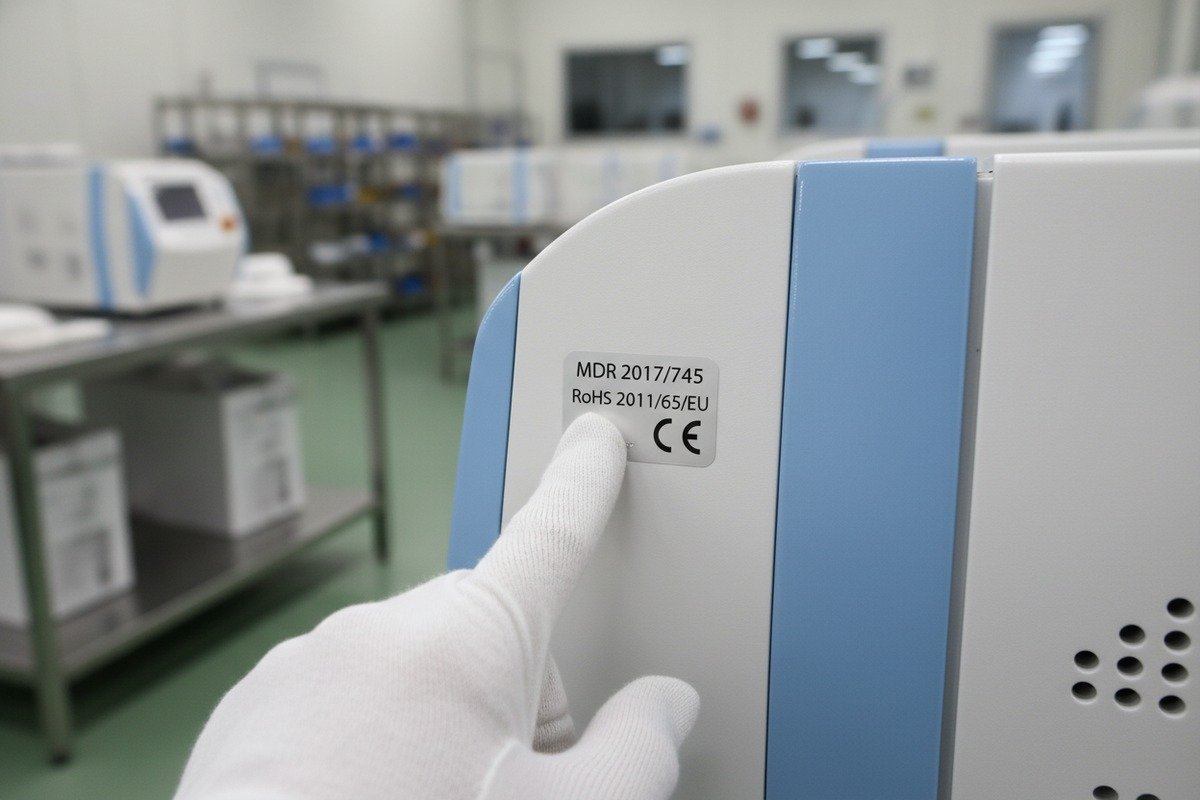
La documentation CE de votre appareil de thérapie par ondes de choc doit faire référence au MDR UE 2017/745 (Règlement sur les dispositifs médicaux), et non à l'obsolète MDD 93/42/CEE. Les directives supplémentaires applicables peuvent inclure RoHS 2011/65/UE pour les substances dangereuses, DEEE 2012/19/UE pour les déchets électroniques, et RED 2014/53/UE si l'appareil comprend des fonctionnalités de connectivité sans fil.
Le MDR 2017/745 est obligatoire
Le Règlement sur les dispositifs médicaux 2017/745 a remplacé l'ancienne Directive sur les dispositifs médicaux en mai 2021. Tout certificat faisant encore référence uniquement à la MDD 93/42/CEE est soit expiré, soit frauduleux.
| Document | Doit faire référence | Signal d'alarme |
|---|---|---|
| Certificat CE | MDR 2017/745 | Uniquement la MDD 93/42/CEE |
| Déclaration de conformité | Règlement (UE) 2017/745 | Numéro de règlement manquant |
| Documentation technique | Annexes II et III du MDR | Références aux annexes de la MDD |
| Validité du certificat | Date d'émission après mai 2021 | Avant 2021 sans mise à jour MDR |
Pendant la période de transition du MDR, de nombreux certificats délivrés sous la MDD sont restés valides jusqu'en 2024. Cependant, depuis fin 2024, seuls des certificats conformes au MDR devraient exister pour les nouvelles mises sur le marché. Notre équipe de conformité rejette toute documentation de fournisseur qui n'a pas achevé cette transition.
La classification affecte les exigences de documentation
Les appareils de thérapie par ondes de choc entrent généralement dans la classe IIa ou IIb selon le MDR. Cette classification détermine la complexité de la documentation.
La classe IIa s'applique aux dispositifs délivrant de l'énergie au corps à des fins thérapeutiques lorsque l'exposition est de courte durée. La classe IIb s'applique lorsque les risques sont plus élevés ou que la délivrance d'énergie est plus invasive.
La documentation doit clairement indiquer la classification du dispositif et la justifier sur la base de :
- Utilisation prévue et indications
- Durée du contact avec le patient
- Type et quantité d'énergie délivrée
- Profil de risque du traitement
Nos ingénieurs en développement de produits travaillent en étroite collaboration avec les organismes notifiés pour assurer une classification correcte. Une classification incorrecte entraîne une documentation inadéquate, que les autorités douanières détectent lors des inspections.
N'oubliez pas les directives qui se chevauchent
Les dispositifs médicaux relèvent souvent de plusieurs directives européennes simultanément. La documentation de votre appareil à ondes de choc doit aborder :
Directive RoHS 2011/65/UE: Restreint les substances dangereuses dans les équipements électriques. Tous les dispositifs médicaux électroniques doivent être conformes.
Directive DEEE 2012/19/UE: Couvre l'élimination des déchets électroniques. Les fabricants doivent s'inscrire auprès des régimes nationaux de responsabilité élargie des producteurs.
Directive sur les équipements radio 2014/53/UE: S'applique si votre appareil à ondes de choc comprend le Bluetooth, le WiFi ou des sondes de traitement sans fil.
Lorsque nous concevons de nouveaux modèles d'ondes de choc, notre équipe d'ingénierie intègre la conformité à toutes les directives applicables dès le début. La mise en conformité ultérieure coûte considérablement plus cher que la conception correcte dès le départ.
Le nom du certificat CE doit-il correspondre à celui de l'usine ou à ma propre marque de distributeur ?
Cette question revient constamment dans les conversations avec nos partenaires OEM. La réponse affecte simultanément la responsabilité légale, le positionnement sur le marché et la conformité réglementaire.
Le titulaire du certificat CE doit être l'entité légalement responsable de l'appareil, soit le fabricant d'origine, soit votre entreprise en tant que fabricant sous marque de distributeur. Si vous utilisez une marque de distributeur, le nom de votre entreprise doit figurer sur le certificat CE, la déclaration de conformité et l'étiquetage de l'appareil en tant que fabricant légal, assumant ainsi l'entière responsabilité réglementaire en vertu du MDR.
Comprendre la définition de “ fabricant ” selon le MDR
Le MDR définit le terme “ fabricant ” différemment de son usage courant. En droit de l'UE, le fabricant est celui qui met l'appareil sur le marché sous son nom ou sa marque commerciale.
Cela signifie que si vous vendez des appareils à ondes de choc sous votre nom de marque, vous devenez le fabricant légal. Vous assumez toutes les obligations :
- Maintenance de la documentation technique
- Mise en œuvre d'un système de management de la qualité
- Activités de surveillance post-marché
- Rapports d'événements indésirables
- Enregistrement EUDAMED
Nos partenaires de marque de distributeur souhaitent souvent initialement simplement utiliser notre certificat CE existant. Cependant, cela crée un écart de conformité que les autorités douanières détectent de plus en plus.
Deux approches pour la conformité sous marque de distributeur
| Approach | Titulaire du certificat | Vos obligations | Risk Level |
|---|---|---|---|
| OEM (Marque d'usine) | Fabricant d'origine | Fonctions d'importateur uniquement | Plus bas |
| Private Label | Votre entreprise | Pleines responsabilités du fabricant | Plus élevé |
Option 1 : Distribution OEM
Conservez la marque d'origine du fabricant. Votre rôle devient celui d“”importateur" selon le MDR. Vous vérifiez la documentation mais ne la possédez pas.
Option 2 : Étiquetage privé complet
Votre entreprise devient le fabricant légal. Vous avez besoin de votre propre certificat CE, de votre propre déclaration de conformité et de votre propre enregistrement EUDAMED.
Notre usine prend en charge les deux modèles. Pour les accords d'étiquetage privé complet, nous travaillons directement avec vos consultants réglementaires et votre organisme notifié pour transférer correctement la propriété de la documentation.
La chaîne des opérateurs économiques
Le MDR établit des responsabilités claires pour chaque opérateur économique :
Fabricant: Crée et maintient la documentation technique, détient le certificat CE, met en œuvre le SMQ, mène la surveillance post-marché.
Représentant Autorisé: Agit pour les fabricants hors UE, maintient des copies de la documentation, coopère avec les autorités.
Importateur: Vérifie la conformité du fabricant avant l'importation, assure les exigences d'étiquetage, signale les non-conformités.
Distributeur: Maintient les conditions de stockage, vérifie l'étiquetage, signale les problèmes en amont.
Lorsque vous étiquetez en privé, vous passez de la position d'importateur à celle de fabricant. Cela augmente vos obligations mais aussi votre contrôle sur le produit et la documentation.
Quels rapports de tests techniques doivent accompagner le certificat CE de ma machine de thérapie par ondes de choc ?
Lorsque notre équipe R&D développe de nouveaux modèles d'ondes de choc, les exigences de test dictent une grande partie du calendrier de développement. Comprendre ces exigences en amont évite des reconceptions coûteuses et des retards de certification.
Les rapports d'essais techniques essentiels pour les appareils de lithotripsie incluent les essais de sécurité électrique selon la norme IEC 60601-1, les essais de compatibilité électromagnétique selon la norme IEC 60601-1-2, la norme IEC 61846 pour les appareils focalisés ou la norme IEC 63045:2020 pour les appareils radiaux/non focalisés, les essais de biocompatibilité selon la série ISO 10993, et les rapports d'évaluation clinique démontrant la sécurité et les performances pour l'usage prévu.
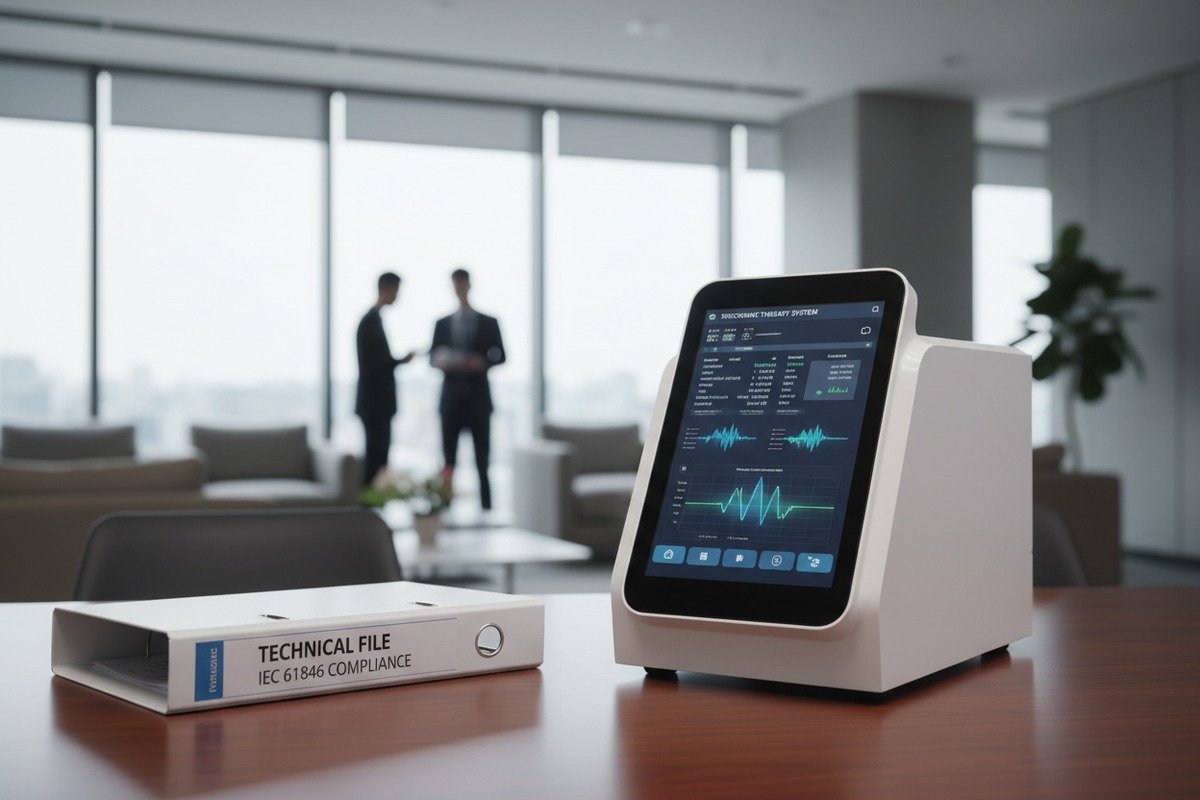
Normes fondamentales de test de sécurité
Chaque appareil médical doit passer des tests de sécurité fondamentaux avant que le marquage CE ne devienne possible.
| 4. Explains the FDA regulatory requirement for Class II medical devices. | Portée | Tests clés |
|---|---|---|
| IEC 60601-1 | Sécurité générale | Isolation électrique, mise à la terre de protection, résistance mécanique |
| Internal Component Reliability Testing | CEM | Limites d'émission, immunité aux interférences |
| IEC 61846 | Onde de choc focalisée | Mesures de pression, caractéristiques de la zone focale |
| IEC 63045:2020 | Radiale/non focalisée | Paramètres d'énergie, sécurité de l'applicateur balistique |
Notre usine de production dispose de capacités de test internes pour la vérification de pré-conformité. Les tests de certification finaux ont lieu dans des laboratoires accrédités, mais nos tests internes détectent les problèmes avant que des frais de laboratoire externes coûteux ne s'accumulent.
Normes spécifiques aux ondes de choc
Le type de technologie d'ondes de choc détermine quelle norme spécifique s'applique.
Appareils à ondes de choc focalisées doit respecter la norme CEI 61846. Cette norme spécifie les méthodes de mesure des paramètres des impulsions de pression, y compris la pression de crête, les dimensions de la zone focale et la densité d'énergie.
Appareils radiaux ou faiblement focalisés relèvent de la norme plus récente CEI 63045:2020. Cette norme traite des générateurs d'impulsions de pression balistiques et de leurs considérations de sécurité spécifiques.
Au cours de notre processus de développement de produits, nous déterminons la norme applicable en fonction du mécanisme thérapeutique. Une sélection incorrecte de la norme entraîne des tests inappropriés, que les organismes notifiés détectent lors de l'examen de la documentation technique.
Exigences de biocompatibilité
Tout composant entrant en contact avec le patient nécessite une évaluation de biocompatibilité conformément à la série ISO 10993 7.
Pour les appareils de lithotripsie, cela comprend généralement :
- Têtes de traitement et applicateurs
- Surfaces de contact du gel de couplage
- Tous les accessoires en contact avec le patient
Les exigences de test dépendent de la durée du contact et du type de tissu. Le contact cutané à court terme nécessite moins de tests que le contact prolongé ou invasif.
Documentation d'évaluation clinique
Le MDR a considérablement augmenté les exigences en matière de preuves cliniques par rapport à l'ancien MDD. Votre documentation technique doit inclure un rapport d'évaluation clinique démontrant :
- Profil de sécurité de l'appareil étayé par des tests et la littérature
- Allégations de performance étayées par des données cliniques
- Analyse bénéfice-risque favorable pour la population de patients visée
- Comparaison avec les traitements de pointe
Pour les appareils de lithotripsie, cela comprend souvent des revues de la littérature d'études cliniques publiées, une analyse des données de surveillance post-commercialisation d'appareils similaires et potentiellement de nouvelles investigations cliniques.
Notre équipe réglementaire maintient de vastes bases de données de littérature clinique pour les applications de la thérapie par ondes de choc. Lors du soutien aux partenaires de marque privée, nous partageons ces preuves fondamentales pour accélérer leurs délais de certification.
Conclusion
Une vérification appropriée du certificat CE protège votre activité d'importation européenne contre les retards coûteux et l'exposition juridique. Concentrez-vous sur la validation des numéros d'organismes notifiés, la confirmation des références au règlement MDR 2017/745, la compréhension des implications de la marque privée et la garantie que la documentation technique complète accompagne chaque expédition.
Notes de bas de page
- Texte officiel de la directive européenne sur la restriction des substances dangereuses dans les équipements électriques. ︎
- Texte officiel de la directive européenne sur les déchets d'équipements électriques et électroniques. ︎
- Texte officiel de la directive européenne sur l'harmonisation des lois relatives aux équipements radio. ︎
- Texte officiel du Règlement sur les dispositifs médicaux (UE) 2017/745. ︎
- Page officielle de la Commission européenne fournissant un aperçu de l'EUDAMED. ︎
- Base de données officielle de la Commission européenne pour les organismes notifiés en vertu de la législation de l'UE. ︎
- Fournit un aperçu de la norme internationale pour l'évaluation biologique des dispositifs médicaux. ︎
- Explique la norme internationale pour la sécurité de base et les performances essentielles des équipements électriques médicaux. ︎

 English
  Español de México
  Deutsch
  Français
  العربية
  Русский